Study abroad scholarships for students

study-abroad-scholarships

Today, we are going to look at various ways to fund your education (BS, MBA or MS in USA) through scholarships or study abroad in select countries where education costs are nearly zero (yes, that is correct!).

One of the major challenges of studying abroad is the hefty tuition fee and living expenses that it entails. If we look at the cost of studying in countries like USA and UK, it can go up to 100,000 USD. Hence, it is not surprising that almost every student going abroad looks for financial support.

Without further ado, here is what we cover in this post:

  1. How can I get scholarship for studying abroad – Steps to find the right scholarship for yourself
  2. What are the scholarships available for Indian students – A list of generic and country specific scholarships that you can apply to
  3. Where can you study abroad for low fee – A list of countries where you can practically study for free

How can I get scholarship for studying abroad?

Before we jump into various scholarships, here is our advice on finding the right study abroad scholarship for yourself.

Finding a scholarship is a matter of planning and constant efforts.

  1. Explore the options in your college or grad school

    Contact your target school – usually, they have counselors, financial aid office and career centers which have extensive information available on the financial aid options available to students. You can email them at the time of admission and later on, visit them in person once you arrive on the campus. This ensures that you make a mark on them and they can help you out as soon as something is available.

    Additionally, most reputed schools offer some sort of scholarship options (usually need or merit based) which are worth checking out. Here are some examples-
    Dartmouth College International Student Scholarship, USA
    NYU Wagner Merit Scholarships, USA
    Clarendon Fund Scholarships at University of Oxford, UK
    Graduate Global Leadership Fellowship, Canada

  2. Search for external study abroad scholarships

    Google your heart out and find various scholarships that are offered by different organizations. For example, we have a list of scholarships available for Indian students right below in this article. Go through many such articles because it will help you in compiling a list of the relevant ones. It is important to mark your calendars with appropriate deadlines so that you don’t miss out applying on time!

  3. Prepare the documents

    Most scholarships ask for the resume, transcripts and proofs of admission which can be prepared in advance. However, it is important that you write each essay separately and make it customized to this particular organization. Just like any employer of college, they want to see that you value them and are genuinely interested in them. If you copy-paste your essays, they can figure it out and it lowers your chances of acceptance.

  4. Tell your story well

    The most important consideration of any application based scholarship is the essay. Make sure you spend some time thinking about it and editing it rather than doing a one-night-job on it. It is your chance to tell your story and if you tell it genuinely, they would want to fund you! – and isn’t that your end goal?

    Additional tip for the scholarship essays
    Highlight why you deserve this scholarship:
    Mention any disadvantages you have faced in completing your education – financial, social or personal
    Mention how would you use your education to make a bigger impact – no one wants to fund someone who has only self-interest at their core. They want to enable your education so that you can make a difference. Highlight how you would do that.

  5. Apply on time

    Apply to as many relevant scholarships as you can. Many scholarships also ask for interviews before announcing the final results. Usually, the interviews are centered around your application and checking whether you would put the scholarships money to good use. If you have done the essays diligently, interviews should be a cakewalk for you. However, it is important to not take them casually. After all, it is a question of real money at stake!


What study abroad scholarships are available for Indian students?

Scholarships are great to get if there are no strings attached. However, in my experience of 15 years, I have noticed there is no free lunch. Almost all the scholarships have some kind of strings attached – some are interest-free loans disguised as scholarship (eg. J N Tata Loan Endowment Scholarship), some are contingent on you studying particular stream of subjects, and most are available only to under-privileged families who have no other means of supporting their education.

So, while there appears to be a long list of scholarships advertised in the market, I have found only few to be feasible for an average candidate. Still, if you look closely and go through various forums and keep an eye on the news, you may find something that you can use.

Let’s look at various scholarships that Indian students can avail. Most of them vary in their extent as well criteria for qualification. So, go through the requirements individually and shortlist the ones that can be applicable in your case.

A. Indian scholarships for studying abroad

1. Inlaks Study Abroad Scholarships

How to apply: https://www.inlaksfoundation.org/scholarships/how-to-apply/
Applications: 15 February, 2023
Deadline: 30 March, 2023 at 12 noon

Scholarships are granted to bright young Indian students to read at top rated American, European and UK institutions for a full-time Masters, M.Phil or a Doctorate programme. The maximum funding given by the Foundation is USD 100,000 to cover programme tuition as well as scholars’ living expenses, healthcare, and one-way airfare.
The Foundation has joint scholarship schemes with Imperial College London, Royal College of Art (RCA) London, School of Oriental and African Studies (SOAS) London, University of Cambridge via the Cambridge Trust, Sciences Po, Paris.

Caveat: They do not fund engineering streams in all the schools. So, check before you apply.

2. Aga Khan Foundation International Scholarship Programme

How to apply: https://www.akdn.org/our-agencies/aga-khan-foundation/international-scholarship-programme
Deadline: 17 March, 2023

Scholarships are awarded on a 50% grant: 50% loan basis through a competitive application process once a year. The Foundation gives priority to requests for Master’s level courses but is willing to consider applications for PhD programmes, only in the case of outstanding students who are highly recommended for doctoral studies by their professors and who need a PhD for the fulfilment of their career objectives (academic or research oriented)

Caveat: Given to those who have no other means of financing their education.

3. JN Tata Endowment for the Higher Education

How to apply: http://www.jntataendowment.org/loan-scholarship-process
Deadline: 7 March, 2023

One-time loan cum study abroad scholarship ranging from INR 1,00,000 to 10,00,000 along with ‘Travel Grant’ and a ‘Gift Award’- which are linked to their academic performance.

Caveat: Requires you to take Thinking Skills Assessment
Good to know: The scholarship is offered at a simple interest of 2% per annum. However, if students repaid the loan within the specified time period (between the end of 3rd and 7th year), the trustees may waive the interest.

4. Narotam Sekhsaria Scholarship Program

How to apply: https://pg.nsfoundation.co.in/application-process/
Deadline: 16 March, 2023

While it is not purely a study abroad scholarship, it is designed for students of academic excellence for pursuing postgraduate studies at prestigious institutions in India or abroad. It is a merit-based interest – free loan scholarship.

5. National Overseas Scholarship Scheme by the Indian Government

How to apply: http://nosmsje.gov.in/docs/Guidelines%20for%20filling%20up%20online%20application-NOS%202021-22.pdf

Deadline: 31 March, 2023

Covers tuition and educational expenses for the following:

  1. Belong to Scheduled Castes, Denotified Nomadic and Semi-Nomadic Tribes, Landless Agricultural Laborers and Traditional Artisans.
  2. Scored 55% marks in under graduation (for those applying to Masters) or 55% in Post-Graduation (for those applying for Ph.D.).
  3. Be below 35 years of age.
  4. Have a combined family income that is less than Rs. 6,00,000.
  5. Not have more than one sibling who got the same scholarship.

6. Fulbright-Nehru MS and Doctoral Research Fellowships

How to apply: https://www.usief.org.in/Fulbright-Nehru-Fellowships.aspx
Deadline: May of the previous year for 2023-24 awards

Offers a monthly stipend, J-1 Visa Support, round-trip economy class air travel, Accident and Sickness Program and modest settling in allowance.

Candidate must have completed the equivalent of a U.S. bachelor’s degree with 55% aggregate marks. They should also have demonstrated leadership qualities and have 3 years of work experience apart from being committed to return to India and contribute to their community.

B. Country specific scholarships for studying abroad

Now, we take a look at some of the country specific scholarships that are given by the governments or agencies in a particular country. The purpose of these scholarships are to encourage incoming students in their schools. For example, British Council offers GREAT scholarship to people coming to study in UK.

1. British Council GREAT Education Full Scholarships

How to apply: https://www.britishcouncil.in/study-uk/scholarships/great-scholarships
Designed for graduate students from India to pursue their dreams of studying abroad. The British Council’s GREAT Education Scholarships have been set up in partnership with 25 leading UK Universities and offer full scholarships to the brightest students across India for various undergraduate and graduate courses in the UK.

2. INSEAD Deepak and Sunita Gupta Endowed Scholarships

How to apply: https://sites.insead.edu/schlmgmt/index.cfm?fuseaction=program_route&prog=mba
Designed for graduate students from developing countries who wish to pursue an INSEAD MBA Program but are constrained by their financial status. Selected scholars under this program receive financial assistance to the tune of EUR 25,000 towards their MBA degree.

3. Erasmus Mundus Joint Master Degrees Scholarships

How to apply: https://eacea.ec.europa.eu/erasmus-plus/emjmd-catalogue_en
EMJMDs are Masters level study programs at institutions across Europe and scholarships are awarded for these programs. Each program has a different deadline for scholarships and hence interested students should keep a check on the official scholarship portal

4. Great Wall Program

How to apply: https://www.china-admissions.com/chinese-scholarships/chinese-government-scholarship-great-wall-program/
This scholarship is aimed at students, from developing countries, who want to study or conduct research in China. It was established by the Chinese Ministry of Education for UNESCO to sponsor students and scholars

5. Orange Tulip Scholarship

Deadline: Varies but around 1 April 2023

How to apply: https://www.studyinnl.org/finances/orange-tulip-scholarship-programme/ots-india
Students applying for the scholarship should be an Indian resident and have been admitted to a Dutch university or be in the process of enrollment in The Netherlands.

6. Scotland’s Saltire Scholarships

How to apply: https://www.scotland.org/study/saltire-scholarships
It offers £8000, towards tuition fees for studying in Master’s programs across Scotland in the areas of science, technology, creative industries, healthcare, and medical sciences, and renewable and clean energy

7. The Heinrich Böll Foundation Scholarship

How to apply: https://www.boell.de/en/foundation/scholarships
€850 per month plus various individual allowances towards studying in Germany. Students applying for the scholarship should have excellent academic records and be able to show written proof of German language proficiency. They should also have demonstrated social and political engagement. This scholarship is given every year to graduates, and doctoral students of all subjects and nationalities. The deadline for application is March 1st

Note: It may look a meagre sum but remember that most of the German programs have already subsidized the tuition fee. Read this post to see if studying in Germany makes sense for you.


Where can you study abroad for low cost?

Believe it or not, it is possible to study abroad in few countries that heavily subsidize their education. If cost is the most important criterion for you, look at these countries first:

Germany

Germany is known for its excellent education, and you can practically study for free except paying a low annual administration fee, which is less than €350. See our interview with Sangram who studied at TU Munich.

Norway

You can study abroad for free in Norway for just a registration fee of about $50 if you can learn Norwegian! How cool is that? Oh and it is also known as the Land of the Midnight Sun.

Sweden

The reason Sweden interests me is that it offers a good option to work while you are in school – this can be very helpful in job hunt. If you have a European Union or Swiss passport, you can study in Sweden for free. Other nationals can expect to pay a few thousands dollars a year. And, PhDs are usually fully funded.

Brazil

Not only are Brazilians the coolest people ever, but also Brazil is a great place to study. If you can speak Portuguese, then you can study at one of its public universities by paying a very small registration fee. The only caveat is – you need to demonstrate your Portuguese skill level by taking a CELPE-Bras certificate.

Luxembourg

University of Luxembourg is incredibly international, and there is no language restriction. Apart from paying around a thousand Euros, it’s completely free to study for all students.

Also Read: Full Article on How to Study Abroad for Free


Recap – Finding Study Abroad Scholarships

So, there are a lot of options to avail if you wish to study abroad without breaking your bank. Make use of the various study abroad scholarships listed above.

Do note that many a times, you are able to land assistantships in graduate schools in USA which makes your education 25-100% free. But if you want to be more conservative in your financial planning, there are many countries where you can study for free.

Career Trends & Predictions 2022

If I graduated in last 2 years, my career strategy would be very different from what I followed in the previous decade. So much has changed (not just because of covid) that career planning needs to be rethought as well.

I am penning down some of the biggest trends I’m seeing on the horizon and the kind of changes we can expect to see in the short and long term. Let’s see if you agree with me.

1/Balance

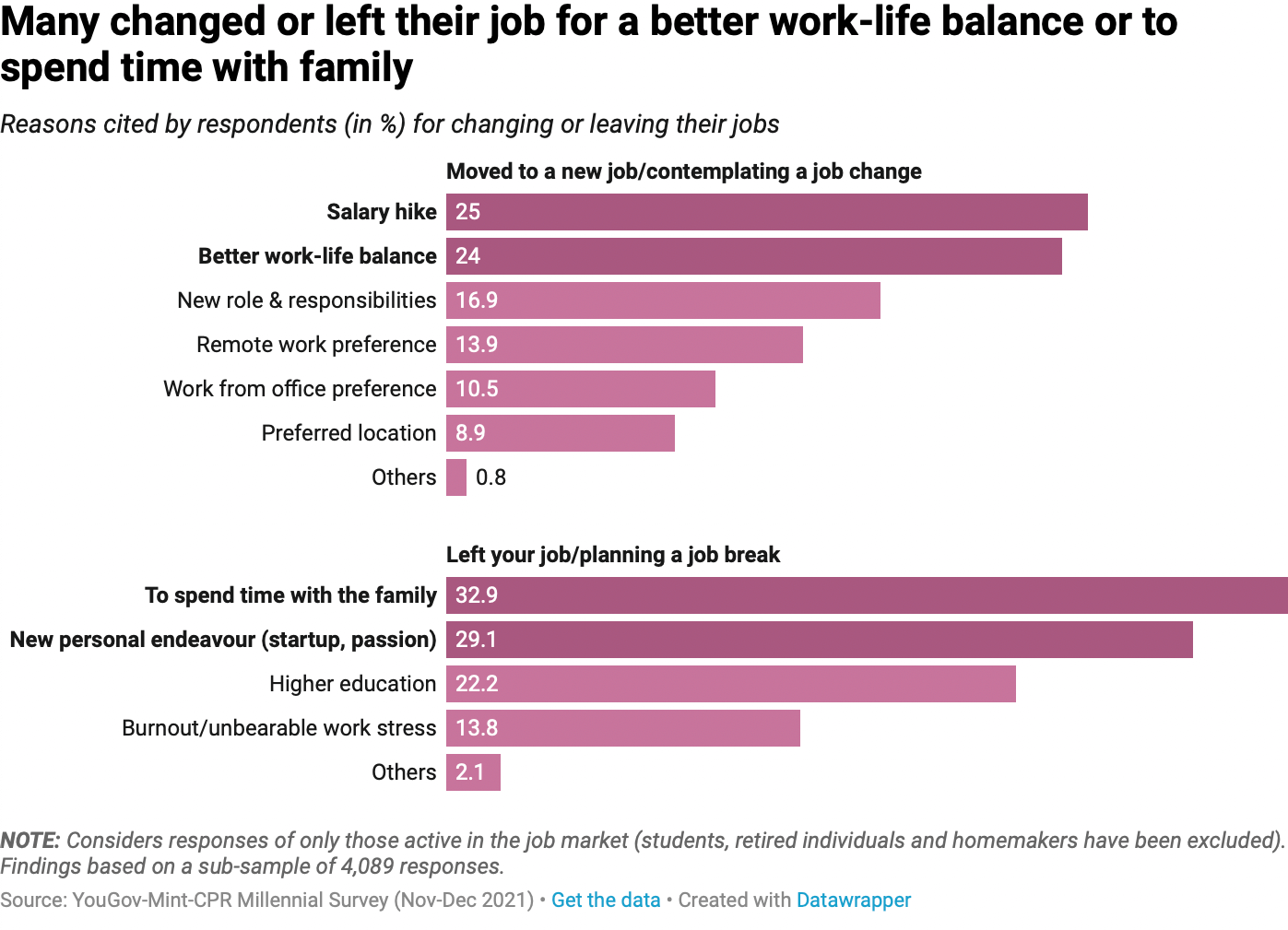
Employers (esp in the West) are finally realizing that millennials don’t want to and don’t have to keep working 24×7. Internet has created opportunities that simply did not exist before. They can earn good money on the side while having fun. So, why would they dedicate their whole life to a mundane job? This means they have to offer better working conditions to attract and retain talent. 

USA and a few countries in Europe are feeling the brunt of ‘The Great Resignation’ – a phenomenon where in record number of employees (4.4 million in Sep 2021 and 4.5 million in Nov 2021 in US alone) are voluntarily quitting their jobs. Quitting in November is a strong trend because people usually don’t quit before the holiday season.

A Microsoft survey showed 41% of employees are considering resigning from their jobs in 2021, compared to 15% rates pre-pandemic.

The real shocker, for me, was to see Goldman Sachs saying that it is ‘working to improve the work-life balance of junior-most employees, known as analysts, by reducing their hours and other measures’. For those of us who have seen Wall Street’s ruthless working culture from close quarters, we were smiling to see this first-of-its-sorts acknowledgment that employers are not able to simply buy people off anymore.

But let’s dig deeper into what is driving this Great Resignation phenomenon. I believe the top reasons are that employees are:

  • experiencing post pandemic burn out
  • used to WFH and don’t want to go back
  • not considering job as their number one priority anymore
  • saw side hustles succeed and now they can actually afford to leave (power of the creator economy, see point no. 5)
  • not feeling valued at work and not willing to compromise on it

People are re-evaluating their options after Covid. It seems we are entering a new era of making different life choices. YOU, now, have a choice to pursue careers more to your interest and exploit your talents (even weird ones) – never before in history have we seen something like it.

Yes, we are still to witness this playing ou with same intensity in Asia. In fact, India has seen job market worsening since covid broke out.

However, the Technology sector (which was not affected by covid) is seeing increasing churn and even Indians are not considering salary as their primary motive in job seeking as discovered in this survey.

src: Mint

2/Quality of Education

India has an average PTR (pupils to teacher ratio) of 28 i.e. there is 1 teacher for 28 students (lower than China & Brazil). It indicates the burden on a single teacher of teaching multiple students as well as the lack of time that each student gets. Combined with the relative unattractive perks of teaching jobs, Indian education has always suffered from lack of teachers, more so, good teachers.

However, with a generous push from the pandemic, the way we consume education has already changed from fully offline to significantly online. Arguably, it is a welcome change. E-learning supports ~50% faster learning speed & 25-60% retention rate vs 8% in offline learning i.e. students can learn faster and retain more because of recordings and option to replay. Also, if students cannot understand a concept in college classroom, they have ton of online courses and videos to learn from.

This has leveled the quality of education accessibility for tier 2 & 3 locations. Further, poor quality of teachers is offset by the teaching talent online. Good for everybody. 

3/Value of Degrees

Most Indian graduates are not qualified to work and yet subpar colleges have survived so far. Why? Because employers wanted a degree. Will we see a future that does not care as much for formal education? In the long term, yes.

The change would be catalyzed by job opportunities that do not require a degree. FYI, Google, Apple, EY, Tesla and a few other firms have started hiring people without 4 year undergrad degrees. Time will see only more companies adopting this trend and give impetus to self-learned talent. This will force Universities to figure out their shit as well – why should students take on hefty education loans to pay tuition fees if they can simply compete for jobs without their degrees.

4/Tests

It took a pandemic for universities to realize that admissions can continue even if the applicants did not have SAT/GRE/GMAT scores. But what does it mean for the candidates? With no exam scores to compensate for lower gpa, will applicants with not so good acads suffer in applications? It is possible. But, in the long run, as degrees matter less (point 3), the supply and demand of candidates in college admissions might just balance out.

5/Gig and Creator Economy

There are at least 59 m gig workers in USA as of 2021 – that’s 1/3rd of its workforce. Gig workers are people like freelancers who are hired for a special task and mostly work remotely. Gigs range from sophisticated work required by large enterprises to something as mundane as transcription or house cleaning. With companies like Urban Clap and Fiverr empowering the service professionals, more and more people are taking up gig working.

A parallel track is that of the creator and influencers who have sprouted like mushrooms on social media. I foresee a future where many students would not even sit for placement in colleges because they have already started their YouTube/IG channels and are making good money.


So, those are my broad comments on the year to come. We are truly living in an exciting time and I am forever bullish on the future. DO YOU AGREE WITH ME? Please share in your comments below, I am very curious to hear your thoughts!


If you liked this post, you would enjoy our free newsletter where we talk about designing a career that makes you come alive. We promise we never spam.

Resume Template for MS/MIS Applications

Announcement:

We have partnered with our friends at Resumonk to let you guys build awesome resume without the hassle of editing the Word documents endlessly. And, they have offered their PREMIUM membership to our successful applicants for FREE for 18 months. With their winning resume templates, your dream internships would be lot more closer for you when you are doing MS/MIS in USA. This is worth a value of $38 but you get it for FREE when you join our counseling (selected packages only).

Introducing our ready-to-edit winning resume template for fresher applicants at the bottom of this article! All your headaches solved in one template.

Purpose

Resumes are often taken for granted. While applicants are busy tinkering their SOPs to perfection, everyone thinks resume is a one night job. Well, may be not. After working with some students, I realized that what I thought was obvious about the resume was not so obvious to the students. And fair enough – since I myself had the benefits of years and diverse experiences before I learned the inside out of a resume writing process. So, I figured that it is time to dedicate a full post to resume building.

First, sit and reflect upon who your reader is and what your resume is trying to convey to her. As an applicant, you want your resume to be coherent with rest of your application. So, while your experiences, education and background are factual information, what to highlight is a matter of judgment. For e.g. if you are showing interest in research/applying for PhD etc, your highlight should be on your research projects and publications. Similarly, if you are applying for a MCS kind of program (geared towards landing corporate jobs upon graduation), your focus should be on professional skills, industry experience etc.
So, before you begin, gather your thoughts and decide the areas/skills in your profile that your resume should be highlighting. Continue reading

GRE vs GMAT: Which one is better for you?

Whenever you are applying to a business school or a management oriented program, you might have to evaluate the merits of taking GRE vs GMAT.

Before you make up your mind about the most suitable aptitude test to enhance your chances of getting into an MBA program, you should get familiar with the differences between GRE vs GMAT.

The most fundamental difference between GMAT and GRE is that GRE is used in the admission process of many different graduate school programs while GMAT is limited to business oriented programs. However, there are several other factors that you must make yourself familiar about.

In this detailed guide, you will get to know about all the major differences so that you are able to make the best choice.

GRE vs GMAT: Popularity

More than 1200 business schools accept the Graduate Record Examination (GRE) all over the world. GRE is typically considered the test that is suitable for creative individuals. Similarly, the Graduate Management Admission Test (GMAT) is accepted by all business schools because it has been considered one of the most reliable ways to assess the applicants by the business schools for a long time now.

GRE Structure

GRE consist of three major sections:

  1. Analytical Writing
  2. Quantitative Reasoning
  3. Verbal Reasoning

The score range for the analytical writing section of the GRE is 0 to 6, while both the verbal and quantitative reason sections have the range of 130 to 170. These three sections are scored separately and not combined into a single score.

Candidates take the GRE on a computer. It is a section-level adaptive test which means the applicants’ scores on the first section will affect the difficulty of the questions on the next sections.

Learn more about the format & score interpretations of the GRE on our detailed guide to the GRE exam

GMAT Structure

The GMAT aims to assess the applicants when they are applying to a business school like an MBA program. Unlike GRE, GMAT is used only by business schools. There are four main sections of the GMAT:

  1. Analytical Writing Assessment
  2. Integrated Reasoning contains
  3. Quantitative section
  4. Verbal section

The candidate will get a composite score in the range of 200 to 800. The scores from the analytical writing and integrated reasoning are not included in the composite score.

Also read: Everything you need to know about the GMAT

GRE vs GMAT Summary

There are several differences between GRE and GMAT in terms of the duration, pattern, sections, registration fee, and other such factors. These differences between GRE and GMAT are tabulated as follows:

DifferencesGREGMAT
What is the duration of the test?3 hours and 45 minutes3 hours and 30 minutes
What is the total number of essays?21
What is the total number of sections?64
What are the marking criteria?Verbal and quantitative reasoning sections have score ranges of 130 to 170, and the total score is between 260 to 340.Composite scores are given in the range of 200 to 800
What are the registration charges for these tests?$205$250
When should you take GRE or GMAT?When you want to get admission in a business school graduate program like MBAWhen you are not sure about the kind of graduate program, you want to get admitted to.
How long are the scores of GRE and GMAT valid?Five yearsFive years
How do the candidates take the test?Computer-based test. Paper-based tests are also available in selected regions.Computer-based test
GRE vs GMAT

GRE vs GMAT Quantitative Section

Quantitative Section of the GMAT

The quantitative section of the GMAT mainly focuses on problem-solving and data sufficiency questions. Candidates typically have to solve equations, graphs, evaluate different types of data, and apply data in different situations.

Quantitative Section of the GRE

On the other hand, the quantitative reason section of the GRE typically deals with the candidates’ skills in algebra, geometry, data analysis, and arithmetic. Following are the major differences between GRE and GMAT in terms of their quantitative sections.

Differences

The differences between the quantitative sections of the GRE and GMAT are as follows:

Differences in Quantitative SectionsGREGMAT
Number of questions2049
Duration60 minutes105 minutes
Score130-170Quantitative: 0-6 Integrated Reasoning: 1-8
GRE vs GMAT quant

Generally, the quantitative section of the GMAT is considered to be more challenging than the GRE. The reason behind this conclusion is the fact that GMAT focuses on data sufficiency questions that are typically difficult for many students.

GRE vs GMAT Verbal Section

Verbal Section of the GMAT

The verbal section of the GMAT consist of the following three types of questions:

  1. Reading comprehension
  2. Sentence correction
  3. Critical reading

Verbal Section of the GRE

The verbal section of the GRE consists of the following three types of questions:

  1. Reading comprehension
  2. Text Completion
  3. Sentence Equivalence

Differences

Differences in Verbal SectionsGREGMAT
Number of questions4041
Duration60 minutes75 minutes
Score130-1700-60
GRE vs GMAT verbal

There are no significant differences between the kind of questions asked in the verbal sections of the GRE and GMAT. Yet, the difficulty level of the verbal section of GRE is little more than the GMAT because, typically, challenging vocabulary and reading passages are included in the GRE.

Differences between GRE and GMAT: Analytical Writing

Analytical Writing Section of GMAT

This section includes one essay that the candidates have to complete within 30 minutes. The task is given in the form of an argument, and the candidates have to evaluate its strengths and weaknesses.

Analytical Writing Section of GRE

In this section, the candidates are required to write two essays. One task is related to analyzing an argument, while the other one is associated with analyzing a task.

Differences

Differences in Analytical WritingGREGMAT
Number of questions21
Duration60 minutes30 minutes
Score0-60-6
GRE vs GMAT writing

Even though there are two tasks in the analytical section of the GRE, the difficulty of this section on both GRE and GMAT can be considered the same.

GRE or GMAT: Which exam should you take?

The purpose of discussing these differences is to help you out in choosing the best test that you think you can ace and get admission to your dream university. You can easily narrow down your options by checking which business programs accept GMAT scores and which ones accept the GRE.

Generally, if you have a very specific goal of getting admission to a business school, you should consider taking the GMAT. Many business schools prefer the GMAT over GRE because it has questions directly associated with the skills you need to succeed in a business school graduate program.  

Whatever your final decision can be, you can rely on our extensive guides to get high marks on the GMAT or GRE.

How to Prepare for GMAT?

Taking the GMAT is a critical point in the academic lives of many people all over the world, including India. You need to be fully equipped with the essential skills and knowledge to prepare for the GMAT and ace it.  It is quite understandable that you must be familiar with the concepts and their applications to succeed at GMAT.

However, the significance of the preparation phase cannot be understated when it comes to making sure that you can achieve an excellent score. Many people think that only reading a GMAT guide book or taking prep classes is enough to get high marks in this aptitude test. While all of these strategies will help you, you should also examine your specific situation and determine the best way to prepare for the GMAT.

Taking sufficient time to plan for GMAT will help you in the long run because you will have everything mapped out efficiently. No matter how intelligent you are, you must not take this preparation phase lightly. Both hard work and smart work will help you in acing the GMAT.

Once you are familiar with the fundamentals of GMAT, the next thing to do is to start preparing for it.

Must Read: All about GMAT exam

In this article, you will get the answers to some of the most common questions associated with preparing for the GMAT.

How long does it take to prepare for GMAT?

Generally, the following factors have the greatest influence on how much time it will take to prepare for the GMAT:

  • Your current level of preparation
  • Target GMAT score
  • Resources you are using to prepare for GMA.

To determine your GMAT baseline score, you can take the GMAT mini quiz or an extensive practice test.  Ultimately, the exact amount of time can greatly vary from student to student.

How to develop the stamina to prepare for GMAT?

It is important to have enough energy and stamina through the GMAT exam to make sure you can achieve a high score on all of the sections. Many students tend to get exhausted by the last section of the exam. Hence, you have to be good at sitting for continuous 4 hours to succeed at GMAT.

Some important tips that you should follow in this regard are:

  • Attempt the 4-hour GMAT practices at least every two weeks.
  • Do not take breaks between these tests as you will not have such an option in the actual exam.
  • Attempt the entire practice test in one go and do not skip sections. It is always a good idea to follow the given order, so you are used to it by the time you take the GMAT exam.
  • Ensure that you are getting used to taking the exam physically as well as mentally.
  • Focus on improving your analytical and decision-making skills because you will have to make around 350 decisions during the exam.

Taking the GMAT exam can be strenuous for anyone, so ensure that you are equipped with the right skills to get through the exam, and practice is the best way to get these skills.

Should I take GMAT Practice Tests?

Definitely, yes! To prepare for GMAT and achieve a high score, you should never ignore the importance of taking GMAT practice tests regularly. These tests help you in measuring and tracking your progress, getting used to performing under time pressure, reviewing the missed problems, and fully understanding the errors you made. When you take GMAT practice exams regularly, you will not feel much pressure on the test day.

You can use the following resources to attempt GMAT practice tests:

  1. GMAT Official Guide 2021
  2. Kaplan GMAT Complete 2021
  3. Business schools like London Business School provide free online GMAT practice tests.

What are the most important parts of the GMAT?

It is important to note that the GMAT exam is not only a test of your intelligent quotient (IQ). Similarly, it cannot be limited as a test of one’s English skills, verbal skills, or mathematical ability. While these subjects do play a role in the test, the fact is that GMAT exam questions are unique and force the candidate to think creatively and apply relevant concepts to different questions.

Your real objective should be to develop critical thinking skills and mental math skills to get a good score in all of the sections. Moreover, you must be able to perform well under time pressure and apply your skills to GMAT questions without getting overwhelmed during the exam.

Learn more about the format and syllabus of GMAT.

How can I avoid procrastination as I prepare for GMAT?

Getting started with preparing for any exam, including GMAT, can be challenging for many people. In fact, it would not be wrong to say that procrastination is one of the major reasons why many candidates end up not scoring low on the aptitude exams.

Following are some of the useful tips that you should follow to avoid procrastination while preparing for the GMAT:

  1. Take small steps towards preparing for GMAT by reading about the exam, pattern, syllabus, and other such important information.
  2. Never plan a lengthy preparation session of 3 to 5 hours in one go, as you will end up burning yourself out and start procrastinating.
  3. Watch the online lectures or attend a GMAT prep session to avoid procrastinating.
  4. Make a study timetable and reward yourself when you achieve your goal of the day to ensure you stick to the timetable.

How Should I Create My Study Plan?

Once you have decided to prepare for GMAT, you should start the process by creating a timetable and sticking to it to ensure you are able to cover all of the topics and attempt practice tests to get used to taking such lengthy exams.

Online resources and books like GMAT Official Guide can help you in following a relevant study plan and prepare for the GMAT. You should divide your time as per the four sections of the GMAT:

  1. Analytical Writing Assessment
  2. Integrated Reasoning
  3. Quantitative Reasoning
  4. Verbal Reasoning

One thing that you should never do is create an overly ambitious timetable. It is common to get carried away and plan out long preparation sessions. However, this kind of timetable will end up overwhelming you and making you unproductive in the long run.

Therefore, you should create a timetable with small tasks, especially in the initial days of preparation, so that you are able to stick to it and remain committed to acing the GMAT.

Conclusion

These are some of the most important aspects that you should keep in mind when you are starting to prepare for the GMAT. Other than following these tips, you should always try to find your learning style so that you remain self-motivated throughout the process of preparing for the GMAT. You might like studying simple prep books, or you might be one of those students who only study in a class.

Whatever might be the case, you can excel at GMAT by following these tips and making sure you are preparing for the GMAT in the best way possible.

Everything You Need to Know About GMAT Exam 2022

The Graduate Management Admission Test (GMAT exam) is developed and conducted by the Graduate Management Admission Council (GMAC) all over the world to facilitate business schools in assessing the aptitude of the applicants at graduate-level. Whether you are aspiring to go for an MBA or an MEM degree, GMAT (or GRE) is required by almost all good schools.

There are several important aspects of the GMAT that the students must know about to ensure they are fully equipped with the required knowledge, skills, and experience to take the GMAT exam. This article will help you in getting familiar with all of these important factors like:

  • Structure of the GMAT exam
  • Mean scores
  • Preparing for the exam
  • Application process

Let’s look at these aspects one by one:

What is the GMAT Exam?

The Graduate Management Admission Test (GMAT) is a standardized aptitude test which the business students must take when they are applying to a business school. Like most of the other aptitude tests like the GRE exam, the GMAT is a computer adaptive test that has multiple-choice questions.

GMAT score, along with the overall academic records and work experience, plays an integral role in accessing the readiness of the applicants for an MBA program.  The purpose of the GMAT exam is to evaluate the applicants’ command over grammar, algebra, geometry, arithmetic, and data analysis.

Measuring the ability to critically analyze and understand a wide range of written material is the most important part of a GMAT exam. Hence, having good analytical skills is the key to scoring a high score on the GMAT exam.

Also check: GRE vs GMAT – what is better for you?

What are the sections of the GMAT exam?

The GMAT exam is divided into four different sections. Yet, all of these sections require the same level of critical thinking and analysis skills. Candidates get the choice to choose a particular order in which they want to take the GMAT exam. Three options will be provided to you at the start of the test.

The four sections of the GMAT exam are:

1.    Analytical Writing Assessment

This section focuses on evaluating the ability of critical thinking and communication of the ideas.

2.    Integrated Reasoning

Integrated reasoning is meant to measure the applicants’ ability to analyze data available in different types of formats and extracting information from this data.

3.    Quantitative Reasoning

This part of the GMAT exam is meant to evaluate the ability of the candidates to analyze data and draw conclusions from it with the help of reasoning skills.

4.    Verbal Reasoning

As the name suggests, the verbal reasoning section is focused on evaluating your reading and verbal skills to ensure the candidates can fully understand the written material and correct it as per the English standards.

How many questions are included in a GMAT exam?

The entire GMAT exam is divided into four sections. Following is the detailed breakdown of these sections:

Test SectionTime Limit / Number of QuestionsQuestion TypesScore Range
Analytical Writing Assessment30 minutes 1 questionAnalysis of an Argument0-6 (in 0.5-point increments)
Integrated Reasoning30 minutes 12 questionsGraphics Interpretation, Table Analysis, Multi-source Reasoning, Two-part Analysis1-8 (in 1-point increments)
Quantitative Reasoning62 minutes 31 questionsData Sufficiency, Problem Solving6-51 (in 1-point increments)
Verbal Reasoning65 minutes 36 questionsReading Comprehension, Critical Reasoning, Sentence Correction6-51 (in 1-point increments)

What is the marking style of the GMAT exam?

The four sections of the GMAT have different marking points, due to which it is important for the candidates to become familiar with these marking styles so that they are able to score higher on the exam. Following is the scoring system of four sections of the GMAT exam:

  • The analytical writing assessment section is scored from 0 to 6 with half-point increments.
  • The integrated reasoning section is scored separated on the basis of a 1 to 8 points scale.
  • Both the qualitative and verbal sections have a scaled score of 0 to 60. These scores are then combined to produce the final score on the 200-800 scale.

Also Read: How to prepare for GMAT and crush it?

What is a good GMAT test score?

When you want to set a GMAT score goal for yourself, you should be looking at the mean or average GMAT score of the MBA programs you are going to apply to. It will be useful in obtaining a good baseline.

Every section of the GMAT exam has a different mean score as follows:

  • Verbal reasoning section has a mean score of 27
  • Quantitative reason section has a mean score of 39
  • Mean score for analytical writing is 4.4
  • Mean score for integrated reasoning is 4.2

You should know that for the MBA programs, your scores in the verbal and quantitative reason sections are considered to be having the most bearing on the final admission decision.

You can also rely on the following table to get familiar with the relationship between scaled scores and the candidates achieving them:

PercentileTotal GMAT Score
Top 10% of all test takers710
Top 25% of all test takers650
Top 50% of all test takers580
Below 50th percentile of all test takers570

It is worth noting that Indian applicants face a higher competition in MBA. Check this post to understand how the chances play up for Indian IT Male applicant.

What is the difference between GRE and GMAT?

A major difference between GMAT and GRE is that GMAT was developed especially for business schools, while the purpose of GRE is to cater to a wide range of graduate schools. Generally, the verbal section of the GRE is more challenging than the verbal section of the GMAT exam. On the other hand, the quantitative section of the GMAT exam is tougher than the same section of the GRE exam.

How can I register for the GMAT?

It is easy for the majority of the students to register for the GMAT online by using the portal of MBA.com, a website used by GMAC to assist candidates wanting to apply for MBA programs. Students with special needs will have to submit a separate accommodation request form before their GMAT exam is scheduled.

Why should I take the GMAT exam?

GMAT is a renowned standardized test that is trusted by a large number of business schools all over the world. Your GMAT score can be the make-or-break factor in getting admission to your dream school. High GMAT scores can certainly help the candidates in standing out during the admissions process because it is a great indicator of academic success in graduate business degree programs.  

What is the registration fee for taking the GMAT?

In the majority of the countries, the registration fee for the GMAT exam is $250. It can cost more than $250 in some countries. However, the applicants also have the option of applying for a fee concession or waiver of the application fee, only if your business school is ready to make this request. It is quite expensive to take the GMAT exam, so you should only register for it once you are fully ready to take the test.

Which are the best GMAT Books for Preparation?

You can find a lot of books as well as online resources to prepare for the GMAT. However, you do not have to research them all as we have compiled a list of top 3 books you should use to prepare for the GMAT exam:

  1. Kaplan GMAT Complete 2021
  2. GMAT Official Guide 2021
  3. Manhattan Prep Complete GMAT Strategy Guide Set

Conclusion

It is important for you to become fully familiar with the various aspects of the GMAT exam discussed in this article to ensure you are able to prepare for the test and achieve a good score on it to get into your dream business school.

If you have any inquiries or want to get more information about the MBA programs or standardized tests like GMAT, you can contact us anytime.

Winning answer to “Tell me about yourself”

You are qualified for the job and ready to ace an interview. You meet your interviewer, and the first question they ask is, “Tell me about yourself.” You knew this was coming, but you are unsure of what to say and end up ranting. 

That is perhaps one of the worst-case scenarios in terms of an interview. But it does not have to be. 

Interviews can be nerve-racking and can make you give unclear and long answers. All you need is a bit of guidance and some practice. In this article, we bring you a 3-step guide to answer the infamous question, “Tell me about yourself.” We have also added a few examples of how one can answer this question. 

Why does an interviewer ask, “Tell me about yourself”?

To craft your response, you need to understand why this question is relevant in an interview. 

The intent of asking, “Tell me about yourself,” is to know the perception you have about your career and yourself.

Context matters, and since you are applying for a job, your answers should be about your career and qualifications. A good thumb rule to follow is to not reveal too much about your personal life unless it matters to the role you have applied. 

Moreover, this question acts as an icebreaker. It is the first time the two of you might be talking, so it helps the interviewer ease into a conversation and the more complex and technical parts of the interview. Your response also makes the interviewer ask more questions relevant to the job and your experience. 

The interviewer is looking for a person who will be the right fit for the company. It is also a way for the interviewer to assess your communication skill and how well you can articulate your past experiences. 

If answered right, it projects a good impression on the interviewer, increasing your chances of getting that job.

3 tips to answer “Tell me about yourself” 

  1. Prepare beforehand

It is one of the most common questions asked in an interview. And it is a good thing. Since you would be better prepared, you should be ready with your answers beforehand. 

Writing it down on a piece of paper is helpful. Why? Because when we are talking, we are processing what to say in the present and the next few seconds. Writing allows you to process your thoughts. You can make any corrections in a much more tangible form. So write your answer down. We have shared a template below that you can follow to structure your answer.

  1. Research the company and the job

The power of the internet allows you to search for the company. 

What does it stand for, the competitors, and the people in a similar role as you.

You can search for the recent and relevant accomplishments of the organization. You can assess whether mentioning them will help you to leverage them better and stand out. When you shift the focus to why your joining would benefit the company, you set yourself apart from the competition. 

  1. Pick and choose from the resume

If they have called you for an interview, then it means that they went through your resume. 

Avoid saying everything in the resume, and only choose points that need mentioning. Did you help your last company increase their sales by 40%? Mention that, especially if the job description involves sales. When you are answering, humanize your resume instead of reciting it.

A template for answering “Tell me about yourself”

A basic structure can help you answer — Tell me about yourself — in a way that increases your chances of selection. 

You must know the rules to break them. It is not a strict guide but a framework you can use and mold according to your profile and experience.

Hello, my name is XYZ, and I am a [the role you are applying for]. I graduated from ABC colleges with a Bachelor’s in [degree name]. I did my Master’s from EFG college/university in [degree name]. I have experience of [total years/months of relevant experience]. Currently, I work at/ my last company was [current company name]. 

As a [job title], I helped the company in the following ways (mention 1-2 accomplishments). I have also worked at [company names] as a [job title] and helped them achieve [goals]. I want to work with you because I like [mention what you like about the company]. The company seems like an excellent fit for me because [what the company values/the vision of the company] aligns with my values.

Also read: How to create a masterful LinkedIn profile

3 answers to “Tell me about yourself” for different situations

If you are a fresh BBA graduate

Hello, my name is Jon, and I have recently graduated from XYZ college with my BBA degree. In college, I ran a small startup and helped to increase the revenue by 40%. My unique insight and ideas helped us generate [X amounts of money] and gave me a deep understanding of business development. Handling a team and the basics of Accounting is also a part of my skill set. I love that the company is keen on delivering the most seamless experience to the customer since I believe in putting the customer first. As a business development executive, I would fit into your organization.

If you are switching companies

Hello, my name is Pooja, and I am a Software Engineer. I have a bachelor’s degree in Computer Science Engineering from NSIT Delhi. 

Currently, I am working at ABC company as an Associate Software Engineer.

I am adept at developing web applications using Java, PHP. In my last project, I contributed by creating a web app for an American health insurance company. I’ve good communication skills and can collaborate well with onshore teams.

If you are switching job roles

Hello, my name is Rahul, and I have worked as a customer service executive but want to be a part of a dynamic sales team as a sales representative. My experience as a customer service executive has helped me discover the pain points faced by customers. And how to better sell our product. In my previous role, I helped many customers and guided them, which helped retain customers. I want to use my people and problem-solving skills to help your organization reach its short-term and long-term sales goals. 

Conclusion

Communicating your accomplishments and skills is a skill. If answered right, “Tell me about yourself ”can help you position as the most suitable candidate for the role. It is such a guaranteed question that even HBR has written a post on it.

With a little practice, we are sure you can ace it. 

Your definitive guide to Study Abroad in USA

Scholar Strategy is India’s leading Study in USA guidance community. For last 9 years, our candidates have gone on to study at MIT, Stanford, UIUC, Cornell, Berkeley, CMU, and other top universities. Not only that, we take pride in helping our candidates be prepared for landing internships at companies like Tesla, Apple, Facebook, Amazon and more.

Are you harboring dreams of world class education and studies abroad for career opportunities? USA has been the leading destination for ambitious students worldwide. Here, we cover all the information you need to realize your dreams.

Why Consider Study in USA

History of Innovation

The United States of America is called the nation of explorers. It is the birthplace of many inventions that changed the world.

From inventors like Henry Ford and Thomas Edison to industrialists like John D. Rockefeller were born in the US. 

Cultural Diversity and Opportunity to Grow

The nation is renowned globally for its multicultural environment, its opportunities, and what has become a common phrase – “American Dream.” 

Don’t know what the American Dream is?

Investopedia defines the American dream as “the belief that anyone, regardless of where they were born or what class they were born into, can attain their version of success in society. It is achieved through sacrifice, risk-taking, and hard work, rather than by chance.”

The US is revered for its infrastructure that promotes innovation, entrepreneurship, and technology. No wonder, it is the number one study abroad destination.

World’s Best Universities

It has some of the world’s oldest universities: Harvard, Stanford, MIT are all based in the US.

As per QS world rankings 2021, five universities in the Top 10 are all based out of the US.

American universities provide a great learning experience, opportunity to grow like no other country.

QS Global RankSchool
1Massachusetts Institute of Technology (MIT)
2Stanford University
3Harvard University
4California Institute of Technology (Caltech)
9University of Chicago

Recruiters of top-notch organizations pay high salaries to students of American universities. 

The schools receive huge donations and are well funded to invest in research and development areas.

Courses to Target

Study in USA allows you to choose from a plethora of courses. The country will probably have a course/degree on every subject you can imagine.

  • MIT, the California Institute of Technology, John Hopkins University, and Carnegie Mellon University are famous for STEM education.
  • Apart from STEM, courses on Psychology, Journalism, Medicine, Business & Management, Social Sciences are also top-rated. 

Indian students mostly enroll in American university programs to study Engineering and Management. The courses like MS and MBA attract Indians applicants due to the high standard of education and the possibility of getting a high-paying job in the world’s largest economy–United States of America.

Undergrad

Colleges in the US offer a four-year Bachelor’s degree. Students aspiring to study at the undergraduate level in American colleges have to give the SAT exam.

The higher the score, the better are your chances to get an admission letter from schools like Harvard, MIT, and Stanford.

MS (Science & Engineering)

Studying MS (Master of Science) in the US is a dream for students passionate about Science and Technology. 

It has the world’s best universities that offer STEM (Science, Technology, Engineering, and Mathematics) education.

The country is a leader in Research & Innovation sectors and is the home to many tech behemoths like Facebook, Amazon, and Intel. 

Where did you find this article?

The chances are you found it on Google Search (or Gmail), Facebook, or LinkedIn–all of these companies were founded in the US.

The Top-5 universities for MS in the US are:

  1. Harvard University
  2. Stanford University
  3. Massachusetts Institute of Technology (MIT)
  4. The University of California, Berkeley (UCB)
  5. Columbia University

See our page on all about MS in USA.

MBA

MBA courses in the US are among the best in the world. 

Studying at top universities in the US allows you to network with people from diverse cultural backgrounds and nationalities. A network built during your time at a B-School can be leveraged later when you are looking to form business partnerships.

As per QS global MBA rankings, four out of the Top-4 MBA programs are taught in American universities. 

QS Global MBA RankSchoolDurationAvg. Salary(USD)
1Stanford Graduate School of Business21 months152,503
2The Wharton School21 months150,000
3MIT Sloan School of Management24 months140,000
4Harvard Business School21 months148750
8Columbia Business School20 months150,000
Top MBA programs in US

Application Process for Study in USA

Most top American universities and colleges have the authority to decide their standard and admission criteria.

The most common aspect of applying to study in the US is standard competitive exams like GRE, GMAT, and SAT. GRE is usually accepted for admission in MS programs, GMAT for MBA, and SAT is the standard test students give for undergraduate courses. 

The below sequence of steps may help you speed up your application process:

  1. Decide five to ten universities you’re planning to get into for the subjects of your interest. 
  2. Search for ways to finance your education. This may include eligibility for a loan, scholarships, and grants. We’ve written a comprehensive article that will give you more clarity on ways to finance your education abroad. 
  3. Prepare for and give the English proficiency exams like TOEFL, IELTS, and degree-specific exams like GRE and GMAT.
  4. Prepare for the colleges based on your exam scores.
  5. Prepare and polish the documents common for admission in most colleges: SOP, Essay, Letter of Recommendations.
  6. Appear for the personal interview with the admission officers.
  7. If you receive an acceptance letter, confirm your intent to take admission to that university. 

The universities require you to pay a non-refundable fee to confirm admission.

If you’re struggling during any phase of admission, we at Scholar Strategy can help you. Click here to contact us.

Main Challenges

Student Visa

The US government allows non-American citizens to enter the country only with a valid visa.

Without a relevant Visa, you won’t be allowed to study in the US if you’re an international student aspiring to study in the country.  All your hopes of studying in the US will go in vain if your visa application isn’t approved.

The US government offers three student visa types, including F, J, and M.

  1. F Student Visa: For study at the university level or to study English at an institute that teaches English.
  2. J Exchange Visa: It is applicable for an exchange program at the university and high school level.
  3. M Student Visa: It is applicable for vocational study or training in the US.

Before you can apply for an F, J, or M student visa, you must have an acceptance letter from an American university or higher education institute.

Read our detailed post on all about the student and work visas in the US

Competitive Admissions

If you aspire to study in top American universities–ranked among the best in the world–the admission process would most probably include an exam. 

These exams are conducted to test your English proficiency or examine particular skill sets needed for a course you’re applying to study. 

ExamPurpose
TOEFLTo test the applicant’s English proficiency. 
IELTSTo test the applicant’s English proficiency. 
GMATFor admission in MBA/Management courses
GREFor MS/MBA courses

Please note that a good score in such exams doesn’t guarantee an admit and is just a tool to filter out applicants. 

If you’re planning to study at these top universities, your work experience and extracurriculars help you stand out among the applicants.

Getting admission into a top school is a dream for many, but not everyone can pay the price to afford it–not talking only about money. The admission process is highly competitive.
For example, The acceptance rate of admission to Stanford MBA is around 7 percent, and for MIT, it is 6.7 percent. 

Cost of Study in USA

The cost of education is one of the critical factors that influence a study-abroad aspirant’s ability to choose a country, courses, and universities for foreign education.

The US is the world’s most popular destination for international students and the most expensive. The tuition fee and living expenses vary based on the student’s university choice and the university’s location. 

The tuition fee for public universities and community colleges is lower as compared to those of private universities. The low cost doesn’t imply that public universities’ quality of education is lower than private universities. 

For example, The University of California–Berkeley is one of the best schools globally despite being funded by the government.

Average fees at US universities 2018-19

 Public two-year collegesPublic four-year colleges (in-state fees)Public four-year colleges (out-of-state fees)Private non-profit four-year colleges
Tuition & Other fees $3,660$10,230$26,290$35,830
Room & Board$8,660$11,140$11,140$12,680
Total (per year)$12,320$21,370$37,430$48,510
src: TopUniversities

The values given in the table above are an estimate, and the actual cost may differ based on the university and city you plan to study in. 

Click here to know more about the cost of college education in the US.
Also, Read the Cost of MS in the USA in INR – how you can afford it.