6 Reasons Why Your F1 US Student VISA Would Get Rejected

This year, many students will apply for a US student visa to go and study in the US. But only 85% of them will get one. 

Why do other 15% get rejected?

In this post, I want to explain the UNDERLYING cause for cause for visa rejections & what you can do to avoid it.

Real Examples of US Student Visa Denial

I have seen less than 5 visa rejects among our clients in last 8 years. One had admission from IIT Chicago but his US student visa got denied. His father had only 20 lac in savings.

And there was another person from Gujarat whose visa was denied too. Why? His brother was already working and settled in US and sister lived in Canada.

What’s common in both the cases?

They are rejected for one reason – the Visa Officer feels that these people are more likely to immigrate to US which is another way of saying – they are NEVER COMING BACK!

US hates this. They don’t want students to stay there after their graduation. They want you to finish your studies and come back to your home country. In fact, the joke went that if there’s anything that US fears after terrorism, it is immigrants. 

I have talked about how US visa policies make no sense in other posts here. The irony is that if international students really started to leave after their graduation, US wouldn’t have many amazing companies that were founded by immigrants including Instagram. But let’s leave that for now. 

Number of F1 student visas issued by US in 2018

So, US is one of the toughest countries to get a visa for Indians. They don’t want people moving there unnecessarily. During your visa interview, this is the biggest flaw that US Visa Officers (VO) look for. They are trained to detect people who are trying to sneak into US under false pretenses.

6 biggest reasons why Student Visa can get rejected

So, if you have admissions to US schools and you are applying for a F1 visa, do not say or show anything that makes you look like a potential immigrant.

Lets take a look at what are these things in case of student visa:

1. Suspicious looking university

If you are heading to a University that very few people have heard of (aka ranking >150-200), VO would question your ability to secure a good future after graduating from it. He would doubt if you can find a job after graduating, which means you might look for other ways to supplement your income and start working (even illegally). Such suspicions are enough for him to reject your visa.

2. Course does not match your profile

This, right away, makes the VO suspicious why you are attending it.

3. No clarity of goals

Again, it makes you look desperate and sneaky. See, a genuine student trying to study in US and build a good career should be clear about his/her goals and how this course would help him/her – which brings me to my next reason:

4. Cannot articulate your reasons for attending this university

This shows that you don’t care about education and that you are enrolling only because you want to sneak into US.

5. Little savings (low bank balance)

This means you are more likely to find ways to work in US and not come back to India!

6. Family already in USA

Yes, it shows you have no strong ties to India and you are likely to stay back in US to be closer to your family.

Note: There is one other reason for visa denial and that is Administrative Reasons, also known as 221G rejection.

This can happen if you come from another religion or work in an industry which is on the technology alert list (TAL) which includes biotech, defense, pharmaceuticals etc.

Don’t worry too much about this because you cannot do anything about it. Focus on the first 6 reasons and make sure you prepare your answers correctly.

Hope this helps. For a more expressive version of this, watch our YouTube video and don’t forget to subscribe.

Join 1 lac+ people who hear from us everyday:

Scholar Strategy TV for weekly videos – http://youtube.com/scholarstrategytv
5 Day email based course to help you crack TOP MS programs – http://eepurl.com/buUpP9
My newsletter (where I tell you what mistakes to avoid for a happier career and life) – https://scholarstrategy.com/career-coaching/
Join my 45000+ LinkedIn family – https://www.linkedin.com/in/nisthatripathi/
8000+ Instagram community – https://www.instagram.com/scholarstrategy/
2000+ Twitter inner circle – https://twitter.com/NisthaTripathi

All about MS in CS (Computer Science) in Germany

MS CS in Germany

MS in Germany is becoming increasingly popular among engineers. In this post, we look at MS in Computer Science (CS) courses and its options in Germany.

Germany has been a pioneer in technological innovations. The country is the origin of inventions ranging from the diesel engine to the printing press. It is home to many engineers and innovators who changed the world for the better. 

The German government always has been at the forefront of digitizing the country and is investing in the education of the workforce needed for this mission. It is among the top study destinations for international students aspiring to build a career in Computer Science and the IT industry.

Why consider MS in CS in Germany?

It has the world’s best universities

  • Many of the world’s highest-rated universities (among the top 50 by Times Higher Education) for computer science like the LMU Munich, Technical University of Munich, and Technical University of Berlin are in Germany. 
  • To sustain its culture of innovation, the country focuses on delivering a world-class education in engineering and research.

Offers highly affordable education

Studying abroad at a top-notch college is a dream for many students, but not everyone has the financial backing to support this dream. The general rule is: the better the university ranking is, the higher is the tuition fee. Well, Germany is an exception.  

  • The education in most of the German public universities is free, or either highly subsidized for local and international students as compared to other destinations popular among international students. 
  • The students have to pay an amount of around 250-300 euros at the beginning of each semester called the “Semester Contribution.” This is charged for the administrative expenses, student union, public transport, and certain academic study material.

Also read: MS in Canada compared to MS in USA

Cost of living in Germany

  • The cost of living in most German cities is way less in contrast to North American and other European countries favored by international students.
  • As per DAAD (the largest German support organization for the international exchange of students and researchers), the average monthly house rent for a student in Germany is around 350 euros. The rent varies across cities and may reach up to 725 euros for places like Munich.
  • The approximate per month living expense for an international student may vary from 750 to 1100 euros depending on the city. This estimate includes expenditures like food, rent for accommodation, and commuting, but excludes the tuition fee.

Job opportunities

  • Germany is the home of many Tech and IT behemoths like SAP and is the hub for innovation and research.
  • To speed up the German’s visions of digitization, the government is investing in training people from across the world to prepare them for IT and Tech jobs in Germany. 
  • A Software Engineer in Germany has an average salary of around 55,000-60,000 euros per year.

Best universities for MS Computer Science in Germany

Germany has 40 plus universities that offer courses in Computer Science.

According to Times Higher Education ranking of educational institutes, the best universities in Germany for studying Computer Science are: 

  1. Technical University of Munich: The count of CS faculty at TUM is among the highest in Germany. The university is renowned for promoting innovation and entrepreneurship.
  1. LMU Munich: One among Europe’s premier universities in research and is committed to international standards for teaching and research. 
  1. Technical University of Berlin: One of the largest universities in Germany. It aims to develop science and technology for the interest of society.
  1. University of Freiburg: Founded in 1457 and introduced the Faculty of Engineering in 1995. 
  1. RWTH Aachen University: The university has around 45,000 students and is renowned for its outstanding reputation in the field of research. 
  1. Technical University of Darmstadt: Among the leading technical universities in Germany. It is recognized in the international education community for its focus on research and innovation. 
  1. Karlsruhe Institute of Technology: Other than Engineering, the university offers courses in a broad range of disciplines, i.e. in natural sciences, economics, and the humanities and social sciences.
  1. University of Bonn:  It has the highest number of Nobel Prize winners and Fields Medalists in the past decades than from any other German university.
  1. University of Tübingen: The university was founded in 1477 and provides innovative courses on Machine Learning, Neuroscience and Behavioral Science, Computational Linguistics, and Management, etc.
  2. University of Erlangen-Nuremberg: “Knowledge in motion” is the university’s motto. The Faculty of Engineering is renowned for its excellence.

Eligibility 

The eligibility criteria for admissions in a postgraduate course in Computer Science in Germany vary due to university-specific guidelines. The criteria given below are common to most German universities.

  • An undergraduate degree in any field of Computer Science, Maths, Technology, or any other closely related disciplines. The aggregate percentage for admission in the best colleges should be at least 60. 
  • B1 or B2 Certificate.
  • An average GRE score of 310-325.
  • Proof of language proficiency based on the language of instruction in a particular course/university
    • IELTS: 6.5
    • TOEFL (iBT): 80-90
    • TestDAF with TDN-16
    • German Language Diploma: Second Level(DSD-II)
    • Goethe Certificate-C2 Level.
    • Proficiency in German is required if the mode of instruction is German or Dual (German and English).

The eligibility criteria, as per Collegedunia for some German universities, is given in the table below:

UniversityEligibilityELP Test scores
Technical University MunichGRE/GATE ScoreTOEFL: 88
UG in relevant SubjectIELTS: 6.5
RWTH Aachen UniversityUG in a relevant subjectTOEFL: 90
GRE scoreIELTS: 5.5
Technical University DarmstadtBSc in a relevant subjectTOEFL: 88
IELTS: 6.5
University of FreiburgUG in CS/Maths or closely related fieldTOEFL: 94
IELTS: 7.0
Technical University of BerlinPrevious degree with CS, IT & methodological scienceTOEFL: 87
IELTS: 6.5

Admission Process

The admission process is exhaustive and should be well-planned. The aspiring students should consult an expert if they are stuck during any phase. 

Ways to apply for admission

The process of admission may vary across universities. The three most common methods to apply for MS in Germany are:

  1. Via the university portal
  2. Uni-assist applications
  3. Through DAAD

Documents Needed

Besides university-specific documents, most universities you are applying to may ask:

  1. Academic Records and Application: These documents are evaluated by Uni-assist. 
  2. Standard admission test scores: Scores for admission tests like GRE and GATE (for Indian students). 
  3. Language proficiency test scores: German or English proficiency exam scores should be submitted based on the courses and universities selected. 
  4. Work Experience: Documentation of relevant work experience. 
  5. Some universities may require additional Documents: Letter of Recommendation, Statement of Purpose, and. CV.

Also read: Interview experience of MS in Germany?

Scholarships

The cost of doing an MS in CS in Germany is significantly less than compared to other popular study destinations in Europe and North America. Despite this, many organizations provide full or partial scholarships to deserving candidates to manage their living expenses in Germany. 

Some of the most popular scholarships for studying in Germany are:

  • DAAD Scholarships
  • The Deutschlandstipendium
  • The Friedrich Ebert Stiftung
  • Heinrich Böll Foundation
  • Bayer Foundations

Conclusion

Enrolling for an MS in CS course in Germany is a great option if you aspire to study at a university ranked among the best globally and in a country that is respected for its historical innovation. 

The tuition fee at most of the German universities, that offer courses in Computer Science and other disciplines, is significantly less than popular international education destinations like the US and Canada.

The job prospects after education in Computer Science at a German university are better in contrast to many European nations. You can dream of working at the best software firms in the world without the burden of an education loan.


We have now covered MS in Germany, MS in Canada and MS in USA. Which other country are you considering and would like to know more about?

What does Biden victory mean for International students?

Now that the US marathon election result week has culminated in a Joe Biden victory, are you wondering what it means for international students? How will Biden shape the immigration policies that affect OPT, H1B and naturalization process? And finally, how should you plan your studies abroad in the wake of a new President in the White House? Let’s take a look in this post.

First of all, welcome to a non-Trump world!

Trump made it amply clear that he is driven by nationalist agenda at any cost. Even if it caused US universities to lose their share of international students. First, a ban of new H1B, then curb on online only international students and finally raising the minimum wages for H1B, he kept sending clear signals to attack the immigrants.

Is Biden better for international students?

Biden once said of his priorities, “Trump just ended H-1B visas the rest of this year. That will not be in my administration. The people who have come on this visa have built this country. Let’s streamline the naturalization process, make it easier for qualified green card holders to move through his backlog” 

Democrats are more open and lenient on matters related to immigration. The fact that Biden recognizes America as a nation of immigrants gives a lot of hope to those wishing to build their careers in USA.

However, the specifics of Biden’s stance remain unknown. He is definitely not likely to pass on rash curbs on work or student visas that Trump didn’t hesitate in doing. However, at another time, his campaign also said, “Biden will work with Congress to first reform temporary visas to establish a wage-based allocation process and establish enforcement mechanisms to ensure they are aligned with the labor market and not used to undermine wages.”

Wage based allocation process means qualifying for work visas only if your salary remains above the mentioned threshold. So, all depends on this threshold. As per the latest action by Trump administration, there was a ridiculous 40% hike in the minimum wages required for a H1B sponsorship. It is highly unlikely that Biden will continue or increase this limit.

In a nutshell…

While Biden is overall less anti-immigrant than Trump, there are no promises or specifics known yet. Given the times we are in when countries are struggling to grow their economies, sustain and create jobs for their people, it is understandable that they would tightly scrutinize the borders. International students should cheer after a Biden victory albeit with cautious optimism. 

However, no one can be as bad at Trump. Therefore, change of office and Biden’s victory is a lot of reason to celebrate for international students!

How to take care of your interests?

If you are vying for the top jobs and top companies, US is still the place to be. A 3 year STEM OPT extension plus 6 years on H1B gives you ample time to figure your next move. 

If you want to potentially immigrate to a new country after your studies abroad and don’t want the anxiety related to H1B visas etc, you can consider more immigrant-friendly countries such as Canada. If the Democrats end up not relieving the difficulty on work and student visas, the competition for US schools might dip a little, giving you a better shot at your dream Ivy Leagues. So, for those who are not so set on settling abroad, it is a good time to get into US. 

Anyway with so much changing in the world, who knows what lies next? Why worry for a future long down the line when you don’t know what tomorrow entails 🙂

Other interesting read on the topic: this Scroll article

10 hacks to help you succeed in Grad School and College

After spending so much time in study abroad applications, you want to ensure that you succeed in grad school or college. What does success mean? – Making the most of what your program offers + landing a great internship/job in the end. So, how to do this? Read on.

While you will be taking many jobs after this and spending next 30-40 years in professional life, the freedom and opportunities of student life shall never be back; even if it does, it probably will be the two years you spend in a business school. And the worst part is that the time in school flies by. Before you know it, the school will be over and hopefully, with a job offer in your hand. But, if you just land a job and never really bonded with your classmates, I feel it is an opportunity wasted.

You need to make efforts to ensure you achieve what you had set out seeking when you entered the school.

How to succeed in Grad School and college?

1. Start early

Between settling in an alien setting, dealing with the course load and making new friends, first semester will fly by and before you know, you will be standing clueless at career fairs. Focus early on, get a hang of recruiting calendar and be prepared for a long and grueling internship and job hunt. This is where our Internship Masterclass program positions you perfectly to succeed in Grad School and colleges.

2. Seek what you want but respond to opportune moments

There is a reason why good schools ask you to write an essay on your short and long term goals. If you do this part diligently, you will be more grounded in the school. With various people recruiting for different fields, it is easy to fall for herd mentality. Knowing what you want is very important so that you don’t start chasing things that seem lucrative but are not what you want.

On that note, a good career is a balancing act of planning and serendipity. There will be opportunities coming your way which may not be part of your plan but if they look right for a reason and appeal to your passion, perhaps you can give it a try. Now, this may sound contradictory to what I said in the previous paragraph but if you follow closely, you will understand.

For example, there comes an opportunity where a team is looking for one more member for a startup pitch contest. You meet them and let’s say you like their idea – you can try it out. Who knows what it might lead to? Grabbing opportunities on the way ensures you expose yourself to what is out there but it does not mean trying things which will suck all your resources and may cost you your original dream. The key is to be nimble and only you can find the right combination for you but you get the idea.

3. Have a hearty breakfast before starting your day. Never eat alone

Expect long days out and getting a healthy fulfilling breakfast will ensure you have the stamina required for it. For your other meals, try to always go out with other person or a group. Preferably try to meet at least one new person every three days. Lunches are a great way to help you make friends!

4. Do not take menial jobs to pay bills that do not add to your skills

A lot of students end up taking demanding on-campus jobs and assistantships that do not add much to their learning just because they pay something. You are already spending time and money to attend the school. Understand the value of your time and resources. Make sure you spend those on something worth engaging in.

5. Work for free if you get to learn

You are here to learn and grow. If an exciting opportunity is knocking on the door but it is not paying you, work for free. Yes, working for free in a research lab or an unfunded project is better than cleaning cafeteria tables.

6. It is okay to feel lost

Many students feel overwhelmed in first few months so much so that they lose track of what matters and what not. They put so much pressure on themselves to find the right assistantship or the courses or friends that it becomes disheartening when things move slow. Remember, it is okay to feel lost. Give yourself time to settle in the new surroundings. You will be fine, don’t panic.

7. Invest in relations. Connect with people from diverse backgrounds

You will probably never make as good friends as you can find in your classrooms. Go, talk to people. Hang out with those who are interesting, inspiring and make you think. Meetups are a good way to do this. Build bonds that can last a long time. Of course, you have to nurture every friendship and relationship but to start with college friends is way easier than making friends in professional circles. This is also the time to widen your lenses. Talking to people from other backgrounds will give you humility and lessons in open-mindedness.

8. Experiment in your internships. Take those jobs that will teach you helpful skills and not the highest paying ones

Another big mistake students make is to choose the highest paying job after graduating. Remember, you are recruiting your employer as much as he is recruiting you. The cost you will pay by taking up a job that will not help you advance in the direction you wish to go is way higher than what any employer can ever pay you. Do not give yourself away for a salary. Your future is worth much more. Do you dream of being an executive of a tech company someday? If so, do you think that job in a big MNC with no hands-on learning is the best way to learn how a company is operated? If not, think what will get you closer to your dream and take jobs where you can develop those skills.

9. Engage in clubs and extra curricular activities. Travel and have fun

A lot of learning comes from outside the classroom – learn on street, hone new talents, experience life because this time will never come back. While a lot of emphases is on building good relationships and connecting with people, it is useful to spend quality time alone to introspect and reflect upon this splendid journey.

10. Take classes with Professors who teach well as opposed to a course that looks great on paper but has an uninspired Professor

Ask your seniors for recommendations. You can learn more from a good professor even if the subject is slightly off track. I have personally experienced that being knowledgeable and a good teacher are two separate things. Look for people who know how to teach and communicate a concept. Choose your electives wisely. Engineering Professors can be quite drab and what seemed a relevant curriculum is reduced to awkward lectures and tiresome assignments.


And, those are a few easy hacks in a nutshell that will help you succeed in the Grad School without breaking much sweat. Which ones resonate with you the most? Reply in comments!

Img credits: Trusty Joe

Studying in Canada: what is it like?

Studying in Canada

Studying in Canada is getting more and more lucrative by the day. So, what is it like to be a student in Canada?

Recent M.Eng. (Computer Engineering) graduate from University of Toronto, Shreya Rajput holds a specialization in Analytics. She is also working part time with a startup that focuses on ML solutions. She took Scholar Strategy services before heading to Canada. She shares her candid feedback on Canada below.

Why did you choose studying in Canada?

During my application process, I remember having applied to 10-11 schools. Out of which 8 were American Universities. Back then the only country that I had in my mind was the U.S.A. Initially, my parents weren’t completely on board with the idea of their daughter moving to a foreign land for studies. After continuous persuasion, they did agree. As my mom’s cousin stays in Toronto, Canada gave them a sense of security and they wanted me to consider it as an option. And honestly, that was the point when I started looking into Canada, as a prospective destination for my masters.

I did some research on Canadian schools and found that Canada has some of the world’s top schools. However, the number of good universities in Canada is much smaller when compared to the USA and most of these schools are competitive. I did not want to compromise on the quality of education. Having said that, Canada would have been an option for me only if I made it into the top Canadian universities. I received my admit from T.A.M.U in April, and I was going to apply for my U.S student permit, that’s when I received my admit from the University of Toronto, which led me to reevaluate my options.

Studying in Toronto
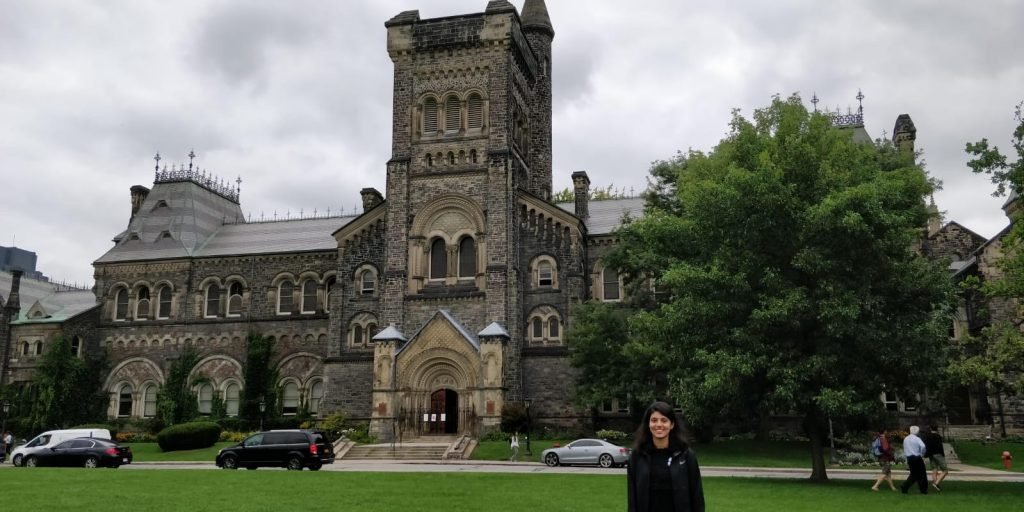
Shreya’s first day at University of Toronto

While I was deciding between T.A.M.U and the University of Toronto, I spoke to my aunt. The only thing she told me was “In your age money and American lifestyle seems exciting but do consider a few years down the lane”. I think that statement greatly influenced my decision. Moreover, Canada is right next to the States. Then, Canadian schools not only offer one of the best educations but are more affordable compared to their counterparts in the U.S.A. The University of Toronto is one of the best computer science schools in Canada as well across the globe. I am happy with the decision I took. Also, Canada being an immigrant-friendly country makes a lot of things easier for international students.

Also read: MS in Canada compared to MS in USA

What have you most enjoyed in Canada so far?

Canadians are very nice people. With one-fifth of its population foreign-born, Canada is very diverse (at least Toronto where I live). I have found people accepting of different races. My favourite thing is the food here, you can literally find everything, from Mexican to Asian to Goan cuisine.

Another thing that I like here is that students can work part-time. It not only reduces the financial burden on the students, but also helps them gain some decent industrial experience before graduation.

What have you not liked about Canada?

Canadian universities are either research-intensive or Industry experience-oriented. The University of Toronto is a research-intensive school and in fact, most top Canadian schools are research-focused. I found the courses at the university are much harder and less industry-oriented (mostly thesis oriented) when compared to American Schools. I feel this is something that differs from school to school. Again, I am talking in the context of graduate courses.

Bachelor’s here is on par with the US. The job market is good. Toronto has many companies and it’s a growing market but, when I discuss the salaries and number of opportunities with my friend in Boston, the numbers are definitely lower. Then, rents are high in Toronto and Vancouver. As a student, it sometimes becomes difficult to afford it. The rent for a two-bedroom apartment in downtown (where most companies are located), is around 3500-3800$, while median salaries in software jobs are around 4500$ per month (after taxes).

Lastly, I am not a winter person, so I do find Canadian winters extremely long and harsh. 

What advice would you give to a friend thinking of studying in Canada?

I would advise my friends to look into school ranking, courses, and the job market for the program/field they intend to pursue. Canada like any other country has all kinds of schools- good and bad, and all universities offer different levels and quality of courses/curriculum. As mentioned earlier universities could either be research-oriented or industrial experience-oriented, make sure that the courses and universities you choose align well with your goals and interests. One suggestion would be, getting in touch with the seniors, and understanding their experiences to make an informed decision.

Additionally, researching the job market before choosing a country is important if you wish to work after your studies. Hence, I would strongly suggest that you research job opportunities in Canada in your field of interest. For instance, my field of education is software and there are tremendous opportunities in the Software Industry, which perfectly align with my career goals. But I have seen my friends struggle looking for jobs in the Hardware, Aerospace and Chemical sector.

Also read: Best Courses to study in Canada for Internationals

How easy or tough is it to get the work visa/PR in Canada?

Obtaining a work visa after post-graduation is easy. The graduate students receive an open work permit which allows them to work in Canada for 2-3 years without any employer sponsorship. The duration of the work permit depends on the course/program length. A course of less than a year entitles you only a year (or less) of work permit.

PR here is based on a point system and going to school in Canada can help you strengthen your profile. From what I hear, the ranking of your university also plays a role and, gaining at least one year of Canadian work experience could be beneficial. A lot of my seniors received their PR within two years of their graduation. While things are easy, being a part of illegal activities like working beyond 20 hours/week can jeopardize your stay in Canada.

Are you considering settling there – why or why not?

At this point, I am not sure about the settlement. I would like to stay another 4-5 years here. I want to live close to my family if that were not the case, then why not! Not being a winter person, the only reason I can think of to reconsider my settlement in Canada would be the winters, else I think it’s a great country to settle in, people here are very friendly and accepting.


To summarize, studying in Canada has its pros and cons. But for someone looking to settle in a peaceful, nature filled, warm hearted country that offers great quality of living, Canada is an option that cannot be ignored.

CPT, OPT, H1B – All about student and work visa in USA

cpt opt h1b

Confused about CPT and OPT? How can you work on the student visa in USA? How can you work after graduating?

How does CPT and OPT work?

While many Indian students plan to go to US for advanced degrees, very few are aware of how the visa process works there and why it is important to know about students and work visa before you join any academic program.

F1 visa and Form I20

For students, there are two important visa categories that determine your career prospects. First is student visa (referred to as F1) without which you cannot study in US. When any university accepts you, it will send you a Form I20 which is required to apply for a student visa. Things to note:

  1. Having an I20 alone does not mean that you will get the student visa. You need to apply for it and pass through the interview process.
  2. An I20 from a good reputed university increases the chances of your getting the student visa. This is another reason why students should apply to good universities.
  3. You can study, do an internship and work for a limited time after graduation on student visa.

Good news is that you can work while studying in USA. Here is University of Washington describing employment options for students.

CPT and OPT

Curricular Practical Training (CPT) is a program that temporarily allows international students with an F1 visa to gain practical experience directly related to their major through employment, paid or unpaid internships, or cooperative (co-op) education. It must be part of an established curriculum. CPT must be completed before graduating. In addition, CPT can be part-time (20 hours or less a week) or full time (20 hours or more a week).

Optional Practical Training (OPT) is a program that temporarily allows international students with an F1 visa in the United States to work in relation to their major of study. F1 visa students are eligible for OPT after completing their first academic year. For a normal student, you are allowed 12 months of OPT.

International students with an F1 visa who have completed degrees in certain science, technology, engineering and mathematics (STEM) are eligible for a 24-month extension for post-graduation completion of OPT employment. 

H1B visa for fulltime work

But to work for longer term, you cannot keep using the CPT and OPT. You need the highly competitive work visa – referred to as H1B visa.

H1B visas are issued by employers and you cannot personally apply for them. This means you need to have a job offer from a company who is willing to sponsor your H1B visa (it has non trivial fee plus is subjected to regulations by US govt.).

Few complications are involved such as H1B visas are issued only for some job categories where govt feels enough local American work force is not sufficiently skilled or available. For eg. while H1B visas are easily issued for software programmers, they are not for marketing or HR roles – this is one reason why more foreign students go for Computer Engineering than lets say MS in Marketing. So, while a lot of Marketing jobs may be available in US, it is not necessary that companies will hire international students (who require H1B visas) for these positions.

I witnessed this first hand while doing MBA at NYU. Some of my classmates could not intern at bigger companies like Amex in Marketing roles because they were not sponsoring H1B visas for Marketing department. Usually, if a company cannot sponsor H1B visa in future, they also don’t offer internships to those candidates even though internships do not require H1B. In short, you need to understand that:

  1. To work long term in USA, you NEED H1B visa sponsored by a company.
  2. H1B visas are issued for specific roles and some fields are friendlier to getting these eg. IT, software engineering, finance etc.
  3. Indian students should consider whether they can get work visas after graduating in their desired field or not. If H1B visas are not easily issued in your field of study, one may have to come back to India for employment after graduation.
  4. Even when you get H1B visa, you can only work that employer. This means, you cannot work part time at any other place in parallel and you cannot start your own company while working on H1B visa.
  5. H1B visas are issued for 3 years after which they can be reissued for another 3 years – thus 6 years in total. By the end of your 6 years, if your employer has filed your green card application and it has reached a specific stage, you can keep extending your H1B visa on a yearly basis. However, if your green card has not been filed or did not reach that stage at the end of 6 years, you need to live outside USA for at least 1 year before you can get H1B for 3 years again.
  6. H1B visas are extremely competitive and subject to strict quotas. If the govt. receives more H1B applications than the quota, then they are picked by lottery and your getting the visa depends on your luck.

One more interesting thing about these visas – F1 visas are granted on your intention of coming back to your home country after studying and thus proving that you have no intention of working in USA. Thus, in your F1 visa interviews, you should be prepared to show that you want to come back to India after studying. On contrary, to keep working in USA, you need H1B visa.

A sensitive time comes when you start working on OPT (the limited time for which you can work directly on student visa until you get the H1B) and your company has applied for H1B visa. In this period if you are traveling to India and re-enter USA on F1 visa (till the H1B is issued), you may be declined an entry due to conflict of interests since your H1B application means that you want to work in US whereas F1 visa status expects you to go back to your home country upon completion of your program. This is why some people prefer not to travel after graduation until you have received your H1B visa.

So, you should be aware of some visa intricacies so that you can plan your studies, travel and career accordingly.

Lately, there have been a lot of attacks on H1B by Trump administration. You can read about latest updates on H1B right here on this blog.

ICE asking online-only international students to leave USA

International students to leave US

JULY 24, 2020: Update

Just last week, we saw Trump revoking his ban and just when we thought the storm is over, Harvard announced that the ban does not apply to incoming Freshmen. In simpler words, any undergraduate student who was going to enter USA for the first time for his studies on a F-1 visa will not be allowed since college courses are running fully online and the ban revoke does not apply to them.

“International freshmen will not be able to come to campus this fall due to federal visa restrictions,” Harvard’s Indian-American Dean of the College Rakesh Khurana wrote to undergraduates Tuesday.

We are trying to find if this applies to incoming Master’s students as well. For the moment, it looks like USA has still not found its peace with students.

In lieu of the above, shall you continue your study abroad plans to USA? Contact us if you need help planning your future. Nistha has been helping students make their decisions this year more than ever and we are always happy to assist you.

JULY 15, 2020: Update

The Trump administration on Tuesday rescinded its ban on international students who planned to take classes entirely online in the fall as university campuses remain largely closed during the coronavirus pandemic.

Details of the administration’s rollback came during a court hearing over a challenge brought by Harvard University and the Massachusetts Institute of Technology in federal court. According to a court order, both sides had reached an agreement to rescind the policy, which was announced by Immigration and Customs Enforcement last week, sending thousands of students into a panic.

JULY 9, 2020: Original News

USA asked international students to leave the country if they are on an online-only coursework. Our analysis below.

US Immigration and Customs Enforcement (ICE) announced all of a sudden that international students will face deportation if their schools switch to remote learning fully due to the pandemic.

Due to COVID-19, there was a temporary exemption that permitted nonimmigrant students to take more online courses than normally permitted by federal regulation to maintain their nonimmigrant status. This ruling by ICE revokes this exemption and basically states that if you are studying fully online, you cannot stay in USA ?

The U.S. Department of State will not issue visas to students enrolled in schools and/or programs that are fully online for the fall semester nor will U.S. Customs and Border Protection permit these students to enter the United States. Active students currently in the USA enrolled in such programs must depart the country or take other measures, such as transferring to a school with in-person instruction to remain in lawful status. If not, they may face immigration consequences including, but not limited to, the initiation of removal proceedings.

It is devastating and cruel to say the least because online classes are not anybody’s fault. This comes after Trump banning issuance of new H1B visas last month ?

Who does it affect?

  • Current F1 students who are taking classes completely in online mode
  • Anybody planning to start Fall 2020 semester whose program is declared not hybrid cannot get F1 stamped or enter United States

Few options available to you:

  • Change your program of study such that they enroll in either hybrid or in person classes
  • Ask your advisor if there’s a way to enroll in courses which qualify for in-person credits – there might be certain project/independent study kind of courses that fulfill this criteria
  • Some people are talking about taking medical leave or transferring to another college but that is not feasible for everyone

Is there any hope on the horizon?

First, this turbulence is mainly caused by Presidential elections due later this year in USA. Things are expected to settle down after the elections.

MIT, Harvard, NEU have sued the govt for the same in order to protect the students.

India is also planning to raise the issue diplomatically to protect the students.

What are current students saying about it?

Nothing great to report.
Next year’s H1B is my last attempt, and with all the noise around, there is nothing promising to look forward to.
I love my job so that keeps me going and even though there are rumors of layoff, my team seems to be safe from being affected.
On a positive note, I feel lucky to have come here, did my MS and get a job before the pandemic hit.
Almost all the juniors who graduated last month from my college have active job offers, so that’s a great news.
The manner in which classes are being held (online) is a major drawback. Professors hate it, and attending a class in person is miles ahead of attending classes online. It’s not just the classes, but being have to be away from the University buzz is a major setback too.

The kind of support we are receiving from our faculty, and graduate associations (at CMU) is reassuring. But constantly being reminded by this administration that we are ‘aliens’ in this country, irrespective of our contributions, has consistently corroded our motivation to stay here for any longer than is needed. Before coming here last year I was of the opinion that every rule had a rationale that probably benefited the country’s economy or it’s politics. But now I am surprised to see how a country that was built by immigrants can be so xenophobic. Many of my friends are judiciously considering moving to other countries or going back home as soon as things settle. And it’s not only us Indians. An Australian colleague in my dept just sent his wife and 2 kids back home. I’ve heard from Chinese friends who want to go back home as soon as they graduate. I too am considering a future out of this country as soon as I graduate this December.

Colleges are trying to provide a hybrid model for current students so that they can stay. Apart from new i20 issuance (stating that we will be attending hybrid classes), nothing major is impacted for most of the universities (in hybrid mode). PS: College is supporting us in every way they can and Trump administration is doing the opposite. Keep calm and wait for November.

Rest, we are keeping an eye on the events very closely and will keep updating things here. You can also join our hyper active FB group to discuss the issues with fellow students.

Leave your comments and concerns below ?

Trump ban on new H1B visas: updates for Grad Students

Trump Suspends New H1B

Trump has put a ban on new H1B visas – what does it mean for Graduate Students? Here’s some clarifications and advice on moving forward.

President Donald Trump blocked visas for a wide variety of jobs, including those for computer programmers and other skilled workers who enter the country under the H1B and L1 visa on June 22, 2020. It is a temporary ban that will remain in effect till Dec 2020. src: NYTimes

Trump has said that the ban will help domestic workers in USA since the economy is already struggling. The visa suspension could open up 525,000 jobs for US workers, a senior administration official said. The official, however, did not explain how the administration arrived at that figure.

Watch Nistha’s analysis

Will Trump putting a ban on new H1B affect Graduate Students?

The ExecutiveOrder does NOT impact students on F1 visas, CPT or OPT. It only impacts the following categories of visa – H-1B, H-2B, L-1A, L-1B, or J-1. This refers to (intern, trainee, teacher, camp counselor, au pair, summer work travel only) and who do not already have such a visa as of June 24, 2020.

New entry suspensions do NOT apply to any of the following:

  • Individuals inside the U.S. on the effective date of the proclamation
  • F-1 students (including those on OPT, STEM OPT, and/or cap-gap)
  • J-1 students (including those on Academic Training)
  • J-1 exchange visitors in categories other than intern, trainee, teacher, camp counselor, au pair, and summer work travel.
  • Individuals outside the U.S. who already have a valid visa prior to June 24, 2020.
  • Individuals outside the U.S. who seek to apply for a visa in a category other than H, L, or the J program categories of intern, trainee, teacher, camp counselor, au pair, and summer work travel
  • Any application filed with USCIS including OPT, STEM OPT, H-1Bs, changes of status, etc.

How does it impact the students who graduate this year?

Trump’s Executive Order places a ban on new issuance of H1B visas till Dec 2020. If your H1B visa is already filed and approved earlier in 2020, you should not be affected. However, it is best to contact your employer and confirm this.

In general, the proclamation does not negate selection in the H-1B lottery or suspend an employer’s ability to file an H-1B petition for an employee. If you have more specific questions about this proclamation as it relates to changes to your immigration status that are or will be handled through your employer (such as H-1B, permanent residency, etc.) please reach out to your employer’s immigration team or legal counsel for specific guidance for your particular situation.

NC State International Students Office

So, who is this bad for?

The proclamation temporarily blocks foreign workers entering on H-1B visas (skilled workers) and L visas (for managers and specialised workers being transferred within a company). Trump also blocked those entering on H-2B seasonal worker visas, which are used by landscapers and other industries. The suspension also applies to J-1 holders “participating in an intern, trainee, teacher, camp counselor, au pair, or summer work travel program.” 

The order also restricts the ability of American companies with global operations and international companies with U.S. branches to transfer foreign executives and other employees to the United States for months or year-long stints. And it blocks the spouses of foreigners who are employed at companies in the United States.

However, the above does NOT ban someone who is already in USA as well as valid visa holders overseas, but they must have an official travel document that permits entry into the United States.

Is this a bad news for international students?

Not directly since it has no bearing on F1 visas whatsoever. Last month, we heard a good news that H1B will give priority to people who have studied in USA which is a great news for international students. However, if Trump carries on like this and makes H1B more restrictive, it creates a ripple effect on students ability to work after graduation. I have already written about What is happening with H1B – should I apply for MS? Such news create an uncertainty in the job market and employers become more cautious in sponsoring H1Bs.

Can there be more bad news for immigration in future?

The June 22, 2020 proclamation does instruct the Secretaries of the Department of Homeland Security, the Department of Labor, and the Department of State to work together to recommend modifications to the proclamation within 30 days and then every 60 days after that. So, we do not know at this time if the proclamation will change or if new proclamations will be issued. However, OIS will continue to monitor news bulletins for more information and update this FAQ accordingly once we know anything.

NC State International Students Office

What can I do so that these developments do not impact me?

Some of my colleagues from Citi who couldn’t get H1B were relocated to other countries. Companies try to retain their skilled employees as much as possible, they can move them to Europe or Canada if needed. Talk to your employer & figure out your options.

Of course, startups may not have all these options but if they really want you, they figure out a way especially now when remote working is widely acceptable.

If you were planning to apply to US for studies, be prepared for such announcements. I believe US is best innovation hub – the kind of work and salaries you get there is unmatched elsewhere. If your goal is immigration, look elsewhere as well.

There’s something called recession or Trump proof graduate – he’s the one who’s been so busy skilling himself that he knows he can find a job in any market. Be that guy. If you want to figure how can you become evergreen employable, try our career coaching services and contact us.

If you are solid in your fundamentals, you WILL find a job. It may not be what & where you wanted it right away but you won’t be unemployed.

Lastly, world is changing in unexpected ways. It’s better to be prepared for the worst. The moment you accept that anything can happen, you are half way ready to handle it. Think of backup options & be damn good in your field.

You can do this. Good luck ?

How can students take care of mental health in Grad School

mental health in grad school

First year in college or grad school can be brutal for the students. Students who are far from home, trying to create a new life in a new city can suffer from deteriorating mental health. Good news is that it is a correctable issue. Even if you are feeling momentarily lost or low, you can get over it with simple precautions.

Given the covid-19 pandemic and heartbreaking news coming from all corners of the world, we have brought in expert Counseling Psychologist, Sharmishtha Khanna for some well-meant advice. The following post is authored by her.

What causes mental health issues in students?

When the surroundings are unusual and the friendships uncertain, the tendency to feel insecure and weak can come through. In such a situation, it becomes even more important to seek mental stability. You must remember that the onset of college life can be tough at times, but it is worth the effort. 

My dear students, the initial excitement and ‘fear of missing out’ can endanger your mental health, so take it easy on yourselves. Take your time to settle in, get accustomed to the novel environment and make friends. If you are in a rush to do everything soon, there are chances that you will not be able to handle all the pressure. Listen to your mind and body, it will always tell you what you can do and when.

This does not mean that you do not push your boundaries – do so with preparation and effort, rather than compulsion and peer pressure.

“A lack of sleep, poor eating habits, and not enough exercise are a recipe for depression among college students. The stress that comes with academia — including financial worries, pressure to get a good job after school, and failed relationships — is enough to force some students to leave college or worse.”- www.healthline.com

How can students cope with depressing thoughts?

  1. Stay in touch with your family and friends, talk to them about your struggles at college and personal life. have someone who you can reach out to when feeling low.
  2. Avoid peer pressure as much as you can. In order to be a part of some group, students do the things that they may not do otherwise. Refrain from losing your sanity because of someone else.
  3. Take charge of your life, set limits for yourself in terms of social activities that involve any kind of intoxication. Exercise the power of choice.
  4. Be assertive. Do not succumb to bullying and report it as and when required. You do not deserve to be insulted and nobody has the right to do that to you. Stay away from such people.
  5. Romantic relationships, at this age, can seem overtly important for survival – losing people may feel like world is ending but remember that it is not the case.
  6. Practice mindfulness. Learn to be in the moment and abstain from living in the past or future. There are apps like Headspace, Calm and Balance that you can use to get started.
  7. Focus on the short term goals that will eventually lead to the main goal. It will build confidence and help you succeed in your endeavours.
  8. Some plans will work out, others may not. Keep trying without worrying about the end result, that is what is in your hands- free will.
  9. Most importantly, seek help when required. Do not let some kind of mental block delay your visit to a therapist. The earlier you identify the problem, there are better chances of you coming out of it.

About the author: Sharmishtha Khanna is a Counseling Psychologist with clients world over. She has been in the field since the last 5 years and has touched the lives of many individuals and helped them in becoming a better version of themselves. She is trained in Cognitive Behaviour and Rational Emotive Behaviour Therapies. You can find her write ups and posts under the name of Maansikta on Facebook and @Maansikta.health on Instagram. She is available for e-counseling, and can be contacted at maansikta.health@gmail.com, along with Facebook Messenger and DM on Instagram for the same. 


Also read: 20 Secrets to Successful Dating in Grad School

Most graduate schools have an in-house counselor and visiting them is covered in your student health coverage. If you are feeling low and sinking into negativity, reach out and make an appointment with your counselor TODAY.