1.92 lac students appeared for CAT 2021. Only 3000-5000 will make it to IIMs. Rest 1.87 lac can beat themselves for not making it or they can explore one of the other options.
It is a brutal competition indeed. Many people take gap years just to prepare for CAT and if you don’t make it to top 2.5%, you have no chance of making it to schools like IIMs. There are some very talented, smart and intelligent people in this pool. So, in this post, we explore the way forward for anyone who couldn’t clear CAT.
Let’s get right into it. Here are the immediate next steps to consider:
1. Think what you wanted to do after the MBA and try it directly.
Most people don’t seem to realize that most careers don’t even require an MBA (especially roles in startups).
2. Get work experience
If MBA is crucial for your career goal (read Investment Banking, Consulting, Finance), get good work experience and go for an MBA later with a better profile. B Schools always value great work experience, so your time is not wasted.
3. Take GMAT instead
Honestly, if you are looking for better options after CAT, there is nothing better than GMAT. With the amount of preparation you do for CAT, you can easily get great scores in GMAT. There are many schools in India (and of course all abroad) that accept GMAT scores including IIM A, B, C, XLRI, SP Jain etc. Plus GMAT score is valid for 5 yrs. You can check out our GMAT guide to learn everything about cracking the exam.
4. Use CAT score to apply abroad
You don’t have to delay your MBA plans. Use your CAT score to apply to other schools. For example, HEC Paris accepts CAT score for some of its Master’s programs
Do I need to say that please don’t take a drop? Ok, let me say it. Please never take a drop 🙂 There are solid options that you can try instead of CAT, so, get going.
Remember, what doesn’t kill you makes you stronger and not making it to IIM most definitely will not kill you. Many people who did not make it to IIMs are thriving in their careers. So can you.
If I graduated in last 2 years, my career strategy would be very different from what I followed in the previous decade. So much has changed (not just because of covid) that career planning needs to be rethought as well.
I am penning down some of the biggest trends I’m seeing on the horizon and the kind of changes we can expect to see in the short and long term. Let’s see if you agree with me.
1/Balance
Employers (esp in the West) are finally realizing that millennials don’t want to and don’t have to keep working 24×7. Internet has created opportunities that simply did not exist before. They can earn good money on the side while having fun. So, why would they dedicate their whole life to a mundane job? This means they have to offer better working conditions to attract and retain talent.
USA and a few countries in Europe are feeling the brunt of ‘The Great Resignation’ – a phenomenon where in record number of employees (4.4 million in Sep 2021 and 4.5 million in Nov 2021 in US alone) are voluntarily quitting their jobs. Quitting in November is a strong trend because people usually don’t quit before the holiday season.
A Microsoft survey showed 41% of employees are considering resigning from their jobs in 2021, compared to 15% rates pre-pandemic.
The real shocker, for me, was to see Goldman Sachs saying that it is ‘working to improve the work-life balance of junior-most employees, known as analysts, by reducing their hours and other measures’. For those of us who have seen Wall Street’s ruthless working culture from close quarters, we were smiling to see this first-of-its-sorts acknowledgment that employers are not able to simply buy people off anymore.
But let’s dig deeper into what is driving this Great Resignation phenomenon. I believe the top reasons are that employees are:
experiencing post pandemic burn out
used to WFH and don’t want to go back
not considering job as their number one priority anymore
saw side hustles succeed and now they can actually afford to leave (power of the creator economy, see point no. 5)
not feeling valued at work and not willing to compromise on it
People are re-evaluating their options after Covid. It seems we are entering a new era of making different life choices. YOU, now, have a choice to pursue careers more to your interest and exploit your talents (even weird ones) – never before in history have we seen something like it.
Yes, we are still to witness this playing ou with same intensity in Asia. In fact, India has seen job market worsening since covid broke out.
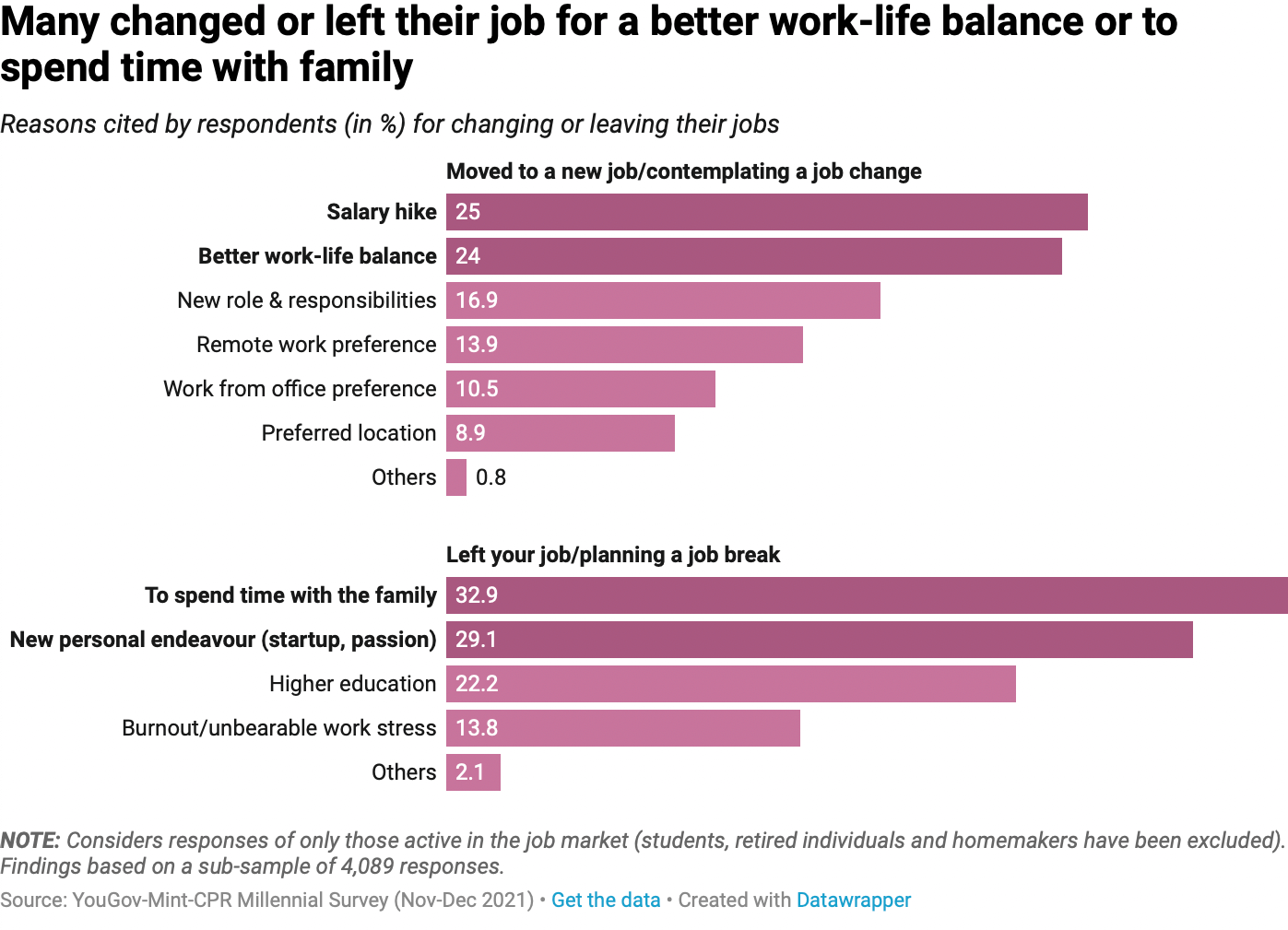
However, the Technology sector (which was not affected by covid) is seeing increasing churn and even Indians are not considering salary as their primary motive in job seeking as discovered in this survey.
src: Mint
2/Quality of Education
India has an average PTR (pupils to teacher ratio) of 28 i.e. there is 1 teacher for 28 students (lower than China & Brazil). It indicates the burden on a single teacher of teaching multiple students as well as the lack of time that each student gets. Combined with the relative unattractive perks of teaching jobs, Indian education has always suffered from lack of teachers, more so, good teachers.
However, with a generous push from the pandemic, the way we consume education has already changed from fully offline to significantly online. Arguably, it is a welcome change. E-learning supports ~50% faster learning speed & 25-60% retention rate vs 8% in offline learning i.e. students can learn faster and retain more because of recordings and option to replay. Also, if students cannot understand a concept in college classroom, they have ton of online courses and videos to learn from.
This has leveled the quality of education accessibility for tier 2 & 3 locations. Further, poor quality of teachers is offset by the teaching talent online. Good for everybody.
3/Value of Degrees
Most Indian graduates are not qualified to work and yet subpar colleges have survived so far. Why? Because employers wanted a degree. Will we see a future that does not care as much for formal education? In the long term, yes.
The change would be catalyzed by job opportunities that do not require a degree. FYI, Google, Apple, EY, Tesla and a few other firms have started hiring people without 4 year undergrad degrees. Time will see only more companies adopting this trend and give impetus to self-learned talent. This will force Universities to figure out their shit as well – why should students take on hefty education loans to pay tuition fees if they can simply compete for jobs without their degrees.
4/Tests
It took a pandemic for universities to realize that admissions can continue even if the applicants did not have SAT/GRE/GMAT scores. But what does it mean for the candidates? With no exam scores to compensate for lower gpa, will applicants with not so good acads suffer in applications? It is possible. But, in the long run, as degrees matter less (point 3), the supply and demand of candidates in college admissions might just balance out.
5/Gig and Creator Economy
There are at least 59 m gig workers in USA as of 2021 – that’s 1/3rd of its workforce. Gig workers are people like freelancers who are hired for a special task and mostly work remotely. Gigs range from sophisticated work required by large enterprises to something as mundane as transcription or house cleaning. With companies like Urban Clap and Fiverr empowering the service professionals, more and more people are taking up gig working.
A parallel track is that of the creator and influencers who have sprouted like mushrooms on social media. I foresee a future where many students would not even sit for placement in colleges because they have already started their YouTube/IG channels and are making good money.
So, those are my broad comments on the year to come. We are truly living in an exciting time and I am forever bullish on the future. DO YOU AGREE WITH ME? Please share in your comments below, I am very curious to hear your thoughts!
If you liked this post, you would enjoy our free newsletter where we talk about designing a career that makes you come alive. We promise we never spam.
You are qualified for the job and ready to ace an interview. You meet your interviewer, and the first question they ask is, “Tell me about yourself.” You knew this was coming, but you are unsure of what to say and end up ranting.
That is perhaps one of the worst-case scenarios in terms of an interview. But it does not have to be.
Interviews can be nerve-racking and can make you give unclear and long answers. All you need is a bit of guidance and some practice. In this article, we bring you a 3-step guide to answer the infamous question, “Tell me about yourself.” We have also added a few examples of how one can answer this question.
Why does an interviewer ask, “Tell me about yourself”?
To craft your response, you need to understand why this question is relevant in an interview.
The intent of asking, “Tell me about yourself,” is to know the perception you have about your career and yourself.
Context matters, and since you are applying for a job, your answers should be about your career and qualifications. A good thumb rule to follow is to not reveal too much about your personal life unless it matters to the role you have applied.
Moreover, this question acts as an icebreaker. It is the first time the two of you might be talking, so it helps the interviewer ease into a conversation and the more complex and technical parts of the interview. Your response also makes the interviewer ask more questions relevant to the job and your experience.
The interviewer is looking for a person who will be the right fit for the company. It is also a way for the interviewer to assess your communication skill and how well you can articulate your past experiences.
If answered right, it projects a good impression on the interviewer, increasing your chances of getting that job.
3 tips to answer “Tell me about yourself”
Prepare beforehand
It is one of the most common questions asked in an interview. And it is a good thing. Since you would be better prepared, you should be ready with your answers beforehand.
Writing it down on a piece of paper is helpful. Why? Because when we are talking, we are processing what to say in the present and the next few seconds. Writing allows you to process your thoughts. You can make any corrections in a much more tangible form. So write your answer down. We have shared a template below that you can follow to structure your answer.
Research the company and the job
The power of the internet allows you to search for the company.
What does it stand for, the competitors, and the people in a similar role as you.
You can search for the recent and relevant accomplishments of the organization. You can assess whether mentioning them will help you to leverage them better and stand out. When you shift the focus to why your joining would benefit the company, you set yourself apart from the competition.
Pick and choose from the resume
If they have called you for an interview, then it means that they went through your resume.
Avoid saying everything in the resume, and only choose points that need mentioning. Did you help your last company increase their sales by 40%? Mention that, especially if the job description involves sales. When you are answering, humanize your resume instead of reciting it.
A template for answering “Tell me about yourself”
A basic structure can help you answer — Tell me about yourself — in a way that increases your chances of selection.
You must know the rules to break them. It is not a strict guide but a framework you can use and mold according to your profile and experience.
Hello, my name is XYZ, and I am a [the role you are applying for]. I graduated from ABC colleges with a Bachelor’s in [degree name]. I did my Master’s from EFG college/university in [degree name]. I have experience of [total years/months of relevant experience]. Currently, I work at/ my last company was [current company name].
As a [job title], I helped the company in the following ways (mention 1-2 accomplishments). I have also worked at [company names] as a [job title] and helped them achieve [goals]. I want to work with you because I like [mention what you like about the company]. The company seems like an excellent fit for me because [what the company values/the vision of the company] aligns with my values.
3 answers to “Tell me about yourself” for different situations
If you are a fresh BBA graduate
Hello, my name is Jon, and I have recently graduated from XYZ college with my BBA degree. In college, I ran a small startup and helped to increase the revenue by 40%. My unique insight and ideas helped us generate [X amounts of money] and gave me a deep understanding of business development. Handling a team and the basics of Accounting is also a part of my skill set. I love that the company is keen on delivering the most seamless experience to the customer since I believe in putting the customer first. As a business development executive, I would fit into your organization.
If you are switching companies
Hello, my name is Pooja, and I am a Software Engineer. I have a bachelor’s degree in Computer Science Engineering from NSIT Delhi.
Currently, I am working at ABC company as an Associate Software Engineer.
I am adept at developing web applications using Java, PHP. In my last project, I contributed by creating a web app for an American health insurance company. I’ve good communication skills and can collaborate well with onshore teams.
If you are switching job roles
Hello, my name is Rahul, and I have worked as a customer service executive but want to be a part of a dynamic sales team as a sales representative. My experience as a customer service executive has helped me discover the pain points faced by customers. And how to better sell our product. In my previous role, I helped many customers and guided them, which helped retain customers. I want to use my people and problem-solving skills to help your organization reach its short-term and long-term sales goals.
Conclusion
Communicating your accomplishments and skills is a skill. If answered right, “Tell me about yourself ”can help you position as the most suitable candidate for the role. It is such a guaranteed question that even HBR has written a post on it.
With a little practice, we are sure you can ace it.
Scholar Strategy is India’s leading Study in USA guidance community. For last 9 years, our candidates have gone on to study at MIT, Stanford, UIUC, Cornell, Berkeley, CMU, and other top universities. Not only that, we take pride in helping our candidates be prepared for landing internships at companies like Tesla, Apple, Facebook, Amazon and more.
Are you harboring dreams of world class education and studies abroad for career opportunities? USA has been the leading destination for ambitious students worldwide. Here, we cover all the information you need to realize your dreams.
Why Consider Study in USA
History of Innovation
The United States of America is called the nation of explorers. It is the birthplace of many inventions that changed the world.
From inventors like Henry Ford and Thomas Edison to industrialists like John D. Rockefeller were born in the US.
Cultural Diversity and Opportunity to Grow
The nation is renowned globally for its multicultural environment, its opportunities, and what has become a common phrase – “American Dream.”
Don’t know what the American Dream is?
Investopedia defines the American dream as “the belief that anyone, regardless of where they were born or what class they were born into, can attain their version of success in society. It is achieved through sacrifice, risk-taking, and hard work, rather than by chance.”
The US is revered for its infrastructure that promotes innovation, entrepreneurship, and technology. No wonder, it is the number one study abroad destination.
World’s Best Universities
It has some of the world’s oldest universities: Harvard, Stanford, MIT are all based in the US.
As per QS world rankings 2021, five universities in the Top 10 are all based out of the US.
American universities provide a great learning experience, opportunity to grow like no other country.
Recruiters of top-notch organizations pay high salaries to students of American universities.
The schools receive huge donations and are well funded to invest in research and development areas.
Courses to Target
Study in USA allows you to choose from a plethora of courses. The country will probably have a course/degree on every subject you can imagine.
MIT, the California Institute of Technology, John Hopkins University, and Carnegie Mellon University are famous for STEM education.
Apart from STEM, courses on Psychology, Journalism, Medicine, Business & Management, Social Sciences are also top-rated.
Indian students mostly enroll in American university programs to study Engineering and Management. The courses like MS and MBA attract Indians applicants due to the high standard of education and the possibility of getting a high-paying job in the world’s largest economy–United States of America.
Undergrad
Colleges in the US offer a four-year Bachelor’s degree. Students aspiring to study at the undergraduate level in American colleges have to give the SAT exam.
The higher the score, the better are your chances to get an admission letter from schools like Harvard, MIT, and Stanford.
MS (Science & Engineering)
Studying MS (Master of Science) in the US is a dream for students passionate about Science and Technology.
It has the world’s best universities that offer STEM (Science, Technology, Engineering, and Mathematics) education.
The country is a leader in Research & Innovation sectors and is the home to many tech behemoths like Facebook, Amazon, and Intel.
Where did you find this article?
The chances are you found it on Google Search (or Gmail), Facebook, or LinkedIn–all of these companies were founded in the US.
MBA courses in the US are among the best in the world.
Studying at top universities in the US allows you to network with people from diverse cultural backgrounds and nationalities. A network built during your time at a B-School can be leveraged later when you are looking to form business partnerships.
As per QS global MBA rankings, four out of the Top-4 MBA programs are taught in American universities.
Most top American universities and colleges have the authority to decide their standard and admission criteria.
The most common aspect of applying to study in the US is standard competitive exams like GRE, GMAT, and SAT. GRE is usually accepted for admission in MS programs, GMAT for MBA, and SAT is the standard test students give for undergraduate courses.
The below sequence of steps may help you speed up your application process:
Decide five to ten universities you’re planning to get into for the subjects of your interest.
Search for ways to finance your education. This may include eligibility for a loan, scholarships, and grants. We’ve written a comprehensive article that will give you more clarity on ways to finance your education abroad.
Prepare for and give the English proficiency exams like TOEFL, IELTS, and degree-specific exams like GRE and GMAT.
Prepare for the colleges based on your exam scores.
Prepare and polish the documents common for admission in most colleges: SOP, Essay, Letter of Recommendations.
Appear for the personal interview with the admission officers.
If you receive an acceptance letter, confirm your intent to take admission to that university.
The universities require you to pay a non-refundable fee to confirm admission.
If you’re struggling during any phase of admission, we at Scholar Strategy can help you. Click here to contact us.
Main Challenges
Student Visa
The US government allows non-American citizens to enter the country only with a valid visa.
Without a relevant Visa, you won’t be allowed to study in the US if you’re an international student aspiring to study in the country. All your hopes of studying in the US will go in vain if your visa application isn’t approved.
The US government offers three student visa types, including F, J, and M.
F Student Visa: For study at the university level or to study English at an institute that teaches English.
J Exchange Visa: It is applicable for an exchange program at the university and high school level.
M Student Visa: It is applicable for vocational study or training in the US.
Before you can apply for an F, J, or M student visa, you must have an acceptance letter from an American university or higher education institute.
Please note that a good score in such exams doesn’t guarantee an admit and is just a tool to filter out applicants.
If you’re planning to study at these top universities, your work experience and extracurriculars help you stand out among the applicants.
Getting admission into a top school is a dream for many, but not everyone can pay the price to afford it–not talking only about money. The admission process is highly competitive. For example, The acceptance rate of admission to Stanford MBA is around 7 percent, and for MIT, it is 6.7 percent.
Cost of Study in USA
The cost of education is one of the critical factors that influence a study-abroad aspirant’s ability to choose a country, courses, and universities for foreign education.
The US is the world’s most popular destination for international students and the most expensive. The tuition fee and living expenses vary based on the student’s university choice and the university’s location.
The tuition fee for public universities and community colleges is lower as compared to those of private universities. The low cost doesn’t imply that public universities’ quality of education is lower than private universities.
For example, The University of California–Berkeley is one of the best schools globally despite being funded by the government.
Average fees at US universities 2018-19
Public two-year colleges
Public four-year colleges (in-state fees)
Public four-year colleges (out-of-state fees)
Private non-profit four-year colleges
Tuition & Other fees
$3,660
$10,230
$26,290
$35,830
Room & Board
$8,660
$11,140
$11,140
$12,680
Total (per year)
$12,320
$21,370
$37,430
$48,510
src: TopUniversities
The values given in the table above are an estimate, and the actual cost may differ based on the university and city you plan to study in.
What are best ROI Courses in Canada for International Students in 2020? Let’s take a look.
Courses with high ROI in Canada
Canada is working on increasing the number of
international students in Canada through effective education strategies
implemented since 2014. Quality education and high living standards in Canada
has attracted many people from all over the world. The high-quality educated
imparted in Canadian universities provides many opportunities after graduation
and set the individuals on an excellent career path. Degrees from Canada, along
with work experience, make it easy for the people to get settled in Canada
permanently.
A general degree from a university in Canada can be
completed in four years, which is considered to be the equivalent of an
American degree. The Canadian education system is well-developed and keeps on
improving with the passage of time. The courses offered in Canada covers all
the modern aspects of life and business, which attracts a myriad of
international students. Such opportunities can lead to numerous work
opportunities in foreign countries, including Canada, the UK, the USA, and many
other countries.
Before making the decision of studying in Canada, you should be familiar with the following factors:
Application Fee
The application fee for Canadian universities is
between 100 to 250 Canadian dollars. It can vary a lot depending on the
university you are applying to. Hence, it is better to check the university in
the initial stages of the application process.
Standardized Tests
Admissions are usually finalized on the basis of high
school grades. However, some universities may require SAT, ACT, or other
standardized tests as well. AP or IB exams can also be taken for credits or
placement in some educational institutes.
Tuition Fees
The tuition fee in Canadian universities varies a lot
on the basis of the program. The average fee can be between CA$7,000
to CA$29,000 per year for the international students at universities. While the
colleges cost about CA$5,000 to CA$15,000 per year, many financial aid
programs, loan schemes, and scholarships are available in Canada to support
international students.
Accommodation
The majority of the colleges and universities in
Canada have accommodation facilities near or on the campus.
Visa and Legal Documents
Verification of the legal documents and visa approval
is mandatory for international students before entering Canada. The application
fee for a study permit in Canada is CA$235. It allows the students to study
as well as work outside the campus for a limited number of hours during the
semester and full-time during Summer or Spring breaks.
1. MBA
MBA has always remained one of the most essential courses in Canada. It provides a lot of international work experience and real-life exposure to the students, which helps them in becoming a successful businessperson and entrepreneur. Moreover, there is a considerable demand for jobs related to investment finance and management consulting in Canada. MBA graduates can specialize in IT-related fields like Analytics, data science, and Big Data, which has some of the most high-paying job opportunities in Canada.
Despite having an affordable education system, the MBA programs offered in Canada are expensive for international students. Even then, it has its own set of advantages and long-term benefits, which play a massive role in establishing stable career paths of MBA graduates in Canada. Soon after graduation, most of the individuals are offered high-paying jobs. Various types of MBA courses are offered in Canada. In India, Canada has just started to become popular for getting MBA degrees, so if you want to learn more about it, you must check out MBA in Canada for Indian applicants.
2. IT and Computer Science
IT and Computer Science programs have become highly popular since the
last decade due to significant advancements in the technology sector. IT
professionals are in huge demand all over the world, including Canada.
Hot Specializations in Computer Science
The tech industry in Canada is growing
rapidly. Last year, about 11,500 more jobs were added to the massive IT
industry. Most of these jobs are very well-paying, as well. According to the
researches, an average annual salary of $81,500 is being paid to the IT
experts. Moreover, experts of complex concepts of computing like blockchain,
AI, and Big Data are enjoying a large annual pay of $100,000 or more.
Computers have evolved
a lot in the last few years and impact every sector of society. As a result, IT
has numerous different categories, and some of the specializations have become
more popular than the others, such as:
Full-stack development
Project Management
Software engineering
Web Development
Program Analysis
Java Development
Cybersecurity
Cloud Computing
Database Administration
Top
Computer Science Universities in Canada
The majority of Canadian universities have state-of-the-art facilities which are important in enhancing the learning experience of the students and imparting modern education to the students. Such facilities have played a considerable role in producing leaders in the IT sector. The fee of the universities varies anywhere between CA$6,500 to CA$33,500 per year, depending on the scale of the university. It is always a good idea to check the fee structure of the respective university from its official website get authentic and updated information.
Though Computer
science has seeped into every different field, the popularity of core
engineering programs has remained almost the same. The engineering jobs have
also grown steadily in Canada, and about 8,000 jobs were added to the
technology sector in 2018.
Mechanical, civil, and
electrical engineers are sought after the most in Canada. Moreover, an engineer
with expertise in AutoCAD and CATIA are preferred by most of the companies.
Ontario and Quebec are the ideal Canadian cities for engineering jobs.
An average annual salary of $81,000 is being paid to the majority of the engineers. The lowest-paying engineering jobs pay approximately $52,000.
Finance, commerce, and
business management have always remained important in the prosperity of the
economy as well as the success of an individual company. A degree in finance
and economics will teach you a lot about the working of the financial markets
and the procedures of the business environments. Moreover, studies related to
finances allow you to develop a variety of skills that are applicable in many
other fields as well.
In Canada, jobs like
asset management, broking, accounting, banking, and investment management are
in huge demand. Other than the undergraduate programs, MBA is one of the most
popular courses in Canada and abroad.
5. Earth Sciences and Energy
With the rising
popularity of renewable energy and eco-friendly developments, the demand for
students in Earth Sciences has also increased.
No economy can prosper
without reliable energy sources. Rapid depletion of fossil fuels and an
increased rate of climate change has alarmed scientists as well as
industrialists in Canada. As a result, many companies are investing a vast
amount of money in finding eco-friendly solutions, and hence the jobs for
renewable energy experts have augmented. Such jobs are not only high-paying but
highly essential in revolutionizing the economy and protecting the planet from
further damage. Earth Sciences programs
like Physics, Petroleum Engineering, Mining, and Geology are in huge demand.
After spending so much time in study abroad applications, you want to ensure that you succeed in grad school or college. What does success mean? – Making the most of what your program offers + landing a great internship/job in the end. So, how to do this? Read on.
While you will be taking many jobs after this and spending next 30-40 years in professional life, the freedom and opportunities of student life shall never be back; even if it does, it probably will be the two years you spend in a business school. And the worst part is that the time in school flies by. Before you know it, the school will be over and hopefully, with a job offer in your hand. But, if you just land a job and never really bonded with your classmates, I feel it is an opportunity wasted.
You need to make efforts to ensure you achieve what you had set out seeking when you entered the school.
How to succeed in Grad School and college?
1. Start early
Between settling in an alien setting, dealing with the course load and making new friends, first semester will fly by and before you know, you will be standing clueless at career fairs. Focus early on, get a hang of recruiting calendar and be prepared for a long and grueling internship and job hunt. This is where our Internship Masterclass program positions you perfectly to succeed in Grad School and colleges.
2. Seek what you want but respond to opportune moments
There is a reason why good schools ask you to write an essay on your short and long term goals. If you do this part diligently, you will be more grounded in the school. With various people recruiting for different fields, it is easy to fall for herd mentality. Knowing what you want is very important so that you don’t start chasing things that seem lucrative but are not what you want.
On that note, a good career is a balancing act of planning and serendipity. There will be opportunities coming your way which may not be part of your plan but if they look right for a reason and appeal to your passion, perhaps you can give it a try. Now, this may sound contradictory to what I said in the previous paragraph but if you follow closely, you will understand.
For example, there comes an opportunity where a team is looking for one more member for a startup pitch contest. You meet them and let’s say you like their idea – you can try it out. Who knows what it might lead to? Grabbing opportunities on the way ensures you expose yourself to what is out there but it does not mean trying things which will suck all your resources and may cost you your original dream. The key is to be nimble and only you can find the right combination for you but you get the idea.
3. Have a hearty breakfast before starting your day. Never eat alone
Expect long days out and getting a healthy fulfilling breakfast will ensure you have the stamina required for it. For your other meals, try to always go out with other person or a group. Preferably try to meet at least one new person every three days. Lunches are a great way to help you make friends!
4. Do not take menial jobs to pay bills that do not add to your skills
A lot of students end up taking demanding on-campus jobs and assistantships that do not add much to their learning just because they pay something. You are already spending time and money to attend the school. Understand the value of your time and resources. Make sure you spend those on something worth engaging in.
5. Work for free if you get to learn
You are here to learn and grow. If an exciting opportunity is knocking on the door but it is not paying you, work for free. Yes, working for free in a research lab or an unfunded project is better than cleaning cafeteria tables.
6. It is okay to feel lost
Many students feel overwhelmed in first few months so much so that they lose track of what matters and what not. They put so much pressure on themselves to find the right assistantship or the courses or friends that it becomes disheartening when things move slow. Remember, it is okay to feel lost. Give yourself time to settle in the new surroundings. You will be fine, don’t panic.
7. Invest in relations. Connect with people from diverse backgrounds
You will probably never make as good friends as you can find in your classrooms. Go, talk to people. Hang out with those who are interesting, inspiring and make you think. Meetups are a good way to do this. Build bonds that can last a long time. Of course, you have to nurture every friendship and relationship but to start with college friends is way easier than making friends in professional circles. This is also the time to widen your lenses. Talking to people from other backgrounds will give you humility and lessons in open-mindedness.
8. Experiment in your internships. Take those jobs that will teach you helpful skills and not the highest paying ones
Another big mistake students make is to choose the highest paying job after graduating. Remember, you are recruiting your employer as much as he is recruiting you. The cost you will pay by taking up a job that will not help you advance in the direction you wish to go is way higher than what any employer can ever pay you. Do not give yourself away for a salary. Your future is worth much more. Do you dream of being an executive of a tech company someday? If so, do you think that job in a big MNC with no hands-on learning is the best way to learn how a company is operated? If not, think what will get you closer to your dream and take jobs where you can develop those skills.
9. Engage in clubs and extra curricular activities. Travel and have fun
A lot of learning comes from outside the classroom – learn on street, hone new talents, experience life because this time will never come back. While a lot of emphases is on building good relationships and connecting with people, it is useful to spend quality time alone to introspect and reflect upon this splendid journey.
10. Take classes with Professors who teach well as opposed to a course that looks great on paper but has an uninspired Professor
Ask your seniors for recommendations. You can learn more from a good professor even if the subject is slightly off track. I have personally experienced that being knowledgeable and a good teacher are two separate things. Look for people who know how to teach and communicate a concept. Choose your electives wisely. Engineering Professors can be quite drab and what seemed a relevant curriculum is reduced to awkward lectures and tiresome assignments.
And, those are a few easy hacks in a nutshell that will help you succeed in the Grad School without breaking much sweat. Which ones resonate with you the most? Reply in comments!
When times are tough, it boils down to who can keep a positive attitude and live another day. No matter how good your job or boss, things do take an unfortunate turn every once in a while. There is always performance pressure and workplace politics to battle with.
90% of the startups do not fail because they don’t have money. They fail because they lose steam and give up. Same with people.
Have you ever seen success coming easy for anyone? That happens only in few movies. Otherwise, you have to grind it out, eat the shit sandwich as Mark Manson calls it and hope the timing works out.
Why is attitude so important?
A few days ago, I posted about psychology of Indians on LinkedIn and how they never encourage. It sort of went viral, sharing an excerpt here:
Indians don’t encourage or applaud. The best approval you get is silence.
They won’t reply to your requests or emails but when you have made it on your own, they’ll come & pat your back 🙂
Exceptions are there and I’ve been fortunate to know some of them 🙂
This post is not to criticize but to remind that each culture comes with its own quirks. And of course to encourage that you shouldn’t rely too much on getting validation in India. It’s nothing personal, it’s just how it is. Silence from the other end is not always a disapproval. Do what you believe in and may you find your own luck.
And it’s almost reminding me of dads in India. They don’t congratulate you on getting 99, they ask where did you lose that one mark! 🙂
The reason it touched a nerve is because that lack of encouragement deters so many people mid way. This is why we need a better attitude if we want to make it big in life. So, how about this mantra –
Positive Attitude + Thick Skin = Recipe for Success
Need more reasons to build a positive attitude?
1. It holds you up especially when things are not going your way
Take Abraham Lincoln. Most people are unaware that he battled crippling depression his entire life. His life was one of enduring and transcending great difficulty. It would be his own experience with suffering which drove his compassion to allay it in others. He was patient because he knew that difficult things took time. Above all, he found purpose and relief in a cause bigger than himself and his personal struggles, as the nation called for a leader of magnanimity during the Civil War. As crafty as he was, Lincoln’s strength was his will: the way he was able to resign himself to an onerous task without giving in to hopelessness, the way he was able to rise above the din and see politics philosophically. “This too shall pass” was Lincoln’s favorite saying, one he once said was applicable in any and every situation one could encounter.
2. It attracts right people in your life professionally and personally
Ah, yes. How many of us have gotten in horrible relationships again and again? What’s common between all of them? YOU. You are attracting these people and afraid of letting them go because of your insecurities.
Same at office. Are you ignoring bullying behaviour in your team or not telling your boss the truth because you are afraid? Having a positive attitude doesn’t mean being nice all the time – it means accepting things for what they are and being optimistic that things can improve. It allows you to find solutions instead of focusing on problems.
3. It makes you happy
I think this reason alone is enough. But again, this aspect is misunderstood.
Developing the positive thoughts is not about being always happy or cheerful. It is definitely not about ignoring things which are negative or unpleasant in your life. It’s about accepting that positive and negative are part of the life.
Once you acknowledge that one can not always be happy and can embrace even your bad moods, difficult emotions cannot ruffle you. And, isn’t that what happiness is anyway?
How to build positive attitude
But of course, the question is how to get this positive attitude? Well, here are few simple ways to get started on your journey of positivity.
Limit social media browsing to 1 hour per day. It really doesn’t help to keep checking the lives and stories of people around us (most of which are fake). Stop comparing yourself to others. You don’t know what is really going on with them.
Embrace a hobby and set time aside for it. Indulge in things outside your work. Take time to cook, bake, garden, paint, play music, run, yoga or whatever speaks to you. Have your happy time to balance the stress of the work. This is your ME time.
Write 5 things you are grateful for each night/morning. This acts like a reaffirmation and reminds you of things you are taking for granted. For eg. you should be grateful for having a clean bed to sleep in, coffee every morning, a job, a family – not everyone has these.
Give benefit of doubt to other people instead of being angry at them. Someone didn’t reply to your email and you assume they are ignoring you? Most likely, they were just too busy. Follow up and be professional. One day you will get busy and will realize how it feels. The point is, anger hurts no one but you.
Ask for HELP. It’s that simple – asking for help is not a sign of weakness but of maturity and reliability. Too many freshers don’t ask for help and screw up the tasks they are given. Your boss wants you to know when it is time to ask for help. So, if things are getting overwhelming, ask for help – not just professionally but personally too. Delivering a task well done is more important than doing it all by yourself. A lot of your professional success will depend on how well you work with your team and colleagues. Asking for help also makes you a like-able person.
In the end, the attitude can make all the difference. Now that you are aware of the positive psychology and ways to build it up, it is never too soon (nor too late) to get started!
Pursuing an MBA after engineering has become a popular career choice for engineers in the recent past. No wonder people scoring the most in CAT or Indians making it to Harvard and Stanford Business Schools are often engineers from IITs. As per few reports, the acceptance rate of IITs is only 1% as compared to MIT which stands at 8%.
I was once giving a talk at a college and someone asked me how did I get into career coaching and writing books after an engineering degree. To that, I replied, “Because every Indian is allowed to have a passion but she first needs to complete engineering.” Jokes apart, there are multiple good reasons why you should consider an MBA after engineering.
Why MBA after Engineering?
Every engineer, one in her lifetime, faces this dilemma – to MBA or not to MBA.
I myself pursued an MS in Computer Science first, worked on Wall Street and felt the need for an MBA eventually. This is when I knew what I wanted to get out of MBA – I wanted to get into startups. So, I headed to NYU Stern and hustled like crazy. In the end, I got what I was looking for – 2 fulltime job offers in my first summer itself. So, I decided to drop out from Stern – my purpose was solved.
So yes, I am a big proponent of an MBA in life but I put only one condition – do it ONLY when you know what you will use it for.
Now, here are some great reasons why you may consider MBA after engineering.
1. Career growth / promotions
At MNCs, it is difficult to get promoted beyond a point on your merit alone. A bling on your resume i.e. a reputed MBA degree can take you far in your professional ambitions. This is true especially for certain industries such as Management Consulting and Investment Banking that rely heavily on MBA grads.
2. Expanding your knowledge beyond technical domain
One you get out into real world after your college, you realize how little you know about interest rates, balance sheets, GDP, stock markets and so on. To follow the micro and macro economic developments and to be able to talk intelligently about it, you need to broaden your exposure. While MBA is not the only way to do it, it is a very good way of doing it.
3. Holistic understanding of business
After a bachelors and masters in engineering, I was comfortable solving equations and writing code. But I had no clue what drove stock market. The mention of balance sheet made me stare blankly. I would see the CEOs talk confidently about the business and I felt I was missing out on the fun.
The crux was that I felt my whole learning was one dimensional and while engineering gave me a great analytical foundation, I wanted to understand the practical aspects of finance and management. I did harbor ambitions of starting up someday and felt that studying business as a major could fill certain voids in my knowledge.
This is why I chose to go for MBA and got into NYU Stern.
Don’t miss the MBA Workshop
Nistha is offering her paid advice for FREE in this one-time-only workshop.
MBA makes sense if it can help in career switch you are looking for. For example, if you are a software engineer looking to get into Finance, yes MBA will give you what you need and may be the only option you have.
5. Feeling stuck in your professional life
Many people feel stuck in their career growth in an industry that values MBA a lot. Therefore they need an MBA to move beyond a certain level. For e.g. some companies such as Big 4 Consulting or Wall Street may not consider you for executive roles unless you have an MBA.
Secondly, one may start feeling uninspired in their 30s and not fulfilled in their corporate jobs. Switching industries or roles at this stage is typically possible only through an MBA or specialized Master’s degree.
6. Getting higher salaries
Yes, want more dough and prestige? Getting that coveted MBA degree may be a perfect way of elevating yourself in the job market and competing for salaries that otherwise look out of reach. For example, average salary post MBA in USA was $116,000 in 2017.
7. Seeking leadership positions
Leadership is more than domain and subject matter expertise. Leaders need people skills, decision making prowess and ability to negotiate, strategize and maneuver their teams in tough times – these are the core skills that an MBA program teaches you. No wonder, >90% CEOs come from MBA backgrounds.
8. Personal development
Having done both MS and MBA from American Universities, I can clearly see the difference between Professors in Business Schools vs those in Engineering Schools.
B School Professors are charismatic. Their lectures are more like art performances. They reel you in, keep you engaged, intrigued and in awe. Engineering school faculty is no doubt, genius, but they lack the inter personal skills that makes the audience go ‘wow’.
If you want to improve your ‘presence’, MBA is a great transformer. I pushed myself outside every comfort zone back in my MBA days. I started speaking more, taking more chances, and became uber confident – all thanks to the MBA ecosystem.
9. Lack of other options
Some people became engineers but have no interest in pursuing a technical or administrative career. MBA is usually a good way out for such people.
10. Meeting interesting and ambitious peers
MBA eventually is about its brand and networking opportunities. How much is that worth to you is something you need to figure out. At NYU Stern, I had a working group of an Italian banker, an American lawyer, an American banker and a Chinese consultant. Such diversity and peer learning is a big selling point to top ranked MBA programs.
Let’s look at some FAQs
Should I do an MS/MTech or an MBA after engineering?
If you have interest in technical fields and want to be an engineer in a core technology company, MS or MTech is better. Also, you can do MBA after MS/MTech.
Does it make sense to consider MBA after engineering?
Absolutely, some of the most successful MBA grads are engineers by background.
When should I decide whether to do an MBA after engineering?
Many people go for MBA right after engineering college. This is okay only if you know what stream you want to choose in your MBA. Business Schools prefer candidates with some work experience. So if you are not sure, wait and get some work experience before going for MBA.
Do I need to have work experience before MBA?
Not necessarily but it helps.
How can I decide whether to do an MBA or not?
If you are not sure, talk to a career counselor such as Scholar Strategy. Make sure you take guidance from someone who has done MBA themselves.
How do I prepare for an MBA after engineering?
You need to clear the CAT test if you wish to pursue MBA in India and GRE/GMAT if you wish to pursue an MBA abroad.
Let’s cut the chase. Many applicants wonder if they should just go for an MTech in India instead of supposedly expensive MS degree in USA. Here are my thoughts on the same.
Whether you should go for GATE or not partly depends on where did you do your Bachelors from.
How helpful is an MTech degree?
Pros: MTech is cheaper than studying abroad and can make you eligible for placement in PSUs. If you did Bachelors from a low tier college and if you can do MTech from IIT/NIT/BITs (that means doing very very well in GATE), it will increase your employability and can give you access to top tier of employers in India.
Cons: Education quality in India is not good enough and the same is true for MTech. You have to, at the end of the day, deal with same kind of teachers and similar infrastructural constraints in colleges. That is why I said it depends on your college. If you did undergrad from a good college, MTech will give you only a little additional advantage in terms of job opportunities and I don’t think spending 2 years is worth it. Even if you get into a top tier institute in GATE, I feel that employers always have a higher demand for undergrads at these places and you might compete against not only your MTech batchmates but BTech guys as well. The fact is a Master’s from India is not considered that cutting-edge. So, if you think you are going to gain some major knowledge boost, that is wishful thinking.
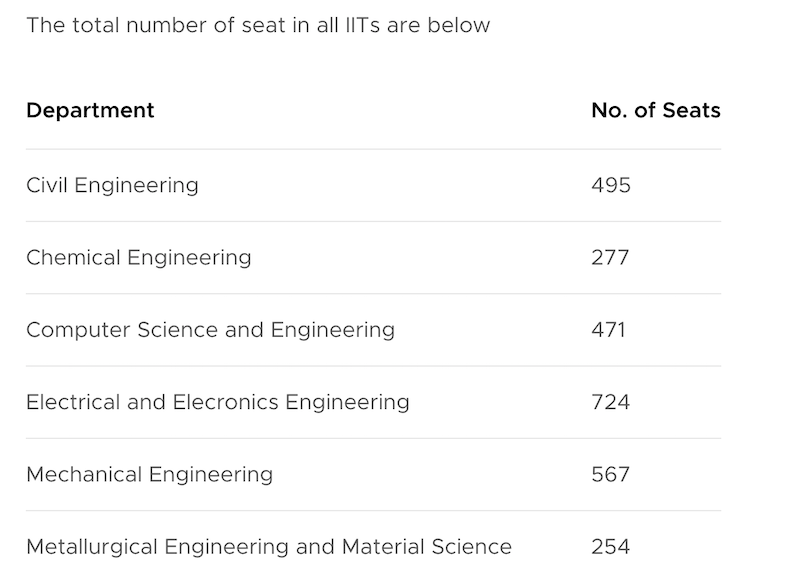
Just to give you a perspective on how competitive GATE is, IITs offered < 700 seats in Computer Science for MTech in 2020. Even if we double the number of IITs and calculating for more branches, that is <10,000 seats for MTech in IITs when 7.5 lac+ people appear for GATE every year. So, 98.5% of the candidates appearing for GATE will end up not meeting the cut off or even if they do, they will get non-IIT kind of colleges.
Pros of doing MS from USA
Education is just way way better than in India. At UIUC and NYU, I had the privilege of learning under Nobel Laureates, reputed award winner scientists and people who were truly experts in their fields.
Starting salaries are quite high (read USD 85k and above) that you can earn so much more than what you will back in India. Many students have this myth about financial affordability but if you do the math, you can repay the loan in 2-4 years if you go to a decent enough school and work hard to get a good internship/job since CS folks are really in demand there.
Besides the exposure to a foreign land, opportunities and learning to be independent are something that will make you a better person and professional in the long run. It will prepare you for a global career better than an MTech.
So, what to do?
In the end, it depends on your financial constraints but if you can manage a semester worth of fee, I highly recommend looking at Master’s from USA instead of MTech in India.