Study abroad scholarships for students

study-abroad-scholarships

Today, we are going to look at various ways to fund your education (BS, MBA or MS in USA) through scholarships or study abroad in select countries where education costs are nearly zero (yes, that is correct!).

One of the major challenges of studying abroad is the hefty tuition fee and living expenses that it entails. If we look at the cost of studying in countries like USA and UK, it can go up to 100,000 USD. Hence, it is not surprising that almost every student going abroad looks for financial support.

Without further ado, here is what we cover in this post:

  1. How can I get scholarship for studying abroad – Steps to find the right scholarship for yourself
  2. What are the scholarships available for Indian students – A list of generic and country specific scholarships that you can apply to
  3. Where can you study abroad for low fee – A list of countries where you can practically study for free

How can I get scholarship for studying abroad?

Before we jump into various scholarships, here is our advice on finding the right study abroad scholarship for yourself.

Finding a scholarship is a matter of planning and constant efforts.

  1. Explore the options in your college or grad school

    Contact your target school – usually, they have counselors, financial aid office and career centers which have extensive information available on the financial aid options available to students. You can email them at the time of admission and later on, visit them in person once you arrive on the campus. This ensures that you make a mark on them and they can help you out as soon as something is available.

    Additionally, most reputed schools offer some sort of scholarship options (usually need or merit based) which are worth checking out. Here are some examples-
    Dartmouth College International Student Scholarship, USA
    NYU Wagner Merit Scholarships, USA
    Clarendon Fund Scholarships at University of Oxford, UK
    Graduate Global Leadership Fellowship, Canada

  2. Search for external study abroad scholarships

    Google your heart out and find various scholarships that are offered by different organizations. For example, we have a list of scholarships available for Indian students right below in this article. Go through many such articles because it will help you in compiling a list of the relevant ones. It is important to mark your calendars with appropriate deadlines so that you don’t miss out applying on time!

  3. Prepare the documents

    Most scholarships ask for the resume, transcripts and proofs of admission which can be prepared in advance. However, it is important that you write each essay separately and make it customized to this particular organization. Just like any employer of college, they want to see that you value them and are genuinely interested in them. If you copy-paste your essays, they can figure it out and it lowers your chances of acceptance.

  4. Tell your story well

    The most important consideration of any application based scholarship is the essay. Make sure you spend some time thinking about it and editing it rather than doing a one-night-job on it. It is your chance to tell your story and if you tell it genuinely, they would want to fund you! – and isn’t that your end goal?

    Additional tip for the scholarship essays
    Highlight why you deserve this scholarship:
    Mention any disadvantages you have faced in completing your education – financial, social or personal
    Mention how would you use your education to make a bigger impact – no one wants to fund someone who has only self-interest at their core. They want to enable your education so that you can make a difference. Highlight how you would do that.

  5. Apply on time

    Apply to as many relevant scholarships as you can. Many scholarships also ask for interviews before announcing the final results. Usually, the interviews are centered around your application and checking whether you would put the scholarships money to good use. If you have done the essays diligently, interviews should be a cakewalk for you. However, it is important to not take them casually. After all, it is a question of real money at stake!


What study abroad scholarships are available for Indian students?

Scholarships are great to get if there are no strings attached. However, in my experience of 15 years, I have noticed there is no free lunch. Almost all the scholarships have some kind of strings attached – some are interest-free loans disguised as scholarship (eg. J N Tata Loan Endowment Scholarship), some are contingent on you studying particular stream of subjects, and most are available only to under-privileged families who have no other means of supporting their education.

So, while there appears to be a long list of scholarships advertised in the market, I have found only few to be feasible for an average candidate. Still, if you look closely and go through various forums and keep an eye on the news, you may find something that you can use.

Let’s look at various scholarships that Indian students can avail. Most of them vary in their extent as well criteria for qualification. So, go through the requirements individually and shortlist the ones that can be applicable in your case.

A. Indian scholarships for studying abroad

1. Inlaks Study Abroad Scholarships

How to apply: https://www.inlaksfoundation.org/scholarships/how-to-apply/
Applications: 15 February, 2023
Deadline: 30 March, 2023 at 12 noon

Scholarships are granted to bright young Indian students to read at top rated American, European and UK institutions for a full-time Masters, M.Phil or a Doctorate programme. The maximum funding given by the Foundation is USD 100,000 to cover programme tuition as well as scholars’ living expenses, healthcare, and one-way airfare.
The Foundation has joint scholarship schemes with Imperial College London, Royal College of Art (RCA) London, School of Oriental and African Studies (SOAS) London, University of Cambridge via the Cambridge Trust, Sciences Po, Paris.

Caveat: They do not fund engineering streams in all the schools. So, check before you apply.

2. Aga Khan Foundation International Scholarship Programme

How to apply: https://www.akdn.org/our-agencies/aga-khan-foundation/international-scholarship-programme
Deadline: 17 March, 2023

Scholarships are awarded on a 50% grant: 50% loan basis through a competitive application process once a year. The Foundation gives priority to requests for Master’s level courses but is willing to consider applications for PhD programmes, only in the case of outstanding students who are highly recommended for doctoral studies by their professors and who need a PhD for the fulfilment of their career objectives (academic or research oriented)

Caveat: Given to those who have no other means of financing their education.

3. JN Tata Endowment for the Higher Education

How to apply: http://www.jntataendowment.org/loan-scholarship-process
Deadline: 7 March, 2023

One-time loan cum study abroad scholarship ranging from INR 1,00,000 to 10,00,000 along with ‘Travel Grant’ and a ‘Gift Award’- which are linked to their academic performance.

Caveat: Requires you to take Thinking Skills Assessment
Good to know: The scholarship is offered at a simple interest of 2% per annum. However, if students repaid the loan within the specified time period (between the end of 3rd and 7th year), the trustees may waive the interest.

4. Narotam Sekhsaria Scholarship Program

How to apply: https://pg.nsfoundation.co.in/application-process/
Deadline: 16 March, 2023

While it is not purely a study abroad scholarship, it is designed for students of academic excellence for pursuing postgraduate studies at prestigious institutions in India or abroad. It is a merit-based interest – free loan scholarship.

5. National Overseas Scholarship Scheme by the Indian Government

How to apply: http://nosmsje.gov.in/docs/Guidelines%20for%20filling%20up%20online%20application-NOS%202021-22.pdf

Deadline: 31 March, 2023

Covers tuition and educational expenses for the following:

  1. Belong to Scheduled Castes, Denotified Nomadic and Semi-Nomadic Tribes, Landless Agricultural Laborers and Traditional Artisans.
  2. Scored 55% marks in under graduation (for those applying to Masters) or 55% in Post-Graduation (for those applying for Ph.D.).
  3. Be below 35 years of age.
  4. Have a combined family income that is less than Rs. 6,00,000.
  5. Not have more than one sibling who got the same scholarship.

6. Fulbright-Nehru MS and Doctoral Research Fellowships

How to apply: https://www.usief.org.in/Fulbright-Nehru-Fellowships.aspx
Deadline: May of the previous year for 2023-24 awards

Offers a monthly stipend, J-1 Visa Support, round-trip economy class air travel, Accident and Sickness Program and modest settling in allowance.

Candidate must have completed the equivalent of a U.S. bachelor’s degree with 55% aggregate marks. They should also have demonstrated leadership qualities and have 3 years of work experience apart from being committed to return to India and contribute to their community.

B. Country specific scholarships for studying abroad

Now, we take a look at some of the country specific scholarships that are given by the governments or agencies in a particular country. The purpose of these scholarships are to encourage incoming students in their schools. For example, British Council offers GREAT scholarship to people coming to study in UK.

1. British Council GREAT Education Full Scholarships

How to apply: https://www.britishcouncil.in/study-uk/scholarships/great-scholarships
Designed for graduate students from India to pursue their dreams of studying abroad. The British Council’s GREAT Education Scholarships have been set up in partnership with 25 leading UK Universities and offer full scholarships to the brightest students across India for various undergraduate and graduate courses in the UK.

2. INSEAD Deepak and Sunita Gupta Endowed Scholarships

How to apply: https://sites.insead.edu/schlmgmt/index.cfm?fuseaction=program_route&prog=mba
Designed for graduate students from developing countries who wish to pursue an INSEAD MBA Program but are constrained by their financial status. Selected scholars under this program receive financial assistance to the tune of EUR 25,000 towards their MBA degree.

3. Erasmus Mundus Joint Master Degrees Scholarships

How to apply: https://eacea.ec.europa.eu/erasmus-plus/emjmd-catalogue_en
EMJMDs are Masters level study programs at institutions across Europe and scholarships are awarded for these programs. Each program has a different deadline for scholarships and hence interested students should keep a check on the official scholarship portal

4. Great Wall Program

How to apply: https://www.china-admissions.com/chinese-scholarships/chinese-government-scholarship-great-wall-program/
This scholarship is aimed at students, from developing countries, who want to study or conduct research in China. It was established by the Chinese Ministry of Education for UNESCO to sponsor students and scholars

5. Orange Tulip Scholarship

Deadline: Varies but around 1 April 2023

How to apply: https://www.studyinnl.org/finances/orange-tulip-scholarship-programme/ots-india
Students applying for the scholarship should be an Indian resident and have been admitted to a Dutch university or be in the process of enrollment in The Netherlands.

6. Scotland’s Saltire Scholarships

How to apply: https://www.scotland.org/study/saltire-scholarships
It offers £8000, towards tuition fees for studying in Master’s programs across Scotland in the areas of science, technology, creative industries, healthcare, and medical sciences, and renewable and clean energy

7. The Heinrich Böll Foundation Scholarship

How to apply: https://www.boell.de/en/foundation/scholarships
€850 per month plus various individual allowances towards studying in Germany. Students applying for the scholarship should have excellent academic records and be able to show written proof of German language proficiency. They should also have demonstrated social and political engagement. This scholarship is given every year to graduates, and doctoral students of all subjects and nationalities. The deadline for application is March 1st

Note: It may look a meagre sum but remember that most of the German programs have already subsidized the tuition fee. Read this post to see if studying in Germany makes sense for you.


Where can you study abroad for low cost?

Believe it or not, it is possible to study abroad in few countries that heavily subsidize their education. If cost is the most important criterion for you, look at these countries first:

Germany

Germany is known for its excellent education, and you can practically study for free except paying a low annual administration fee, which is less than €350. See our interview with Sangram who studied at TU Munich.

Norway

You can study abroad for free in Norway for just a registration fee of about $50 if you can learn Norwegian! How cool is that? Oh and it is also known as the Land of the Midnight Sun.

Sweden

The reason Sweden interests me is that it offers a good option to work while you are in school – this can be very helpful in job hunt. If you have a European Union or Swiss passport, you can study in Sweden for free. Other nationals can expect to pay a few thousands dollars a year. And, PhDs are usually fully funded.

Brazil

Not only are Brazilians the coolest people ever, but also Brazil is a great place to study. If you can speak Portuguese, then you can study at one of its public universities by paying a very small registration fee. The only caveat is – you need to demonstrate your Portuguese skill level by taking a CELPE-Bras certificate.

Luxembourg

University of Luxembourg is incredibly international, and there is no language restriction. Apart from paying around a thousand Euros, it’s completely free to study for all students.

Also Read: Full Article on How to Study Abroad for Free


Recap – Finding Study Abroad Scholarships

So, there are a lot of options to avail if you wish to study abroad without breaking your bank. Make use of the various study abroad scholarships listed above.

Do note that many a times, you are able to land assistantships in graduate schools in USA which makes your education 25-100% free. But if you want to be more conservative in your financial planning, there are many countries where you can study for free.

How to Study Abroad for Free

Studying abroad is a dream for many students. Some may aspire to study abroad to experience a new culture, travel, and enjoy the freedom of being away from home. Others might be interested in the universities renowned globally, because of prospects of a better future than their own country. While the intention may vary, one common concern of everyone is the hefty tuition fees. What if you could study abroad practically for free?

Many students kill their dreams of studying in a foreign university based on the assumption that they will have to spend a fortune on tuition fees and living expenses. 

Completing a degree from countries like the US and the UK may cost around 100,000 USD for many courses, it is not the case with every country renowned for its quality of education. 

In this article, we will uncover how you can study abroad for free or at a highly subsidized cost.

Three ways to study abroad for free 

1. Select the study program and the country that offers free education

While this may seem obvious, many students are unaware of the fact that many universities all over the world provide free or highly affordable education to foreign students. 

For example, students who enroll themselves at Paris’ La Sorbonne only have to pay a modest registration fee of around 200 USD, and no tuition fee. The only limitation is that the applicant should be proficient in French.

The language barrier should not stop you from studying in non-English-speaking nations. 

Many such countries, like Germany, offer courses that are taught in English. For instance, the Technical University of Munich offers an M.Sc. in Software Engineering that has the language of instruction as English.

And you don’t have to spend a penny on tuition fees in most public universities in Germany.

2. Apply for scholarships

This is the most popular method of limiting your expenses for studying abroad.

There are hundreds of scholarships to assist students who aspire to study in foreign universities. Most of them, that offer significant help as money, are competitive. Organizations award these scholarships based on factors like past academic performance, relevant work experience, and involvement in social work. 

Scholarships might cover just the tuition fee, or may pay you a certain amount monthly or annually. We would recommend you to apply for most of the relevant ones, even if you are planning to study in countries that charge no tuition fee. Many organizations who give these scholarships even pay for your living expenses, which makes your education free.  

You can also apply for grants. People use interchangeably the terms grants and scholarships, but there is a slight variation. Grant is mostly need-based, while scholarships are usually merit-based. 

Also check: Full Guide on Study Abroad Scholarships for students 

3. Work and Study programs

Working along with your studies can help you earn and cover your expenses more effectively. It can also help you understand the working culture of the country you are studying in and gain insights before you apply for a job.

We recommend that you check the Labor Laws of the country you are planning to study in, since many countries have work restrictions for international students.

  • While many countries don’t allow you to work full-time, a nation like the United Kingdom allows you to work part-time if you are staying for over 6 months. 
  • If you enroll in an Australian university, the government allows student visa holders to work for 40 hours every two weeks during the duration of studies and full-time when you are on vacation.
  • In Germany, the authorities allow students to work part-time for not over 20 hours per week during an ongoing term. 

The option of working part-time, along with your studies, may look lucrative from a distance but most of these jobs won’t cover your expenses entirely. We recommend that you plan well and stay updated on the country-specific employment laws before finalizing the country for your education. 

10 countries for free study abroad

1. Germany

Germany is the most popular destination among international students who don’t want to spend big bucks while not compromising on the quality of education. 

The country has universities that are ranked among the best globally. 

Most of the German public universities don’t charge a tuition fee. The students only have to pay “Semester Contribution” at the beginning of each semester, which is around 250-300 euros. It covers administrative expenses, public transport, and certain academic study material.

Also Read: MS in Computer Science in Germany.

2. France

It is not as popular among international students tight on budget, as compared to Germany, but offers many courses which charge no tuition fee for national and foreign students. 

The universities teach most of the free courses in French. Be proficient in French if you aspire to enroll in these courses. 

You can pay for a preparatory school, before starting your course, to enhance your French proficiency if you are serious about studying in France.

3. Norway

Most universities don’t require you to pay tuition fees, irrespective of your nationality. Just like Germany, the students only have to pay a semester fee of around 50 USD.

The only downfall is that most of the undergraduate courses have Norwegian as the medium of instruction. English taught courses are still more common at the Masters and the Ph.D. level. 

4. Iceland

The four public universities in the country charge no tuition fee, but only a registration fee of around 600 USD per year.

5. Austria

Education is free or highly affordable in Austria for locals and EU/EEA students. The country requires foreign students to pay a higher fee than the nationals and is around 810 USD per semester.

The country’s capital, Vienna, was ranked 13th in the QS Best Student Cities 2019.

6. Finland

Most of the colleges in Finland charge no tuition fee. This applies to citizens of all nationalities. 

Many courses are now being offered in English, and the cost of living in the country is low compared to the US.

7. Czech Republic

Education at any public university is free for students who can communicate well in Czech. People who want to study in English would have to spend around (4450 to 13500) USD per year.

The living cost in the Czech Republic is around 9200 USD per year.

8. Greece

All the EU/EEA students are eligible for free education for most of the courses at public universities. Non-EU students are also eligible for affordable higher education and have to spend around 1700 USD per year. The country is one of the most affordable countries to live in within the European Union. 

9. Argentina

International students have to pay a low fee while the education is free for the locals at the public universities in Argentina. The private universities in the country may charge north of 5000 USD per year.

The country’s capital, Buenos Aires, was ranked 31st in the QS Best Student Cities 2019.

10. Spain

The international students, not part of the European Union, have to spend around 840 USD to 2800 USD per year at public universities. 

The EU students don’t have to pay high education fees like others. Spanish cities like Barcelona, Madrid are among the QS Best Student Cities. 

Conclusion

Many dream of studying in an international student destination and at a university that is renowned globally. Unfortunately, many students aren’t able to make this dream true because of a lack of funds.

We covered various aspects of studying at a foreign university and discussed a few options. 

Even though scholarships are helpful, most of them will not cover your entire expenses. The ones that take care of most of your expenditures have a very low acceptance rate.

If you are low on a budget or don’t want the burden of an education loan weighing you down mentally,  then you should take admission in any of the German universities. The country is respected internationally for its historical inventions and has renowned public universities that charge no tuition fee.

Book a call with Nistha if you are serious about studying abroad and need help with your application.

How to finance your MS or MBA education abroad

Discover multiple ways to finance your education abroad whether you are going for MBA or MS in USA. While the education in USA seems prohibitively costly at first glance, there is good news – there is high possibility of funding if you can get into a reputed grad school. You can finance your MS or MBA education abroad by understanding how it works.

In this post, we will discuss:

  1. How can Grad Schools help in financing your education abroad

  2. How can you avail external sources to finance your education abroad


Using Grad School funds to finance your education abroad

Universities and Professors in USA are funded by government and other agencies that invest in research; these funds are, in turn, used to support research students. Except when recession hits the funding grants, schools do try their best to support as many PhD students as possible. This is the reason why getting funding in PhD is easier than getting for Master’s because it is understood that PhD students are contributing more towards research.

Similarly Master’s in Engineering schools has more grants and research funding than Management oriented programs such as MIS/MEM and MBA. MBA is practically not funded because the goal of a MBA grad is to join corporate world and not research. Schools are more likely to fund students working closely in research.

1. Scholarships

These are the monetary awards given to students based on some qualifications, which could be academic excellence or extra curricular talent (sports related scholarships). There might be additional qualifications for these awards such as nationality, ethnic background, gender etc. These can be given in the form of a one-time cash award or be yearly covering your length of study. A school may have few such scholarships and they might ask for a separate application for these scholarships. Given the competition and scarcity of such awards, it is better to not bank on one. However, do find out about these especially if your academic record is excellent.

2. Tuition waivers

Sometimes, a school may offer full or partial tuition waiver to few students. It is usually awarded in conjunction with teaching or research assistantships (see below). A student still needs to pay other kind of fee (health insurance, administrative, library etc.) as tuition waivers only cover the tuition fee. These are most likely announced along with the news of your admission. For example, Case Western Reserve University typically offers 40- 50% tuition waiver at the time of sending the admission letter to its MEM students. In this case, the I-20 will only show remaining tuition fee to be paid by the student.

3. Assistantship

This is the most common form of funding offered by the graduate school to its admitted students especially PhD students. Getting an assistantship involves getting a cash stipend in return for some work that you do officially in the school itself. Normally, a student is allowed to work up to 20 hours per week. These are frequently combined with a full/partial tuition waivers in research oriented programs such as MS. However, assistantships offered in MIS/MEM programs may be only paid hourly and not include a tuition waiver (exceptions apply). There are three main kind of assistantships:

Teaching Assistantship

As per Virginia Tech, “graduate teaching assistants (GTAs) provide academic program support under the supervision of a faculty member. GTAs may assist faculty in the department in teaching undergraduate courses, including laboratory teaching assignments, or in providing other appropriate professional assistance, including grading examinations, problem sets, and/or lab assignments, setting up displays for lectures and laboratory sections, and preparing or maintaining equipment used in laboratory sections.”

Research Assistantship

As per Virginia Tech, “graduate research assistants (GRAs) are graduate students conducting academically significant research under the direction of a faculty member, who is generally a principal investigator on an external grant or contract. Graduate research assistantships are awarded by departments and professors who are engaged in research projects. Since GRAs are often funded by sponsored research grants, they may be paid at a higher stipend level than GAs or GTAs.” When I was studying at University of Illinois, Urbana Champaign, I received an RA by a Professor in Wireless Networking that paid me a cash stipend (for 20 hours per week work) along with a full tuition waiver. It meant that I did not have to pay any tuition fee and got a stipend that easily covered my living expenses and helped me save some money as well.

Graduate Assistantship

Again, as per Virginia Tech, “graduate assistants (GAs) are graduate students who provide academic and program support. GA responsibilities may be administrative in nature and consist of duties unrelated directly to teaching or research (such as academic advising, program planning, advising student groups, and assisting with the administration of student services offices). GA responsibilities may also be academic in nature and include grading examinations, problem sets, and/or lab assignments, setting up displays for lectures or laboratory sections, and preparing or maintaining equipment used in laboratory sections.”

4. Grants

These are similar to scholarships but awarded solely based on the financial need of a student. American universities may offer several forms of government-supported grants but these are usually available only to American citizens.

How to finance your education abroad using external funding

There are other types of funding that you can look for outside what is offered by the school. These include:

  1. External Scholarships/Fellowships – You can look for scholarships offered by private organizations external to your school as well. We have covered a detail of all study abroad scholarships available to Indian students in our blog. These are given to students with exceptional records and pass some qualifying criteria. To compete for these, you have to fill out a separate application which usually includes writing few essays explaining why you deserve the scholarship and how will you use it.
    All reputed universities often have a database of merit-based scholarship and fellowship opportunities available to its students.
    For example, University of Washington lists it at Student Financial Aid. Other than that, you can search on Internet for opportunities available to you. Scholarships In India 2016, Fellowships In India 2016, Internships In India 2016, Financial Aid For Education 2016, Students Grants For Schools And Colleges, Scholarships 2016 lists a lot of active scholarships in India.
    Fulbright Program is one of the most reputed scholarships available worldwide on a merit basis. As expected, there is a lot of competition for these awards.
  2. On-campus jobs – These include helper positions on campus such as the school library, dining hall, housing office, bookstore etc. and allow international students to work up to 20 hours per week. Students working in these jobs are paid hourly (usually sufficient to cover living expenses) and do not get tuition waivers. These are the least preferred form of funding since they do not usually involve building any valuable skills.
  3. Bank loans – Lastly, if nothing else works out, a student has to look for loans to finance her education. There are a lot of loan schemes now available but most of them are processed only once you receive an admit. Since loan processing takes a long time, it is advisable to start early.

What if I do not receive any funding from the university at the time of admission?

Do not write off your funding chances just yet. These days, schools have stopped giving funding except to PhD students but it does not mean that you cannot find one after being admitted. In most cases, Master’s (especially MIS/MEM) students will not receive funding at the time of admission.

First, you should have done some research on funding possibility at a school before deciding to apply for it. This includes contacting current students and recent graduates and asking them how did they fund their education. If you hear favorable funding news (let’s say multiple students tell you that they received some form of funding after reaching the campus), then you can still consider attending this school and hunting for funding after arriving on campus. The downside to this is that you still need to manage and show higher finances for your visa interview since you have no funding to show to the visa officer.

Many students take a loan if they cannot show sufficient personal funds and go to the school. There, they start looking for funding and return the loan as soon as they find it. This is what I did because I had not received any financial assistance when I was admitted to UIUC. However, it is a risk and you must do some background research on how likely it is to find funding before making such a decision. Again, if you have shortlisted schools after proper research, you would have applied only to the schools where you can manage the finances.


These are some ways how you can finance your education abroad. With a little proactive preparation, you can manage some sort of funding sooner or later.

We have covered funding, finances, employment opportunities, application strategies more comprehensively in MS BOOK: Smart Engineer’s complete guide to MS in USA

Cost of MS in USA in INR – how you can afford it

study-abroad-finances

In this post, we discuss how much does it cost to do an MS in USA and why it is affordable for you. Some of the content is taken from the MS Book: Smart Engineer’s Complete Guide to MS in USA.

Understanding Grad School finances

If you are concerned about finances of managing a Master’s degree education, a good way to start is to understand:

  • how much does it cost to do MS in USA
  • how long will it take you to recover your expenses

For this, we need to understand what total expenses you are likely to incur, what kind of income are you expecting after graduation and how much can you save. This is known as break even analysis and I have covered it in detail in the MS book so that you know what to expect. Doing this analysis using the tools in the book will let you feel more comfortable about the decision. 

What is the cost of doing MS in USA?

The cost of MS in USA is a sum total of what you spend in getting there + what you spend after getting there. Following is the breakdown:

  • Taking the tests – $500
  • Applying to Grad Schools – $1000-1500
  • Visa – $600 (F1 and SEVIS fee)
  • Traveling to USA – $1500
  • Tuition fee – $50,000
  • Living Expenses – $18,000

In short, the cost of doing your Master’s in US can go up to $75,000 which comes to ₹50 lac at the exchange rate of 1 USD = INR 75.

How long does it take to recover your money?

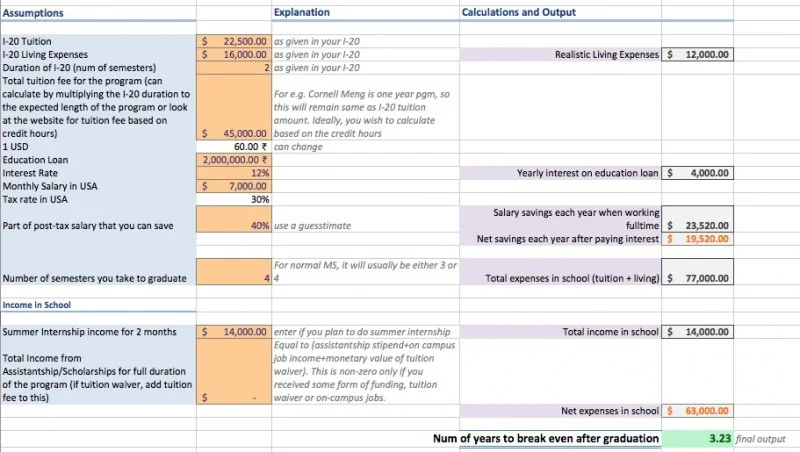
For e.g. if you spend $77000 on your MS (tuition + living + interest on loan), getting $14000 in summer internship, paying a 12% interest rate on your loan of Rs 20L, graduating in 4 semesters and saving 40% of your post-tax salary ($84000 p.a), it will take you roughly 3.15 years to break even in worst case. If you find any assistance or on-campus job (which is very feasible and again, discussed in the book) or graduating in 3 or fewer semesters, you can break even sooner.

breakeven

The details of the calculations are covered in the book. You get to download a sheet (snapshot above) that shows you exactly how long will it take to recover your investment in the Grad School. You can add variables as per your specific scenario and play with it.

Let’s say that the sheet tells you that it will take roughly 2 years to recoup your money. Usually, the starting salary in US far exceeds the package in India at that level upon graduation. You can compare the financial benefits and kind of work exposure you are getting in US to decide whether it makes sense for you.

What did I get from doing an MS in USA?

Professional value

Coming from a middle class family and a mediocre college in Central India, I received admission from MS in CS program at UIUC. That was the 4th best program in the world. From there, I managed to secure an internship at Wall Street for which only 7 people were selected all across the world (I was actually the only girl in there). After getting one of the highest packages ($100,000+) during those days, I decided to get into startups and secured admission to the MBA program at New York University which is 10th best MBA program in the world.

Seeing the world

I have lived in Manhattan, worked at Wall Street and startups. That is where I got to network with some of the finest entrepreneurs and investors in USA. Meanwhile, I traveled the world and finally came to India to work on my own ventures and write. I find my life personally and professionally rewarding and I want you to enjoy yours without compromising on your dreams.  

Finding the joy of helping people

Plus, we have helped some of the students at Scholar Strategy inch towards their dream life. For example, one of our first students, Supreeth, had a failed application season before he joined us. He had a good profile but had some weaknesses. We helped him highlight his strengths, focus on the programs that were better for him and re-apply. He wanted to get into Robotics and he was able to get into one of the Top 10 programs in that field. After a year, he emailed us to inform that he will be interning at Microsoft Research Labs. Now that is what I call a perfect hustle and not giving up till you reach where you want to be.

You would say I got lucky or Supreeth got lucky or I had some advantage that you don’t. But my background will show you that I began just like you are now. And that anyone can reach the places I did. Back in college, I also thought that US education is unaffordable but now I know how wrong I was! It is within your reach. Not only that, I strongly believe it is worth all the expenses.

I devoted an entire section in the MS Book to tell you how to think about money and finances and why MS is totally affordable. But let’s quickly understand how to look at it here.

Education is not an expense but an investment in yourself

I considered my MS fee as an investment and not an expense. If that is how you look at it, then you realize that its not the money that is sinking down the drain but you are gaining:

  • Skills that make you employable
  • A credible degree in the resume
  • A great brand name to help you stand out in the competition

Imagine applying for a job with a credible international grad school degree in your resume. Who is the employer going to recruit? You with a reputed degree from US or someone with a relatively unknown degree in India? 

And with a little hustle, you can manage funding for your education abroad.

msbook-guide-to-ms-in-usa
Smart Engineer’s Complete Guide to MS in USA