
Cost of MS in USA in INR – how you can afford it

study-abroad-finances

In this post, we discuss how much does it cost to do an MS in USA and why it is affordable for you. Some of the content is taken from the MS Book: Smart Engineer’s Complete Guide to MS in USA.

Understanding Grad School finances

If you are concerned about finances of managing a Master’s degree education, a good way to start is to understand:

  • how much does it cost to do MS in USA
  • how long will it take you to recover your expenses

For this, we need to understand what total expenses you are likely to incur, what kind of income are you expecting after graduation and how much can you save. This is known as break even analysis and I have covered it in detail in the MS book so that you know what to expect. Doing this analysis using the tools in the book will let you feel more comfortable about the decision. 

What is the cost of doing MS in USA?

The cost of MS in USA is a sum total of what you spend in getting there + what you spend after getting there. Following is the breakdown:

  • Taking the tests – $500
  • Applying to Grad Schools – $1000-1500
  • Visa – $600 (F1 and SEVIS fee)
  • Traveling to USA – $1500
  • Tuition fee – $50,000
  • Living Expenses – $18,000

In short, the cost of doing your Master’s in US can go up to $75,000 which comes to ₹50 lac at the exchange rate of 1 USD = INR 75.

How long does it take to recover your money?

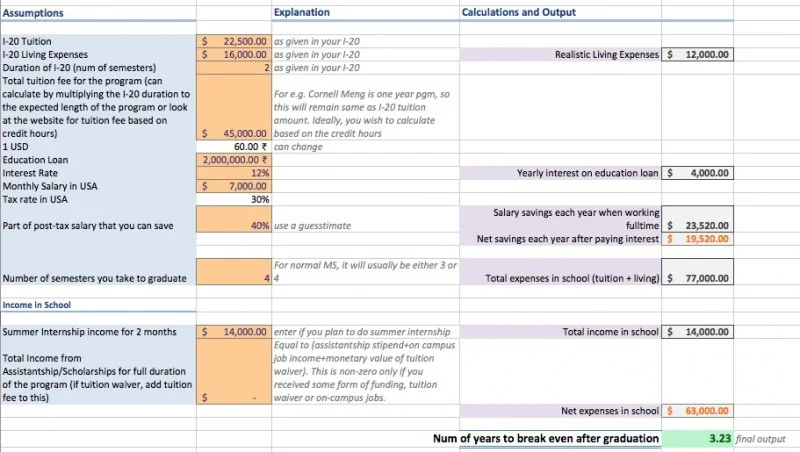
For e.g. if you spend $77000 on your MS (tuition + living + interest on loan), getting $14000 in summer internship, paying a 12% interest rate on your loan of Rs 20L, graduating in 4 semesters and saving 40% of your post-tax salary ($84000 p.a), it will take you roughly 3.15 years to break even in worst case. If you find any assistance or on-campus job (which is very feasible and again, discussed in the book) or graduating in 3 or fewer semesters, you can break even sooner.
breakeven

The details of the calculations are covered in the book. You get to download a sheet (snapshot above) that shows you exactly how long will it take to recover your investment in the Grad School. You can add variables as per your specific scenario and play with it.

Let’s say that the sheet tells you that it will take roughly 2 years to recoup your money. Usually, the starting salary in US far exceeds the package in India at that level upon graduation. You can compare the financial benefits and kind of work exposure you are getting in US to decide whether it makes sense for you.

What did I get from doing an MS in USA?

Professional value

Coming from a middle class family and a mediocre college in Central India, I received admission from MS in CS program at UIUC. That was the 4th best program in the world. From there, I managed to secure an internship at Wall Street for which only 7 people were selected all across the world (I was actually the only girl in there). After getting one of the highest packages ($100,000+) during those days, I decided to get into startups and secured admission to the MBA program at New York University which is 10th best MBA program in the world.

Seeing the world

I have lived in Manhattan, worked at Wall Street and startups. That is where I got to network with some of the finest entrepreneurs and investors in USA. Meanwhile, I traveled the world and finally came to India to work on my own ventures and write. I find my life personally and professionally rewarding and I want you to enjoy yours without compromising on your dreams.  

Finding the joy of helping people

Plus, we have helped some of the students at Scholar Strategy inch towards their dream life. For example, one of our first students, Supreeth, had a failed application season before he joined us. He had a good profile but had some weaknesses. We helped him highlight his strengths, focus on the programs that were better for him and re-apply. He wanted to get into Robotics and he was able to get into one of the Top 10 programs in that field. After a year, he emailed us to inform that he will be interning at Microsoft Research Labs. Now that is what I call a perfect hustle and not giving up till you reach where you want to be.

You would say I got lucky or Supreeth got lucky or I had some advantage that you don’t. But my background will show you that I began just like you are now. And that anyone can reach the places I did. Back in college, I also thought that US education is unaffordable but now I know how wrong I was! It is within your reach. Not only that, I strongly believe it is worth all the expenses.

I devoted an entire section in the MS Book to tell you how to think about money and finances and why MS is totally affordable. But let’s quickly understand how to look at it here.

Education is not an expense but an investment in yourself

I considered my MS fee as an investment and not an expense. If that is how you look at it, then you realize that its not the money that is sinking down the drain but you are gaining:

  • Skills that make you employable
  • A credible degree in the resume
  • A great brand name to help you stand out in the competition

Imagine applying for a job with a credible international grad school degree in your resume. Who is the employer going to recruit? You with a reputed degree from US or someone with a relatively unknown degree in India? 

And with a little hustle, you can manage funding for your education abroad.
msbook-guide-to-ms-in-usa
Smart Engineer’s Complete Guide to MS in USA

One thing you need to nail for superb application results

I interviewed Bhavesh Sanghvi, CS grad from Iowa State University who is now working with Amazon in USA. He thinks that everyone works on their SOP, LORs and resume but if you can do this one thing, it might put you at a big advantage. He did it himself and found much success.

GRE and GMATs may become obsolete in the coming years but there is one thing that will not stop mattering for MS/PhD applications. This is also one of those things which if you get right can get you admitted right into your dream school.

And, now is the time to do it.

I bet you are thinking that we mean publishing more papers. But nope, that is not enough.

What we are talking about is emailing the Professors!

I also interviewed Ankit Srivastava, Asst Professor at IIT Chicago and PhD from University of California, San Diego. He said emailing Professors can be tricky but highly rewarding.

Here is why it can be so effective (as Ankit told me) – Professors fund students through grants and the goal of any school is to be able to admit and fund as many good students as possible. So, if a Professor recommends a student and can potentially fund her, the school committee would be more than happy to admit her directly with no fuss. 

It’s funny how simple and logical it is and yet, how many students ignore this step.

I had a client last year whose friend put her in touch with her advisor. As it happened, the advisor was looking for a suitable grad student immediately. Not only did the Professor recommend my client’s admission after a quick review of her resume (yes not even looking at SOP etc) but also gave her full funding. Things moved at lightning speed and it was one of the smoothest admission and visa process as you can imagine.

Also Read: Want to get more emails from Indian students, says award winning Prof in USA

The bottom line is while it is very hard to get positive responses from the Professors, but if you hit it right, it can be more effective than ANY other thing in your application. So you would be a fool to not try it out.

In MS Book, I have covered the topic in detail and provided sample emails and templates on how to contact the Professors because it is an important thing to do. Check it out here – https://scholarstrategy.com/smart-engineer-book/

So, do not leave out on this step when you are working hard to get into those TOP schools anyway. Good luck!

Exclusive MS advice from successful grads and professionals

In last two posts, we touched upon financial concerns and SOP tips. To recap,

1. MS in USA is affordable and within your reach if you understand the numbers and plan properly. We discussed break even analysis to look into that. Read it on http://wp.me/p39Fhf-oB

2. SOP is the magic wand you can use to help your application stand out. We looked at some Do’s and Don’ts. Check it on http://wp.me/p39Fhf-oW

We built specific tools for these two in the MS Book that you can use to save some time.

Applications are a multi-step complex process to ace which you need clarity of thought and action. Don’t let the details daunt you. The key is to know what kind of career you want to build and then choose the right program that will help you get there. But getting to a good university alone is NOT enough. It also matters how you spend your time in Graduate School. At least, in my case, I wish that I had taken some courses from non-CS departments too to augment my understanding. I felt that such advice can be valuable when you are about to join the Grad School. 

Continue reading

How to write a powerful SOP

how to write SOP

How to write that powerful SOP that will get you admitted to your dream schools? Many applicants shudder at the thought of staring at a blank sheet. In this post, we will make the process easy for you.

An SOP is a mandatory component for applying to Master’s programs in US and other countries. Hence, it is important that you write a perfect SOP that contains everything that Adcom is looking for.

What is a good SOP?

Let me show what I mean. Look at the following examples, which one do you think is a better approach?

A: “I have CCNA and CCNP certifications in most of the fields to serve as a proof for my knowledge in these fields

OR

B: “For instance, in my math class, I found myself getting frustrated with my calculator because it could not handle matrices with complex numbers. I took the matter into my hands and wrote a java program to find the determinant of a matrix involving complex numbers, which would run on my mobile phone. It worked well, and this was just the beginning of bigger things for the next three years.

Approach A tells what you have done, something that is easily mentioned in the resume itself. B tells me why you did something and gives me an insight into your thought process.

A is wasting precious space by repeating stuff on your resume. Clearly the Admission Committee will prefer to know your potential better as a candidate and B shows them exactly that.

A: “As it is evident, my academic qualifications in the field of networking are exceptional.

OR

B: “During the internship, I faced a crunch situation while designing a Cost-effective Power Generation Unit. Since factors such as time to procure and implement the solution were not considered by me before designing the circuit, the entire complexion of the solution got changed – which taught me my first lesson in engineering management.

Approach A is to state your opinion (which in this case makes you sound arrogant anyway even if you are not). In B, you are giving facts and letting the Admission Committee form its opinion. This is known as TELL vs SHOW. Don’t tell me what you think you are, show me examples and let me form my own opinion. Obviously approach B will give better results.

How to write a compelling SOP?

We covered the essential paragraphs of a SOP in our Statement of Purpose (SOP) guide

Now you know that SOP is not your verbose resume and it is not simply a collection of what you did. It is your story and unless you understand what is the Admission Committee looking for in your story, you will struggle to write the winning SOP.

Trying to cover the following pointers has worked well for applicants working with us-

  1. Background and Aspirations
    • Clear goals help
  2. Academic and Professional relevance
    • Show you are good in your field
  3. Personal Story
    • Show a face behind the application
    • Talk about how you have overcome challenges, what motivates you?
    • Talk about how you have applied your learning
    • Show that you can execute your lessons in practice
  4. Why are you applying to this school?
  5. Why should this school admit you?

How to write the perfect Introduction for your SOP

Next, let’s look at a real introduction used by a candidate who is now studying MEng at Cornell-

“From programming cells of an excel sheet with math formulas in my fourth grade to building a security plugin for Mozilla Firefox considering the current threats to privacy and security on Internet, I have realized that problem solving is what excites me. After a year and a half as an Application Developer in Risk Technology at JP Morgan Chase, I have found my passion in improving the way Information is used in businesses. Therefore, I wish to return to school to pursue a Master’s degree in Computer Science that will allow me to explore the subject in greater depth, particularly the fields of Data Mining, Database and Software Engineering, and use it effectively to address real-world challenges.”

  • First line shows that the candidate knows about his field
  • Second line shows that he has solid background and proficiency
  • The last line clearly identifies his goals

In the MS Book, we use something called SOP Canvas to help build your story. If you fill it out sincerely, I’m pretty sure your SOP will end up better than majority of applicants out there!

Don’t use templates

One major mistake that I have seen in students’ SOPs is that they all look same. It is tempting to pick out 5-6 SOPs from Internet and hash them up to create your own SOP. That is where you will dig your own grave because using templates or copying will only get you to come up with things that others already have. The key to a successful application is to stand out from the crowd, not copying them.

Read how to Avoid other common mistakes that 80% applicants make in their SOPs

In summary: understand what AdCom is looking for

So, those were some insights into the tricky world of SOPs. It’s a rookie mistake to think that SOP is a description of your resume or that there is a set template that you can use as a shortcut. Use SOP to highlight your strengths and tell your unique story.

This is why we do a detailed call to craft a student’s story and then formulate strategy for SOP and LORs in our MS Admissions Consulting. Do not use shortcuts for your SOP, give it time and let it evolve into a solid personal statement.