All About SAT Exam 2023 You Need to Know

What is the SAT?

SAT stands for Scholastic Aptitude Test. It is a standardized test that is designed to evaluate the reading, writing, and mathematical aptitude of the candidates. SAT exam is managed by The College Board and is usually taken by the high school students while applying to colleges. The final score of the SAT exam is under the range of 400 to 800. The written essay section is an optional part of the SAT, which is required by some selective colleges.  

There are no specific eligibility criteria stated by The College Board for taking the SAT. The official schedule of the essential SAT dates is released early in the year, and tests are scheduled on Saturdays. The number of applicants in the Fall session is much higher than the rest of the year because admissions are open in almost all of the international educational institutes. 

How much does it cost to take the SAT? 

  • The fee for SATs varies from country to country.
  • General SAT with written essay cost $106. 
  • General SAT without essay costs $94.
  • SAT with subject tests cost approximately $111.
  • In Indian currency, the fee of the SAT exam is about 6000-7000 INR. 

What is the format of SAT? 

SAT Reasoning and SAT Subject tests are conducted by The College Board. There is a specific pattern set by The College Board, which should be kept in mind by the applicants to make sure they are able to score maximum marks on the tests.  

There are two sets of exams in SAT, which are SAT Reasoning Test and SAT Subject Test. Usually, most universities accept SAT Reasoning Test during the admission process. While SAT Subject Test might be required by a few universities to ensure the applicants have enough knowledge in a particular subject.

Pattern of SAT Reasoning Test 

The essay portion of the SAT exam is optional, as some universities need it as part of the academic records, while the majority do not. You get the admission eligibility criteria from the universities you are applying to determine whether you need to take the essay test.   

Topic Number of Questions Duration (minutes) 
Reading 52 65 
Writing & Language 44 35 
Mathematics 58 80 
Essay (optional) 01 50 
Total 155 230 

SAT Subject Test Exam Pattern

The SAT Subject Test is meant to assess the knowledge of the applicants in a specific subject. 

  • The total marks of an SAT Subject Test are 800.
  • 20 subjects are available for testing from The College Board.
  • The total duration is 1 hour. 
  • Most commonly, subjects like Maths I, Maths II, Chemistry, Biology are taken as Sat Subject Test. However, other subjects, like German, Physics, French, Chinese with Listening, among many others, are also available.

What is a good score on SAT exam for the top 15 colleges?

There is no specific SAT score, which is deemed good for the admission in universities and colleges. No official scores or percentiles are released by the leading universities and colleges, so there is no specific SAT score, which can be called the threshold of the admission. Such criteria keep on changing every year due to various factors like the number of students applying to a specific program, the overall academic records of the applicants, and other factors. However, on average and smart calculations, the following score is considered to be good for the top 15 colleges:

Institutes SAT Scores 
Princeton University 1430-1570 
Harvard University 1480-1560 
Yale University 1420-1590 
Columbia University 1490-1590 
Stanford University 1510-1580 
University of Chicago 1490-1560 
Massachusetts Institute of Technology 1510-1580 
Duke University 1490-1560 
University of Pennsylvania 1420-1550 
California Institute of Technology 1530-1590 
Johns Hopkins University 1460-1580 
Dartmouth College 1420-1560 
Northwestern University 1420-1560 
Brown University 1405-1570 
Cornell University 1390-1550 

Your definitive guide to Study Abroad in USA

How many times can you take SAT exams? 

To make it easy for the applicants to get admission to their dream university by securing high marks in SAT, The College Board allows candidates to take the SAT Exam as many times as they want. It means the candidates can keep improving their marks as much as they want.  

What are SAT Subject Tests?

Highly-selective colleges require applicants to take at least two SAT Subject Tests to demonstrate their ability to study in challenging programs. The SAT Subject Tests offered by The College Board are: 

  • SAT Biology E/M to evaluate the applicant’s knowledge of general concepts of Biology. 
  • SAT Chemistry to check your ability to organize and interpreting results of different observations and experiments.
  • SAT Physics to assess the ability to solve problems related to laws of physics, simple algebra, trigonometric problems, and graphical relations.
  • SAT U.S History to test the knowledge of applicants about the history, geography, and major developments in USA history.
  • SAT World History to evaluate the candidate’s understanding of the major events in global history and the basic terminologies.
  • SAT Literature checks reading and interpretation skills. 
  • SAT Math I include algebra, basic statistics, number theory, trigonometry, and geometry.
  • SAT Math II evaluates advanced mathematical concepts.
  • Foreign Languages like French, Germany, Spanish, Hebrew, and others. 
  • Foreign Languages with Listening skills to evaluate a candidate’s proficiency in a specific language.  

How to prepare for SAT Exam 2023? 

The paper pattern and setting of the SAT have been revised, which is considered more difficult for international students. As a result, there is no use of preparing for the old SAT, and your preparation for the old version would not work well in the new pattern. There is a lot of fake material available on the internet, so it is better that you refer to the official SAT practice sets given by The College Board official website. These practices tests are: 

Shall I take SAT or ACT?

Many US colleges and universities accept both SAT or American College Testing (ACT) for the admission of international students in undergraduate degrees.  

The pattern, difficulty level, and preference in the admission process of both SAT and ACT are quite similar to each other, which makes it difficult for the students to decide which tests they should take. A significant difference between SAT and ACT is that there is a Science section included in the ACT, while the SAT includes a Math section in which calculator is not allowed.  

The modifications in SAT in 2016 have made it very similar to the ACT. As a result, many applicants have started to take both SAT and ACT to earn maximum scores on both of them. If you want to take only one of the tests, it is better to get in touch with the universities you are going to apply to determine their eligibility criteria and the standardized testing required. 

Most of the foreign universities accept both SAT and ACT. To make a final decision about which test to take, you should practice the mock SAT and ACT tests available on their official websites. It will give you help you in determining the difficulty levels of both the tests yourself and make a smart choice in terms of taking the test to enhance your chances of getting maximum marks in either of the standard tests and get admission to your dream university.  

Resume Template for MS/MIS Applications

Announcement:

We have partnered with our friends at Resumonk to let you guys build awesome resume without the hassle of editing the Word documents endlessly. And, they have offered their PREMIUM membership to our successful applicants for FREE for 18 months. With their winning resume templates, your dream internships would be lot more closer for you when you are doing MS/MIS in USA. This is worth a value of $38 but you get it for FREE when you join our counseling (selected packages only).

Introducing our ready-to-edit winning resume template for fresher applicants at the bottom of this article! All your headaches solved in one template.

Purpose

Resumes are often taken for granted. While applicants are busy tinkering their SOPs to perfection, everyone thinks resume is a one night job. Well, may be not. After working with some students, I realized that what I thought was obvious about the resume was not so obvious to the students. And fair enough – since I myself had the benefits of years and diverse experiences before I learned the inside out of a resume writing process. So, I figured that it is time to dedicate a full post to resume building.

First, sit and reflect upon who your reader is and what your resume is trying to convey to her. As an applicant, you want your resume to be coherent with rest of your application. So, while your experiences, education and background are factual information, what to highlight is a matter of judgment. For e.g. if you are showing interest in research/applying for PhD etc, your highlight should be on your research projects and publications. Similarly, if you are applying for a MCS kind of program (geared towards landing corporate jobs upon graduation), your focus should be on professional skills, industry experience etc.
So, before you begin, gather your thoughts and decide the areas/skills in your profile that your resume should be highlighting. Continue reading

Your definitive guide to Study Abroad in USA

Scholar Strategy is India’s leading Study in USA guidance community. For last 9 years, our candidates have gone on to study at MIT, Stanford, UIUC, Cornell, Berkeley, CMU, and other top universities. Not only that, we take pride in helping our candidates be prepared for landing internships at companies like Tesla, Apple, Facebook, Amazon and more.

Are you harboring dreams of world class education and studies abroad for career opportunities? USA has been the leading destination for ambitious students worldwide. Here, we cover all the information you need to realize your dreams.

Why Consider Study in USA

History of Innovation

The United States of America is called the nation of explorers. It is the birthplace of many inventions that changed the world.

From inventors like Henry Ford and Thomas Edison to industrialists like John D. Rockefeller were born in the US. 

Cultural Diversity and Opportunity to Grow

The nation is renowned globally for its multicultural environment, its opportunities, and what has become a common phrase – “American Dream.” 

Don’t know what the American Dream is?

Investopedia defines the American dream as “the belief that anyone, regardless of where they were born or what class they were born into, can attain their version of success in society. It is achieved through sacrifice, risk-taking, and hard work, rather than by chance.”

The US is revered for its infrastructure that promotes innovation, entrepreneurship, and technology. No wonder, it is the number one study abroad destination.

World’s Best Universities

It has some of the world’s oldest universities: Harvard, Stanford, MIT are all based in the US.

As per QS world rankings 2021, five universities in the Top 10 are all based out of the US.

American universities provide a great learning experience, opportunity to grow like no other country.

QS Global RankSchool
1Massachusetts Institute of Technology (MIT)
2Stanford University
3Harvard University
4California Institute of Technology (Caltech)
9University of Chicago

Recruiters of top-notch organizations pay high salaries to students of American universities. 

The schools receive huge donations and are well funded to invest in research and development areas.

Courses to Target

Study in USA allows you to choose from a plethora of courses. The country will probably have a course/degree on every subject you can imagine.

  • MIT, the California Institute of Technology, John Hopkins University, and Carnegie Mellon University are famous for STEM education.
  • Apart from STEM, courses on Psychology, Journalism, Medicine, Business & Management, Social Sciences are also top-rated. 

Indian students mostly enroll in American university programs to study Engineering and Management. The courses like MS and MBA attract Indians applicants due to the high standard of education and the possibility of getting a high-paying job in the world’s largest economy–United States of America.

Undergrad

Colleges in the US offer a four-year Bachelor’s degree. Students aspiring to study at the undergraduate level in American colleges have to give the SAT exam.

The higher the score, the better are your chances to get an admission letter from schools like Harvard, MIT, and Stanford.

MS (Science & Engineering)

Studying MS (Master of Science) in the US is a dream for students passionate about Science and Technology. 

It has the world’s best universities that offer STEM (Science, Technology, Engineering, and Mathematics) education.

The country is a leader in Research & Innovation sectors and is the home to many tech behemoths like Facebook, Amazon, and Intel. 

Where did you find this article?

The chances are you found it on Google Search (or Gmail), Facebook, or LinkedIn–all of these companies were founded in the US.

The Top-5 universities for MS in the US are:

  1. Harvard University
  2. Stanford University
  3. Massachusetts Institute of Technology (MIT)
  4. The University of California, Berkeley (UCB)
  5. Columbia University

See our page on all about MS in USA.

MBA

MBA courses in the US are among the best in the world. 

Studying at top universities in the US allows you to network with people from diverse cultural backgrounds and nationalities. A network built during your time at a B-School can be leveraged later when you are looking to form business partnerships.

As per QS global MBA rankings, four out of the Top-4 MBA programs are taught in American universities. 

QS Global MBA RankSchoolDurationAvg. Salary(USD)
1Stanford Graduate School of Business21 months152,503
2The Wharton School21 months150,000
3MIT Sloan School of Management24 months140,000
4Harvard Business School21 months148750
8Columbia Business School20 months150,000
Top MBA programs in US

Application Process for Study in USA

Most top American universities and colleges have the authority to decide their standard and admission criteria.

The most common aspect of applying to study in the US is standard competitive exams like GRE, GMAT, and SAT. GRE is usually accepted for admission in MS programs, GMAT for MBA, and SAT is the standard test students give for undergraduate courses. 

The below sequence of steps may help you speed up your application process:

  1. Decide five to ten universities you’re planning to get into for the subjects of your interest. 
  2. Search for ways to finance your education. This may include eligibility for a loan, scholarships, and grants. We’ve written a comprehensive article that will give you more clarity on ways to finance your education abroad. 
  3. Prepare for and give the English proficiency exams like TOEFL, IELTS, and degree-specific exams like GRE and GMAT.
  4. Prepare for the colleges based on your exam scores.
  5. Prepare and polish the documents common for admission in most colleges: SOP, Essay, Letter of Recommendations.
  6. Appear for the personal interview with the admission officers.
  7. If you receive an acceptance letter, confirm your intent to take admission to that university. 

The universities require you to pay a non-refundable fee to confirm admission.

If you’re struggling during any phase of admission, we at Scholar Strategy can help you. Click here to contact us.

Main Challenges

Student Visa

The US government allows non-American citizens to enter the country only with a valid visa.

Without a relevant Visa, you won’t be allowed to study in the US if you’re an international student aspiring to study in the country.  All your hopes of studying in the US will go in vain if your visa application isn’t approved.

The US government offers three student visa types, including F, J, and M.

  1. F Student Visa: For study at the university level or to study English at an institute that teaches English.
  2. J Exchange Visa: It is applicable for an exchange program at the university and high school level.
  3. M Student Visa: It is applicable for vocational study or training in the US.

Before you can apply for an F, J, or M student visa, you must have an acceptance letter from an American university or higher education institute.

Read our detailed post on all about the student and work visas in the US

Competitive Admissions

If you aspire to study in top American universities–ranked among the best in the world–the admission process would most probably include an exam. 

These exams are conducted to test your English proficiency or examine particular skill sets needed for a course you’re applying to study. 

ExamPurpose
TOEFLTo test the applicant’s English proficiency. 
IELTSTo test the applicant’s English proficiency. 
GMATFor admission in MBA/Management courses
GREFor MS/MBA courses

Please note that a good score in such exams doesn’t guarantee an admit and is just a tool to filter out applicants. 

If you’re planning to study at these top universities, your work experience and extracurriculars help you stand out among the applicants.

Getting admission into a top school is a dream for many, but not everyone can pay the price to afford it–not talking only about money. The admission process is highly competitive.
For example, The acceptance rate of admission to Stanford MBA is around 7 percent, and for MIT, it is 6.7 percent. 

Cost of Study in USA

The cost of education is one of the critical factors that influence a study-abroad aspirant’s ability to choose a country, courses, and universities for foreign education.

The US is the world’s most popular destination for international students and the most expensive. The tuition fee and living expenses vary based on the student’s university choice and the university’s location. 

The tuition fee for public universities and community colleges is lower as compared to those of private universities. The low cost doesn’t imply that public universities’ quality of education is lower than private universities. 

For example, The University of California–Berkeley is one of the best schools globally despite being funded by the government.

Average fees at US universities 2018-19

 Public two-year collegesPublic four-year colleges (in-state fees)Public four-year colleges (out-of-state fees)Private non-profit four-year colleges
Tuition & Other fees $3,660$10,230$26,290$35,830
Room & Board$8,660$11,140$11,140$12,680
Total (per year)$12,320$21,370$37,430$48,510
src: TopUniversities

The values given in the table above are an estimate, and the actual cost may differ based on the university and city you plan to study in. 

Click here to know more about the cost of college education in the US.
Also, Read the Cost of MS in the USA in INR – how you can afford it.

Sample SOP for Engineers

A good SOP is well structured, well written but most importantly unique to you. Download a sample SOP and learn how to make your SOP stand out in a crowd

I am not interested in what they did or how. I am keen to know why,” said a senior Admission Director in one of our campus visits in NYU.

SOP is where you tell that guy – why you did what you did and how it makes you the unique you.

Why do we need a SOP

GRE score can show whether you have the aptitude to understand the coursework or not. Your GPA and undergrad transcripts can show whether you have the necessary academic credentials for this program or not. Toefl shows if you will be able to communicate and hence, adjust well in an english speaking community or not.

But alas, you cannot capture the awesomeness of a human being in 3 scores. If that was the case, only the highest qualified will get admits to the Ivy Leagues. But what about that girl from small town in Africa who frickin’ fought against the societal bias and her closed minded aunts to dream of studying in USA! Or how about that IT guy from a tier 3 school in Indonesia who has mediocre grades but wants to be a data scientist!

Good schools want these super motivated candidates instead of uni-dimensional 10 pointers. And this is how, we came to the concept of SOP – its a Statement of Purpose. They want to know why you want to study this particular program in this particular school. It’s a story that tells them how you have come to this point in your life – what incidences have shaped your thinking, how you think, what will you do with your education and will you put it to a good use. And, what remains unsaid is – will you be a successful and good alum for the school?

Now that we have an understanding of what SOP is, let’s look at an example.

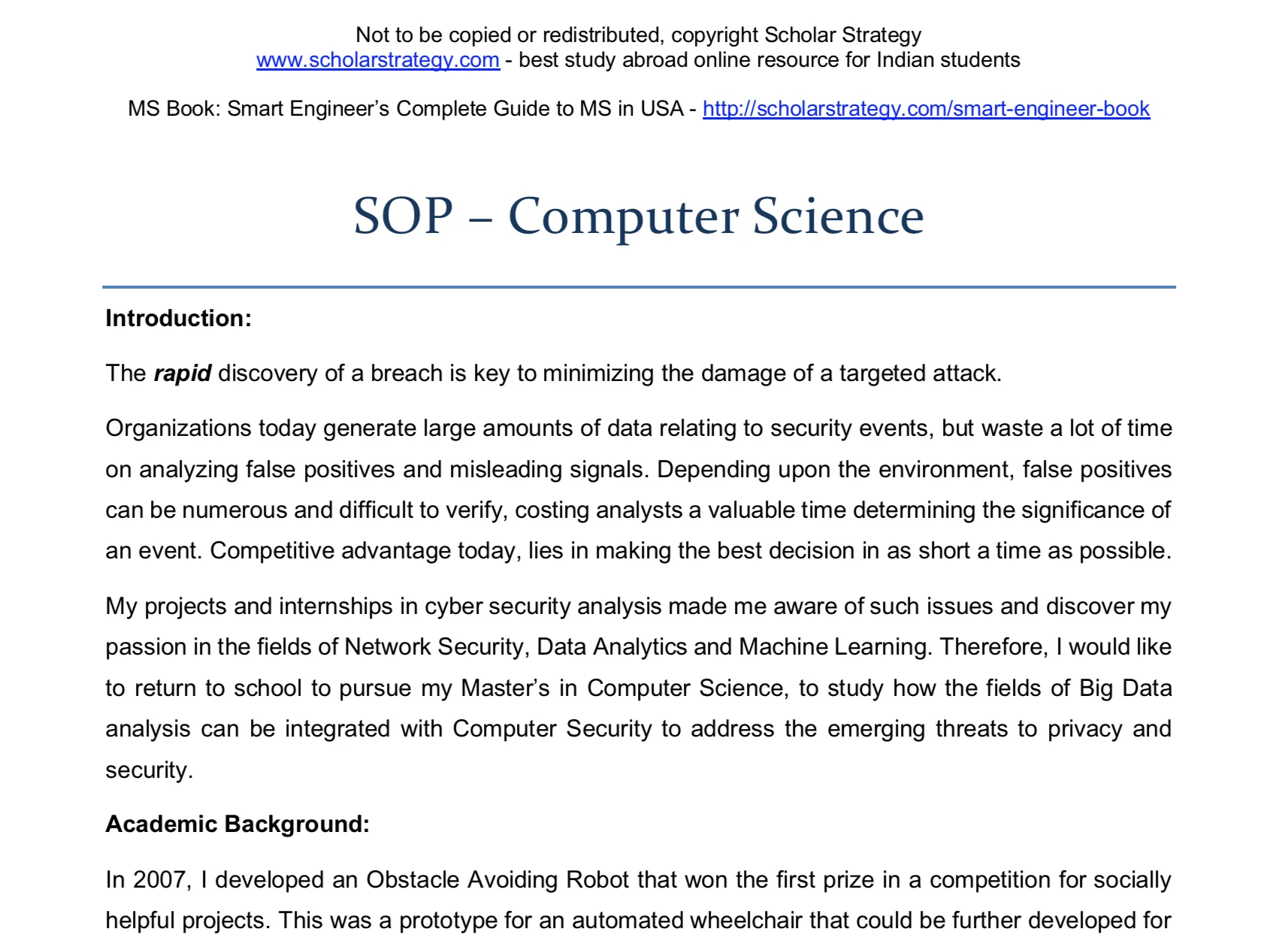
Sample SOP for CS

This is the real SOP of a candidate of ours who got into CMU MSIT, ASU MCS, NEU CS and TU Munich CS programs.

You can download the full PDF below.

Structure of a good SOP

There are a lot of samples available on Internet but what you will struggle with is finding out the right style for yourself. Of course, since these samples are available freely to everyone, you cannot copy them either.

So, let’s understand how to structure your SOP.

After 6 years of being in business and working with 500+ candidates, we have developed a deep understanding of what works. The problem is there is no one-size-fits-all solution here. But, to the extent that we can generalise, this is what we recommend.

Introduction

The opening paragraph should give a solid summary of your profile to the admission committee. It should answer why you are applying to this program, what makes you qualified for it and what is impressive about you.

Academic Background

Start with a brief summary of your college life. Try to cover your relevant academic details here such as grades in important subjects, accomplishments (scholarship, hackathon prizes, TAship etc). Start talking about how your interests started evolving in college. Follow up with 1-2 important academic project paragraphs.

Professional/Research Background

This is where you write about your internships, fulltime work experience and/or research experience. Talk about most relevant projects and what you learned from them.

Extracurriculars

Here, you can showcase your leadership and teamwork skills apart from anything meaningful you have done outside studies and work. People can talk about their serious hobbies, sports achievements, volunteering activities, experiences of leading a team in clubs etc.

Caveat – avoid cliches. If you were just a member of the IEEE club or volunteered for a simple event, that does not really count.

Why MS

As we discussed above, the admission committee wants to see how does MS fit in with your plan. So, this section has to convince them that you know what you want to get out of your MS. Talk about your career goals and what will you do after MS.

[pullquote]This is a good time to read our other post which shows good example statements you can use in SOP [/pullquote]

How to make your SOP unique?

As you can see, everybody can follow this structure but what is really hard is to personalize a SOP so that it stands out from the competition. It needs expert storytelling and multiple iterations to evolve a rough draft into a winning SOP. It has taken us years to perfect this process in our consulting.

Here are three pointers you need to keep in mind to make your SOP awesome-

  1. It should be genuine – Admission committee develops an eye for the fakers. If you keep telling how great you are and how you developed passion for microprocessors since childhood, no one is going to buy that. Don’t try to exaggerate unnecessarily. Keep it real.
  2. Address your salient strengths and weaknesses – Winning hackathons? Had low GPA because you went to participate in Formula SAE? Had to return to your hometown to take care of an ailing mother which caused a gap in your work? Only you can tell your story and you should.
  3. Your goals should make sense with your background – Everyone is applying for data Science these days even if they have never worked with ML or have any fundamental knowledge of statistics. If this is the case, you should ask yourself why are you applying to this program. If you cannot justify it yourself, how is the admission committee going to ever be convinced with it?

Never Use Templates

Please refrain from using templates given by counselors or websites. The whole point is to make your application stand out and by using a template (especially the ones where you just change your specific information), you are looking similar to thousand other applicants. In fact, try to write the first SOP yourself without seeing any sample SOPs. After writing the first draft, check out some good SOPs and tweak accordingly.

Don’t miss our 3 Exclusive SOP Tips

https://youtu.be/4IL-gzfHFTY

Download the Sample SOP in a PDF 

Click here to download [download id=”2941″]


Join our mailing list to discover inside strategies on how to get admitted to top schools in US  – sign up for our newsletter

For our paid professional counseling, check out our counseling packages

Studying in Canada: what is it like?

Studying in Canada

Studying in Canada is getting more and more lucrative by the day. So, what is it like to be a student in Canada?

Recent M.Eng. (Computer Engineering) graduate from University of Toronto, Shreya Rajput holds a specialization in Analytics. She is also working part time with a startup that focuses on ML solutions. She took Scholar Strategy services before heading to Canada. She shares her candid feedback on Canada below.

Why did you choose studying in Canada?

During my application process, I remember having applied to 10-11 schools. Out of which 8 were American Universities. Back then the only country that I had in my mind was the U.S.A. Initially, my parents weren’t completely on board with the idea of their daughter moving to a foreign land for studies. After continuous persuasion, they did agree. As my mom’s cousin stays in Toronto, Canada gave them a sense of security and they wanted me to consider it as an option. And honestly, that was the point when I started looking into Canada, as a prospective destination for my masters.

I did some research on Canadian schools and found that Canada has some of the world’s top schools. However, the number of good universities in Canada is much smaller when compared to the USA and most of these schools are competitive. I did not want to compromise on the quality of education. Having said that, Canada would have been an option for me only if I made it into the top Canadian universities. I received my admit from T.A.M.U in April, and I was going to apply for my U.S student permit, that’s when I received my admit from the University of Toronto, which led me to reevaluate my options.

Studying in Toronto
Shreya’s first day at University of Toronto

While I was deciding between T.A.M.U and the University of Toronto, I spoke to my aunt. The only thing she told me was “In your age money and American lifestyle seems exciting but do consider a few years down the lane”. I think that statement greatly influenced my decision. Moreover, Canada is right next to the States. Then, Canadian schools not only offer one of the best educations but are more affordable compared to their counterparts in the U.S.A. The University of Toronto is one of the best computer science schools in Canada as well across the globe. I am happy with the decision I took. Also, Canada being an immigrant-friendly country makes a lot of things easier for international students.

Also read: MS in Canada compared to MS in USA

What have you most enjoyed in Canada so far?

Canadians are very nice people. With one-fifth of its population foreign-born, Canada is very diverse (at least Toronto where I live). I have found people accepting of different races. My favourite thing is the food here, you can literally find everything, from Mexican to Asian to Goan cuisine.

Another thing that I like here is that students can work part-time. It not only reduces the financial burden on the students, but also helps them gain some decent industrial experience before graduation.

What have you not liked about Canada?

Canadian universities are either research-intensive or Industry experience-oriented. The University of Toronto is a research-intensive school and in fact, most top Canadian schools are research-focused. I found the courses at the university are much harder and less industry-oriented (mostly thesis oriented) when compared to American Schools. I feel this is something that differs from school to school. Again, I am talking in the context of graduate courses.

Bachelor’s here is on par with the US. The job market is good. Toronto has many companies and it’s a growing market but, when I discuss the salaries and number of opportunities with my friend in Boston, the numbers are definitely lower. Then, rents are high in Toronto and Vancouver. As a student, it sometimes becomes difficult to afford it. The rent for a two-bedroom apartment in downtown (where most companies are located), is around 3500-3800$, while median salaries in software jobs are around 4500$ per month (after taxes).

Lastly, I am not a winter person, so I do find Canadian winters extremely long and harsh. 

What advice would you give to a friend thinking of studying in Canada?

I would advise my friends to look into school ranking, courses, and the job market for the program/field they intend to pursue. Canada like any other country has all kinds of schools- good and bad, and all universities offer different levels and quality of courses/curriculum. As mentioned earlier universities could either be research-oriented or industrial experience-oriented, make sure that the courses and universities you choose align well with your goals and interests. One suggestion would be, getting in touch with the seniors, and understanding their experiences to make an informed decision.

Additionally, researching the job market before choosing a country is important if you wish to work after your studies. Hence, I would strongly suggest that you research job opportunities in Canada in your field of interest. For instance, my field of education is software and there are tremendous opportunities in the Software Industry, which perfectly align with my career goals. But I have seen my friends struggle looking for jobs in the Hardware, Aerospace and Chemical sector.

Also read: Best Courses to study in Canada for Internationals

How easy or tough is it to get the work visa/PR in Canada?

Obtaining a work visa after post-graduation is easy. The graduate students receive an open work permit which allows them to work in Canada for 2-3 years without any employer sponsorship. The duration of the work permit depends on the course/program length. A course of less than a year entitles you only a year (or less) of work permit.

PR here is based on a point system and going to school in Canada can help you strengthen your profile. From what I hear, the ranking of your university also plays a role and, gaining at least one year of Canadian work experience could be beneficial. A lot of my seniors received their PR within two years of their graduation. While things are easy, being a part of illegal activities like working beyond 20 hours/week can jeopardize your stay in Canada.

Are you considering settling there – why or why not?

At this point, I am not sure about the settlement. I would like to stay another 4-5 years here. I want to live close to my family if that were not the case, then why not! Not being a winter person, the only reason I can think of to reconsider my settlement in Canada would be the winters, else I think it’s a great country to settle in, people here are very friendly and accepting.


To summarize, studying in Canada has its pros and cons. But for someone looking to settle in a peaceful, nature filled, warm hearted country that offers great quality of living, Canada is an option that cannot be ignored.

MS in USA: Full Process to Apply

ms in usa guide

MS in USA course is becoming an increasingly lucrative option for international students who wish to work globally. However, with so many choices, an applicant can feel overwhelmed. 

In this post, we will cover all you need to know about pursuing MS in USA:
Why are so many people opting for MS in USA?
Who is eligible to study in USA?
What is the process to apply for MS in USA?

Why are so many people opting for Master’s in USA?

MS in USA courses consist of a number of technical courses, requirement to write a thesis or do an industry project. Sometimes, the industry oriented courses offer an MEng degree instead of MS. Someone who is interested in exploring in-depth the research problems in their fields can go for the MS (research) program. Students who demonstrate excellence in their academic performance and research potential also have the option to convert to the PhD program.

USA is the most popular study destinations for international students since it houses few of the world’s finest university systems such as Ivy Leagues. If we look at the global ranking for MS programs, the universities in USA mostly fill the top 100 spots. They offer cutting edge equipment and resources to their students. It is not surprising to see Nobel Laureates teaching at US schools.

Studying MS in USA can broaden not only the student’s educational opportunities but the cultural exposure as well.

Who is eligible to study in USA?

Most of the universities in USA require:

  • 16 years of previous education (XII + 4 years of Bachelors or XII + 3 years of Bachelors and 1 year of Diploma/MS)
  • Transcripts
  • Standardized tests score (like GRE)
  • English Language Proficiency Score (like IELTS/TOEFL/PTE)

Additional requirements may apply. For example, University of Minnesota mentions that one has to possess significant background in Computer Science to apply to CS department.

Cost of doing a Master’s in USA

ItemCost in USD
(rate of 75 INR/USD)
Cost in INR
GRE$205₹ 15,375
TOEFL$180₹ 13,500
10 Applications$1250₹ 93,750
Visa & SEVIS Fee$700₹ 52,500
Flights$1500₹ 1,12,500
Tuition$50000₹ 37,50,000
Living Costs$18000₹ 13,50,000
TOTAL$71,835₹ 53,87,625

In short, the cost of doing your Master’s in US can go up to $75,000 which comes to ₹50-55 lac at the exchange rate of 1 USD = INR 75.

Related articles:
Cost of MS in USA in INR – can you afford it?
How to finance your MS or MBA education abroad
Study abroad scholarships for students

What is the process to apply for MS in USA?

Applications for MS in USA is much different than what we are used to in India with MTech. Let’s take a look at the process first.

Following are the components of the application process-

ms in usa process
MS in USA application process
  1. GRE, TOEFL
  2. Shortlisting schools for your aspirations 
  3. Preparing required documents for the application
    1. Writing the SOP
    2. Submitting the LOR
    3. Submitting the Resume
  4. Apply by the deadline – Once you have finished the steps above, you are all set to submit the online applications to each university. The only components not sent by you are the LORs, so ensure that your recommenders submit those on time as well.

Note: Ideally, shortlisting schools should be done before giving GRE but students prefer to get the tests out of the way and be comfortable with the score before focusing all energies into shortlisting schools and actually applying to them. A candidate is able to typically apply to around 10 universities for MS and MIS programs.

Familiarize yourself with the process well before actually starting anything so that you know what all you need to do.

What next?

Found this useful? Do you now want to know what matters more in your applications and how to actually strengthen your profile? We are not talking about generic stuff but specific things you can do to stand out. All this is covered in our MS Book: Smart Engineer’s Complete Guide to MS in USA which has been receiving fascinating reviews from readers and applicants alike.

Want to read the whole process easily in a PDF? 

[sociallocker id=”2544″][download id=”4381″][/sociallocker]


Join our mailing list to discover inside strategies on how to get admitted to top schools in US  – sign up for our newsletter

Let us help you crack your dream graduate schools (Harvard, MIT and all), check out our MS Admissions Consulting Packages

All about Statement of Purpose (SOP) for MS

sop for ms applications guide

How to write good SOP for MS applications? – It takes introspection, good writing and understanding. We know what AdCom is looking for in a SOP.

This is third article in this series. See the previous article on GRE here and School Selection here.

Once you have shortlisted which schools and programs you will be applying to, you need to go ahead and actually fill out the applications for each of them. Most of the schools now accept online applications, all you need is good internet access, valid email account and a credit card to pay the application fee in dollars.

Each application will ask you to fill out personal details. Tip: This can get repetitive, so it is advised that you create a text file and store your basic information from which you can copy and paste it into each application.
You will be required to upload some specific documents as well. This includes-

  1. Statement of Purpose (SOP)
  2. Letters of Recommendation (LOR)
  3. Resume (in some cases)
  4. Transcripts

In this post, we will focus on writing a powerful SOP for MS applications.

What is a Statement of Purpose (SOP) for MS

An SOP is a reflection of ‘who you are’ in front of the admission committee. This is one of the most important components of your application because this is the only document that is totally under your control. This is the place where you can tell your story and differentiate yourself from other candidates.

Here are the guidelines by Cornell University on what are they looking for in a SOP.

Components of a SOP

Background and Aspirations

In a typical SOP for MS applications, you will begin with a brief background/description of yourself and what you hope to achieve through studying MS at this university. Caveat: Don’t quote cliches here as everyone is doing it! Also, avoid getting too poetic. Remember you are applying for MS.

Academic and Professional relevance

Every school wants great students who will carry its name and reputation higher. For that, you need to show your academic and professional brilliance. So, talk about the academic (or professional if you have work experience) projects that can tell them about your subject expertise. Tip: Give more space to what you contributed and learned from that project instead of just describing it. How many and what kind of projects you want to highlight is up to you. But we recommend expanding on at least one and show your involvement. MS is about a lot of course projects and some research. You have to demonstrate that you can not only handle it but excel at it. Similarly, talk about any papers you might have published. Research papers and project become more important for PhD and MS programs that require a thesis to be completed.

Personal Story

Admission Committee consists of people who are reading your applications. Since they handle a large volume of applications every day, it is important to make your SOP stand out or be memorable. You can stand out by being academically brilliant too but if your experience is not that distinguished, try to put forth a strong story that connects your background and aspirations and aligns it with your passion to do MS at that school.

For e.g. even if you have not published big papers or done great research projects, you could have still started a startup with couple of friends and done some relevant work through it. The startup could be as simple as a website that offers building surveys for companies who want to do some marketing research. You could be highlighting some personal angle here such as how you came up with the concept and what were some of your lessons.

Here, you can also talk about extra-curriculars esp if you excel at something such as playing in a band, professional photography (something that is more than just a hobby), blogging (may be how you applied your php programming lessons to customize wordpress) etc.

Tip: Remember, anything that helps the admission committee personnel see a face behind your application is good as it will help him in remembering you. Caveat: But, dont spend too much space talking personal story that is not directly relevant to the course as that alone can’t get you admitted. Personal stories are good to supplement your acad/professional experience section.

Talk about how you have applied your learnings

Be it professional or personal section, remember to talk how you have applied your education or lessons into real world. This is a GREAT way to show that you’ll be able to translate your classroom lessons to your professional life. A naive example but you’ll get the point-

Having learned how xyz and abc help improving the signal strength of the wireless networks in my CCNA certification course, I was excited to help the system admin at my current company do so and so.

One more-

My brother’s company wanted to get customer feedback on one of their new products and I offered to get the surveys designed, filled and collected for them. Initially, I was doing it manually with my friends but then I realized that we can automate and package the service in a very easy-to-use way and put it online. To our surprise, we got contacted by lot of local companies in first month itself. Slowly, we iterated and developed pro packages that charged a premium for nicer result analysis. By integrating our services with right social media platforms and offline distribution channels, we had built a fully functional survey building service in six months. This gave me an inspiration to test new ideas online.

The above concludes the topics that should feature in all your SOPs (irrespective of the school). Next, you should be talking specific points about each school-

Why are you applying to this school?

This will typically discuss specific coursework, professors and research that you are interested in. This should tie up with your experience and background sections as well as your aspirations. You should have selected universities based on these anyways, so you should just be tying it all together at this point. If you are not finding good stuff to write here, you should rethink why you are applying to this school in the first place?

Caveats: Whenever you are mentioning specific professors, avoid talking about very famous ones as everyone will be talking about them. If the schools feels that your education will be hampered unless you are able to work for that professor only and if that professor is over subscribed, it might actually get you rejected even if your profile was great otherwise. So, exercise some caution when selecting professors with whom you want to work. A good strategy is to mention a couple of them and dont make your plans look too contingent on the availability of one professor.

Why should this school admit you?

As I said, it’s all about the ‘fit’. Talk about why you will excel at their program and afterwards professionally. The more you can convince them on this, better your chances are.

Alright, now that you are ready to crack your SOP, check out our Sample SOP for Engineers (yes you can use the inspiration to write for any program).

Don’t use Templates

Please refrain from using templates given by counselors or websites. The whole point is to make your application stand out and by using a template (especially the ones where you just change your specific information), you are looking similar to thousand other applicants. In fact, try to write the first SOP yourself without seeing any sample SOPs. After writing the first draft, check out some good SOPs and tweak accordingly.

You may also want to read some basic mistakes that you must avoid in writing your SOP.


For specific SOP tactics and samples, check out our bestselling MS Book: Smart Engineer’s Complete Guide to MS in USA.

For our paid professional counseling, check out our counseling packages.

MTech in India vs MS in USA – which is better?

Let’s cut the chase. Many applicants wonder if they should just go for an MTech in India instead of supposedly expensive MS degree in USA. Here are my thoughts on the same.

Whether you should go for GATE or not partly depends on where did you do your Bachelors from.

How helpful is an MTech degree?

Pros: MTech is cheaper than studying abroad and can make you eligible for placement in PSUs. If you did Bachelors from a low tier college and if you can do MTech from IIT/NIT/BITs (that means doing very very well in GATE), it will increase your employability and can give you access to top tier of employers in India.

Cons: Education quality in India is not good enough and the same is true for MTech. You have to, at the end of the day, deal with same kind of teachers and similar infrastructural constraints in colleges. That is why I said it depends on your college. If you did undergrad from a good college, MTech will give you only a little additional advantage in terms of job opportunities and I don’t think spending 2 years is worth it. Even if you get into a top tier institute in GATE, I feel that employers always have a higher demand for undergrads at these places and you might compete against not only your MTech batchmates but BTech guys as well. The fact is a Master’s from India is not considered that cutting-edge. So, if you think you are going to gain some major knowledge boost, that is wishful thinking.

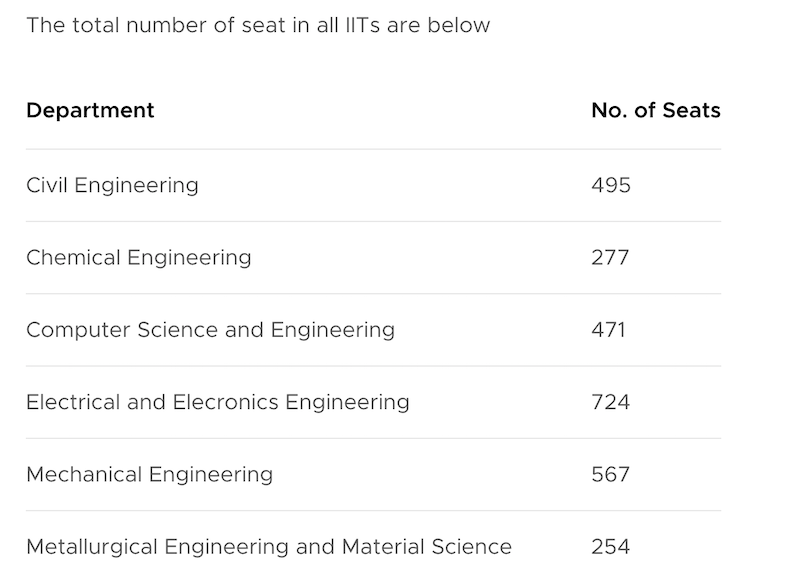
Just to give you a perspective on how competitive GATE is, IITs offered < 700 seats in Computer Science for MTech in 2020. Even if we double the number of IITs and calculating for more branches, that is <10,000 seats for MTech in IITs when 7.5 lac+ people appear for GATE every year. So, 98.5% of the candidates appearing for GATE will end up not meeting the cut off or even if they do, they will get non-IIT kind of colleges.

Pros of doing MS from USA

  1. Education is just way way better than in India. At UIUC and NYU, I had the privilege of learning under Nobel Laureates, reputed award winner scientists and people who were truly experts in their fields.
  2. Starting salaries are quite high (read USD 85k and above) that you can earn so much more than what you will back in India. Many students have this myth about financial affordability but if you do the math, you can repay the loan in 2-4 years if you go to a decent enough school and work hard to get a good internship/job since CS folks are really in demand there.
  3. Besides the exposure to a foreign land, opportunities and learning to be independent are something that will make you a better person and professional in the long run. It will prepare you for a global career better than an MTech.

So, what to do?

In the end, it depends on your financial constraints but if you can manage a semester worth of fee, I highly recommend looking at Master’s from USA instead of MTech in India.

Agree/Disagree? Comment below!

Most popular universities for Indians in last decade

Popular Grad Schools for Indians

Ever wondered what are the most popular US universities amongst Indian MS applicants?

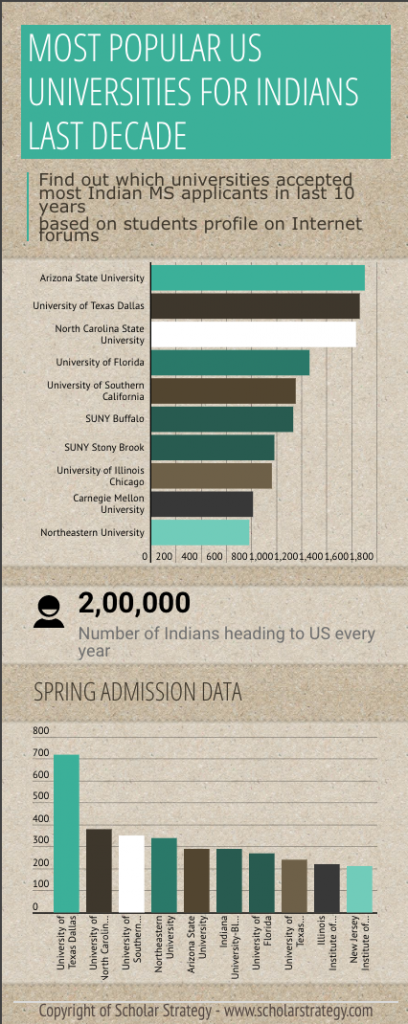
In 2019, 90,000+ Indian students headed to United States to enroll in graduate programs. Overall, 2 lac + students go to USA every year from India. Needless to say, USA is one of the most popular study abroad destination for Indians.

We dug up some numbers to find which schools are most Indian-friendly! So, here are the Top 10 schools by the intake of Indian students for last 10 years. Unsurprisingly, ASU and UT Dallas lead the pack. We were surprised by CMU’s high intake nonetheless. What do you think?

popular US universities for Indians

Top 10 popular destinations for Indian applicants

Where do most Indians head to in Spring?

So, here are the top 10 universities that gave admits to Indians over last decade.

Are you considering applying in Spring? Do read our post about pros and cons of applying in Spring semester.

Disclaimer: This is based on only the data that we gathered from students who reported their results on Internet. However, it should still give a pretty good insight into the bigger picture. 

Should you apply only to popular universities for Indians?

Of course, not. The above information is to help you select some safe schools. You should pick schools that you really wish to attend. See our guide to school selection for MS applications.