All about TOEFL 2022

all about toefl

Test of English as a Foreign Language (TOEFL) is an exam primarily used to judge the applicant’s ability to communicate well in English — the way they need it in a university. It is a prerequisite for international students/non-native English speakers to apply for admission in many universities worldwide, where the language of instruction is English. 

The exam measures the applicant’s English skills in reading, listening, speaking, and writing. Students who are interested to pursue higher education abroad register for the exams like TOEFL.

ETS (Educational Testing Service) conducts and manages all the logistics associated with the exam.

Looking for GRE? Read all about GRE test here.

Types of TOEFL exam

TOEFL is conducted in two formats, i.e., TOEFL iBT (Internet-based Test) and TOEFL Paper-delivered Test.

TOEFL iBT

This is the internet-based/online version of the exam. Over 98 percent of the TOEFL exams given have been taken online because of the easy availability of the internet today. This format has 4 sections: Reading, Listening, Speaking, and Writing. 

TOEFL Paper-delivered Test

The TOEFL Paper-delivered Test is conducted 4 times a year for candidates who can’t give the online version of the test. ETS schedules the exam in locations where internet testing isn’t available. It is like TOEFL iBT but doesn’t include the Speaking section.

Since most of the candidates give the exam online, for the rest of the text, the term “TOEFL” would imply the TOEFL iBT test and not the Paper-delivered Test.

Why take TOEFL

The TOEFL exam scores are accepted by over 11,000 universities in over 150 countries. 

Global recognition

Universities worldwide recognize the exam as a tool to measure a candidate’s readiness to study in colleges where the language of instruction is English.  

As per ETS, here are some statistics that show the popularity of this test:

  • TOEFL is preferred by 9 out of 10 American universities.
  • Accepted by 100 percent of universities in the United Kingdom.
  • Most preferred exam to measure English proficiency for admission in France and Germany. 
  • Widely accepted in top universities in Asia, including China, Japan, Hong Kong, and Malaysia.
  • The universities in Canada get more TOEFL scores than all other English proficiency tests combined.

IELTS is another English proficiency testing exam that is accepted in many of the countries. If you are confused between TOEFL vs IELTS and which one to write, you can read our detailed comparison here.

Flexible schedule

ETS conducts the TOEFL exam 60 times a year. The candidates can register for the exam on the ETS website, via email, or through a phone. 

Earlier, it was only conducted at specific test centers. ETS has now introduced a new edition of the exam- TOEFL iBT Home Edition. This edition gives you the comfort of taking the exam from home under the supervision of a live proctor. The conducting body recently launched it in response to the closure of test centers across the globe because of the COVID-19 pandemic. 

You can read more about the Home Edition exam here.

Ease of use & a good test experience

  • The most prominent advantage of the exam is that you can give it as many times as you want in a year.
  • The mandatory wait time between two consecutive TOEFL attempts is only 3 days. You can register online up to 2 days before the exam date.  
  • ETS provides a free sample test to help you prepare for the exam
  • You receive unofficial scores for the Reading and Listening section the moment you are done with the test. 
  • The applicants receive the TOEFL exam score within 6 days post the test date.
  • MyBest™ Scores: You can share your best overall score with universities by combining the highest section scores from all the tests given within the last 2 years

Eligibility

According to ETS, there are no specific eligibility criteria to appear for a TOEFL exam. The candidate should have valid ID proof to register for the examination.

The type of ID needed differs based on the citizenship and the test location preferred by the candidate. For applicants based out of India, having a passport is mandatory to register for the examination.

TOEFL Exam Format

The test has 4 sections – Reading, Listening, Speaking, and Writing. During the test, you will be evaluated by combining these skills. For example-

  • Read/listen and then share your response by speaking.
  • Read/listen to a question and then write your answer.

As per ETS, this is how the test structure looks like.

SectionTime LimitQuestionsTasks
Reading54–72 minutes30–40 questionsRead passages and respond to questions
Listening41–57 minutes28–39 questionsAnswer questions about brief lectures or classroom discussions
Break10 minutes
Speaking17 minutes4 tasksTalk about a familiar topic and discuss material you read and listened to
Writing50 minutes2 tasksRead a passage, listen to a recording, type your response

Exam Fee

The fee of the exam varies according to the test location. Applicants planning to give the exam from India would have to pay 185 USD.

The below table lists the fee for additional services provided by ETS.

ItemFees
RegistrationFees vary by testing location
Late registrationUSD 40
ReschedulingUSD 60
Reinstatement of canceled scoresUSD 20
Additional score reports (per institution or agency)USD 20 each
Speaking or Writing Section score reviewUSD 80
Speaking and Writing Section score reviewUSD 160
Returned paymentUSD 20

Click here to check the location-specific fee along with the addresses of the test centers in that location.

TOEFL Scores

A TOEFL score reflects your skill level to communicate in English. Each section of the exam is 30 marks each, which makes the total score of 120.

  • The score is valid for 2 years
  • You can view your scores online, or receive them by mail by selecting this option before the exam date.
  • You can send your TOEFL exam scores to up to 4 universities for free that you select before the test. Post the 4 free reports, ETS charges 20 USD to share your score with the university/agency of your choice.

What is a good score?

The idea of a good score is subjective and there is no single answer to this question.

ETS has set no passing or failing score. Many popular universities need you to have a required minimum score to apply for admissions. 

If you get above the minimum required score, your odds of getting accepted at a university increase, and anything below the minimum score would act as a stumbling block during your admission process. 

ETS proficiency level

ETS has provided a range of scores to help you better understand your ability to communicate in English.

Listening

Advanced (22–30)
High-Intermediate (17–21)
Low-Intermediate (9–16)
Below Low-Intermediate (0–8)

Speaking

Advanced (25–30)
High-Intermediate (20–24)
Low-Intermediate (16–19)
Basic (10–15)
Below Basic (0–9)

Writing

Advanced (24–30)
High-Intermediate (17–23)
Low-Intermediate (13–16)
Basic (7–12)
Below Basic (0–6)

TOEFL score for top universities 

The minimum TOEFL score needed for admission differs across universities and departments within those universities. Use the below format to Google search for the score you would need to get admission to your dream college.

[university name] [department name] “TOEFL score”

For example: If you want to know the score needed for admission into Stanford University’s Graduate School of Business department or MBA, the search query would look like this-

“Stanford Graduate School of Business TOEFL score” or “Stanford MBA TOEFL score” 

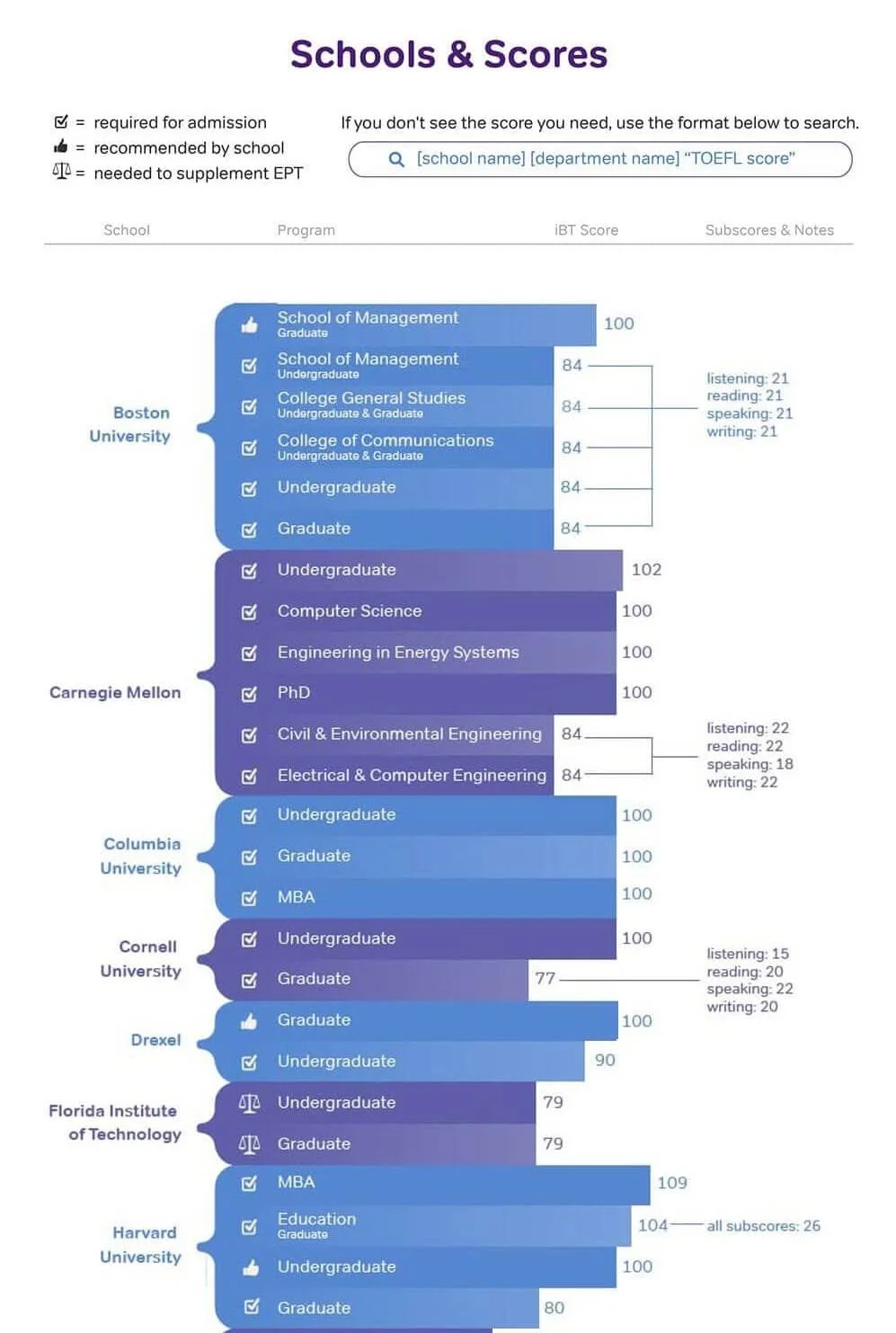
This infographic by Magoosh will give you a brief idea of TOEFL scores required by some popular schools and will help you set the target score for admission into your dream college.
Summary

TOEFL is used to judge a candidate’s capability to study at a university in English-speaking nations. It is also a requirement in many colleges and courses across Europe and the world for non-native English speakers.

It is hugely popular among top-notch universities and has helped students get into their dream college. The exam is just a prerequisite to filter out applicants who are not fluent in academic English, and the test does not guarantee admission into top schools. Students should focus on their overall application as well, besides preparing for TOEFL. 

We have tried to cover key points of the TOEFL exam but there is no better resource to know about it than the ETS website. Please click here to know more. 

If you have already given the TOEFL exam and need help with your application, please book a call with Nistha. We have helped many students to get admission to schools like Harvard, MIT, and Columbia.

We can help you get into your dream school abroad.

TOEFL exam FAQs

What is TOEFL?

TOEFL is an English-proficiency exam that is primarily used to judge the applicant’s readiness to join a university abroad.

What is the fee for this exam?

The fee varies based on the test country/location. The applicant has to pay 185 USD if they are planning to give the exam from India.

What are the eligibility criteria for TOEFL?

The exam does not have the eligibility criteria per se. Indian applicants should have a passport to register for the test. 

Can I give TOEFL multiple times?

ETS conducts the exam 60 times a year and you can give it as many times as you want. The only caveat is that you need to wait for 3 days before registering for the next attempt.

You can register online up to 2 days before the exam date.  

What is considered a ”good” score in TOEFL?

You only need to score above the minimum benchmark set by the university you are targeting for admission. Generally, a score of 100 makes you eligible for admission to most top universities.

Which books are recommended for TOEFL preparation?

The Official Guide to the TOEFL iBT® Test is considered a great resource to prepare for the exam. 

Which is better- TOEFL or IELTS?

The exam which is widely accepted in the region/universities you are planning to get admission into is better for you. There is no point in giving an exam if it is not accepted at the university of your choice.

FAQs for MIS and MEM programs

FAQs for MIS MEM

We are getting lot of interest from MIS and MEM programs’ applicants. Plus, those who are interested in Data Science and Analytics specifically. Let’s look at some of the most commonly asked questions.

See our elaborate post on MIS/MEM and other techno-management programs for details on these curriculum, rankings and their job prospects.

Frequently Asked Questions on MIS programs

Should I go for MIS only if my profile is not good enough for MS in Computer Science (and other branches respectively for MEM)?

This is a misconception that MIS stands second to core engineering MS programs. I have known students with excellent profiles and a shot at top MS in CS programs to opt for MIS because of their career goals. It is important to understand the difference in career paths that stem from MS CS vs MIS. You should see which program aligns better with your career goals and not choose based upon its perceived reputation in your head.

If I want to do MBA later on, then should I still go for MIS/MEM?

Many MIS/MEM programs are offered by business schools (and some by engineering schools). As a result, you might be taking some courses along with the MBA students. I recommend doing MBA much later in career for either switching your career stream or to get a jump in career ladder within your industry. Doing a MIS/MEM (granted that it fits in with your aspirations now) will not rule out an option for MBA later on. You might be studying some of the courses again but you can still do it if you feel the need to do so.

Are the job prospects after MIS/MEM worse that MS or MBA?

Please understand that all these are different programs and hence comparing them is not ideal. MS and MBA have been there for a long time and have established reputation whereas MIS/MEM programs are comparatively newer and still building their base. And this is the reason that they are growing steadily in demand as well. Would you rather do MBA when fewer people were doing it and there was a higher demand or when the market is saturated and practically everyone has an MBA?

Top MIS/MEM programs such as Duke, CMU, Stanford etc are highly competitive and graduating from them is highly rewarding in terms of career opportunities. So, I feel that if you graduate from a good MIS/MEM program, you will not be compromising on any job prospects compared to other fields. Currently, there is an employment boom for engineers (especially CS related) which may change later on. Therefore, job prospects after these programs depends on the industry demands and not the reputation of these programs alone. As is true for MS or MBA, doing MIS/MEM from higher ranked schools should open lucrative opportunities for anyone.

How can I make my MIS/MEM application stronger?

Following things can help especially for MIS/MEM-
– Having at least a year of fulltime work experience. This is because management programs benefit from exposure to industry and students can better contribute to the classes if they have worked previously. Also, they are able to better understand some concepts that are applicable in real world jobs
– Get at least one LOR from the Industry. This can come from your Manager if you are employed or a project guide if you are an engineering student and did some industry project/internship.

Should I apply for MIS or not?

If you want to get into IT consulting, Analytics, Project Management, Product Management etc kind of careers, then and ONLY then you should opt for MIS and NOT because it is less competitive or easier entry for US.


Our students are joining MIS/MEM/MS Business Analytics/MS Data Science programs at Columbia, UT Austin, CMU, TAMU, Duke, Syracuse, Buffalo, NEU, UIC etc every year. Contact us if you need help with your MIS/MEM applications.

More information on these and some case studies are covered in MS Book: Smart Engineer’s Complete Guide to MS in USA.

Sample SOP for Engineers

A good SOP is well structured, well written but most importantly unique to you. Download a sample SOP and learn how to make your SOP stand out in a crowd

I am not interested in what they did or how. I am keen to know why,” said a senior Admission Director in one of our campus visits in NYU.

SOP is where you tell that guy – why you did what you did and how it makes you the unique you.

Why do we need a SOP

GRE score can show whether you have the aptitude to understand the coursework or not. Your GPA and undergrad transcripts can show whether you have the necessary academic credentials for this program or not. Toefl shows if you will be able to communicate and hence, adjust well in an english speaking community or not.

But alas, you cannot capture the awesomeness of a human being in 3 scores. If that was the case, only the highest qualified will get admits to the Ivy Leagues. But what about that girl from small town in Africa who frickin’ fought against the societal bias and her closed minded aunts to dream of studying in USA! Or how about that IT guy from a tier 3 school in Indonesia who has mediocre grades but wants to be a data scientist!

Good schools want these super motivated candidates instead of uni-dimensional 10 pointers. And this is how, we came to the concept of SOP – its a Statement of Purpose. They want to know why you want to study this particular program in this particular school. It’s a story that tells them how you have come to this point in your life – what incidences have shaped your thinking, how you think, what will you do with your education and will you put it to a good use. And, what remains unsaid is – will you be a successful and good alum for the school?

Now that we have an understanding of what SOP is, let’s look at an example.

Sample SOP for CS

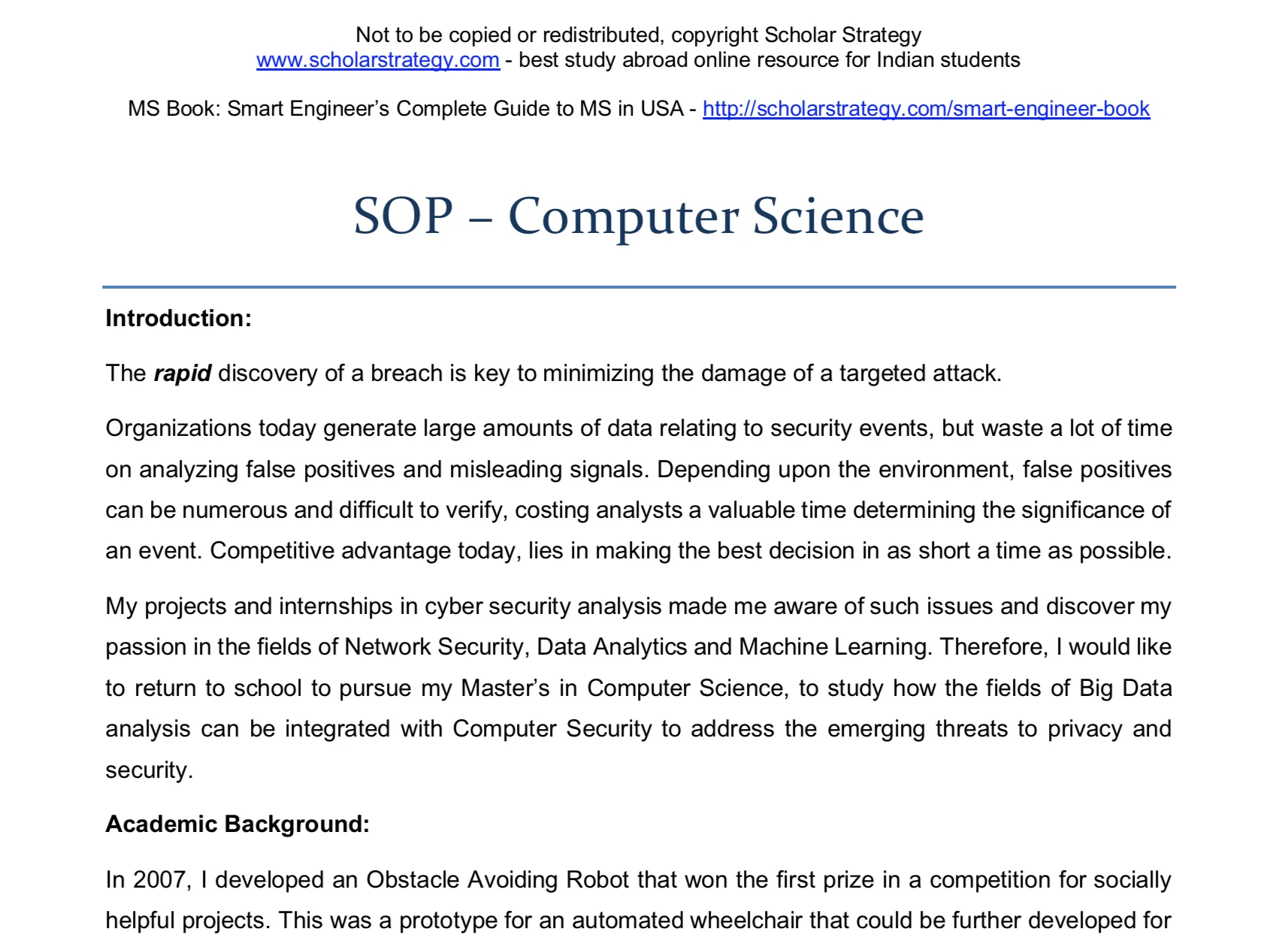
This is the real SOP of a candidate of ours who got into CMU MSIT, ASU MCS, NEU CS and TU Munich CS programs.

You can download the full PDF below.

Structure of a good SOP

There are a lot of samples available on Internet but what you will struggle with is finding out the right style for yourself. Of course, since these samples are available freely to everyone, you cannot copy them either.

So, let’s understand how to structure your SOP.

After 6 years of being in business and working with 500+ candidates, we have developed a deep understanding of what works. The problem is there is no one-size-fits-all solution here. But, to the extent that we can generalise, this is what we recommend.

Introduction

The opening paragraph should give a solid summary of your profile to the admission committee. It should answer why you are applying to this program, what makes you qualified for it and what is impressive about you.

Academic Background

Start with a brief summary of your college life. Try to cover your relevant academic details here such as grades in important subjects, accomplishments (scholarship, hackathon prizes, TAship etc). Start talking about how your interests started evolving in college. Follow up with 1-2 important academic project paragraphs.

Professional/Research Background

This is where you write about your internships, fulltime work experience and/or research experience. Talk about most relevant projects and what you learned from them.

Extracurriculars

Here, you can showcase your leadership and teamwork skills apart from anything meaningful you have done outside studies and work. People can talk about their serious hobbies, sports achievements, volunteering activities, experiences of leading a team in clubs etc.

Caveat – avoid cliches. If you were just a member of the IEEE club or volunteered for a simple event, that does not really count.

Why MS

As we discussed above, the admission committee wants to see how does MS fit in with your plan. So, this section has to convince them that you know what you want to get out of your MS. Talk about your career goals and what will you do after MS.

[pullquote]This is a good time to read our other post which shows good example statements you can use in SOP [/pullquote]

How to make your SOP unique?

As you can see, everybody can follow this structure but what is really hard is to personalize a SOP so that it stands out from the competition. It needs expert storytelling and multiple iterations to evolve a rough draft into a winning SOP. It has taken us years to perfect this process in our consulting.

Here are three pointers you need to keep in mind to make your SOP awesome-

  1. It should be genuine – Admission committee develops an eye for the fakers. If you keep telling how great you are and how you developed passion for microprocessors since childhood, no one is going to buy that. Don’t try to exaggerate unnecessarily. Keep it real.
  2. Address your salient strengths and weaknesses – Winning hackathons? Had low GPA because you went to participate in Formula SAE? Had to return to your hometown to take care of an ailing mother which caused a gap in your work? Only you can tell your story and you should.
  3. Your goals should make sense with your background – Everyone is applying for data Science these days even if they have never worked with ML or have any fundamental knowledge of statistics. If this is the case, you should ask yourself why are you applying to this program. If you cannot justify it yourself, how is the admission committee going to ever be convinced with it?

Never Use Templates

Please refrain from using templates given by counselors or websites. The whole point is to make your application stand out and by using a template (especially the ones where you just change your specific information), you are looking similar to thousand other applicants. In fact, try to write the first SOP yourself without seeing any sample SOPs. After writing the first draft, check out some good SOPs and tweak accordingly.

Don’t miss our 3 Exclusive SOP Tips

https://youtu.be/4IL-gzfHFTY

Download the Sample SOP in a PDF 

Click here to download [download id=”2941″]


Join our mailing list to discover inside strategies on how to get admitted to top schools in US  – sign up for our newsletter

For our paid professional counseling, check out our counseling packages

How to score 330+ in GRE?

Score 330 on GRE

Back when I wrote GRE, I got 2320/2400. The scoring and format has changed since then but I have talked to multiple candidates who cracked 330+ score in GRE recently – I realize that few best practices remain same.

So, I am revisiting what I think works well when you are taking an online adaptive test like GRE. It’s all old wisdom packaged afresh in millennial slangs. Remember that you, yes YOU, can score 330+ in GRE.

This is what we will cover in this post-

  1. Assess your current status
  2. Take your GRE appointment
  3. Collect the GRE preparation material
  4. Planning last two weeks

1. Assess your current status

The very first step when you contemplate GRE should be to read about the latest format of the GRE test.

The first thing that will make your mind boggle is that GRE is a frickin’ long test. It is not for weak hearted and given how much social media has screwed your and my attention span, it sounds insane to sit 4+ hours and focus on a damn screen and remember what the word ‘reticent’ means!

This is what I suggest – take a practice test without any additional prep. This helps in understanding what is your current level and what are the areas where you will need to put in more efforts. By doing this, you can avoid wasting time on the areas of your strength.

a. Taking a good practice test

I would prefer taking one of the two free Powerprep tests offered by ETS since they are closest to the real test.

b. Evaluating your results

After taking any test, go over the scorecard carefully. Since this is only an initial evaluation, you want to take a look at the sections where you performed the worst. For most of the engineers, the pain lies in verbal section and mostly the reading comprehension. However, it could be math section for you and don’t be surprised to find that you ran out of time. It happens. This reality check will make you take time management more seriously.

Ok, now that you know which sections are going to be your undoing, let’s start preparing for it! For e.g. If you got 4 out of 7 text completion (TC) questions wrong, then you know you need to get your act straight there and better download that vocabulary app.

But before we dive into the books and the online tests, go and take that damn appointment.

2. Take your GRE appointment

I had a friend in NYC when I was working on Wall Street. Let’s call him Ankit. Four months into our jobs, he announced that he is soon going to write GMAT and do an MBA. Next thing I know he has his new fancy book delivered by Amazon and I am already visualizing Ankit going to Harvard with his Macbook tucked in on one side.

He gave me a proper FOMO and as it would happen, I would write my own GMAT ten months later. In between, we would meet often and I was always in awe of his knowledge on finance related topics. He is going to make a great banker, I would say to myself. He was not getting enough time in the hectic job. I asked him if we could start preparing together. But the man was too busy. I asked him if wants to book the test dates at the same center but he felt he needed a little more preparation.

My scores came out and I got busy with my business school apps and job. After getting the coveted admit to NYU 1 year later, I pinged him and enquired with excitement, “Dude, so where are you heading?”. The dude told me he is going to appear for the GMAT very soon and then apply in a jiffy. Whaaaa?!?!

As it turned out, Ankit never wrote the GMAT and while he remains a great friend of mine, I know he was just too scared to face a bad score. It happens!

So, my advice is – don’t be Ankit.

It is easy to keep procrastinating on writing this test forever. You know what is worse than a score of 300? Not writing GRE and never fulfilling your MS dreams. Don’t let that happen to you.

Book that damn date so that you are committed to it. Mark it with big red cross on your calendar. People have reported that 2-3 months is an ideal time for prep – keep it soon enough so that you don’t lose tempo.

3. Collect the GRE preparation material

You would need some essentials and then additional practice resources depending on your weak points.

a. Must-Have Material

b. Additional Practice Material

These are some of the most often recommended resources by recent candidates:

  • Manhattan 5-lb book (mostly for Math)
  • Varsity Tutors material and app
  • GRE Big Book with 27 Old Tests
  • Khan Academy for any particular topic you are struggling with esp Math

c. GRE Mock Tests

  • Official ETS Tests
  • Manhattan Review GRE diagnostic test
  • Manhattan Prep’s GRE practice test
  • Kaplan GRE practice test (considered tougher than actual test)
  • McGraw-Hill GRE practice test

d. Vocabulary Preparation

  • Quizlet flashcards
  • Magoosh’s GRE Vocabulary Flashcards
  • Word Power Made Easy by Norman Lewis

e. AWA

You cannot write well until you read well. GRE is a lot about how well-read you are and then doing some focused reading that can help you in improving the vocabulary, understanding proper grammar and writing the essays. Few candidates have recommended essays in Arts and Letters Daily, and The Best American Essays of the Century by Joyce Carol Oates.

I find Magoosh AWA guide to be one of the best and would highly recommend that for AWA tips and practice.

4. Planning last two weeks

I am not a good finisher and had a hard time not going psycho in the last week of the exam. There is only one way to calm your nerves – feeling more in control. Have a good 14 or 10 day plan for last few days before the exam.

a. Practice, practice and only timed practice

Many people take the practice tests in bits and pieces; I sympathize with them. GRE test is not a sprint – you cannot excel at the first section and then make excuses that your back started hurting by 3rd hour. You cannot complain that you knew how to calculate that median but time ran out. GRE is a marathon and the only way to prepare is do timed practices.

Whatever tests you take, sit down and put an alarm on your smartphone. Do it in time else it is useless. If you want to score 330 or more in GRE, you simply must take at least 10 full length practice tests.

b. Back breaking reviews

Are you jumping after getting 318 on Kaplan? Don’t be a fool. Sit down and study all the answers one by one. Not just wrong ones but also the right ones. Frankly, taking tests is again useless if you do not sit and reflect on your performance.

You should know why an answer is right or wrong. The actual result matters less than the why of it.

c. Revise

You will come across tricky questions from day one – you should keep marking them. Read the answer, understand why you got it wrong or why you did not feel confident about it even if you guessed it correctly. Keep it marked. Revisit these questions in last 10 days.

Do you get them correctly this time? If not, be alarmed. The whole point of the preparation is to know what you did not know at the beginning. This is why reviews of your practice tests are important. Don’t worry, do it again now. Review and revise after 5 days.

Why 5 days? – no point in doing it immediately because you would identify the correct answer by memory and not by logic. Let few days pass before you revisit these tricky questions.

Remember that a score of 330+ in GRE needs high precision. You cannot rely on getting most of the questions right – the key is to avoid getting anything wrong. This requires painstaking revisions. You have to review your performance and improve consistently.

What we want is to learn the underlying concept and not just the answer to this question.

d. Stop studying on the last day

It can be counter productive to take tests till last day. One day before your GRE, you should try to calm your nerves, relax, and be mentally prepared to focus. Apart from revising few areas, you should try not to study on your last day before the exam.

So, what does it take to score 330+ in GRE

As you can see, an early start followed by meticulous practice and timely test taking can go a long way in getting your coveted scores. If you have prepared and revised well and keep your cool on the exam day, you can totally score 330+ in GRE.

Lastly, know that it is ONLY AN EXAM and you can always retake it. Do not let pressure of scoring high wreck you. Good luck!

Read how important GRE is for your MS/MBA applications

MS in USA: Full Process to Apply

ms in usa guide

MS in USA course is becoming an increasingly lucrative option for international students who wish to work globally. However, with so many choices, an applicant can feel overwhelmed. 

In this post, we will cover all you need to know about pursuing MS in USA:
Why are so many people opting for MS in USA?
Who is eligible to study in USA?
What is the process to apply for MS in USA?

Why are so many people opting for Master’s in USA?

MS in USA courses consist of a number of technical courses, requirement to write a thesis or do an industry project. Sometimes, the industry oriented courses offer an MEng degree instead of MS. Someone who is interested in exploring in-depth the research problems in their fields can go for the MS (research) program. Students who demonstrate excellence in their academic performance and research potential also have the option to convert to the PhD program.

USA is the most popular study destinations for international students since it houses few of the world’s finest university systems such as Ivy Leagues. If we look at the global ranking for MS programs, the universities in USA mostly fill the top 100 spots. They offer cutting edge equipment and resources to their students. It is not surprising to see Nobel Laureates teaching at US schools.

Studying MS in USA can broaden not only the student’s educational opportunities but the cultural exposure as well.

Who is eligible to study in USA?

Most of the universities in USA require:

  • 16 years of previous education (XII + 4 years of Bachelors or XII + 3 years of Bachelors and 1 year of Diploma/MS)
  • Transcripts
  • Standardized tests score (like GRE)
  • English Language Proficiency Score (like IELTS/TOEFL/PTE)

Additional requirements may apply. For example, University of Minnesota mentions that one has to possess significant background in Computer Science to apply to CS department.

Cost of doing a Master’s in USA

ItemCost in USD
(rate of 75 INR/USD)
Cost in INR
GRE$205₹ 15,375
TOEFL$180₹ 13,500
10 Applications$1250₹ 93,750
Visa & SEVIS Fee$700₹ 52,500
Flights$1500₹ 1,12,500
Tuition$50000₹ 37,50,000
Living Costs$18000₹ 13,50,000
TOTAL$71,835₹ 53,87,625

In short, the cost of doing your Master’s in US can go up to $75,000 which comes to ₹50-55 lac at the exchange rate of 1 USD = INR 75.

Related articles:
Cost of MS in USA in INR – can you afford it?
How to finance your MS or MBA education abroad
Study abroad scholarships for students

What is the process to apply for MS in USA?

Applications for MS in USA is much different than what we are used to in India with MTech. Let’s take a look at the process first.

Following are the components of the application process-

ms in usa process
MS in USA application process
  1. GRE, TOEFL
  2. Shortlisting schools for your aspirations 
  3. Preparing required documents for the application
    1. Writing the SOP
    2. Submitting the LOR
    3. Submitting the Resume
  4. Apply by the deadline – Once you have finished the steps above, you are all set to submit the online applications to each university. The only components not sent by you are the LORs, so ensure that your recommenders submit those on time as well.

Note: Ideally, shortlisting schools should be done before giving GRE but students prefer to get the tests out of the way and be comfortable with the score before focusing all energies into shortlisting schools and actually applying to them. A candidate is able to typically apply to around 10 universities for MS and MIS programs.

Familiarize yourself with the process well before actually starting anything so that you know what all you need to do.

What next?

Found this useful? Do you now want to know what matters more in your applications and how to actually strengthen your profile? We are not talking about generic stuff but specific things you can do to stand out. All this is covered in our MS Book: Smart Engineer’s Complete Guide to MS in USA which has been receiving fascinating reviews from readers and applicants alike.

Want to read the whole process easily in a PDF? 

[sociallocker id=”2544″][download id=”4381″][/sociallocker]


Join our mailing list to discover inside strategies on how to get admitted to top schools in US  – sign up for our newsletter

Let us help you crack your dream graduate schools (Harvard, MIT and all), check out our MS Admissions Consulting Packages

Want to get more emails from Indian students, says award winning Prof in USA

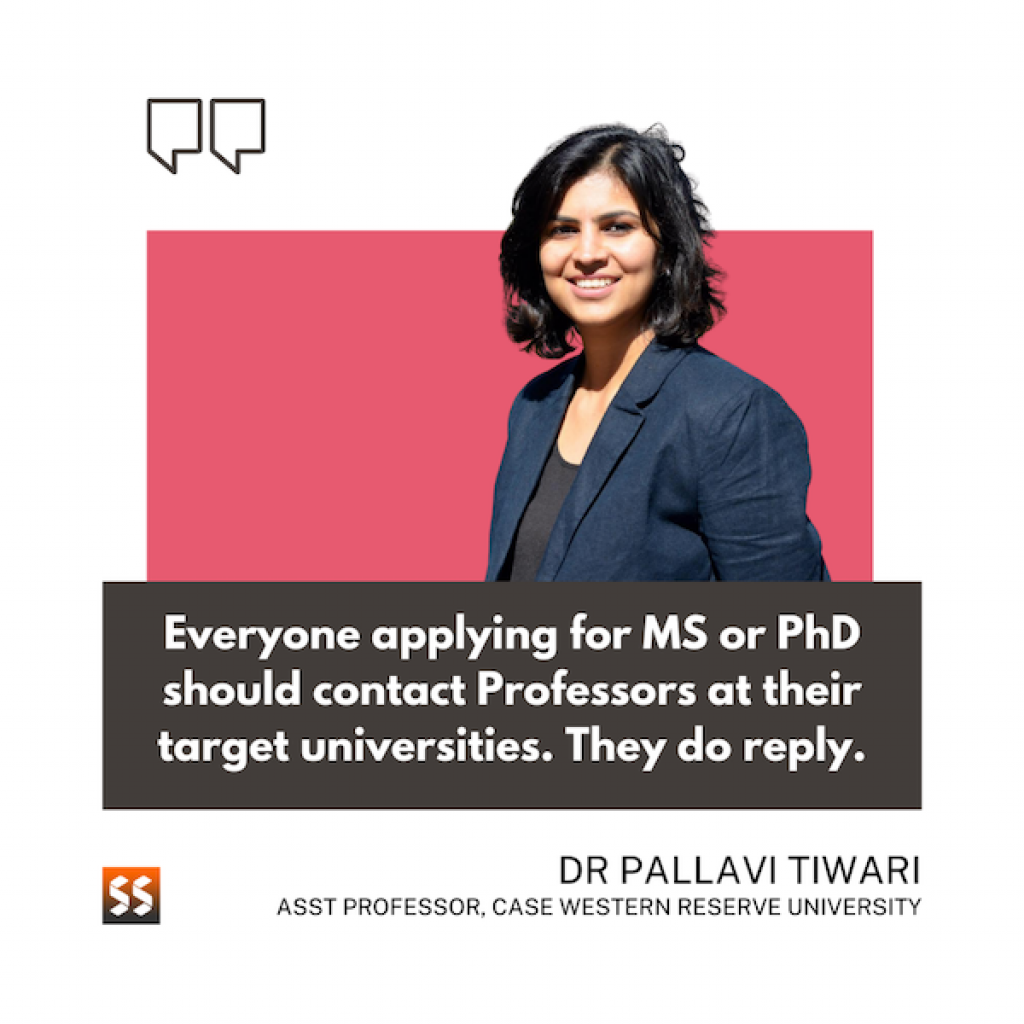
We invited Dr Pallavi Tiwari, Asst professor at Case Western Reserve University for a chat with the Scholar Strategy community. We discussed topics such as how to build a career in R&D and academia, how to contact professors etc.

She went on to Rutgers University where she finished her PhD in Biomedical Engineering and decided to continue her R&D career by taking the academia route. 

Pallavi, who herself hailed from a Tier 2 town in India and had a limited research exposure in college, has achieved great heights in her research career in USA.  

Dr Tiwari’s impact on brain cancer research was recognized in June when she was selected as one of six winners of the third annual Johnson & Johnson Women in STEM2D (WiSTEM2D) Scholars Award. Each recipient, representing each of the STEM2D disciplines—science, technology, engineering, math, manufacturing and design—will receive a $150,000 grant and three years of mentorship. She has previously been a recipient of many research-related awards including the Presidential 100 Women achievers award by the Govt of India for her contributions to Science and Research.  

At Case Western Reserve University, she is spearheading cutting-edge research in the field of computational imaging, artificial intelligence and machine learning to address some of the most critical clinical problems in brain tumors. She is the Director of Brain Image Computing Laboratory.

In her chat, Dr Tiwari advised engineering students to proactively reach out to Professors if they are applying to Grad School.

Keep the emails succinct because Professors are busy and do not copy paste the same email to multiple Professors. It is always good to read a few of their papers and mention them briefly in the email. Most importantly, be genuine.

I often get emails from students all over the world but I would like to see more emails from Indian students. I want them to know that research is a viable career option.

She would love to get more emails from Indian students and is always encouraging women to pursue careers in STEM. 

Also Read: Why Email Professors before applying to MS programs?

Dr Tiwari also added that worrying too much about jobs and salaries very early on can hamper grad students from exploring all the options.

Don’t pigeonhole yourself initially, else you will not know what other option could have worked very well for you. I myself didn’t have a very clear plan when I came to the USA but slowly realised that I want to continue to pursue research as a career option. If you are not sure of the commitment for PhD, you can come for MS and then decide later on.

She also discussed the importance of finding a good research mentor.

Working in a productive and collegial research lab in the long-run is a lot more important than going to a high-profile university. I have benefited greatly from the mentorship I received during my PhD and the friendships I built with my labmates over the years.

Full conversation with Dr Pallavi Tiwari is available on our Instagram TV.

All about Statement of Purpose (SOP) for MS

sop for ms applications guide

How to write good SOP for MS applications? – It takes introspection, good writing and understanding. We know what AdCom is looking for in a SOP.

This is third article in this series. See the previous article on GRE here and School Selection here.

Once you have shortlisted which schools and programs you will be applying to, you need to go ahead and actually fill out the applications for each of them. Most of the schools now accept online applications, all you need is good internet access, valid email account and a credit card to pay the application fee in dollars.

Each application will ask you to fill out personal details. Tip: This can get repetitive, so it is advised that you create a text file and store your basic information from which you can copy and paste it into each application.
You will be required to upload some specific documents as well. This includes-

  1. Statement of Purpose (SOP)
  2. Letters of Recommendation (LOR)
  3. Resume (in some cases)
  4. Transcripts

In this post, we will focus on writing a powerful SOP for MS applications.

What is a Statement of Purpose (SOP) for MS

An SOP is a reflection of ‘who you are’ in front of the admission committee. This is one of the most important components of your application because this is the only document that is totally under your control. This is the place where you can tell your story and differentiate yourself from other candidates.

Here are the guidelines by Cornell University on what are they looking for in a SOP.

Components of a SOP

Background and Aspirations

In a typical SOP for MS applications, you will begin with a brief background/description of yourself and what you hope to achieve through studying MS at this university. Caveat: Don’t quote cliches here as everyone is doing it! Also, avoid getting too poetic. Remember you are applying for MS.

Academic and Professional relevance

Every school wants great students who will carry its name and reputation higher. For that, you need to show your academic and professional brilliance. So, talk about the academic (or professional if you have work experience) projects that can tell them about your subject expertise. Tip: Give more space to what you contributed and learned from that project instead of just describing it. How many and what kind of projects you want to highlight is up to you. But we recommend expanding on at least one and show your involvement. MS is about a lot of course projects and some research. You have to demonstrate that you can not only handle it but excel at it. Similarly, talk about any papers you might have published. Research papers and project become more important for PhD and MS programs that require a thesis to be completed.

Personal Story

Admission Committee consists of people who are reading your applications. Since they handle a large volume of applications every day, it is important to make your SOP stand out or be memorable. You can stand out by being academically brilliant too but if your experience is not that distinguished, try to put forth a strong story that connects your background and aspirations and aligns it with your passion to do MS at that school.

For e.g. even if you have not published big papers or done great research projects, you could have still started a startup with couple of friends and done some relevant work through it. The startup could be as simple as a website that offers building surveys for companies who want to do some marketing research. You could be highlighting some personal angle here such as how you came up with the concept and what were some of your lessons.

Here, you can also talk about extra-curriculars esp if you excel at something such as playing in a band, professional photography (something that is more than just a hobby), blogging (may be how you applied your php programming lessons to customize wordpress) etc.

Tip: Remember, anything that helps the admission committee personnel see a face behind your application is good as it will help him in remembering you. Caveat: But, dont spend too much space talking personal story that is not directly relevant to the course as that alone can’t get you admitted. Personal stories are good to supplement your acad/professional experience section.

Talk about how you have applied your learnings

Be it professional or personal section, remember to talk how you have applied your education or lessons into real world. This is a GREAT way to show that you’ll be able to translate your classroom lessons to your professional life. A naive example but you’ll get the point-

Having learned how xyz and abc help improving the signal strength of the wireless networks in my CCNA certification course, I was excited to help the system admin at my current company do so and so.

One more-

My brother’s company wanted to get customer feedback on one of their new products and I offered to get the surveys designed, filled and collected for them. Initially, I was doing it manually with my friends but then I realized that we can automate and package the service in a very easy-to-use way and put it online. To our surprise, we got contacted by lot of local companies in first month itself. Slowly, we iterated and developed pro packages that charged a premium for nicer result analysis. By integrating our services with right social media platforms and offline distribution channels, we had built a fully functional survey building service in six months. This gave me an inspiration to test new ideas online.

The above concludes the topics that should feature in all your SOPs (irrespective of the school). Next, you should be talking specific points about each school-

Why are you applying to this school?

This will typically discuss specific coursework, professors and research that you are interested in. This should tie up with your experience and background sections as well as your aspirations. You should have selected universities based on these anyways, so you should just be tying it all together at this point. If you are not finding good stuff to write here, you should rethink why you are applying to this school in the first place?

Caveats: Whenever you are mentioning specific professors, avoid talking about very famous ones as everyone will be talking about them. If the schools feels that your education will be hampered unless you are able to work for that professor only and if that professor is over subscribed, it might actually get you rejected even if your profile was great otherwise. So, exercise some caution when selecting professors with whom you want to work. A good strategy is to mention a couple of them and dont make your plans look too contingent on the availability of one professor.

Why should this school admit you?

As I said, it’s all about the ‘fit’. Talk about why you will excel at their program and afterwards professionally. The more you can convince them on this, better your chances are.

Alright, now that you are ready to crack your SOP, check out our Sample SOP for Engineers (yes you can use the inspiration to write for any program).

Don’t use Templates

Please refrain from using templates given by counselors or websites. The whole point is to make your application stand out and by using a template (especially the ones where you just change your specific information), you are looking similar to thousand other applicants. In fact, try to write the first SOP yourself without seeing any sample SOPs. After writing the first draft, check out some good SOPs and tweak accordingly.

You may also want to read some basic mistakes that you must avoid in writing your SOP.


For specific SOP tactics and samples, check out our bestselling MS Book: Smart Engineer’s Complete Guide to MS in USA.

For our paid professional counseling, check out our counseling packages.

MS in MIS, MEM, MIM – engineering management programs

ms in mis

More applicants are considering MS in MIS and MEM programs for their Master’s ambitions these days. Let us understand the scope of these programs and whether you should consider them too. The process for applying to these programs is same as MS in USA.

What is MS in MIS about?

MS in MIS stands for Master’s in Management Information System. It is one of the most popular techno-management programs that engineers go for.

Specifically, MS in MIS is an engineering management program that teaches how to use IT to manage huge volumes of business-relevant information to facilitate strategic decision-making. One might think of it as a less competitive version of MBA specializing in IS (but then, less reputed than an MBA too).

Why are techno-management programs getting more popular?

As technology spreads to every tiny aspect of our lives, role of engineering management is becoming more relevant in every domain and industry. Be it pharmaceutical or an agricultural company, everyone is dealing with information. While chemical, mechanical, civil, hardware electronics engineering deal with tangible products, software and computer engineering deal with the abstract information.

Understandably, there has been a constant increase in the demand for managers who understand technology and management aspects alike. This gave rise to programs such as MEM (MS in Engineering Management), MIS (Management Information Systems), MIM (MS in Information Management), MSIS (MS in Information Systems) and so forth.

With few differences, these programs aim at combining technical depth with business breadth so that the students can understand both management and engineering language. One theme that underlines all these programs is that they are core business programs with engineering electives or vide versa. The focus is still on management courses such as statistics, analytics, supply chain etc and one can pick electives in database, programming, networks etc.

What is the curriculum of MIS and MEM programs?

It has a combination of engineering and management electives. Some programs are heavier on engineering courses and some are more focused on management courses. Therefore, it is crucial to study the curriculum before choosing to apply to a program – make sure it fulfills your interest.

Some MIS courses also offers specialization tracks. For example, CMU MISM offers following tracks:

  • Managing AI & Robotics
  • Digital Marketing & Commerce
  • Business Intelligence
  • IT Strategy & Management
  • Health Care Informatics

Duke MEM is more business oriented and offers the following:

  • Customer Experience and Product Design
  • Data Analytics and Machine Learning
  • Operations and Supply Chain Management
  • Product Management
  • Technology Development and Commercialization
  • Entrepreneurship and Founders

Engineering electives can include:

  • Data Mining
  • Artificial Intelligence
  • Networking 
  • Object-Oriented Programming in Java

Business electives/core can include:

  • Marketing
  • Finance
  • Management
  • Operations
  • Modeling

What are the TOP MS in MIS programs?

Here are our handpicked 10 best Management Information Systems courses-

UniversitySpecialtyFee
1. CMU MISMThe three semester, 16-month curriculum can be reduced to one year for those with at least three years of professional work experience. One of the most prestigious and job friendly MIS programs. However, it can be expensive but you are getting a CMU degree.$75,100
for 16 months
2. MIT MSMSThe MSMS degree is 90-unit curriculum, with courses at Sloan, in other MIT departments and Harvard University. Those are two schools to kill for – enough said. $84,134 for 12 months
3. University of California, Berkeley MISMThe 48-unit degree program is intentionally interdisciplinary, combining aspects of computer science, cognitive science, psychology and sociology, economics, business, law, library/information studies, and communications.$71,767 for 12 months
4. New York University MSISCombining computer technology from Courant Institute of Mathematical Sciences and business preparation from Stern School of Business, the MSIS at NYU prepares graduates for successful careers in management positions that require deep technical skills.$68,517 for 12 months
5. Texas A&M University MSISTexas A&M is one of the most affordable comprehensive public universities in the nation. The department also offers scholarships and graduate assistantships.$51,000 for a year
6. Indiana University– Bloomington MSISGraduates of this program are in high demand, with 97 percent of them receiving job offers before graduation.$45,000 for 12 months
7. Arizona State University MSIMClasses for the twelve-month on-campus program are designed to accommodate working professionals. Small class sizes and evening classes allow students to get an intimate, collaborative experience while not having to put their careers on hold.$60,000 for 12 months
8. University of Texas at Austin MSITM10 month, STEM designated degree that creates business leaders prepared for disruptive innovations due to emerging technologies, such as deep learning and blockchain.$55,000 for 12 months
9. University of Texas, Dallas MSITMThe Master of Science in Information Technology and Management is a 36-credit curriculum that prepares students to better understand the world of information technology.$37,000 for 12 months
10. Georgia State University MSISThe MSIS offers concentrations in big data management and analytics, enterprise systems, cybersecurity, information technology, health informatics, and management of information technology.$55,000 for 12 months

What is MEM program?

MEM stands for Master’s in Engineering Management. It is the generic techno-management program with courses in Marketing, Finance, Management, Operations, Modeling and available engineering electives (not just software but industrial engineering, nanotechnology etc).

Duke MEM program
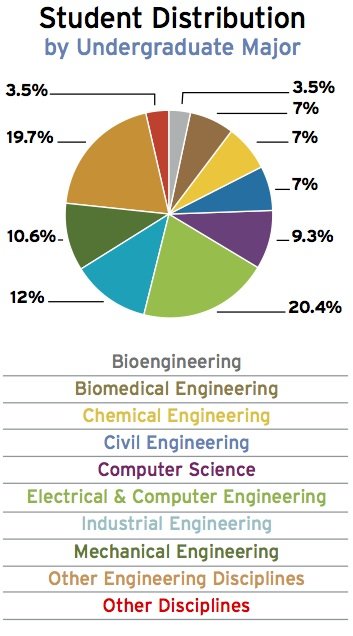
Duke MEM students by backgrounds

Duke’s MEM program is leading in this category. Look at their electives to get a sense of the course offering. Above chart shows how the incoming student profile is distributed. As you can see, it is widely spread among various engineering majors.

Some other engineering or techno-management programs go under the names of MIM, MSIS, MISM etc.

What kind of jobs can you land after MIS or MEM programs?

MIS – Expect roles such as IT consultants, data analytics engineer, system analysts, data analysts, systems engineer, database administrators.

MEM prepare candidates for consulting, business analysis in any engineering related work function.

Also read FAQ for MIS/MEM programs

If you found this useful, there is lot more information in MS Book: Smart Engineer’s Complete Guide to MIS in USA

Our students are joining MIS/MEM/MS Business Analytics/MS Data Science programs at Columbia, UT Austin, CMU, TAMU, Duke, Syracuse, Buffalo, NEU, UIC etc every year. Contact us if you need help with your MIS/MEM applications.

All about Letter of Recommendation (LOR) for MS programs

LOR guide

What is a letter of recommendation or LOR? – Get insider tips on what makes for a good LOR and how to get one from your recommenders.

This is fourth article in MS in USA series. See the previous article on GRE here, School Selection here and SOP here.

Remember we were discussing the key documents in last article and we discussed the matter that goes into SOPs. Now is the time to discuss what constitute a good LOR.

Letter of Recommendation (LOR)

LOR stands for Letter of Recommendation. It is a document that provides the admission officers with a comprehensive insight into your candidature for admission.

All universities usually ask for 3 LORs – and you can choose who to get them from. Here are the LOR guidelines set by University of California, Berkeley.

“Indicate how long you have known the applicant and in what capacity. Graduate schools are primarily interested in recommendations that come from professors who know the applicant and his/her academic work as well as from employers. They are primarily interested in faculty members’ summary estimates of the candidate’s general promise as a graduate student. The more the recommendation reflects real knowledge of the applicant and his/her performance, the more useful the letter is to the graduate school admissions committees and thus to the applicant.”

University of California, Berkeley

Why is LOR so important?

LOR is the only place where a third person can help strengthen your application. Sometimes, a LOR from a highly regarded Professor alone can get you admitted – even if rest of the application was average. LOR is an unbiased external perspective that schools highly value. As such, LORs can be more important for PhD applicants in vouching for their ability to research.

First, let’s understand what constitutes a good LOR-

A good LOR is one that validates your candidacy by sounding genuine, vouching for your ability to excel at your target program and comes from someone who is credible. 

Don’t forget to check out sample LORs for MS programs

Who should you get your LOR from?

This is very important factor. Since you have a choice, make sure you understand the difference it can make. Ideally, you would want to choose an internationally known recommender whom the schools can trust and who is ready to vouch for you! But its easier said than done and in 95% cases, its hard to find such a perfect recommender.

Academic LORs

You can look for someone who is better regarded (HOD vs an Associate Prof for example) and with whom you have worked closely. If you can find someone like this, then just go for them. Understand that people at higher positions are expected to connect with more number of  students. Therefore their evaluation can be more trustworthy as they will judge you against a broader pool. As such, their evaluation saying ‘top 5% people I have interacted with’ holds more weightage than a lower ranked person’s ‘top 2% people I have worked with’.

Now, if you need to find another recommender and don’t have much choice left, go for people who know you better and will sound genuine. The mistakes that students make sometimes is that they take LORs from HODs or Deans even if they haven’t really worked with them. Although such a person has more credibility, he cannot be expected to know the student personally. As such, any recommendation from him will lack the substance. As opposed to it, it may be better to get LOR from someone who knows your work better and regards it highly even if he doesn’t have a fancy title.

Professional LORs

If you are presently working, you could get one LOR from your project manager/lead. The longer you have worked, better it is to get a LOR from your manager. This is because they will be up to date on your skills and accomplishments. Sometimes, people still choose to get academic LORs as they don’t wish to disclose their MS plans to their employer. This is fine as MS do not require professional LORs per se anyways.

Other factors to consider are – the articulation ability of person. Even if he thinks highly of you but can’t convey it nicely, it may jeopardize your chances.

In case you are applying for PhD, getting a LOR from someone in your desired area of research matters. You should get at least one LOR that evaluates your research skills. So, choose your recommenders accordingly.

Writing the actual LOR

Few Professors are used to writing LORs. They can do the job on their own but you can still give them inputs. For eg. you can provide them details on what you have been working on and what is your proposed area of study so that they can talk about that in the LOR. Remember that these people are busy, so you will need to follow up and help them help you.

Sometimes recommender might ask the student to draft a letter that they can then modify. This is perfectly acceptable but students should take care that the letter gives the perspective from the recommender and not feed praises for the sake of it. Try to provide only partial drafts and have them write the meat of it so that the letter has a unique voice. If you end up writing full drafts for every recommender, they could sound all same.

So, as a student, you can do the following to help your recommenders-

  1. Remind them of your accomplishments (try to split it between them based on relevance of the field and subjects)
  2. Brief them on your work and what/where you are applying to
  3. Provide them with written descriptions of projects that they can use in their letters directly
  4. Follow up politely so that the process gets done on time

So, that’s it about the LORs. Always, remember to keep recommenders updated on the schedule as you don’t want to miss the deadlines if they end up going on vacation in the last minute.

Next, you should be building an impressive resume, check out our guide and template here.


For specific LOR tactics, check out our bestselling MS Book: Smart Engineer’s Complete Guide to MS in USA.

For our professional counseling, check out our MS/MBA Admissions Consulting Services