Did you think Data Science & ML jobs are taking over the world? You’ll be surprised. Here are Top 10 STEM Careers for all engineers seeking a global career
Continue reading
Did you think Data Science & ML jobs are taking over the world? You’ll be surprised. Here are Top 10 STEM Careers for all engineers seeking a global career
Continue reading
400+ people have died because of the coronavirus in Mainland China. To curb the spread and contagion, the government had to shut down the schools. Whole semester are getting delayed and those students who were preparing for college entrance examinations are left in fray and frenzy.
But like always, China has a way out of their biggest viral problem and unsurprisingly, it involves technology. China’s Ministry of Education issued a statement last week to push schools to use internet platforms as an alternative way of teaching students amid the suspension of the new semester.
Schools are now teaching its teachers to live-stream their classes. Alibaba Group’s DingTalk is one such tool that allows them to keep teaching the children who are no longer permitted to attend the schools. Many older teachers are now having a tough time learning the new generation tools as they strive to keep teaching the traditional subjects to the younger generation.
As per South China Morning Post,
Suddenly, the spotlight is on China’s online education market, which grew 25.7% year on year in 2018 to 251.7 billion yuan (US$35.9 billion), according to iResearch Consulting Group. The previous forecast of annual growth of between 16% to 24% in the subsequent three to five years may now need to be revised upwards.
Companies are also stepping up to deal with the crisis.
TAL Education announced free live-streaming courses for all grades to “minimise the influence on study due to the outbreak” while VIPKID, which specialises in teaching English online, said on Weibo it would offer 1.5 million free online courses to children aged from four to 12.
As of Sunday, more than 220 education bureaus in 20 Chinese provinces had joined the free-of-charge DingTalk homeschool programme, covering over 20,000 primary and secondary schools and 12 million students, according to state media Xinhua.
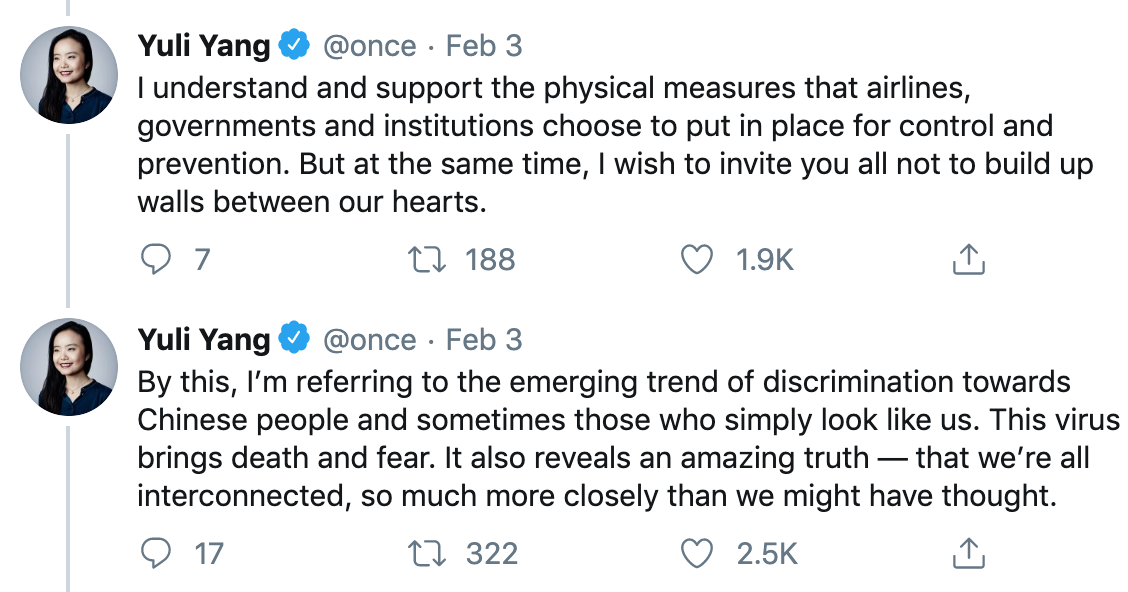
Meanwhile, many Chinese students who are studying abroad may be safe medically but are worrying for their families back home. Recently, a Chinese girl from Wuhan (which is where the coronavirus started) who is now living in HongKong took to Twitter to appeal to the world to be kinder to the people from Wuhan who have been facing wrath from the media worldwide.
Tensions may be fraught between the United States and China, but there are still 370,000 Chinese students enrolled at U.S. colleges and universities. My own alma mater, University of Illinois at Urbana Champaign houses nearly 6000 of them. They are filled with anxiety as every day brings them news of more deaths of their dear ones or new travel bans.
When such contagion arise at this scale, we suddenly realize how powerless we are. And I believe its only technology and entrepreneurship that can help survive these challenges. No, I am forgetting the important thing – the indefatigable human spirit.
China is not surrendering. Its students & teachers are fighting back one video at a time.
Click to read the referred article on SCMP here.

As per the 2018 QS TopMBA report, 2017 reported a 13% increase in MBA hiring with USA paying average MBA salary of $102,100 (a dip from last year) and Europe offering $85,500 (up from last year). In other continents, Australia remains a lucrative employer almost matching USA with a package of $98,400. India remains behind with packages of $66,500.
Let us see the compensation trends by functions and industry (src: QS TopMBA.com).
| Region | Avg Salary | Avg Total Compensation |
|---|---|---|
| Africa & Middle East | $78,200 | $90,700 |
| Asia-Pacific | $71,300 | $85,900 |
| Eastern Europe & Central Asia | $57,000 | $69,100 |
| Latin America | $62,500 | $75,900 |
| US & Canada | $98,900 | $116,300 |
| Western Europe | $85,500 | $101,300 |
| Country | MBA Salary | Total Compensation |
|---|---|---|
| United States | $102,100 | $120,900 |
| UK | $92,400 | $122,900 |
| India | $66,500 | $76,300 |
| Australia | $98,400 | $116,200 |
| Canada | $99,800 | $111,100 |
| Switzerland | $123,500 | $140,900 |
| Industry | %MBAs Hired | Avg MBA Salary |
|---|---|---|
| Technology | 13% | $89,633 |
| Finance | 5% | $97,100 |
| Consulting | 11% | $90,900 |
| Other | 15% | $89,675 |
The growth in ‘Other’ sector points to Millenials opting for diverse roles after MBA including Entrepreneurship in non traditional industries.
Studying the older reports of MBA salaries, I see overall a flat or even dip in average salaries in last 3-4 years. The higher salaries in North America and Western Europe and Australia hover just around the six-figure mark (variation pointing out to the volatile bonuses). Bonuses form almost 20% of the compensations and come in form of signing and performance-related bonuses.
MBA hiring in traditional sectors such as Finance and Consulting, unsurprisingly, sees slower growth but packages remain high. While USA and Western Europe saw the highest (35%) hiring in Technology sector, Asia Pacific saw 25% hiring in Others and 16% in Consulting. Finance has been big in Latin America (20%).
Among other worth-noting trends:
To summarize, MBAs continue to command six figure average salaries for traditional roles in Finance, and Consulting. Technology hiring is on a rise in mature markets but the overall employment and salary growth that was expected 3-4 years ago has not delivered. While MBA will remain a solid career option, don’t expect the frenzy seen in early part of this century.
What do you think? Has this encouraged you or discouraged from your MBA plans?
Our most-affordable MBA counseling is open for Fall 2019. Join us now to make the most of your time.

There are many ways to improve your profile before you apply to MS. Here are few things that can make the most impact-
You can work with your college Professors to stay engaged in research. Publishing papers add a whole new depth to your candidacy by showing your research potential.
Even if you don’t have clients, you can build interesting projects and publish on github. Shows you are a pro-active learner. (can do along with taking MOOCs in your areas of interest). Keep doing competitive coding, any accomplishments in there can improve your profile. Certificates directly don’t matter but participating in such things ensure that you stay hands-on and get to explore deeper concepts of programming.
Read papers on latest developments, connect the dots. You will start talking more intelligently about it. The biggest point where applicants stumble is that they have nothing intelligent to say in their SOP – everyone is saying ‘how they were attracted to computers since childhood’. The more you code, more you explore, better stuff you will be able to talk about. Your goals will be more specific.
One of my students switched his job from a business analyst role to a research based startup in ECE. First time, he did not get good admits but second time, he got into some decent schools for MS in ECE. He headed to UC Santa Cruz. The idea is to proactively push towards your passion. If your job is not helping in what you want to do, look for something more relevant.
For people who have low grades or relatively less working knowledge of the subjects of their interests, doing online courses (reputed certified ones) can add some more credibility to your academic background. Read how much can MOOCs help you.
Lastly, if your test scores are holding you back, get that sorted. There is no point in being held back if you think you can do much better on the tests. This becomes especially more important if your GPA is low.

Confused whether to get some work experience before applying for MS? Work experience matters more for some programs but not any kind of experience! Let us check what matters.
Continue reading
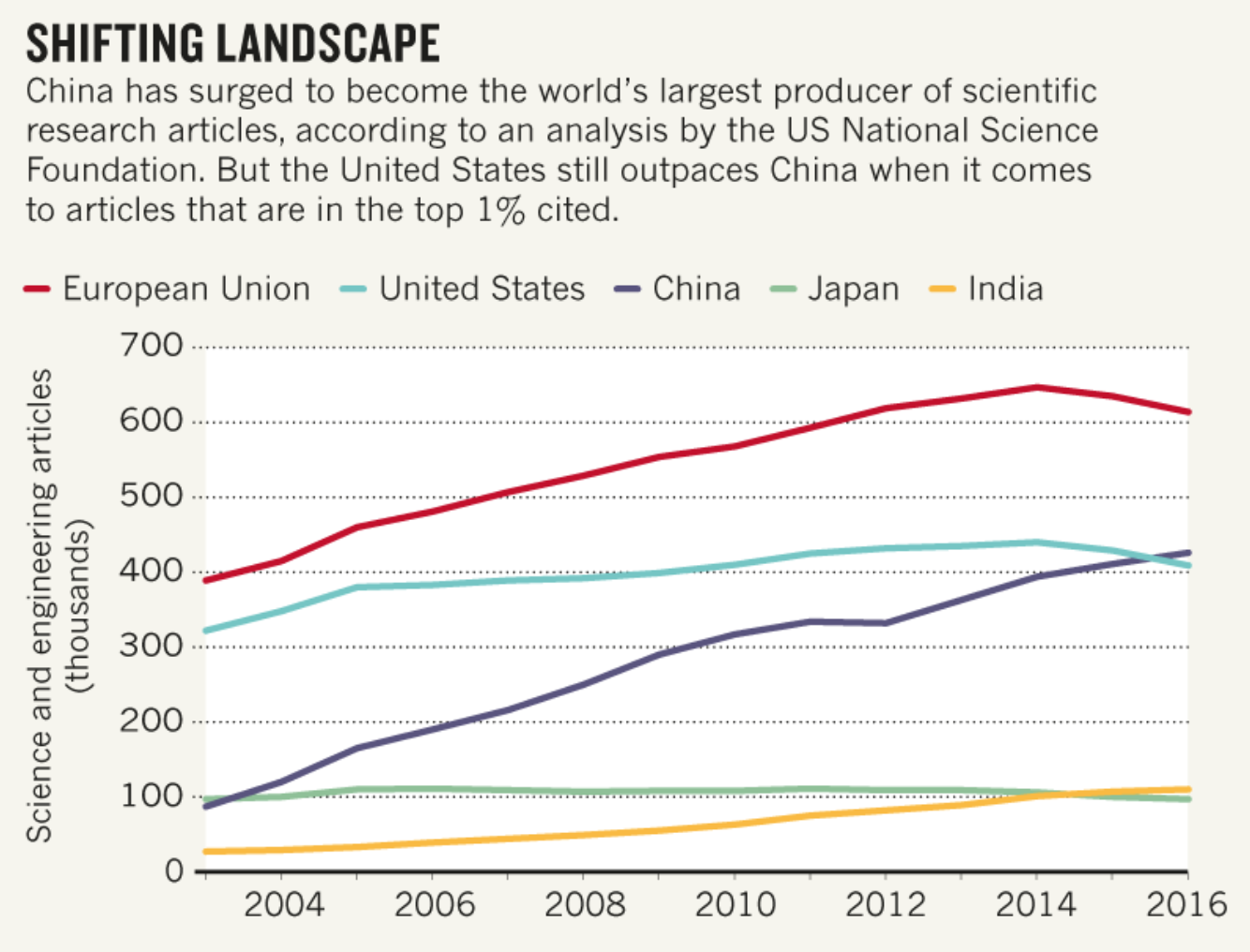
For the first time, China has overtaken the United States in terms of the total number of science research papers publications, according to statistics compiled by the US National Science Foundation (NSF).
As an aspiring grad student or researcher, one of the best things you can do to enhance your application chances is publish a good quality research paper. But many applicants do not know how exactly to go about it.
So, we invited Utkarsh Sinha who is a Petroleum Engineer, graduating from University of Houston and a published researcher to share some tips about the same. He is currently working with Hicor Technologies and is a JPSE & ATCE Published Author. Utkarsh has also been a summer research fellow at IIT Delhi!
He answers the following in this short video-
Go through it and start cranking on your own research!

It is not surprising that online courses (MOOCs) are helping many engineers compensate for their poor quality of education. Growing number of engineers who apply to graduate schools abroad are facing a massive challenge. With engineering colleges sprouting in every corner, the quality of education and infrastructure has taken a huge beating. With barely qualified teachers, students lack any avenues to learn and get the kind of exposure that would make them competitive against their counterparts from China, Europe and USA. So how do these students learn when their colleges are offering so little?
Enter the number of MOOCs (Massive Open Online Courses), thanks to education startups like Udemy, Coursera and so on. With quality courses and online availability, an increasing number of students are resorting to taking such courses to augment their knowledge of popular subjects like Data Science, Basics of Computer Science and so on.
Yasho Vardhan, an MIS applicant that I worked with, was feeling that his average GPA was putting him at a disadvantage in his applications. To further enhance his profile, he decided to take Introduction to Python for Data Science on edX and R Programming on Coursera. Since he was interested in Analytics which is growing more popular and competitive, he felt that he needed something more than his academics and work experience to differentiate himself. Further, such courses were highly recommended by his seniors at University of Maryland, the place where he is heading to this September.
Another popular online course is Machine Learning by Andew Ng on Coursera. When Sheelabhadra Dey, an Electronics Engineering student at NIT Trichy, started applying for MS in Computer Science (CS) programs with an interest in Machine Learning, he knew that CS is one of the most competitive programs. With a non-CS background, he needed to prove his mettle. So, he opted to complete online courses that would help him develop the CS skills that he could not in college. Now that he has admits from multiple reputed CS programs such as Texas A&M University, and University of Florida, he thinks his decision was a life saver.
The point is to gather the real skills and not worry about the certificate. Besides, developing good projects in these classes can be a great way to show you are a pro-active learner! These can also help to compensate for your low grades in a similar class you took in college or can fill in for lack of a formal education in the area you are applying to.
So, if you feel that you lack certain skill set that is hampering your career growth, it is time to go for a MOOC!
This article was originally written for and appeared in Tribune newspaper.

Many people are shocked to learn that applications to universities abroad can take anywhere between 6-9 months.
It’s not a sprint, it’s a marathon. And, to do well, you need to have a proper plan in place.
The good news is your future does not depend on the outcome of a single exam. One bad day doesn’t ruin you. You can do many things to put up a winning application in the end.
First things first – you need to follow the timeline so that you do not lose track of multiple things that need to be completed. Applying late or very close to deadlines can be detrimental to success. You do not want to do that.
What is the best time to apply to maximize your chances of admit? When should you take GRE? How long should you work on your SOP and essays? If you have all these questions, you are in the right place.
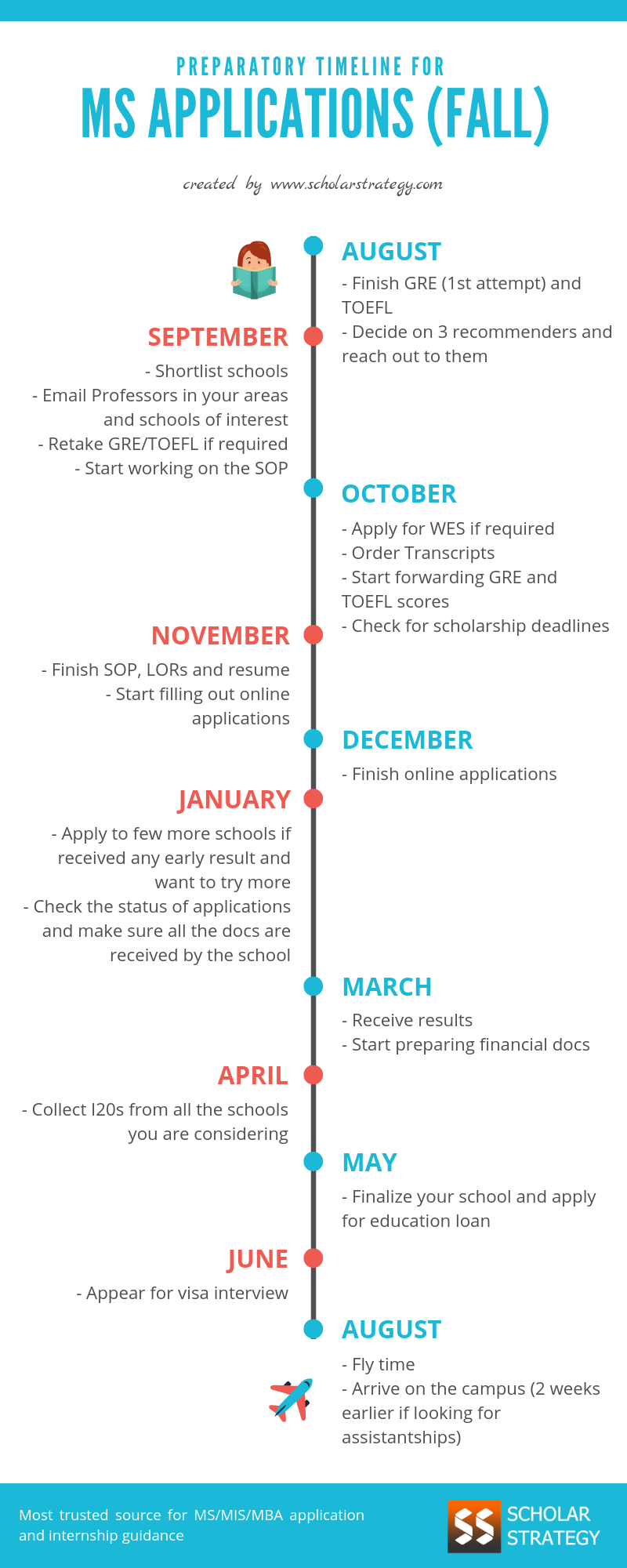
MS in USA application process can be overwhelming and cumbersome. So, here we have tried to put up an easy to understand timeline so that you can keep a tab on what needs to be completed when.
Discipline and time management is key to cracking your dream schools. And it starts from TODAY.
Take by end of Aug so that you have enough time to retake if necessary
Retake GRE if required by end of Sep (need 21 days between reattempts)
by end of Sep – mid Oct. Here’s full post on how to shortlist schools.
Drop emails to relevant Professors you are interested to work with (especially for people interested in research) by mid of Oct.
If any of your shortlisted schools require a WES evaluation, apply for it by the end of Oct since it can take a month or more to get their results.
There are some third party scholarships available for MS applicants. Search these by end of Oct (so that you can apply by their stated deadlines)
from your undergraduate college by end of Oct
by mid Nov
by end of Nov – mid Dec
and if the required material has been received by the schools in Jan. Resend if anything is amiss
by end of Mar-Apr
by end of Apr
by May
by end of June
by Aug (2 weeks earlier if you need to look for funding on campus)
That’s it – it is not as cumbersome if you know what to expect. Save this infographic for a quick reminder.
For personalized assistance for your applications, check our counseling packages.

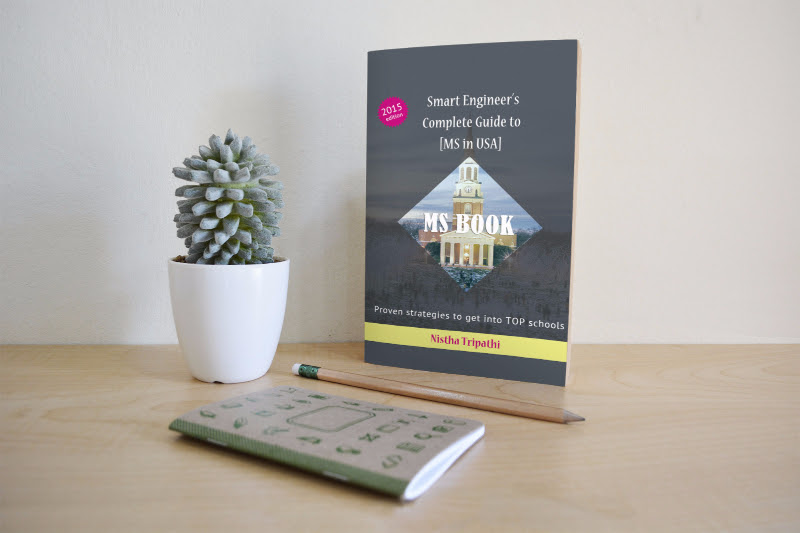
In this post, we discuss how much does it cost to do an MS in USA and why it is affordable for you. Some of the content is taken from the MS Book: Smart Engineer’s Complete Guide to MS in USA.
If you are concerned about finances of managing a Master’s degree education, a good way to start is to understand:
For this, we need to understand what total expenses you are likely to incur, what kind of income are you expecting after graduation and how much can you save. This is known as break even analysis and I have covered it in detail in the MS book so that you know what to expect. Doing this analysis using the tools in the book will let you feel more comfortable about the decision.
The cost of MS in USA is a sum total of what you spend in getting there + what you spend after getting there. Following is the breakdown:
In short, the cost of doing your Master’s in US can go up to $75,000 which comes to ₹50 lac at the exchange rate of 1 USD = INR 75.
For e.g. if you spend $77000 on your MS (tuition + living + interest on loan), getting $14000 in summer internship, paying a 12% interest rate on your loan of Rs 20L, graduating in 4 semesters and saving 40% of your post-tax salary ($84000 p.a), it will take you roughly 3.15 years to break even in worst case. If you find any assistance or on-campus job (which is very feasible and again, discussed in the book) or graduating in 3 or fewer semesters, you can break even sooner.
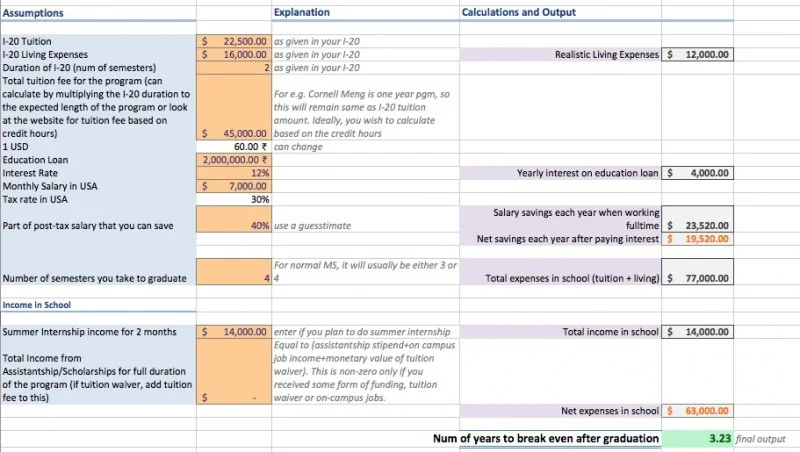
The details of the calculations are covered in the book. You get to download a sheet (snapshot above) that shows you exactly how long will it take to recover your investment in the Grad School. You can add variables as per your specific scenario and play with it.
Let’s say that the sheet tells you that it will take roughly 2 years to recoup your money. Usually, the starting salary in US far exceeds the package in India at that level upon graduation. You can compare the financial benefits and kind of work exposure you are getting in US to decide whether it makes sense for you.
Coming from a middle class family and a mediocre college in Central India, I received admission from MS in CS program at UIUC. That was the 4th best program in the world. From there, I managed to secure an internship at Wall Street for which only 7 people were selected all across the world (I was actually the only girl in there). After getting one of the highest packages ($100,000+) during those days, I decided to get into startups and secured admission to the MBA program at New York University which is 10th best MBA program in the world.
I have lived in Manhattan, worked at Wall Street and startups. That is where I got to network with some of the finest entrepreneurs and investors in USA. Meanwhile, I traveled the world and finally came to India to work on my own ventures and write. I find my life personally and professionally rewarding and I want you to enjoy yours without compromising on your dreams.
Plus, we have helped some of the students at Scholar Strategy inch towards their dream life. For example, one of our first students, Supreeth, had a failed application season before he joined us. He had a good profile but had some weaknesses. We helped him highlight his strengths, focus on the programs that were better for him and re-apply. He wanted to get into Robotics and he was able to get into one of the Top 10 programs in that field. After a year, he emailed us to inform that he will be interning at Microsoft Research Labs. Now that is what I call a perfect hustle and not giving up till you reach where you want to be.
You would say I got lucky or Supreeth got lucky or I had some advantage that you don’t. But my background will show you that I began just like you are now. And that anyone can reach the places I did. Back in college, I also thought that US education is unaffordable but now I know how wrong I was! It is within your reach. Not only that, I strongly believe it is worth all the expenses.
I devoted an entire section in the MS Book to tell you how to think about money and finances and why MS is totally affordable. But let’s quickly understand how to look at it here.
I considered my MS fee as an investment and not an expense. If that is how you look at it, then you realize that its not the money that is sinking down the drain but you are gaining:
Imagine applying for a job with a credible international grad school degree in your resume. Who is the employer going to recruit? You with a reputed degree from US or someone with a relatively unknown degree in India?
And with a little hustle, you can manage funding for your education abroad.