

More applicants are considering MS in MIS and MEM programs for their Master’s ambitions these days. Let us understand the scope of these programs and whether you should consider them too. The process for applying to these programs is same as MS in USA.
What is MS in MIS about?
MS in MIS stands for Master’s in Management Information System. It is one of the most popular techno-management programs that engineers go for.
Specifically, MS in MIS is an engineering management program that teaches how to use IT to manage huge volumes of business-relevant information to facilitate strategic decision-making. One might think of it as a less competitive version of MBA specializing in IS (but then, less reputed than an MBA too).
Why are techno-management programs getting more popular?
As technology spreads to every tiny aspect of our lives, role of engineering management is becoming more relevant in every domain and industry. Be it pharmaceutical or an agricultural company, everyone is dealing with information. While chemical, mechanical, civil, hardware electronics engineering deal with tangible products, software and computer engineering deal with the abstract information.
Understandably, there has been a constant increase in the demand for managers who understand technology and management aspects alike. This gave rise to programs such as MEM (MS in Engineering Management), MIS (Management Information Systems), MIM (MS in Information Management), MSIS (MS in Information Systems) and so forth.
With few differences, these programs aim at combining technical depth with business breadth so that the students can understand both management and engineering language. One theme that underlines all these programs is that they are core business programs with engineering electives or vide versa. The focus is still on management courses such as statistics, analytics, supply chain etc and one can pick electives in database, programming, networks etc.
What is the curriculum of MIS and MEM programs?
It has a combination of engineering and management electives. Some programs are heavier on engineering courses and some are more focused on management courses. Therefore, it is crucial to study the curriculum before choosing to apply to a program – make sure it fulfills your interest.
Some MIS courses also offers specialization tracks. For example, CMU MISM offers following tracks:
- Managing AI & Robotics
- Digital Marketing & Commerce
- Business Intelligence
- IT Strategy & Management
- Health Care Informatics
Duke MEM is more business oriented and offers the following:
- Customer Experience and Product Design
- Data Analytics and Machine Learning
- Operations and Supply Chain Management
- Product Management
- Technology Development and Commercialization
- Entrepreneurship and Founders
Engineering electives can include:
- Data Mining
- Artificial Intelligence
- Networking
- Object-Oriented Programming in Java
Business electives/core can include:
- Marketing
- Finance
- Management
- Operations
- Modeling
What are the TOP MS in MIS programs?
Here are our handpicked 10 best Management Information Systems courses-
| University | Specialty | Fee |
|---|---|---|
| 1. CMU MISM | The three semester, 16-month curriculum can be reduced to one year for those with at least three years of professional work experience. One of the most prestigious and job friendly MIS programs. However, it can be expensive but you are getting a CMU degree. | $75,100 for 16 months |
| 2. MIT MSMS | The MSMS degree is 90-unit curriculum, with courses at Sloan, in other MIT departments and Harvard University. Those are two schools to kill for – enough said. | $84,134 for 12 months |
| 3. University of California, Berkeley MISM | The 48-unit degree program is intentionally interdisciplinary, combining aspects of computer science, cognitive science, psychology and sociology, economics, business, law, library/information studies, and communications. | $71,767 for 12 months |
| 4. New York University MSIS | Combining computer technology from Courant Institute of Mathematical Sciences and business preparation from Stern School of Business, the MSIS at NYU prepares graduates for successful careers in management positions that require deep technical skills. | $68,517 for 12 months |
| 5. Texas A&M University MSIS | Texas A&M is one of the most affordable comprehensive public universities in the nation. The department also offers scholarships and graduate assistantships. | $51,000 for a year |
| 6. Indiana University– Bloomington MSIS | Graduates of this program are in high demand, with 97 percent of them receiving job offers before graduation. | $45,000 for 12 months |
| 7. Arizona State University MSIM | Classes for the twelve-month on-campus program are designed to accommodate working professionals. Small class sizes and evening classes allow students to get an intimate, collaborative experience while not having to put their careers on hold. | $60,000 for 12 months |
| 8. University of Texas at Austin MSITM | 10 month, STEM designated degree that creates business leaders prepared for disruptive innovations due to emerging technologies, such as deep learning and blockchain. | $55,000 for 12 months |
| 9. University of Texas, Dallas MSITM | The Master of Science in Information Technology and Management is a 36-credit curriculum that prepares students to better understand the world of information technology. | $37,000 for 12 months |
| 10. Georgia State University MSIS | The MSIS offers concentrations in big data management and analytics, enterprise systems, cybersecurity, information technology, health informatics, and management of information technology. | $55,000 for 12 months |
What is MEM program?
MEM stands for Master’s in Engineering Management. It is the generic techno-management program with courses in Marketing, Finance, Management, Operations, Modeling and available engineering electives (not just software but industrial engineering, nanotechnology etc).
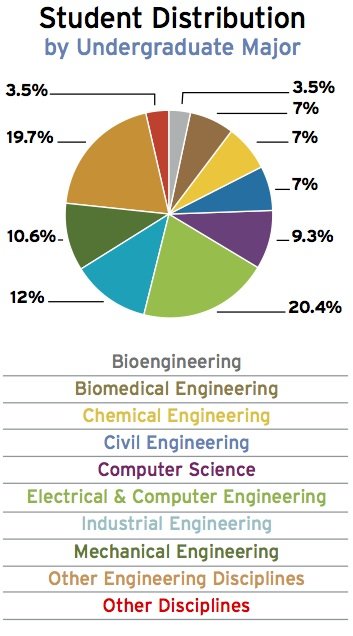
Duke’s MEM program is leading in this category. Look at their electives to get a sense of the course offering. Above chart shows how the incoming student profile is distributed. As you can see, it is widely spread among various engineering majors.
Some other engineering or techno-management programs go under the names of MIM, MSIS, MISM etc.
What kind of jobs can you land after MIS or MEM programs?
MIS – Expect roles such as IT consultants, data analytics engineer, system analysts, data analysts, systems engineer, database administrators.
MEM prepare candidates for consulting, business analysis in any engineering related work function.
Also read FAQ for MIS/MEM programs
If you found this useful, there is lot more information in MS Book: Smart Engineer’s Complete Guide to MIS in USA
Our students are joining MIS/MEM/MS Business Analytics/MS Data Science programs at Columbia, UT Austin, CMU, TAMU, Duke, Syracuse, Buffalo, NEU, UIC etc every year. Contact us if you need help with your MIS/MEM applications.
