
Confused whether to get some work experience before applying for MS? Work experience matters more for some programs but not any kind of experience! Let us check what matters.
Continue reading
Confused whether to get some work experience before applying for MS? Work experience matters more for some programs but not any kind of experience! Let us check what matters.
Continue reading
Many people are shocked to learn that applications to universities abroad can take anywhere between 6-9 months.
It’s not a sprint, it’s a marathon. And, to do well, you need to have a proper plan in place.
The good news is your future does not depend on the outcome of a single exam. One bad day doesn’t ruin you. You can do many things to put up a winning application in the end.
First things first – you need to follow the timeline so that you do not lose track of multiple things that need to be completed. Applying late or very close to deadlines can be detrimental to success. You do not want to do that.
What is the best time to apply to maximize your chances of admit? When should you take GRE? How long should you work on your SOP and essays? If you have all these questions, you are in the right place.
MS in USA application process can be overwhelming and cumbersome. So, here we have tried to put up an easy to understand timeline so that you can keep a tab on what needs to be completed when.
Discipline and time management is key to cracking your dream schools. And it starts from TODAY.
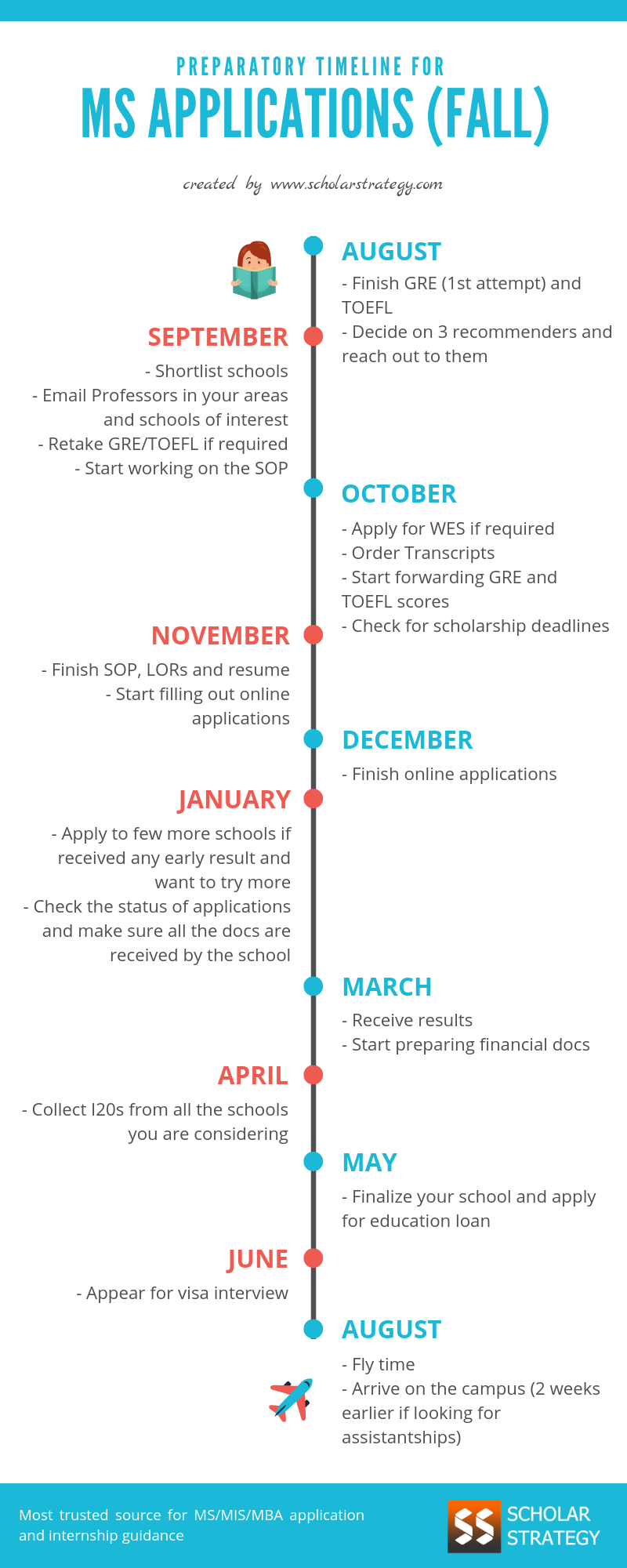
Take by end of Aug so that you have enough time to retake if necessary
Retake GRE if required by end of Sep (need 21 days between reattempts)
by end of Sep – mid Oct. Here’s full post on how to shortlist schools.
Drop emails to relevant Professors you are interested to work with (especially for people interested in research) by mid of Oct.
If any of your shortlisted schools require a WES evaluation, apply for it by the end of Oct since it can take a month or more to get their results.
There are some third party scholarships available for MS applicants. Search these by end of Oct (so that you can apply by their stated deadlines)
from your undergraduate college by end of Oct
by mid Nov
by end of Nov – mid Dec
and if the required material has been received by the schools in Jan. Resend if anything is amiss
by end of Mar-Apr
by end of Apr
by May
by end of June
by Aug (2 weeks earlier if you need to look for funding on campus)
That’s it – it is not as cumbersome if you know what to expect. Save this infographic for a quick reminder.
For personalized assistance for your applications, check our counseling packages.

In this post, we discuss how much does it cost to do an MS in USA and why it is affordable for you. Some of the content is taken from the MS Book: Smart Engineer’s Complete Guide to MS in USA.
If you are concerned about finances of managing a Master’s degree education, a good way to start is to understand:
For this, we need to understand what total expenses you are likely to incur, what kind of income are you expecting after graduation and how much can you save. This is known as break even analysis and I have covered it in detail in the MS book so that you know what to expect. Doing this analysis using the tools in the book will let you feel more comfortable about the decision.
The cost of MS in USA is a sum total of what you spend in getting there + what you spend after getting there. Following is the breakdown:
In short, the cost of doing your Master’s in US can go up to $75,000 which comes to ₹50 lac at the exchange rate of 1 USD = INR 75.
For e.g. if you spend $77000 on your MS (tuition + living + interest on loan), getting $14000 in summer internship, paying a 12% interest rate on your loan of Rs 20L, graduating in 4 semesters and saving 40% of your post-tax salary ($84000 p.a), it will take you roughly 3.15 years to break even in worst case. If you find any assistance or on-campus job (which is very feasible and again, discussed in the book) or graduating in 3 or fewer semesters, you can break even sooner.
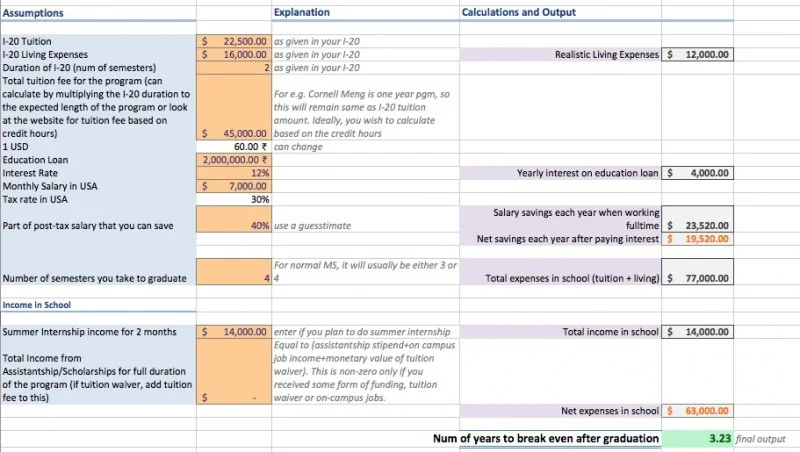
The details of the calculations are covered in the book. You get to download a sheet (snapshot above) that shows you exactly how long will it take to recover your investment in the Grad School. You can add variables as per your specific scenario and play with it.
Let’s say that the sheet tells you that it will take roughly 2 years to recoup your money. Usually, the starting salary in US far exceeds the package in India at that level upon graduation. You can compare the financial benefits and kind of work exposure you are getting in US to decide whether it makes sense for you.
Coming from a middle class family and a mediocre college in Central India, I received admission from MS in CS program at UIUC. That was the 4th best program in the world. From there, I managed to secure an internship at Wall Street for which only 7 people were selected all across the world (I was actually the only girl in there). After getting one of the highest packages ($100,000+) during those days, I decided to get into startups and secured admission to the MBA program at New York University which is 10th best MBA program in the world.
I have lived in Manhattan, worked at Wall Street and startups. That is where I got to network with some of the finest entrepreneurs and investors in USA. Meanwhile, I traveled the world and finally came to India to work on my own ventures and write. I find my life personally and professionally rewarding and I want you to enjoy yours without compromising on your dreams.
Plus, we have helped some of the students at Scholar Strategy inch towards their dream life. For example, one of our first students, Supreeth, had a failed application season before he joined us. He had a good profile but had some weaknesses. We helped him highlight his strengths, focus on the programs that were better for him and re-apply. He wanted to get into Robotics and he was able to get into one of the Top 10 programs in that field. After a year, he emailed us to inform that he will be interning at Microsoft Research Labs. Now that is what I call a perfect hustle and not giving up till you reach where you want to be.
You would say I got lucky or Supreeth got lucky or I had some advantage that you don’t. But my background will show you that I began just like you are now. And that anyone can reach the places I did. Back in college, I also thought that US education is unaffordable but now I know how wrong I was! It is within your reach. Not only that, I strongly believe it is worth all the expenses.
I devoted an entire section in the MS Book to tell you how to think about money and finances and why MS is totally affordable. But let’s quickly understand how to look at it here.
I considered my MS fee as an investment and not an expense. If that is how you look at it, then you realize that its not the money that is sinking down the drain but you are gaining:
Imagine applying for a job with a credible international grad school degree in your resume. Who is the employer going to recruit? You with a reputed degree from US or someone with a relatively unknown degree in India?
And with a little hustle, you can manage funding for your education abroad.


MS in Canada is becoming an increasingly lucrative to international students looking to study abroad. Let’s see its pros and cons over MS in USA.
Trump has hinted that he does not like immigrants (which is the intention of 90%+ internationals who go for MS in USA), H1B caps and OPT rules are constantly under scrutiny and green card processing takes forever.
In comparison, you easily get work permit upon graduation in Canada for 2-4 years in any field to work anywhere you want. The study permit itself allows for taking jobs off campus right from the beginning. Within this time frame, you can easily get your permanent residency. Therefore, studying from Canada means not only getting higher education but a hassle-free option of settling in Canada.
Canada’s political stability, tolerant government, super healthcare, natural beauty lends itself to the wonderful quality of living in a peaceful environment. Yes, winters might be an issue for some people.
I saw the ultimate reward of being in Canada in our alumnus’ Rafi’s response –
“I used to weigh 120+ kg in India and had multiple health issues. After coming to Canada and seeing the fitness of people around me, it made me work hard to become healthy myself. Today I weigh 70 kg and have learned swimming and skiing. I love it here.”
While Canada may have a fewer number of schools than the USA, most of them are comparable in quality of coursework and research to the top tier schools of USA.
Plus, for all the health and wellness benefits it offers, the job scenario is also not bad (we are talking about engineering fields for this post). There are increasing opportunities in growing fields such as Data Science. Plus, most of the bigger tech companies are opening offices in Canada if not already.
In terms of the cost of attendance and living, it may be akin to the USA in total. However, financial aid opportunities seem to be abundant in good Canadian universities.
Also read: Courses with high ROI in Canada
As is the case we discussed in MS in Germany blog post, downsides of studying in Canada are:
While it is not unheard of to get $100K USD+ packages in the USA in software and technology along with handsome relocation bonuses, Canadian offers are lower with little bonuses.
It is hard to get placement in US offices from Canada. So, if you graduate from Canada, you are best positioned to work in Canada only. I still believe that the USA offers the best job market and growth opportunities in most of the engineering fields.
To summarize, those looking for long-term settlement, relocation to a foreign country and peaceful living, Canada offers you a wonderful opportunity. But if you are studying abroad to earn as much as possible and might want to come back to India, USA is still a better bet.
The comparison is more clear from this interview with Rafi Alam. He shares insights about studying and working in Canada.
Also read: MBA in Canada for Indian applicants
Hear it from Rafi Alam
Read Shreya Rajput’s account of studying in Canada – how do the work visa and PR work?
That’s it, hope it helps you make a more informed choice for your study abroad plans!
We have now covered MS in Germany, MS in Canada and MS in USA. Which other country are you considering and would like to know more about?

Did you know that Hyperloop competition by Elon Musk was won by TU Munich students for a second time! That is not all, pursuing MS in Germany can nearly be free in technical streams. German schools further help all students in getting co-ops kind of internships for practical training. However, there is still a catch when you compare it to USA. Read on to find out…
In an interview with Sangram Gupta, we chat about his experience of pursuing an MS in CS from TU Munich, Germany. He is also interning with a Business Intelligence startup called Incuda.gmbh where he is earning 15 euros per hour. Best thing – he did not spend a single penny in his MS.
Let us find out more directly from him in this video-
Here is the list of top German schools that Sangram considered while applying.
We have now covered MS in Germany and MS in Canada. Which other country are you considering and would like to know more about?

“Everyone from derivatives traders to hedge fund managers want to predict financial market outcomes. Who wouldn’t bet on a sure thing? The reality is that no one can really guarantee where the stock market is headed. But don’t think people aren’t trying. Financial engineers are the folks that just might figure it out.” – reads the description on Baruch Master’s in Financial Engineering program website. Although that sounds a tall claim to me, the fact is that these programs are on a rise.

For long, finance as a field attracts engineers because of the stupendous compensation packages as well as the glamor. While the traditional route has been to study MBA later in your career to move into Banking or Trading, why compete in those super-duper competitive Business Schools? Why not go directly for a Finance course? Enter Master of Financial Engineering (MFE) degree programs such as CMU, Columbia, Berkeley, UCLA, NYU, Cornell, Washington etc. Baruch is probably the cheapest of the lot but ranked quite high.
The finance industry needs people who possess deep mathematical modeling skills and computational expertise. While no specific undergraduate major is required, most students will have a degree in quantitative subject matters such as mathematics, engineering, computer science, physics, etc. Engineer’s quantitative and programming skills lend themselves well to solving the complex and creative challenges of today’s financial markets. Although it is not related to traditional branches of engineering, the field picks a lot of people with engineering backgrounds (as is true with MBA). Financial engineering draws on tools from applied mathematics, computer science, statistics and economic theory to address current financial issues as well as to devise new and innovative financial products.
One can venture into Computational Finance, Risk Management, Corporate Finance, Algorithmic and Technical Finance etc.
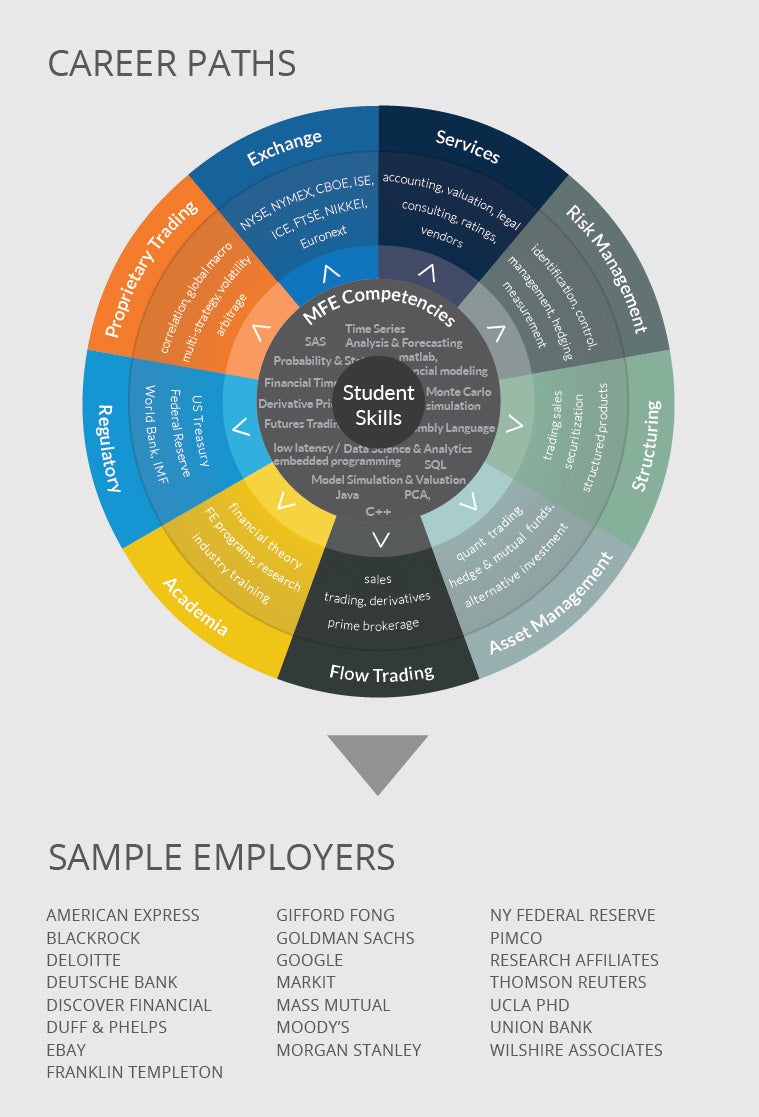
Following image is taken from UCLA MFE course website. As it shows, one can go into risk management, trading desks, financial services, quant pricing, regulatory roles etc. Often incoming students are also coming from similar roles and are looking for further specialization. In non-finance category, probably engineers make the biggest chunk of the incoming class.
If you have made your mind to get into finance industry and some relevant experience or background, MFE might offer you good opportunities with the advantage of lower competition than traditional MBA (Stanford MBA has acceptance rate of <6%). Plus, make sure you love Mathematics!
Join us and we will guide you with our very strategic guidance! 🙂 Strong quantitative background, preparation for CFA, programming skills, mathematical modeling tools knowledge etc helps. Rest, we help you step by step in crafting a strong story and guide you through our selective sample SOPs.

If you did not receive your dream admit in Fall or if you had missed your Fall deadlines, you are probably considering a critical question that many applicants are confused about – Fall vs Spring?
Although it remains inconclusive whether starting your graduate school in Spring adversely affects your admission chances, there are few things you should know about applying for Spring semester:
Primarily, not all schools have a Spring intake and hence, your choices of programs that you can apply to are fewer than what you have in Fall. Moreover, some schools have Spring applications only to fill out their left over seats from Fall admissions and admit students on a rolling basis. Some of the schools that have a Spring intake are:
You can get a CPT only after 9 months of your arrival into USA. For this reason, Spring students cannot get a CPT to intern off-campus during their first summer. However, they can still do a full-time summer internship their second summer but they need to attend one more semester at their school after finishing the internship. This means that they cannot do a summer internship in the second year if they are planning to graduate in 3 semesters only. If a summer internship is critical for you, then consider applying for a course beginning in Fall so that you do not face such restrictions.
Do enquire with your department if summer internship is possible after going in Spring. Our student Praneeth confirms that SUNY Stonybrook does NOT allow it.
While some people argue that chances of scholarships are low in Spring than Fall, there is no evidence to support this. It all depends on the availability of funding with the university and the Professors.
There is another notion that not all the mainstream courses are offered in Spring. Again, I have seen this both ways i.e. some courses are offered in Fall typically and some in Spring, so there is no general rule across all the schools. More popular courses might be offered preferably in Fall since that is the most common intake period and number of students enrolling for the courses are higher in Fall. However, it is better to take a look at the curriculum before assuming that you will not find enough good courses in Spring. You might be interested in some courses which are offered in Fall only but the chances are that you can take it in your second semester anyway. Many courses are designed such that you can take first part in fall second part in spring, you wouldn’t be able to take these courses in spring.
It might also be very difficult to get accommodation when you join during spring as most leases start fall and end in summer. You also miss the big university wide orientations that happen during fall. January weather in east coast is pretty bad too.
This is part of the MS Book. To get more such relevant information, please check out MS Book: Smart Engineer’s Complete Guide to MS in USA.

Here are the fabulous results for Spring/Fall 2017, we have some great new schools to our portfolio now – UIUC MS CS, UT Austin, MS CS, UCLA MS CS, UC Davis PhD, Wisconsin Madison MS EE, CMU ECE, Berkeley MIS, Foster MIS, Virginia Tech CS, Purdue Mechanical etc etc! If you are applying next year and want to work with us, check out our Counseling Options.
Here are Spring/Fall 2016 results (awesome, isnt it? 🙂 )-
And here are the results from Fall 2015-
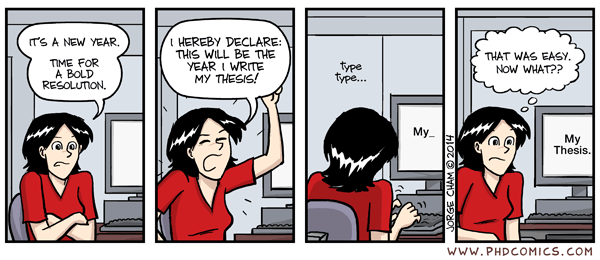
And for all the graduate and to-be-graduate students, your academic life is incomplete until you read all the PhdComics. Here’s one for you-
Presenting the case study of AG’s successful MIS application journey.


AG graduated from NIT Allahabad with a great GPA of 8.55 and incredible GRE score of 332 (170, 162, 5). He had a Toefl score of 112 and will be finishing 3 years of work experience at Oracle before moving for his MIS program. His professional and academic projects gave him enough credibility for the IS stream. His goal was clear from the beginning to go for MIS and not normal MS in CS. This helped focus on exactly the programs he wanted. Sometimes, students are trying to apply for both and their efforts eventually get diluted. Since his profile was above average, he selectively applied to only the top programs – CMU, TAMU, University of Arizona and IU Kelley. His first interview happened for Kelley but the group case study didn’t go as well as he wanted, turning into a reject. However, he aced all apps after that getting into CMU, TAMU and Arizona.
Some lessons-