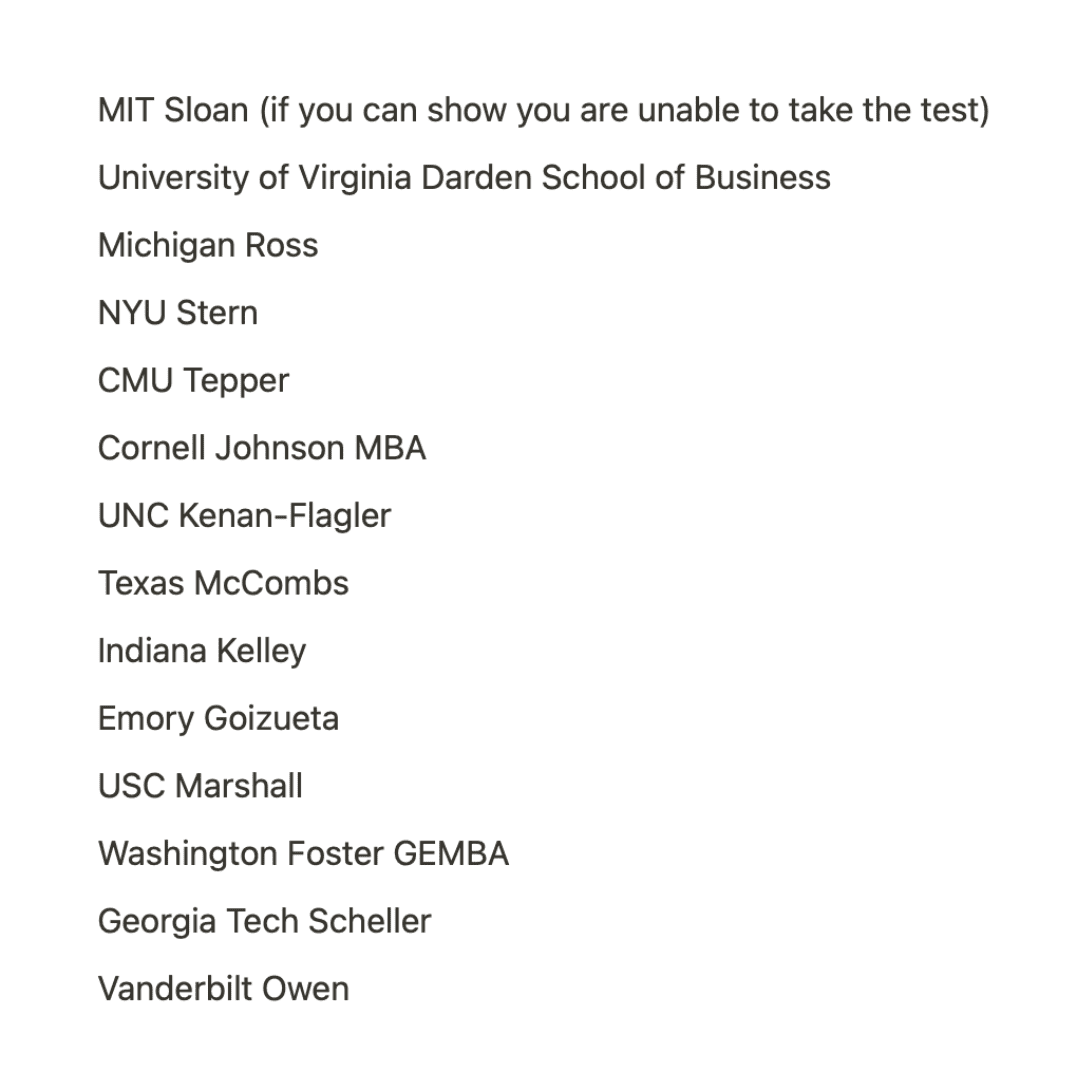
Gone are those days when you can’t apply to any business school without having your GMAT scores. In today’s times, top universities have programs that promote diversity, and let applicants boost their profile over their GMAT scores by offering GMAT waiver through multiple ways.
If you are looking to apply to your dream university without actually submitting your GMAT scores. this article is for you. Find a complete list of MBA colleges that do not require GMAT scores for fall 2023.
B Schools offering alternative tests instead of GMAT
Non-US MBA programs that allow GMAT waivers
1. B Schools where you can request GMAT waiver
MBA programs do not give flat GMAT waiver (except very few). But they allow you to request a waiver. If you can demonstrate your analytical and aptitude skills via any other thing such as another relevant MS degree, CPA, CFA kind of exams, relevant job role, expired GMAT/GRE score etc, then some universities waive off GMAT.
When GMAT waiver is based on GPA, they typically ask you for proof such as your transcripts and CV. On the other hand, some institutes ask you to submit an essay describing the conditions under which you are asking for a GMAT waiver.
Let’s take a look at some such programs that give you an option to get waiver:
2. B Schools offering alternative tests instead of GMAT
Some other programs require you to take an alternative test such as Executive Assessment (EA) or their internal business school test to submit instead of a GMAT/GRE score. It means that you still have to give some test even if its not GMAT.
The Executive Assessment is an entrance exam that was designed specifically for applicants to executive MBA programs for professionals with about 10 years of business experience. It was created by the Graduate Management Admission Council (GMAC) and designed for “experienced leaders” who are interested in applying to graduate school but who don’t necessarily have the time to prepare for the GMAT.
Lets look at which schools accept EA or another test in place of GMAT:
Columbia Business School
Duke University Fuqua School of Business
Baruch College Zicklin School of Business
Case Western University, Weatherhead School of Management
Fordham University Gabelli School of Business
Georgetown University McDonough School of Business
University of Nevada, Reno
University of Toledo College of Business and Innovation
Vanderbilt University Owen Graduate School of Management
Stanford Graduate School of Business (MSx)
3. Non-US MBA programs that allow GMAT waivers
Please note that US is more particular about GMAT. If you are open to B schools in Europe, Canada and other countries, you will have more options.
Let’s look at some of these:
Imperial College London
ANU (Australian National University)
Ivey Business School and Rotman Canada (gmat waived for applicants who have passed all 3 Levels of the CFA designation)
IE Business School, Spain
Amsterdam Business School
EGADE Business School, Mexico (#1 in Latin America)
SDA Bocconi (can take their SDA Test instead of GMAT/GRE)
So this was the list of all popular and well-known universities around the world that are waiving off GMAT for fall 2023. Most of these schools will only have Round 3 deadlines pending now, so hurry up and apply to your dream schools!
Whenever you are applying to a business school or a management oriented program, you might have to evaluate the merits of taking GRE vs GMAT.
Before you make up your mind about the most suitable aptitude test to enhance your chances of getting into an MBA program, you should get familiar with the differences between GRE vs GMAT.
The most fundamental difference between GMAT and GRE is that GRE is used in the admission process of many different graduate school programs while GMAT is limited to business oriented programs. However, there are several other factors that you must make yourself familiar about.
In this detailed guide, you will get to know about all the major differences so that you are able to make the best choice.
GRE vs GMAT: Popularity
More than 1200 business schools accept the Graduate Record Examination (GRE) all over the world. GRE is typically considered the test that is suitable for creative individuals. Similarly, the Graduate Management Admission Test (GMAT) is accepted by all business schools because it has been considered one of the most reliable ways to assess the applicants by the business schools for a long time now.
GRE Structure
GRE consist of three major sections:
Analytical Writing
Quantitative Reasoning
Verbal Reasoning
The score range for the analytical writing section of the GRE is 0 to 6, while both the verbal and quantitative reason sections have the range of 130 to 170. These three sections are scored separately and not combined into a single score.
Candidates take the GRE on a computer. It is a section-level adaptive test which means the applicants’ scores on the first section will affect the difficulty of the questions on the next sections.
The GMAT aims to assess the applicants when they are applying to a business school like an MBA program. Unlike GRE, GMAT is used only by business schools. There are four main sections of the GMAT:
Analytical Writing Assessment
Integrated Reasoning contains
Quantitative section
Verbal section
The candidate will get a composite score in the range of 200 to 800. The scores from the analytical writing and integrated reasoning are not included in the composite score.
There are several differences between GRE and GMAT in terms of the duration, pattern, sections, registration fee, and other such factors. These differences between GRE and GMAT are tabulated as follows:
Differences
GRE
GMAT
What is the duration of the test?
3 hours and 45 minutes
3 hours and 30 minutes
What is the total number of essays?
2
1
What is the total number of sections?
6
4
What are the marking criteria?
Verbal and quantitative reasoning sections have score ranges of 130 to 170, and the total score is between 260 to 340.
Composite scores are given in the range of 200 to 800
What are the registration charges for these tests?
$205
$250
When should you take GRE or GMAT?
When you want to get admission in a business school graduate program like MBA
When you are not sure about the kind of graduate program, you want to get admitted to.
How long are the scores of GRE and GMAT valid?
Five years
Five years
How do the candidates take the test?
Computer-based test. Paper-based tests are also available in selected regions.
Computer-based test
GRE vs GMAT
GRE vs GMAT Quantitative Section
Quantitative Section of the GMAT
The quantitative section of the GMAT mainly focuses on problem-solving and data sufficiency questions. Candidates typically have to solve equations, graphs, evaluate different types of data, and apply data in different situations.
Quantitative Section of the GRE
On the other hand, the quantitative reason section of the GRE typically deals with the candidates’ skills in algebra, geometry, data analysis, and arithmetic. Following are the major differences between GRE and GMAT in terms of their quantitative sections.
Differences
The differences between the quantitative sections of the GRE and GMAT are as follows:
Differences in Quantitative Sections
GRE
GMAT
Number of questions
20
49
Duration
60 minutes
105 minutes
Score
130-170
Quantitative: 0-6 Integrated Reasoning: 1-8
GRE vs GMAT quant
Generally, the quantitative section of the GMAT is considered to be more challenging than the GRE. The reason behind this conclusion is the fact that GMAT focuses on data sufficiency questions that are typically difficult for many students.
GRE vs GMAT Verbal Section
Verbal Section of the GMAT
The verbal section of the GMAT consist of the following three types of questions:
Reading comprehension
Sentence correction
Critical reading
Verbal Section of the GRE
The verbal section of the GRE consists of the following three types of questions:
Reading comprehension
Text Completion
Sentence Equivalence
Differences
Differences in Verbal Sections
GRE
GMAT
Number of questions
40
41
Duration
60 minutes
75 minutes
Score
130-170
0-60
GRE vs GMAT verbal
There are no significant differences between the kind of questions asked in the verbal sections of the GRE and GMAT. Yet, the difficulty level of the verbal section of GRE is little more than the GMAT because, typically, challenging vocabulary and reading passages are included in the GRE.
Differences between GRE and GMAT: Analytical Writing
Analytical Writing Section of GMAT
This section includes one essay that the candidates have to complete within 30 minutes. The task is given in the form of an argument, and the candidates have to evaluate its strengths and weaknesses.
Analytical Writing Section of GRE
In this section, the candidates are required to write two essays. One task is related to analyzing an argument, while the other one is associated with analyzing a task.
Differences
Differences in Analytical Writing
GRE
GMAT
Number of questions
2
1
Duration
60 minutes
30 minutes
Score
0-6
0-6
GRE vs GMAT writing
Even though there are two tasks in the analytical section of the GRE, the difficulty of this section on both GRE and GMAT can be considered the same.
GRE or GMAT: Which exam should you take?
The purpose of discussing these differences is to help you out in choosing the best test that you think you can ace and get admission to your dream university. You can easily narrow down your options by checking which business programs accept GMAT scores and which ones accept the GRE.
Generally, if you have a very specific goal of getting admission to a business school, you should consider taking the GMAT. Many business schools prefer the GMAT over GRE because it has questions directly associated with the skills you need to succeed in a business school graduate program.
Whatever your final decision can be, you can rely on our extensive guides to get high marks on the GMAT or GRE.
Taking the GMAT is a critical point in the academic lives of many people all over the world, including India. You need to be fully equipped with the essential skills and knowledge to prepare for the GMAT and ace it. It is quite understandable that you must be familiar with the concepts and their applications to succeed at GMAT.
However, the significance of the preparation phase cannot be understated when it comes to making sure that you can achieve an excellent score. Many people think that only reading a GMAT guide book or taking prep classes is enough to get high marks in this aptitude test. While all of these strategies will help you, you should also examine your specific situation and determine the best way to prepare for the GMAT.
Taking sufficient time to plan for GMAT will help you in the long run because you will have everything mapped out efficiently. No matter how intelligent you are, you must not take this preparation phase lightly. Both hard work and smart work will help you in acing the GMAT.
Once you are familiar with the fundamentals of GMAT, the next thing to do is to start preparing for it.
In this article, you will get the answers to some of the most common questions associated with preparing for the GMAT.
How long does it take to prepare for GMAT?
Generally, the following factors have the greatest influence on how much time it will take to prepare for the GMAT:
Your current level of preparation
Target GMAT score
Resources you are using to prepare for GMA.
To determine your GMAT baseline score, you can take the GMAT mini quiz or an extensive practice test. Ultimately, the exact amount of time can greatly vary from student to student.
How to develop the stamina to prepare for GMAT?
It is important to have enough energy and stamina through the GMAT exam to make sure you can achieve a high score on all of the sections. Many students tend to get exhausted by the last section of the exam. Hence, you have to be good at sitting for continuous 4 hours to succeed at GMAT.
Some important tips that you should follow in this regard are:
Attempt the 4-hour GMAT practices at least every two weeks.
Do not take breaks between these tests as you will not have such an option in the actual exam.
Attempt the entire practice test in one go and do not skip sections. It is always a good idea to follow the given order, so you are used to it by the time you take the GMAT exam.
Ensure that you are getting used to taking the exam physically as well as mentally.
Focus on improving your analytical and decision-making skills because you will have to make around 350 decisions during the exam.
Taking the GMAT exam can be strenuous for anyone, so ensure that you are equipped with the right skills to get through the exam, and practice is the best way to get these skills.
Should I take GMAT Practice Tests?
Definitely, yes! To prepare for GMAT and achieve a high score, you should never ignore the importance of taking GMAT practice tests regularly. These tests help you in measuring and tracking your progress, getting used to performing under time pressure, reviewing the missed problems, and fully understanding the errors you made. When you take GMAT practice exams regularly, you will not feel much pressure on the test day.
You can use the following resources to attempt GMAT practice tests:
It is important to note that the GMAT exam is not only a test of your intelligent quotient (IQ). Similarly, it cannot be limited as a test of one’s English skills, verbal skills, or mathematical ability. While these subjects do play a role in the test, the fact is that GMAT exam questions are unique and force the candidate to think creatively and apply relevant concepts to different questions.
Your real objective should be to develop critical thinking skills and mental math skills to get a good score in all of the sections. Moreover, you must be able to perform well under time pressure and apply your skills to GMAT questions without getting overwhelmed during the exam.
How can I avoid procrastination as I prepare for GMAT?
Getting started with preparing for any exam, including GMAT, can be challenging for many people. In fact, it would not be wrong to say that procrastination is one of the major reasons why many candidates end up not scoring low on the aptitude exams.
Following are some of the useful tips that you should follow to avoid procrastination while preparing for the GMAT:
Take small steps towards preparing for GMAT by reading about the exam, pattern, syllabus, and other such important information.
Never plan a lengthy preparation session of 3 to 5 hours in one go, as you will end up burning yourself out and start procrastinating.
Watch the online lectures or attend a GMAT prep session to avoid procrastinating.
Make a study timetable and reward yourself when you achieve your goal of the day to ensure you stick to the timetable.
How Should I Create My Study Plan?
Once you have decided to prepare for GMAT, you should start the process by creating a timetable and sticking to it to ensure you are able to cover all of the topics and attempt practice tests to get used to taking such lengthy exams.
Online resources and books like GMAT Official Guide can help you in following a relevant study plan and prepare for the GMAT. You should divide your time as per the four sections of the GMAT:
Analytical Writing Assessment
Integrated Reasoning
Quantitative Reasoning
Verbal Reasoning
One thing that you should never do is create an overly ambitious timetable. It is common to get carried away and plan out long preparation sessions. However, this kind of timetable will end up overwhelming you and making you unproductive in the long run.
Therefore, you should create a timetable with small tasks, especially in the initial days of preparation, so that you are able to stick to it and remain committed to acing the GMAT.
Conclusion
These are some of the most important aspects that you should keep in mind when you are starting to prepare for the GMAT. Other than following these tips, you should always try to find your learning style so that you remain self-motivated throughout the process of preparing for the GMAT. You might like studying simple prep books, or you might be one of those students who only study in a class.
Whatever might be the case, you can excel at GMAT by following these tips and making sure you are preparing for the GMAT in the best way possible.
The Graduate Management Admission Test (GMAT exam) is developed and conducted by the Graduate Management Admission Council (GMAC) all over the world to facilitate business schools in assessing the aptitude of the applicants at graduate-level. Whether you are aspiring to go for an MBA or an MEM degree, GMAT (or GRE) is required by almost all good schools.
There are several important aspects of the GMAT that the students must know about to ensure they are fully equipped with the required knowledge, skills, and experience to take the GMAT exam. This article will help you in getting familiar with all of these important factors like:
Structure of the GMAT exam
Mean scores
Preparing for the exam
Application process
Let’s look at these aspects one by one:
What is the GMAT Exam?
The Graduate Management Admission Test (GMAT) is a standardized aptitude test which the business students must take when they are applying to a business school. Like most of the other aptitude tests like the GRE exam, the GMAT is a computer adaptive test that has multiple-choice questions.
GMAT score, along with the overall academic records and work experience, plays an integral role in accessing the readiness of the applicants for an MBA program. The purpose of the GMAT exam is to evaluate the applicants’ command over grammar, algebra, geometry, arithmetic, and data analysis.
Measuring the ability to critically analyze and understand a wide range of written material is the most important part of a GMAT exam. Hence, having good analytical skills is the key to scoring a high score on the GMAT exam.
The GMAT exam is divided into four different sections. Yet, all of these sections require the same level of critical thinking and analysis skills. Candidates get the choice to choose a particular order in which they want to take the GMAT exam. Three options will be provided to you at the start of the test.
The four sections of the GMAT exam are:
1. Analytical Writing Assessment
This section focuses on evaluating the ability of critical thinking and communication of the ideas.
2. Integrated Reasoning
Integrated reasoning is meant to measure the applicants’ ability to analyze data available in different types of formats and extracting information from this data.
3. Quantitative Reasoning
This part of the GMAT exam is meant to evaluate the ability of the candidates to analyze data and draw conclusions from it with the help of reasoning skills.
4. Verbal Reasoning
As the name suggests, the verbal reasoning section is focused on evaluating your reading and verbal skills to ensure the candidates can fully understand the written material and correct it as per the English standards.
How many questions are included in a GMAT exam?
The entire GMAT exam is divided into four sections. Following is the detailed breakdown of these sections:
The four sections of the GMAT have different marking points, due to which it is important for the candidates to become familiar with these marking styles so that they are able to score higher on the exam. Following is the scoring system of four sections of the GMAT exam:
The analytical writing assessment section is scored from 0 to 6 with half-point increments.
The integrated reasoning section is scored separated on the basis of a 1 to 8 points scale.
Both the qualitative and verbal sections have a scaled score of 0 to 60. These scores are then combined to produce the final score on the 200-800 scale.
When you want to set a GMAT score goal for yourself, you should be looking at the mean or average GMAT score of the MBA programs you are going to apply to. It will be useful in obtaining a good baseline.
Every section of the GMAT exam has a different mean score as follows:
Verbal reasoning section has a mean score of 27
Quantitative reason section has a mean score of 39
Mean score for analytical writing is 4.4
Mean score for integrated reasoning is 4.2
You should know that for the MBA programs, your scores in the verbal and quantitative reason sections are considered to be having the most bearing on the final admission decision.
You can also rely on the following table to get familiar with the relationship between scaled scores and the candidates achieving them:
Percentile
Total GMAT Score
Top 10% of all test takers
710
Top 25% of all test takers
650
Top 50% of all test takers
580
Below 50th percentile of all test takers
570
It is worth noting that Indian applicants face a higher competition in MBA. Check this post to understand how the chances play up for Indian IT Male applicant.
What is the difference between GRE and GMAT?
A major difference between GMAT and GRE is that GMAT was developed especially for business schools, while the purpose of GRE is to cater to a wide range of graduate schools. Generally, the verbal section of the GRE is more challenging than the verbal section of the GMAT exam. On the other hand, the quantitative section of the GMAT exam is tougher than the same section of the GRE exam.
How can I register for the GMAT?
It is easy for the majority of the students to register for the GMAT online by using the portal of MBA.com, a website used by GMAC to assist candidates wanting to apply for MBA programs. Students with special needs will have to submit a separate accommodation request form before their GMAT exam is scheduled.
Why should I take the GMAT exam?
GMAT is a renowned standardized test that is trusted by a large number of business schools all over the world. Your GMAT score can be the make-or-break factor in getting admission to your dream school. High GMAT scores can certainly help the candidates in standing out during the admissions process because it is a great indicator of academic success in graduate business degree programs.
What is the registration fee for taking the GMAT?
In the majority of the countries, the registration fee for the GMAT exam is $250. It can cost more than $250 in some countries. However, the applicants also have the option of applying for a fee concession or waiver of the application fee, only if your business school is ready to make this request. It is quite expensive to take the GMAT exam, so you should only register for it once you are fully ready to take the test.
Which are the best GMAT Books for Preparation?
You can find a lot of books as well as online resources to prepare for the GMAT. However, you do not have to research them all as we have compiled a list of top 3 books you should use to prepare for the GMAT exam:
It is important for you to become fully familiar with the various aspects of the GMAT exam discussed in this article to ensure you are able to prepare for the test and achieve a good score on it to get into your dream business school.
If you have any inquiries or want to get more information about the MBA programs or standardized tests like GMAT, you can contact us anytime.