

Test of English as a Foreign Language (TOEFL) is an exam primarily used to judge the applicant’s ability to communicate well in English — the way they need it in a university. It is a prerequisite for international students/non-native English speakers to apply for admission in many universities worldwide, where the language of instruction is English.
The exam measures the applicant’s English skills in reading, listening, speaking, and writing. Students who are interested to pursue higher education abroad register for the exams like TOEFL.
ETS (Educational Testing Service) conducts and manages all the logistics associated with the exam.
Looking for GRE? Read all about GRE test here.
Types of TOEFL exam
TOEFL is conducted in two formats, i.e., TOEFL iBT (Internet-based Test) and TOEFL Paper-delivered Test.
TOEFL iBT
This is the internet-based/online version of the exam. Over 98 percent of the TOEFL exams given have been taken online because of the easy availability of the internet today. This format has 4 sections: Reading, Listening, Speaking, and Writing.
TOEFL Paper-delivered Test
The TOEFL Paper-delivered Test is conducted 4 times a year for candidates who can’t give the online version of the test. ETS schedules the exam in locations where internet testing isn’t available. It is like TOEFL iBT but doesn’t include the Speaking section.
Since most of the candidates give the exam online, for the rest of the text, the term “TOEFL” would imply the TOEFL iBT test and not the Paper-delivered Test.
Why take TOEFL
The TOEFL exam scores are accepted by over 11,000 universities in over 150 countries.
Global recognition
Universities worldwide recognize the exam as a tool to measure a candidate’s readiness to study in colleges where the language of instruction is English.
As per ETS, here are some statistics that show the popularity of this test:
- TOEFL is preferred by 9 out of 10 American universities.
- Accepted by 100 percent of universities in the United Kingdom.
- Most preferred exam to measure English proficiency for admission in France and Germany.
- Widely accepted in top universities in Asia, including China, Japan, Hong Kong, and Malaysia.
- The universities in Canada get more TOEFL scores than all other English proficiency tests combined.
IELTS is another English proficiency testing exam that is accepted in many of the countries. If you are confused between TOEFL vs IELTS and which one to write, you can read our detailed comparison here.
Flexible schedule
ETS conducts the TOEFL exam 60 times a year. The candidates can register for the exam on the ETS website, via email, or through a phone.
Earlier, it was only conducted at specific test centers. ETS has now introduced a new edition of the exam- TOEFL iBT Home Edition. This edition gives you the comfort of taking the exam from home under the supervision of a live proctor. The conducting body recently launched it in response to the closure of test centers across the globe because of the COVID-19 pandemic.
You can read more about the Home Edition exam here.
Ease of use & a good test experience
- The most prominent advantage of the exam is that you can give it as many times as you want in a year.
- The mandatory wait time between two consecutive TOEFL attempts is only 3 days. You can register online up to 2 days before the exam date.
- ETS provides a free sample test to help you prepare for the exam
- You receive unofficial scores for the Reading and Listening section the moment you are done with the test.
- The applicants receive the TOEFL exam score within 6 days post the test date.
- MyBest™ Scores: You can share your best overall score with universities by combining the highest section scores from all the tests given within the last 2 years
Eligibility
According to ETS, there are no specific eligibility criteria to appear for a TOEFL exam. The candidate should have valid ID proof to register for the examination.
The type of ID needed differs based on the citizenship and the test location preferred by the candidate. For applicants based out of India, having a passport is mandatory to register for the examination.
TOEFL Exam Format
The test has 4 sections – Reading, Listening, Speaking, and Writing. During the test, you will be evaluated by combining these skills. For example-
- Read/listen and then share your response by speaking.
- Read/listen to a question and then write your answer.
As per ETS, this is how the test structure looks like.
| Section | Time Limit | Questions | Tasks |
| Reading | 54–72 minutes | 30–40 questions | Read passages and respond to questions |
| Listening | 41–57 minutes | 28–39 questions | Answer questions about brief lectures or classroom discussions |
| Break | 10 minutes | — | — |
| Speaking | 17 minutes | 4 tasks | Talk about a familiar topic and discuss material you read and listened to |
| Writing | 50 minutes | 2 tasks | Read a passage, listen to a recording, type your response |
Exam Fee
The fee of the exam varies according to the test location. Applicants planning to give the exam from India would have to pay 185 USD.
The below table lists the fee for additional services provided by ETS.
| Item | Fees |
| Registration | Fees vary by testing location |
| Late registration | USD 40 |
| Rescheduling | USD 60 |
| Reinstatement of canceled scores | USD 20 |
| Additional score reports (per institution or agency) | USD 20 each |
| Speaking or Writing Section score review | USD 80 |
| Speaking and Writing Section score review | USD 160 |
| Returned payment | USD 20 |
Click here to check the location-specific fee along with the addresses of the test centers in that location.
TOEFL Scores
A TOEFL score reflects your skill level to communicate in English. Each section of the exam is 30 marks each, which makes the total score of 120.
- The score is valid for 2 years
- You can view your scores online, or receive them by mail by selecting this option before the exam date.
- You can send your TOEFL exam scores to up to 4 universities for free that you select before the test. Post the 4 free reports, ETS charges 20 USD to share your score with the university/agency of your choice.
What is a good score?
The idea of a good score is subjective and there is no single answer to this question.
ETS has set no passing or failing score. Many popular universities need you to have a required minimum score to apply for admissions.
If you get above the minimum required score, your odds of getting accepted at a university increase, and anything below the minimum score would act as a stumbling block during your admission process.
ETS proficiency level
ETS has provided a range of scores to help you better understand your ability to communicate in English.
Listening
Advanced (22–30)
High-Intermediate (17–21)
Low-Intermediate (9–16)
Below Low-Intermediate (0–8)
Speaking
Advanced (25–30)
High-Intermediate (20–24)
Low-Intermediate (16–19)
Basic (10–15)
Below Basic (0–9)
Writing
Advanced (24–30)
High-Intermediate (17–23)
Low-Intermediate (13–16)
Basic (7–12)
Below Basic (0–6)
TOEFL score for top universities
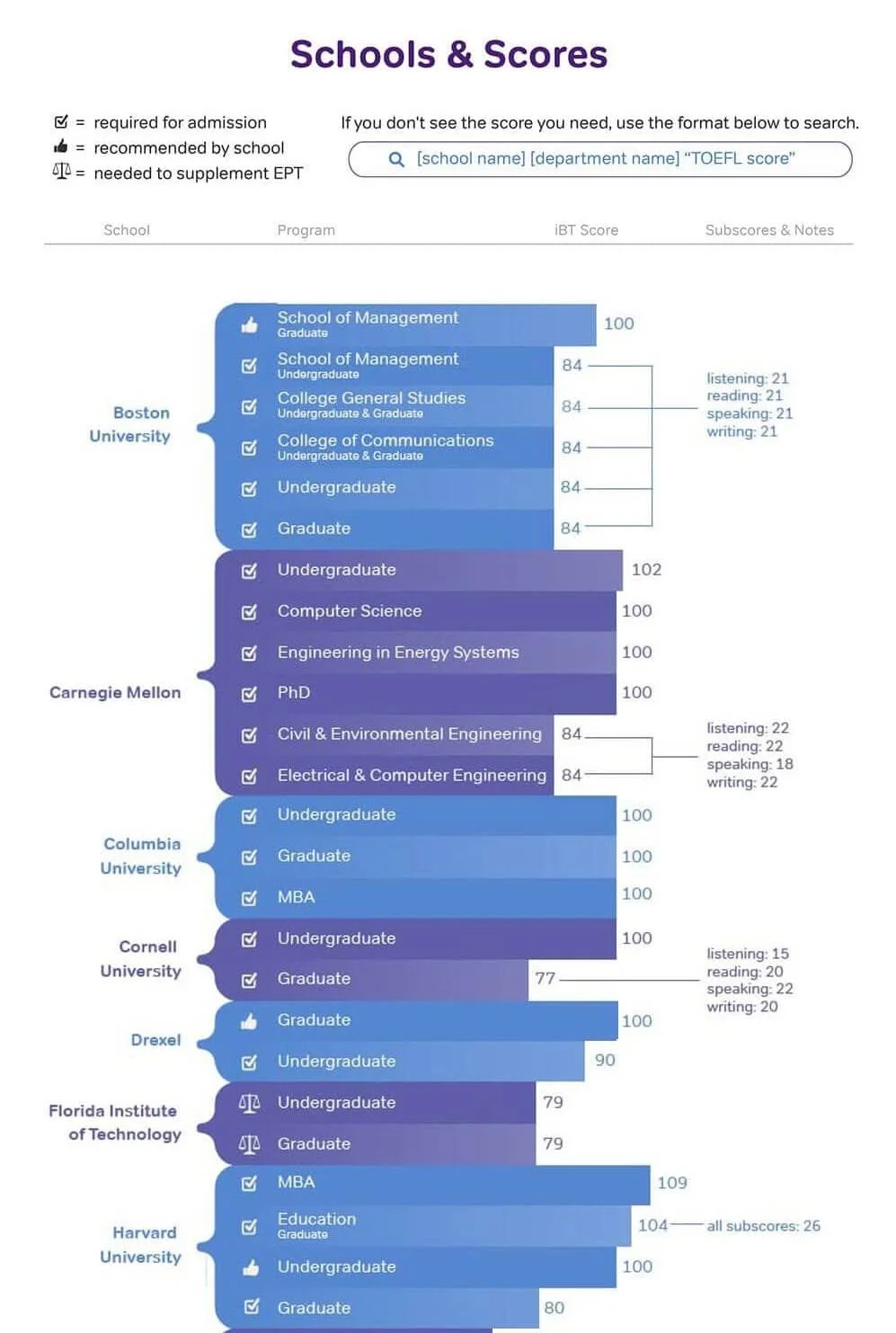
The minimum TOEFL score needed for admission differs across universities and departments within those universities. Use the below format to Google search for the score you would need to get admission to your dream college.
[university name] [department name] “TOEFL score”
For example: If you want to know the score needed for admission into Stanford University’s Graduate School of Business department or MBA, the search query would look like this-
“Stanford Graduate School of Business TOEFL score” or “Stanford MBA TOEFL score”
This infographic by Magoosh will give you a brief idea of TOEFL scores required by some popular schools and will help you set the target score for admission into your dream college.
Summary
TOEFL is used to judge a candidate’s capability to study at a university in English-speaking nations. It is also a requirement in many colleges and courses across Europe and the world for non-native English speakers.
It is hugely popular among top-notch universities and has helped students get into their dream college. The exam is just a prerequisite to filter out applicants who are not fluent in academic English, and the test does not guarantee admission into top schools. Students should focus on their overall application as well, besides preparing for TOEFL.
We have tried to cover key points of the TOEFL exam but there is no better resource to know about it than the ETS website. Please click here to know more.
If you have already given the TOEFL exam and need help with your application, please book a call with Nistha. We have helped many students to get admission to schools like Harvard, MIT, and Columbia.
We can help you get into your dream school abroad.
TOEFL exam FAQs
What is TOEFL?
TOEFL is an English-proficiency exam that is primarily used to judge the applicant’s readiness to join a university abroad.
What is the fee for this exam?
The fee varies based on the test country/location. The applicant has to pay 185 USD if they are planning to give the exam from India.
What are the eligibility criteria for TOEFL?
The exam does not have the eligibility criteria per se. Indian applicants should have a passport to register for the test.
Can I give TOEFL multiple times?
ETS conducts the exam 60 times a year and you can give it as many times as you want. The only caveat is that you need to wait for 3 days before registering for the next attempt.
You can register online up to 2 days before the exam date.
What is considered a ”good” score in TOEFL?
You only need to score above the minimum benchmark set by the university you are targeting for admission. Generally, a score of 100 makes you eligible for admission to most top universities.
Which books are recommended for TOEFL preparation?
The Official Guide to the TOEFL iBT® Test is considered a great resource to prepare for the exam.
Which is better- TOEFL or IELTS?
The exam which is widely accepted in the region/universities you are planning to get admission into is better for you. There is no point in giving an exam if it is not accepted at the university of your choice.