
Most popular universities for Indians in last decade

Popular Grad Schools for Indians

Ever wondered what are the most popular US universities amongst Indian MS applicants?

In 2019, 90,000+ Indian students headed to United States to enroll in graduate programs. Overall, 2 lac + students go to USA every year from India. Needless to say, USA is one of the most popular study abroad destination for Indians.

We dug up some numbers to find which schools are most Indian-friendly! So, here are the Top 10 schools by the intake of Indian students for last 10 years. Unsurprisingly, ASU and UT Dallas lead the pack. We were surprised by CMU’s high intake nonetheless. What do you think?
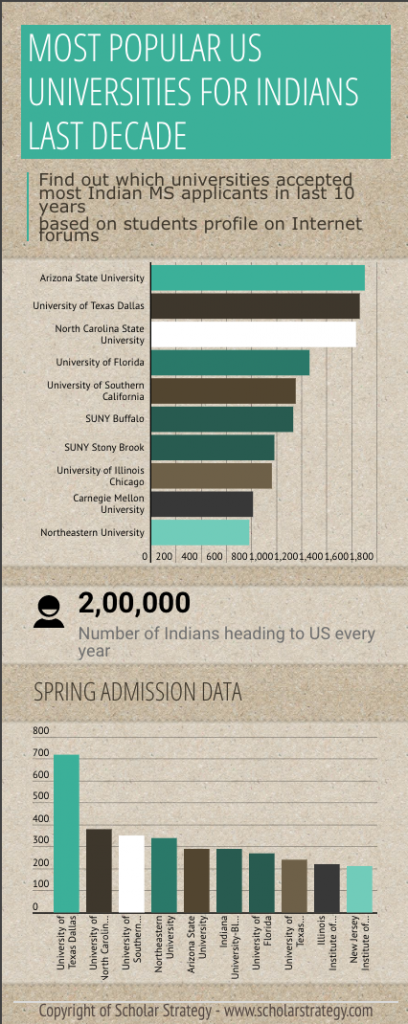
popular US universities for Indians

Top 10 popular destinations for Indian applicants

Where do most Indians head to in Spring?

So, here are the top 10 universities that gave admits to Indians over last decade.

Are you considering applying in Spring? Do read our post about pros and cons of applying in Spring semester.

Disclaimer: This is based on only the data that we gathered from students who reported their results on Internet. However, it should still give a pretty good insight into the bigger picture. 

Should you apply only to popular universities for Indians?

Of course, not. The above information is to help you select some safe schools. You should pick schools that you really wish to attend. See our guide to school selection for MS applications.

Why MBA? Here’s how to decide

Why MBA is a big question mark to tackle not only in business school application but in introspection. Here are few things for you to ponder upon before you make the big decision.

Does it make financial sense to do an MBA?

Assumptions

Let’s talk about full time MBA in USA/Europe where most of the Top B Schools are. Assuming you are currently working in a non-fancy job in industry earning $70K. No interest rate on your student loans for simplified calculations.

Financials

  1. On an average, a FT MBA in USA will cost at least $150K and 2 years. Assuming you were earning $70K right now, that is a cost of $150K+$140K of opportunity cost = roughly $300K. Go for part-time to save your opportunity cost.
  2. For banking or consulting or high growth tech sector, average salaries post MBA can range between $90-$100K (total compensation however can add another 40–80K depending on bonuses). Taking a modest average salary of $130K for our average candidate, 30% tax and $40K living costs, it means 5-6 years of break even period. As bonuses pile up and you ride higher the career ladder with your MBA brand, this is not a problem. You will eventually recover the cost and grow.
  3. For other non-traditional roles esp in non profits or startups, salaries may average out around $80-$90K in an optimistic scenario with no bonuses. You might break even in 8–9 years.
  4. If you end up performing below average or move back to a country where avg salaries are low, ROI may not even make sense extending to >10 years.

What are the biggest benefits of an MBA?

Even if it makes financial sense to do an MBA, you need to have better reasons to spend 2 years of time, energy and money into B School. Plus, it’s not easy. Stanford has 6% acceptance rate and if you are an Indian IT Grad, all odds are against you.

Career Growth

  1. If you are performing decently in your job and keep getting promoted, MBA add on does not help as much. Especially in tech, non profit and startup sectors, MBA may not be as big a must-have as in banking and consulting lines.
  2. If you are already at a senior position, it is better to convince your company to sponsor your Executive MBA.
  3. MBA makes sense if it can help in career switch you are looking for. For example, if you are a software engineer looking to get into Finance, yes MBA will give you what you need and may be the only option you have.

Network/Brand

MBA eventually is about its brand and networking opportunities. How much is that worth to you is something you need to figure out.


I know of 2 good situations which genuinely warrant an MBA-

  1. You are stuck in your career growth in an industry that values MBA a lot. Therefore you need an MBA to move beyond a certain level. For e.g. some companies such as Big 4 Consulting or Wall Street may not consider you for executive roles unless you have an MBA.
  2. You want to switch careers to an industry that worships MBA.

Beyond these, I think you should carefully evaluate your ROI and decide if it makes sense.

Also read: 10 reasons why you should pursue MBA after engineering

I must put a caveat out there. If you want to start your venture, please skip MBA and go for it. You will learn things practically and that is for the best.


Lastly, I must add that MBA is more than knowledge or brand. It is exposure and a way of thinking. Some people know exactly what they are going to get out of it and how they will use it to get multi fold returns. If you are that person, then, by all means, go for it. Because when it comes to education, exposure, opportunities, swag/partying, attitude, and confidence, very few experiences can match MBA.

You will get what you put into it.

I am writing down my half-MBA story from NYU Stern on Pre MBA Book – Scholar Strategy for the same reason.