What does Biden victory mean for International students?

Now that the US marathon election result week has culminated in a Joe Biden victory, are you wondering what it means for international students? How will Biden shape the immigration policies that affect OPT, H1B and naturalization process? And finally, how should you plan your studies abroad in the wake of a new President in the White House? Let’s take a look in this post.

First of all, welcome to a non-Trump world!

Trump made it amply clear that he is driven by nationalist agenda at any cost. Even if it caused US universities to lose their share of international students. First, a ban of new H1B, then curb on online only international students and finally raising the minimum wages for H1B, he kept sending clear signals to attack the immigrants.

Is Biden better for international students?

Biden once said of his priorities, “Trump just ended H-1B visas the rest of this year. That will not be in my administration. The people who have come on this visa have built this country. Let’s streamline the naturalization process, make it easier for qualified green card holders to move through his backlog” 

Democrats are more open and lenient on matters related to immigration. The fact that Biden recognizes America as a nation of immigrants gives a lot of hope to those wishing to build their careers in USA.

However, the specifics of Biden’s stance remain unknown. He is definitely not likely to pass on rash curbs on work or student visas that Trump didn’t hesitate in doing. However, at another time, his campaign also said, “Biden will work with Congress to first reform temporary visas to establish a wage-based allocation process and establish enforcement mechanisms to ensure they are aligned with the labor market and not used to undermine wages.”

Wage based allocation process means qualifying for work visas only if your salary remains above the mentioned threshold. So, all depends on this threshold. As per the latest action by Trump administration, there was a ridiculous 40% hike in the minimum wages required for a H1B sponsorship. It is highly unlikely that Biden will continue or increase this limit.

In a nutshell…

While Biden is overall less anti-immigrant than Trump, there are no promises or specifics known yet. Given the times we are in when countries are struggling to grow their economies, sustain and create jobs for their people, it is understandable that they would tightly scrutinize the borders. International students should cheer after a Biden victory albeit with cautious optimism. 

However, no one can be as bad at Trump. Therefore, change of office and Biden’s victory is a lot of reason to celebrate for international students!

How to take care of your interests?

If you are vying for the top jobs and top companies, US is still the place to be. A 3 year STEM OPT extension plus 6 years on H1B gives you ample time to figure your next move. 

If you want to potentially immigrate to a new country after your studies abroad and don’t want the anxiety related to H1B visas etc, you can consider more immigrant-friendly countries such as Canada. If the Democrats end up not relieving the difficulty on work and student visas, the competition for US schools might dip a little, giving you a better shot at your dream Ivy Leagues. So, for those who are not so set on settling abroad, it is a good time to get into US. 

Anyway with so much changing in the world, who knows what lies next? Why worry for a future long down the line when you don’t know what tomorrow entails 🙂

Other interesting read on the topic: this Scroll article

USA needs International Students

US needs International Students

Last week, a tiny but significant news popped in on our feed.

91springboard ties up with University of Arizona to provide virtual courses to Indian students

Co-working operator 91springboard on 18 July 2020 said the company has tied up with the University of Arizona to provide virtual courses to Indian students at its shared workspace centres.

The University of Arizona, USA, and 91springboard have partnered to provide undergraduate and graduate courses to students and working professionals, the company said in a statement.

Src: PTI

Trump’s anti-immigration policies and rash acts against international students have irked the student community. But think of the universities as well, their business relies on foreign students who come and pay much higher out-of-state tuition fee. Indian and Chinese students make up for a large part of the student community in USA.

So, if Trump is making it tough for international students to come to USA, universities are now stepping up to explore other options. This partnership by Arizona shows that they are looking for ways to continue woo’ing foreign students.

By offering virtual courses but partnering with physical co-working space can give a better than online-only experience to students. So, they are tapping into that market segment which was not going to USA.

Of course, it remains to be seen if such hybrid courses will prove better than what is already being offered online.

Students can choose from over 40 undergraduate (4 years) and 20 graduate (2 years) courses in engineering, computer technology, humanities, business management, and applied sciences, among others.

src: PTI

They are offering the most popular courses among international students. This way, they are also trying to expand their bases in college students – many of who can consider in-person MS later on.

Why are international students important to USA?

  1. They pay higher tuition fee, thereby subsidizing education for domestic students
  2. Almost 25% of the unicorn startups in USA have been founded by an immigrant student
  3. These students spend money on many other things, thus contributing to the economy

What does this mean for you?

If you are an international students, this is an encouraging news because it opens more options to you. You don’t have to worry about being in USA, travel bans etc. You are taking courses at lower price points.

What you should think about though is – are such courses going to devalue the degrees?

Our Analysis

This move can make education more widely available and affordable for a certain segment of international students. However, will it also negatively impact the MS in USA segment? Will it eat on the customer base who was likely to come to USA for their studies? Do they think the higher volume of students who can take such courses virtually from India will compensate for the lower revenues they can generate on such courses?

It definitely shows that the universities are getting desperate and are looking for options to keep the students interested.

In the end, success of any program is determined by its ROI. If and only if a course can help its students get placed in the industry in good roles, will it succeed. That is why Ivy Leagues had been commanding such fee because their degrees were seen as a pathway to successful jobs.

But all that can change. It is an interesting time indeed. The education industry is reinventing itself and we hope its for good.

ICE asking online-only international students to leave USA

International students to leave US

JULY 24, 2020: Update

Just last week, we saw Trump revoking his ban and just when we thought the storm is over, Harvard announced that the ban does not apply to incoming Freshmen. In simpler words, any undergraduate student who was going to enter USA for the first time for his studies on a F-1 visa will not be allowed since college courses are running fully online and the ban revoke does not apply to them.

“International freshmen will not be able to come to campus this fall due to federal visa restrictions,” Harvard’s Indian-American Dean of the College Rakesh Khurana wrote to undergraduates Tuesday.

We are trying to find if this applies to incoming Master’s students as well. For the moment, it looks like USA has still not found its peace with students.

In lieu of the above, shall you continue your study abroad plans to USA? Contact us if you need help planning your future. Nistha has been helping students make their decisions this year more than ever and we are always happy to assist you.

JULY 15, 2020: Update

The Trump administration on Tuesday rescinded its ban on international students who planned to take classes entirely online in the fall as university campuses remain largely closed during the coronavirus pandemic.

Details of the administration’s rollback came during a court hearing over a challenge brought by Harvard University and the Massachusetts Institute of Technology in federal court. According to a court order, both sides had reached an agreement to rescind the policy, which was announced by Immigration and Customs Enforcement last week, sending thousands of students into a panic.

JULY 9, 2020: Original News

USA asked international students to leave the country if they are on an online-only coursework. Our analysis below.

US Immigration and Customs Enforcement (ICE) announced all of a sudden that international students will face deportation if their schools switch to remote learning fully due to the pandemic.

Due to COVID-19, there was a temporary exemption that permitted nonimmigrant students to take more online courses than normally permitted by federal regulation to maintain their nonimmigrant status. This ruling by ICE revokes this exemption and basically states that if you are studying fully online, you cannot stay in USA ?

The U.S. Department of State will not issue visas to students enrolled in schools and/or programs that are fully online for the fall semester nor will U.S. Customs and Border Protection permit these students to enter the United States. Active students currently in the USA enrolled in such programs must depart the country or take other measures, such as transferring to a school with in-person instruction to remain in lawful status. If not, they may face immigration consequences including, but not limited to, the initiation of removal proceedings.

It is devastating and cruel to say the least because online classes are not anybody’s fault. This comes after Trump banning issuance of new H1B visas last month ?

Who does it affect?

  • Current F1 students who are taking classes completely in online mode
  • Anybody planning to start Fall 2020 semester whose program is declared not hybrid cannot get F1 stamped or enter United States

Few options available to you:

  • Change your program of study such that they enroll in either hybrid or in person classes
  • Ask your advisor if there’s a way to enroll in courses which qualify for in-person credits – there might be certain project/independent study kind of courses that fulfill this criteria
  • Some people are talking about taking medical leave or transferring to another college but that is not feasible for everyone

Is there any hope on the horizon?

First, this turbulence is mainly caused by Presidential elections due later this year in USA. Things are expected to settle down after the elections.

MIT, Harvard, NEU have sued the govt for the same in order to protect the students.

India is also planning to raise the issue diplomatically to protect the students.

What are current students saying about it?

Nothing great to report.
Next year’s H1B is my last attempt, and with all the noise around, there is nothing promising to look forward to.
I love my job so that keeps me going and even though there are rumors of layoff, my team seems to be safe from being affected.
On a positive note, I feel lucky to have come here, did my MS and get a job before the pandemic hit.
Almost all the juniors who graduated last month from my college have active job offers, so that’s a great news.
The manner in which classes are being held (online) is a major drawback. Professors hate it, and attending a class in person is miles ahead of attending classes online. It’s not just the classes, but being have to be away from the University buzz is a major setback too.

The kind of support we are receiving from our faculty, and graduate associations (at CMU) is reassuring. But constantly being reminded by this administration that we are ‘aliens’ in this country, irrespective of our contributions, has consistently corroded our motivation to stay here for any longer than is needed. Before coming here last year I was of the opinion that every rule had a rationale that probably benefited the country’s economy or it’s politics. But now I am surprised to see how a country that was built by immigrants can be so xenophobic. Many of my friends are judiciously considering moving to other countries or going back home as soon as things settle. And it’s not only us Indians. An Australian colleague in my dept just sent his wife and 2 kids back home. I’ve heard from Chinese friends who want to go back home as soon as they graduate. I too am considering a future out of this country as soon as I graduate this December.

Colleges are trying to provide a hybrid model for current students so that they can stay. Apart from new i20 issuance (stating that we will be attending hybrid classes), nothing major is impacted for most of the universities (in hybrid mode). PS: College is supporting us in every way they can and Trump administration is doing the opposite. Keep calm and wait for November.

Rest, we are keeping an eye on the events very closely and will keep updating things here. You can also join our hyper active FB group to discuss the issues with fellow students.

Leave your comments and concerns below ?

Trump ban on new H1B visas: updates for Grad Students

Trump Suspends New H1B

Trump has put a ban on new H1B visas – what does it mean for Graduate Students? Here’s some clarifications and advice on moving forward.

President Donald Trump blocked visas for a wide variety of jobs, including those for computer programmers and other skilled workers who enter the country under the H1B and L1 visa on June 22, 2020. It is a temporary ban that will remain in effect till Dec 2020. src: NYTimes

Trump has said that the ban will help domestic workers in USA since the economy is already struggling. The visa suspension could open up 525,000 jobs for US workers, a senior administration official said. The official, however, did not explain how the administration arrived at that figure.

Watch Nistha’s analysis

Will Trump putting a ban on new H1B affect Graduate Students?

The ExecutiveOrder does NOT impact students on F1 visas, CPT or OPT. It only impacts the following categories of visa – H-1B, H-2B, L-1A, L-1B, or J-1. This refers to (intern, trainee, teacher, camp counselor, au pair, summer work travel only) and who do not already have such a visa as of June 24, 2020.

New entry suspensions do NOT apply to any of the following:

  • Individuals inside the U.S. on the effective date of the proclamation
  • F-1 students (including those on OPT, STEM OPT, and/or cap-gap)
  • J-1 students (including those on Academic Training)
  • J-1 exchange visitors in categories other than intern, trainee, teacher, camp counselor, au pair, and summer work travel.
  • Individuals outside the U.S. who already have a valid visa prior to June 24, 2020.
  • Individuals outside the U.S. who seek to apply for a visa in a category other than H, L, or the J program categories of intern, trainee, teacher, camp counselor, au pair, and summer work travel
  • Any application filed with USCIS including OPT, STEM OPT, H-1Bs, changes of status, etc.

How does it impact the students who graduate this year?

Trump’s Executive Order places a ban on new issuance of H1B visas till Dec 2020. If your H1B visa is already filed and approved earlier in 2020, you should not be affected. However, it is best to contact your employer and confirm this.

In general, the proclamation does not negate selection in the H-1B lottery or suspend an employer’s ability to file an H-1B petition for an employee. If you have more specific questions about this proclamation as it relates to changes to your immigration status that are or will be handled through your employer (such as H-1B, permanent residency, etc.) please reach out to your employer’s immigration team or legal counsel for specific guidance for your particular situation.

NC State International Students Office

So, who is this bad for?

The proclamation temporarily blocks foreign workers entering on H-1B visas (skilled workers) and L visas (for managers and specialised workers being transferred within a company). Trump also blocked those entering on H-2B seasonal worker visas, which are used by landscapers and other industries. The suspension also applies to J-1 holders “participating in an intern, trainee, teacher, camp counselor, au pair, or summer work travel program.” 

The order also restricts the ability of American companies with global operations and international companies with U.S. branches to transfer foreign executives and other employees to the United States for months or year-long stints. And it blocks the spouses of foreigners who are employed at companies in the United States.

However, the above does NOT ban someone who is already in USA as well as valid visa holders overseas, but they must have an official travel document that permits entry into the United States.

Is this a bad news for international students?

Not directly since it has no bearing on F1 visas whatsoever. Last month, we heard a good news that H1B will give priority to people who have studied in USA which is a great news for international students. However, if Trump carries on like this and makes H1B more restrictive, it creates a ripple effect on students ability to work after graduation. I have already written about What is happening with H1B – should I apply for MS? Such news create an uncertainty in the job market and employers become more cautious in sponsoring H1Bs.

Can there be more bad news for immigration in future?

The June 22, 2020 proclamation does instruct the Secretaries of the Department of Homeland Security, the Department of Labor, and the Department of State to work together to recommend modifications to the proclamation within 30 days and then every 60 days after that. So, we do not know at this time if the proclamation will change or if new proclamations will be issued. However, OIS will continue to monitor news bulletins for more information and update this FAQ accordingly once we know anything.

NC State International Students Office

What can I do so that these developments do not impact me?

Some of my colleagues from Citi who couldn’t get H1B were relocated to other countries. Companies try to retain their skilled employees as much as possible, they can move them to Europe or Canada if needed. Talk to your employer & figure out your options.

Of course, startups may not have all these options but if they really want you, they figure out a way especially now when remote working is widely acceptable.

If you were planning to apply to US for studies, be prepared for such announcements. I believe US is best innovation hub – the kind of work and salaries you get there is unmatched elsewhere. If your goal is immigration, look elsewhere as well.

There’s something called recession or Trump proof graduate – he’s the one who’s been so busy skilling himself that he knows he can find a job in any market. Be that guy. If you want to figure how can you become evergreen employable, try our career coaching services and contact us.

If you are solid in your fundamentals, you WILL find a job. It may not be what & where you wanted it right away but you won’t be unemployed.

Lastly, world is changing in unexpected ways. It’s better to be prepared for the worst. The moment you accept that anything can happen, you are half way ready to handle it. Think of backup options & be damn good in your field.

You can do this. Good luck ?

H1B good news for Indian students in US: special quota

h1b indian students

The H1B and L1 Visa Reform Act has brought relief for International and Indian students studying in USA. As introduced in House of Representatives and Senate, the act will require US Citizenship and Immigration Services to prioritize people educated in USA for the first time in the annual allocation of H-1B visas. This news came out on 23rd May 2020.

What’s good about this H1B reform act for Indian students?

The new system would ensure that the best and brightest students being educated in the United States receive preference for an H-1B visa, including advanced degree holders, those being paid a high wage, and those with valuable skills.

As of May 2020, H1-B lottery doesn’t differentiate between Indian applicants – whether they are students studying in USA or people employed in Indian companies. Trump often launched offensive on H1-B seekers. But as I pointed out before, his discontentment and attacks are truly meant to be not against people studying in USA but those who come from outsourcing companies and act as a cheap labor replacing American workers. Indian (International) students compete for highly paid jobs at companies like Apple and Facebook and are coveted in the tech industry.

Finally, few Senior Senators are looking into ways to differentiate between desirable H1-B seekers such as MS/PhD students and undesirable H1-B seekers from IT outsourcing companies.

In the Senate, it was introduced by Senators Chuck Grassley and Dick Durbin. In the House of Representatives, it was introduced by Congressmen Bill Pascrell, Paul Gosar, Ro Khanna, Frank Pallone and Lance Gooden.
The legislation reinstates Congress’s original intent in the H-1B and L-1 visa programmes by increasing enforcement, modifying wage requirements and securing protections for both American workers and visa holders, the lawmakers said.

IndianExpress reporting from PTI

What is interesting – these Senators come from both Republican and Democratic party. This strengthens the probability of it getting enacted.

What does it mean?

In long term, graduate students in US will get preferential treatment over Indian employees coming directly and trying to file for H-1B. This reduces the competition and bodes for better chances of procuring H-1Bs by the students.

More than anything, this is a strong message that USA doesn’t want to push away the very students who are studying in its hallowed universities, and whose education it is subsidizing through assistantships. It never made sense for US to invest in students and then tell them to leave the country before they could add to its GDP, contribute to its industries and status.

Many of the Silicon Valleys companies are run by Indians who went to study in USA. The govt is realizing that the whole anti-immigration narrative is hurting its desirability in the eyes of these talented students. While it wants to appease its homegrown workers, it also wants to retain these skilled students and let them create next unicorns on US soil.

Of course, this is still a proposal and you should keep an eye on the updates. However, this bodes well for applicants, graduate students and dreamers. If you dreamed of MS in USA, this bill is a gift.

How Chinese teachers are dealing with coronavirus and helping keep its student’s futures alive

400+ people have died because of the coronavirus in Mainland China. To curb the spread and contagion, the government had to shut down the schools. Whole semester are getting delayed and those students who were preparing for college entrance examinations are left in fray and frenzy.

But like always, China has a way out of their biggest viral problem and unsurprisingly, it involves technology. China’s Ministry of Education issued a statement last week to push schools to use internet platforms as an alternative way of teaching students amid the suspension of the new semester.

Schools are now teaching its teachers to live-stream their classes. Alibaba Group’s DingTalk is one such tool that allows them to keep teaching the children who are no longer permitted to attend the schools. Many older teachers are now having a tough time learning the new generation tools as they strive to keep teaching the traditional subjects to the younger generation.

As per South China Morning Post,

Suddenly, the spotlight is on China’s online education market, which grew 25.7% year on year in 2018 to 251.7 billion yuan (US$35.9 billion), according to iResearch Consulting Group. The previous forecast of annual growth of between 16% to 24% in the subsequent three to five years may now need to be revised upwards.

Companies are also stepping up to deal with the crisis.

TAL Education announced free live-streaming courses for all grades to “minimise the influence on study due to the outbreak” while VIPKID, which specialises in teaching English online, said on Weibo it would offer 1.5 million free online courses to children aged from four to 12.

As of Sunday, more than 220 education bureaus in 20 Chinese provinces had joined the free-of-charge DingTalk homeschool programme, covering over 20,000 primary and secondary schools and 12 million students, according to state media Xinhua.

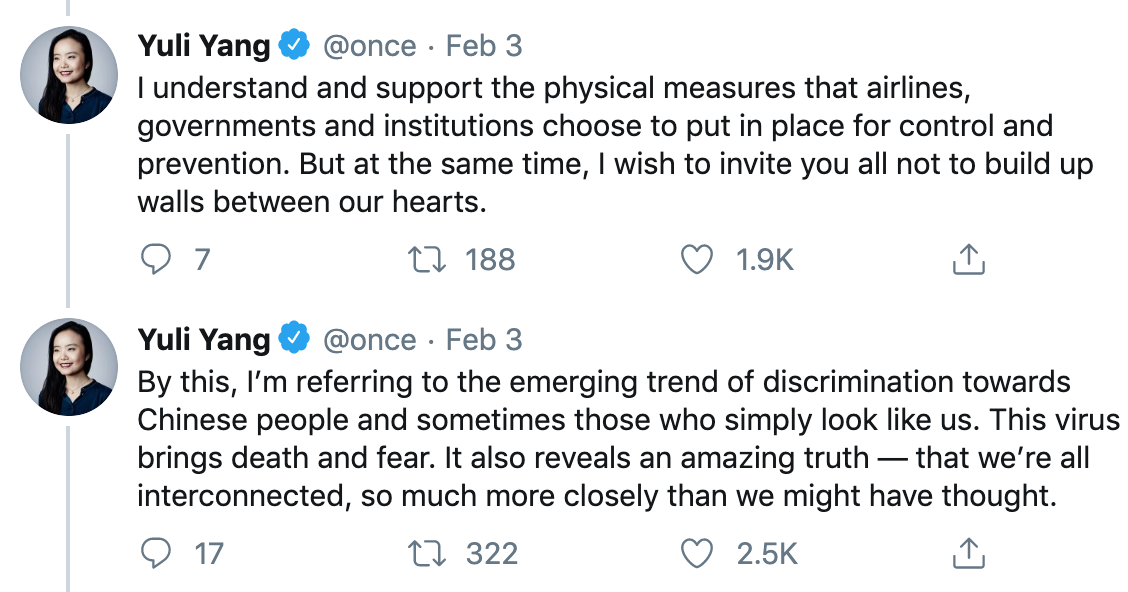
Meanwhile, many Chinese students who are studying abroad may be safe medically but are worrying for their families back home. Recently, a Chinese girl from Wuhan (which is where the coronavirus started) who is now living in HongKong took to Twitter to appeal to the world to be kinder to the people from Wuhan who have been facing wrath from the media worldwide.

Tensions may be fraught between the United States and China, but there are still 370,000 Chinese students enrolled at U.S. colleges and universities. My own alma mater, University of Illinois at Urbana Champaign houses nearly 6000 of them. They are filled with anxiety as every day brings them news of more deaths of their dear ones or new travel bans.

When such contagion arise at this scale, we suddenly realize how powerless we are. And I believe its only technology and entrepreneurship that can help survive these challenges. No, I am forgetting the important thing – the indefatigable human spirit.

China is not surrendering. Its students & teachers are fighting back one video at a time.

Click to read the referred article on SCMP here.

What is happening with H1B – should I apply for MS?

Ever since Trump was elected, there have been articles that blamed his policies on H1B for Indians being forced to exit US. Let us focus on facts and discuss how it impacts your MS plans.

Relevant Anti H1B Bills proposed so far-

  1. Increase in minimum wage requirement to qualify for H1B
    1. A bill called Protect and Grow American Jobs Act was introduced to amend the original Act that created the H-1B program. It asks to raise the minimum salary requirement for H-1B workers to $100,000 a year, up from $60,000, and remove the Master’s degree exemption that allowed the replacing of American workers with foreign workers with master’s degrees. The House Judiciary Committee approved it in November 2017 but it is far from becoming a law at this point. Tech lobby is so strong, I’ll be surprised if this passes ever.
  2. Revoking work permits of H1B spouses
    1. A rule is proposed to revoke work permits of H1B spouses – popularly called H4 EAD. It is currently in “final clearance and review” process.

Bills approved and made into law so far-

None

Other impacts of Trump’s anti-immigration stance:

  1. Employers were wary of what rule might be proposed and hence, were more cautious in rolling out H1B applications for new employees. I have heard Amex managers etc thinking twice before hiring internationals.
  2. In October 2017, the USCIS made it so that H1B extension applications are subjected to the same level of scrutiny as on fresh visa applications. Earlier, if anyone made a mistake in the application, they could get an RFE (request for evidence). However, now USCIS can outright right reject with no obligation to send RFE.
    The ground reality is that some people are seeing a tougher time getting their H1B renewed especially if their real day to day work doesn’t justify the reasons for which the H1B was filed in the first place. If they are doing routine mundane tasks and not requiring higher skills, they are likely to be questioned and may even see revoking of H1Bs.

Who will Trump’s bias really impact? – outsourcing firms who are sending people on client side for no real reason. This was also reflected in the fact that the number of approved H1B petitions filed by Indian IT firms (Cognizant, Infosys) declined in 2017 whereas those by leading tech companies such as Apple, Amazon increased (as reported by NFAP).

Outsourcing IT firms have realized that they cannot bulk file for H1Bs now and there will be tighter scrutiny on applications. As a result, they are also more cautious and not filing too many H1B petitions now.

Quoting verbatim from the above NFAP report-

Emerging technologies, such as driverless vehicles, may also be increasing the demand for people with high levels of technical skill, including foreign-born researchers. Tesla (207 approved new H-1B petitions in FY 2017), Uber (158) and General Motors (179) all employ individuals in H-1B status.

It indicates a shift in preferring to grant H1Bs to direct employers rather requiring more sophisticated knowledge of technology than outsourcing IT firms.


Frankly, these are the only real things happening. I have seen articles claiming that people are leaving USA because of Trump’s policies and they are cherry picking evidence. The height of irresponsible journalism is when they cite reasons such as – H1B is too restrictive, you cannot work for anyone else, I did not get H1B 2 years after graduation. I wrote a big counter article on that which went viral and you must read it.

Let’s be objective. All this was happening before Trump as well. H1B was always restrictive (you could not start your own company on H1B), it was always harder for people graduating with questionable degrees from questionable schools, who did not learn any real skills.

At Scholar Strategy, I have heard from our students who got internships and fulltime employment at Tesla, Facebook, Amazon, Intel, Qualcomm, Google, Microsoft, Apple etc this very year. So, if you want to extrapolate Trump’s frenzy to a doomsday scenario for people who know their shit, all I have for you is ‘I don’t buy that.’

You may say many deserving people on H1B from outsourcing firms are now at risk. I say – yes, they are. But believe me, if you have good skills and are a good developer, Project Manager, Product Manager, software architect – you will never have dearth of opportunities – yes, you may have to work for it.

I advised a 34 year old woman, who was fed up of the IT firms politics and stagnation in career in India, get into MIT SDM program and she interned at Salesforce as a product manager this year. If she can do it, so can you.

But if you are trying to defend skill-less people sitting as managers in middle management layer in so many IT companies – you cannot. They were and are always at risk of being shoved out (even in India) – its nothing to do with H1B. After all, H1B is not a charity, it is a work visa with a specific purpose for its country.

I am not defending Trump by any means, but I am saying that there frankly has not been a damage to prospects of working in USA for good people. In fact, I would argue that going forward, it bodes well for people with advanced degrees from good institutes because they are the ones that will possess the requisite skills.

Updated thoughts after H1B report came out in Feb 2019-

Is it worth doing an MS in the US and get H1B visa?

After Trump and H1B news, is it worth doing MS in USA? Read our detailed analysis to help you decide whether it makes sense to pursue MS abroad or not

Why is Trump after H1Bs?

Trump has so much political pressure because of his promises during the elections that he is going over board. This has been worsened by Disney’s lawsuit where an American employee who was laid off sued that tech companies are not hiring foreigners because they cannot find that talent in US but they are hiring them because of low wages. Making it too tough will definitely antagonize Tech industry which itself is a non-trivial lobby. Therefore, I see it as a short term issue rather than long term.

Obviously, its a multi layered issue. Lets take a look-

What are the proposed changes to H1B visa norms?

As per HindustanTimes, following changes has been suggested in recent bills (some readers have pointed out that some of these are incorrect which shows how misguiding Indian media can be)-

  • Doubling minimum salaries of H-1B visa holders to $130,000 – BAD
  • Earmark 20% of H-1B visas for small and start-up employers
  • Remove ‘per country’ cap for employment visas to ensure equal distribution
  • Firms hiring H-1B visa holders need to make a “good faith” effort to recruit Americans first
  • Give preference to students educated in the US for H-1B visas rather than computerized lottery system – GOOD
  • Crack down on outsourcing companies that import workers for temporary training and then send them back home to do the same job – GOOD
  • Prohibit spouses of H-1B visa holders from working in the US
  • Prohibit companies with more than 50 employees, of which at least half are H-1B or L-1 holders, from hiring additional H-1B employees – BAD
  • Strict audit and vetting by Department of Labor to clamp down on fraud or misuse

Should international students be worried?

Many of these will negatively impact people getting H1B via TCS/Infosys kind of companies. An international F1 based grad student will only be impacted when-

  1. Min H1B wage is raised
  2. OPT extension is removed
  3. MS quota is removed

First point here is quite negative and if its raised to 130K as per the latest proposal on 31 Jan, it will be brutal. No doubt. In fact, if they clamp down more on TCS/Infosys scenarios, it might turn out beneficial to other H-1B applicants (including grad students) because of reduced competition!

There has been hue and cry over H1Bs in the past as well but anti H1B laws never passed. In fact, OPT 24 months extension was a big boost for international students. But it does not mean that the new law cannot pass. I think we need to wait for what happens with this bill. (as of 1 Feb, 2017)

Assuming it passes and minimum wage is raised to 100K+ will impact recruitment and many employers may cut down on campus recruitment of internationals. As one post here points out about Mech recruitment slowdown even from a school like UIUC – that is possible in other non-IT fields as well. Although to be fair, Mech recruiting has always been more sluggish than CS, EE, MIS/MEM recruitment because many jobs are in defense or state agencies which require American citizenship. It means that a student will have to hustle more for limited jobs. That is harsh reality.

So, there is no doubt that circumstances of finding jobs/internships will get TOUGHER if these laws are passed (only if min wage is increased too much, OPT ext revoked).

Now, is it worth doing MS in that case?

I would still be optimistic about MS but I will be cautious on financial matters. USA, still, remains a better job market than most other countries. For tech fields, it is worth a hustle. For non-tech fields, yes, be more wary. A better strategy can be to:

  • Apply to schools with chances of funding/lower financial burden.
  • Apply to schools in urban areas, metros such as NYC, Silicon Valley, Boston, Chicago – if companies get wary of recruitment, they stop traveling to interior locations.
    At the end of the day, there will always be jobs for people with strong skills (in in-demand fields such as IT, Analytics etc) but those who are relying on getting an easier pass just by graduating from US may have to bite a bullet.

In summary, I am not saying that things are all hunky dory and there is nothing to worry but unless this law gets passed, it doesn’t matter. Just like his ban on 7 nations is still in a state of confusion (with federal court ruling against his ban but executive order still prevailing) – things are murky. Let’s wait and watch. So, please be patient.

What I have heard about campus placements so far?

  1. UMCP MIS has seen decline in companies sponsoring H1Bs.
  2. A student seeing a decline in campus placements and H1B sponsorships at NCSU.
  3. Another student was more neutral about her MSBA program at ASU. She will inform once the fulltime recruitment begins this semester.
  4. A student who recently graduated and is on OPT has not reported any negative news in his company yet.
  5. A Harvard CS student is less fearful – ‘I’ve had emails this week from 3 different companies asking me if I’m interested in full-time positions starting after spring. It will definitely have some negative impact, but if you’re good and try hard enough, I’m pretty sure you’ll be able to find a job.’
  6. One ECE student from TAMU – ‘During career fair last week most of the companies were particularly asking about sponsorship requirement which I haven’t heard that much during the career fairs conducted last semester.’

I am not taking sides yet but bracing up for a tough ride if Trump goes rogue 🙂

I mentor students and have been directly helping MS aspirants at Scholar Strategy but I have tried to keep my views as unbiased as possible. The fact is when I went to attend UIUC and graduated, there was no STEM OPT extension. Lottery happened and I lucked out. I could get lucky only because I had decided to take a chance. So, take a calculated risk, an informed decision. Go for MS – not just for jobs but to build your skills and learn. Once you focus on learning valuable skills, job will find you (if not US, a better place) 🙂

This post was originally posted on Quora.

Should you be worried about Trump’s attack on H-1B?

Why is Trump after H-1Bs?

Trump has political pressure to get back jobs for Americans – can act upon that. This has been worsened by Disney’s lawsuit where an American employee who was laid off sued that tech companies are not hiring foreigners on H-1B because they cannot find that talent in US but they are hiring them because of low wages.

H-1Bs are the most coveted work visas: In 2016, the US Citizenship and Immigration Services announced that they received 2,36,000 H-1B petitions within five days of opening the process, more than thrice the number of mandated cap of 65,000 in the general category.

What are the proposed changes to H-1B visa norms?

As per HindustanTimes, following changes has been suggested in recent bills-

  1. Doubling minimum salaries of H-1B visa holders to $130,000
  2. Earmark 20% of H-1B visas for small and start-up employers
  3. Remove ‘per country’ cap for employment visas to ensure equal distribution
  4. Firms hiring H-1B visa holders need to make a “good faith” effort to recruit Americans first
  5. Give preference to students educated in the US for H-1B visas rather than computerized lottery system
  6. Crack down on outsourcing companies that import workers for temporary training and then send them back home to do the same job
  7. Prohibit spouses of H-1B visa holders from working in the US
  8. Prohibit companies with more than 50 employees, of which at least half are H-1B or L-1 holders, from hiring additional H-1B employees
  9. Strict audit and vetting by Department of Labor to clamp down on fraud or misuse

Should international students be worried?

There has been hue and cry over H-1Bs in the past as well but anti H-1B laws never passed. In fact, OPT 24 months extension was a big boost for international students. But it does not mean that the new law cannot pass. H-1B for international students on F1 is a different case from people getting H-1B via TCS/Infy etc (as is evident from some of the proposed reforms above). That said, what can hurt international students-

1. raising of minimum H-1B wages significantly. This directly impacts recruiting.

2. removing OPT extension.

Making it too tough will definitely antagonize Tech industry which itself is a non-trivial lobby. However, it may take some time before we see the opposition able to make a significant impact or pressurize Trump in the opposite direction. I am more worried short term than long term.

In summary, I am not saying that things are all hunky dory and there is nothing to worry but unless this law gets passed, it doesn’t matter. Just like his ban on 7 nations is still in a state of confusion (with federal court ruling against his ban but executive order still prevailing) – things are murky. Let’s wait and watch. So, please be patient.

What I have heard about campus placements so far?

1. UMCP MIS has seen decline in companies sponsoring H-1Bs

2. A student seeing a decline in campus placements and H-1B sponsorships at NCSU.

3. Another student was more neutral about her MSBA program at ASU. She will inform once the fulltime recruitment begins this semester.

4. A student who recently graduated and is on OPT has not reported any negative news in his company yet.

5. A Harvard CS student is less fearful – ‘I’ve had emails this week from 3 different companies asking me if I’m interested in full-time positions starting after spring. It will definitely have some negative impact, but if you’re good and try hard enough, I’m pretty sure you’ll be able to find a job.’

6. One ECE student from TAMU – ‘During career fair last week most of the companies were particularly asking about sponsorship requirement which I haven’t heard that much during the career fairs conducted last semester.’

I will keep you updated on what I get to know – I am not taking sides yet but bracing up for a tough ride if Trump goes rogue 🙂

This post was originally posted on our Fb group for MS internships and jobs.