Rejected by your dream school? This is what you can do

how to handle rejections

Getting rejected hurts. After all that hard work, when you get that ‘we are sorry’ email from your dream school, it is not easy. So, what can you do now? The good news is – there is always a silver lining.

I know the feeling because I have been there. I got 9 rejection letters out of 10 when I applied for MS the first time. And 10th admit was from a university ranked lower than 80 and I don’t even know why I had applied there. So, of course, I decided not to go there and stayed back to work for a year. Next year, I was heading to UIUC for a MS in CS that admitted only 18 students. If I had gotten into a 20-30 ranked school the first year itself, I might have gone and probably missed the chance to be at UIUC. That is how I choose to look at my results.

And that wasn’t the only unfavorable result I had seen, when I applied to MBA programs the first year, I was rejected by them all! Couple of interviews but no final admit – it was heartbreaking and tough. I persisted, applied the second time around and got into NYU Stern! Frankly, I did a lot of introspection the second time around and had a much clearer vision for what I was looking for. And I can tell this with conviction, if I had received an admit in my first attempt, I would NOT have made the most of my MBA because I might have followed the herd, gotten into a stream that I am not that passionate about. When I joined NYU finally, I knew I wanted to work with startups only and had a plan of action. It helped me get a job offer after my first summer itself and I dropped out of the program saving one year of opportunity cost and MBA fee!

So, while our results page is full of glorious admits (which have even caught me by surprise), not every result is a positive one. I have a student who has great potential and he has not received admits at par with his capability. It happens sometimes even though you try your best to improve your success probability. In this post, I am going to talk about rejects and how to deal with them.

I shared my story above to just convey that rejects are not necessarily bad if you do not give up and if you learn from your past experiences. Most of the successful people I know have not been simply lucky, they are just better at dealing with negative results. Did you notice that I haven’t used the word ‘failure’ at all here? It is because these negative results are not a failure by any means. They are only telling you that you should try things differently and get better results. They are telling you to take a breather and punch back harder.

Frankly, I am the kind of person who punches back stronger when I am down. I know you are too. So, cast aside your doubts, ego-bruises and take some time off to relax. And, then get back to work – whatever it is that you need to do to leave these rejects behind.

What to do when you get rejected in your application?

First, let yourself feel disappointed and mourn a little. It’s okay – we need to let our emotions come out. Once you are feeling more composed, it is time to sit down and think of next steps. This is how I would go about it-

1. Re-evaluate your school list

If it is an early reject and you still have time to apply to more schools (assuming there are ones that you are motivated to go to), go for it.

2. Ask for feedback

Do not forget to email the school after you are officially rejected. It never hurts to express that you are disappointed – tell them how much you wanted to attend it. Ask them if they can pass any feedback and what else you can do to improve your candidacy in future. Remember to be polite and nice. It is not a good feeling to receive a reject but it doesn’t justify being nasty on your email. The whole point is to let them think about you in a positive light.

There have been times when the school tells that they could not admit a candidate simply because they did not have funds. That is good to know!

3. Figure your Plan B

We ask our clients to do this at the beginning itself because it forces you to think of alternatives. If the whole season is done and if you haven’t received an admit of your choice, you will have to decide whether and when to re-apply.

  1. If you have an admit that you are not too keen on (ideally, you should not have applied to such a school in the first place), you should request them to DEFER your admission. Not all schools will allow it but give it a try. It will give you a backup next time you apply.
  2. Should you re-apply? That is up to you. If you don’t have very long work-experience, it is always worth to re-apply at least once since you have done most of the work anyway. If you decide to re-apply, the most imp question is applying for Spring or waiting till next Fall. We covered pros and cons of Spring applications in another post.

4. Reflect why you got rejected

Now that your results are out and if you got rejected by seemingly safer schools, you must reflect on your applications and try to figure out what went wrong. Is it wrong selection of schools, weak LORs, rushed SOP that you were not feeling good about or what?

5. Consider working with a consultant if you reapply

We have worked with few people who were simply not good at writing SOPs or telling their stories. With our guidance, they were able to crack their desired schools in their next attempt. A good admissions consultant can easily help you there. It is worth paying an expert than spending another year and more money in your reapplications.


Our counseling is open for next season. Check out our counseling packages here.

5 deadly mistakes by MS/MBA applicants

Every year I see some good profiles getting rejected on various forums. It is not that shocking really. Let us see the worst mistakes applicants make in their applications. application mistakes

1. Applying to wrong/very-few schools

Wrong schools are the ones that are likely to reject you or do not offer you the right career prospects in your field. The result is that you end up with no admits or worse yet, have a bad admit which can jeopardize your career. Secondly, if you do not apply to enough (at least 10 for MS and 6 for MBA), then you are not distributing your risk properly. The incremental cost of another school’s application is relatively low, so do not be miserly when it comes to applying to enough number of schools. application mistakes

Wrong school is not always the low ranked, it could be a higher ranked one but one that doesn’t offer you right resources for your areas of interest.

Why does this happen?

It happens when applicants do not do proper school research, go by the advice of counselors who just want to get you an admit anyhow and suggest uber-safe but horrible schools, rely too much on the ranking alone, want to save money by applying to low tuition schools etc.

It also happens when applicants are not clear on what they are looking for. Knowing what you want to do after Master’s is crucial to choosing right schools.

Examples

A very good PhD applicant applied to Columbia EE program and got into it. This was the only admit but they did not offer any form of aid. It was not possible for this candidate to attend Columbia with a $100K loan. This situation could have been saved if he had found out earlier that Columbia offers scholarships rarely.

A student reported negative feedback on CMU 12 months MIS program. This could have been avoided by doing better fact-finding and connecting to the alumni of this specific program before deciding to attend it.application mistakes

There are some CS schools which rarely take students from non-CS background. If you are ECE student applying to CS in such a school, then it is simply a foolish choice.

2. Applying late

Many very good profile candidates decide very late that they should apply. If you apply after 15th Jan, I feel that your admit as well as aid chances start going down significantly. Simply because seats are getting filled already and competition for remaining seats goes up. That is why we suggest a Fall timeline wherein you finish applications by end of Dec max.

Why does this happen?

Lack of awareness and targeting too many things (applying for MS, MBA, taking CAT, GATE at the same time). Spending too much time by yourself hoping you can do it all on your own while being in a demanding job.

3. Not spending enough time on SOP/essays and story

SOP is not a formality. It is a critical piece of your application. Applications are a sales pitch telling the AdCom what they are looking for about you. ‘Why should they admit you’ should be clearly conveyed. [pullquote]I had parts of my application ready but I was still not able to glue them together in order to impress the admission committee. So I started seeking an authentic reputed counselor who would give decisive opinions and statements about different aspects of my application. Nistha is always available for any doubts or clarifications and the phone calls I had with her were super helpful! I want to thank you Nistha for all the support and motivation that you have given me. My University of Illinois Urbana Champaign – Data Science dream wouldn’t have been possible without you – Akhil (UIUC) See all testimonials [/pullquote]

Why does this happen?

Same as above – it happens when people are running late and are too busy or just take the whole process very lightly. The fact is admissions in US/Europe/Canada work very differently from that in India. As a result, Indians underestimate how much time it will take to prepare a good application. I have seen that a good MS application can take 1-2 months for SOP/LOR prep and a solid MBA application needs around 3 months to get done all the essays. 

Another cause is overconfidence. I have seen many people with good GPA and GRE scores thinking that they can easily get anywhere. They do not pay attention to what they are writing in SOP and essays and there are cases when 330+/780+ scores are not able to make it to Top 20 schools. Admission Committee is looking for technical expertise other than scores. And they are looking for someone with clear goals. They are looking for a winner who will take the name of their school to new heights. And a high GRE/GMAT and GPA score alone does not convince them.

Story matters even more when you are switching your streams (e.g. ECE student applying to MS in CS, IT to Banking in MBA). You need to very carefully demonstrate your fit in these cases.

4. Relying on [wrong] counselors

By wrong, we mean the counselors whose commercial interests are not aligned with your career interests. Those whose metric of success stem from how many admits they got you instead of thinking of your wellbeing. Those who are number driven and willing to take anyone and everyone. Counselors who get paid by the universities will recommend you to apply to schools which are not worth attending (these will land you with zero career prospects and in some cases, visa rejections).

While one doesn’t need a counselor, a right counselor at right time can really be the difference between a Top 30 and Top 10 school. See how we work with out clients.

Why does this happen?

If you feel you are not able to find enough time, it is better to take counseling help and save time. The problem happens when people go for big names and those who offer cheaper counseling (compensating by taking a lot of students and not giving enough time to anyone). The problem is that these counselors might suggest you safe but unworthy schools because they want to show they have gotten so many admits. They have tieups with shady schools which do not even require GRE. Whenever you hear this, run in another direction. Many of these counselors claim to write SOP for you. Yes, when you hear this, again run. And don’t look back. [pullquote]Nistha was very helpful in giving advice about sop. She also organized webinars regarding internships which were quite helpful – Shravya (Georgia Tech, UCLA) See all testimonials [/pullquote]

What you need to ask any counselor is – who is exactly advising you and does he have background in your field? Has he gone through MS/MBA application process himself? Will he be reviewing your essays personally and on what points? How much time will he be devoting to you? Have they helped get students with your profile in the past? What exactly were the results?

I have heard from 2 students in this season already who went for other counselors in Delhi and Mumbai and had very bad experience. Every year, I get enrollments from people who have already wasted time with unreliable counselors.

First of all, if you start 6-8 months in advance of the deadlines, you can find all the information on the Internet and do NOT really need a counselor. A good counselor will not spoonfeed or write for you, he will guide you in the right direction and keep you on track. He will tell you honestly your chances in good schools and make you work hard to get there.

5. Not addressing the weak points in their profile

If I am the AdCom and I am seeing a GPA which seems low for your background, then I will question your ability to handle the coursework in Graduate School. It is your responsibility to tell me why that low GPA does not represent your true capability. If you ignore that or choose not to say anything about it, I would assume that there is no good reason for it and you may face problem in handling the coursework. This is one example of why you must think about what are the shortcomings in your profile and how to address those.

Why does this happen?

Lack of awareness and shortage of time 🙂

One-year or two-year MS program?

Let us discuss the pros and cons of each and decide whether you should apply for one-year or two-year MS programs. Most of the thesis based courses are two years. Only if you wish to return to industry, some universities offer one-year fast track MS programs. One year programs are more usual in professional programs such as MIS/MEM and MBA.

Popular one year Master’s degrees

S No.UniversityProgram Name
1CornellMEng in CS, EE and others
2University of ChicagoMPCS
3CMUMISM
4UT AustinMS Business Analytics
5ColumbiaMFE
6University of WashingtonMSIS
7Indiana University, BloomingtonMIS
8MIT Sloan One year trackMBA
9Cornell Johnson One year trackMBA
10Kellogg One year trackMBA

By program-

MIS/MEMCMU 12 month MISM, Washington MSIS, U Buffalo MIS, Duke MEM, Indiana University, Bloomington

MS – Cornell MEng, MPCS (Masters Program in Computer Science) at U of Chicago

Business AnalyticsUT Austin, Georgia Tech, UIC

MFE – Berkeley, Columbia, UCLA

MBA – INSEAD, London Business School, Kellogg one year track, Cornell Johnson one year track, MIT Sloan one year track, ISB

One-year or two-year MS

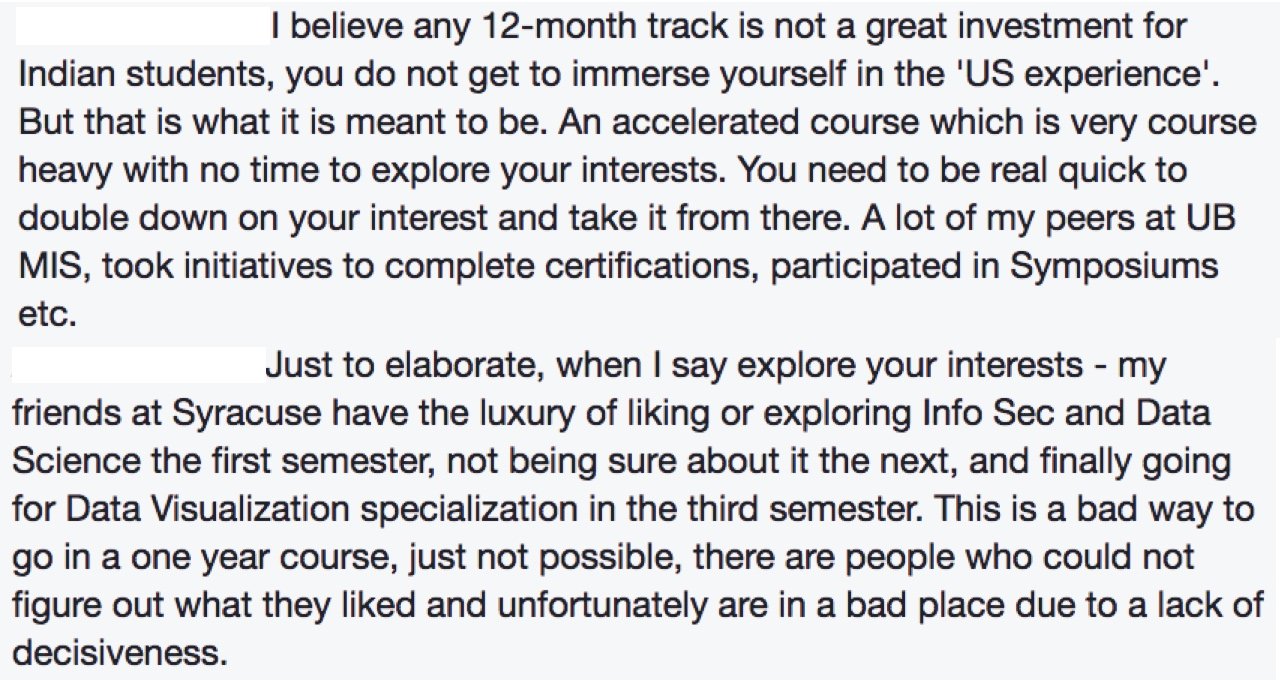
One year programs are more intensive whereas two-year programs space out the curriculum at a more breathable pace. Time flies by in graduate school and one-year duration means that before you know it, the job hunt is on and you are about to graduate. Two-year programs are obviously more immersive and give you a chance to experience the culture, location and build better relations. One year programs do not have time for summer internships.

One year programs typically admit people with higher work experience and proven quantitative aptitude so that they can handle the coursework intensity. A portion of the folks in one-year programs come from companies which as sponsoring their studies (e.g. Washington MSIS).

When should you choose one year program?

Just looking for a degree? One-year programs are your savior!

If you are clear on your goals (and are not looking for a drastic career change), one year program can save you one year of opportunity cost, which can be huge! Most of the students pursue MS to get into campus placements and one-year programs still offer you that without the extra fee and extra year of lost employment. Secondly, if your company is sponsoring you, then they might prefer that you finish the degree sooner.

When should you choose a two-year MS over one-year program?

If you have less than three years of work experience and want to explore different options before choosing your fulltime employer, then go for a longer program. This will allow you to take more courses, do more networking and do a summer internship.

If you are a higher work-ex candidate but wish to do a career change, go for a two-year program so that you can get a summer internship – which is a great way of trying out a role without committing to it.

Word of advice

In an interesting discussion in our closed Facebook group of only our clients, we were arguing what works better. I am posting some interesting comments from it-

Conclusion

At the end, it can be a tricky call. I have worked with freshers who chose a ten-month program and >10 years experienced professional who chose a two-year program. Eventually, it is about understanding what you need at this juncture of your career. In our counseling, we address such doubts and help you pick what is right for you.

Building career in Analytics through MS programs

Anyone looking to build a career in Analytics should check out MIS (Analytics), MS Data Science and MS Business Analytics programs.

Career in Analytics – Why you should not miss riding this trend?

In four years of Scholar Strategy, one trend that is so glaringly clear is the rise of interest in Analytics and Data Science programs. This stems from the growth of number of jobs in this field in big enterprises and small businesses alike. Be it a software giant, pharma company, a SAAS business, a food tech or ed-tech company, analytics underpins every industry and sector. Thanks to the massive data science teams at FANG (Facebook, Amazon, Netflix, and Google) and their success, suddenly everyone wants to play the data game!

As large number of professionals pursue a career in analytics and many looking to switch over, competition is on the rise as well. Which means that it can be very tricky to navigate the quantitative job landscape as an entry-level graduate. Burtch Works Study reported that 86% of analytics professionals have at least a Master’s degree, and 18% have a Ph.D. No wonder, we at Scholar Strategy have seen an increasing number of applicants in MIS (Analytics), MS Data Science and MS Business Analytics programs. We already discussed the subtle differences between these in our previous post.

What is Predictive Analytics?

A new term that is becoming more ubiquitous is Predictive Analytics and a lot of jobs use it in their descriptions! It can be looked upon as a subset of Data Science which specifically deals with forecasting future business outcomes. It helps us predict what can happen based on the past events. As per adobe data blog, “for instance, your credit score is calculated using predictive analytics. Based on a predetermined predictive analytics model that includes data about how you have behaved in the past, your credit score predicts how creditworthy you are likely to be in the future.” Since a major application of data science in business is to predict and prepare for the future trends and customer behavior, predictive analytics is growing in demand.

Analytics has changed many industries, one of the major ones being Marketing. The way businesses attract customers and draw leads has changed significantly. In fact, the very way that businesses think of customer acquisition and focus on incoming vs outgoing interest, has grown because analytics makes it possible to measure the efficacies of different channels. This growth in data and ability to use it effectively for business decisions is one of the major transformations we have seen in past 5-6 years.

What does it mean for you and your career?

If you are looking to become a data analytics professional, you need to wade through the competitive waters to get a good analytics position. An advanced graduate degree can give you the differentiation and a good entry point in the market. But still, it takes effort and sagacity to get to a coveted analytics role in the market. To better understand this, we are holding a webinar on Studying and Recruiting in Analytics! Looking at the overwhelming response to our last Data Science webinar, we are focusing on providing more insider information by successful grads who are now working in the industry. And if you want to know what does it take to become an Analytics professional, do not miss it 🙂

How to prepare for UT Austin MSBA interview

Getting an UT Austin MSBA interview invite is a big deal since it is one of the best Business Analytics programs in USA. Here are the questions you need to prepare for it.

As per one of our students who appeared for the interview and later attended this fantastic program-

The interview was mainly behavioral and the questions were mostly repeated. Since my interview was quite late, I had connected with many people and prepared a comprehensive set of questions. No question was asked beyond these.

UT Austin msba interview

UT Austin MSBA Interview questions

  1. Why Analytics?
  2. Why UTA?
  3. Long and short term career goals.
  4. Where do you see analytics in 3-5 years and how do you think you would contribute to it?
  5. Tell me about a project or an experience or something of that sort which you built from scratch, or something you really contributed to.
  6. Where did you hear about this program?
  7. An incidence from your life that changed you as an individual/ something that you are really proud of.
  8. Is there anything more that you feel that the admissions committee should know about you?
  9. Where do you want to work after graduation and why? US or India?
  10. Your knowledge on programming languages and statistics?
  11. Which company /domain in analytics do you wish to work for?
  12. Any questions for me?
  13. What are the other programs that you have applied to? Why will you choose UTA over others?
  14. Describe your work experience.

The interviewer had my CV open in front of her. So she asked a few questions around my work experience, projects and other activities that I had mentioned.


Among the MSBA programs, UT Austin interview is comparatively less technical than University of San Francisco etc.

For such discussions, join our FB group – MS Internships and Jobs (only for grads)

And, if you are looking to crack a top program in Business Analytics, MIS or Data Science, come work with us.

MS in Financial Engineering courses

“Everyone from derivatives traders to hedge fund managers want to predict financial market outcomes. Who wouldn’t bet on a sure thing? The reality is that no one can really guarantee where the stock market is headed. But don’t think people aren’t trying. Financial engineers are the folks that just might figure it out.” – reads the description on Baruch Master’s in Financial Engineering program website. Although that sounds a tall claim to me, the fact is that these programs are on a rise.

For long, finance as a field attracts engineers because of the stupendous compensation packages as well as the glamor. While the traditional route has been to study MBA later in your career to move into Banking or Trading, why compete in those super-duper competitive Business Schools? Why not go directly for a Finance course? Enter Master of Financial Engineering (MFE) degree programs such as CMU, Columbia, Berkeley, UCLA, NYU, Cornell, Washington etc. Baruch is probably the cheapest of the lot but ranked quite high.

The finance industry needs people who possess deep mathematical modeling skills and computational expertise. While no specific undergraduate major is required, most students will have a degree in quantitative subject matters such as mathematics, engineering, computer science, physics, etc. Engineer’s quantitative and programming skills lend themselves well to solving the complex and creative challenges of today’s financial markets. Although it is not related to traditional branches of engineering, the field picks a lot of people with engineering backgrounds (as is true with MBA). Financial engineering draws on tools from applied mathematics, computer science, statistics and economic theory to address current financial issues as well as to devise new and innovative financial products.

What specializations are possible within MFE?

One can venture into Computational Finance, Risk Management, Corporate Finance, Algorithmic and Technical Finance etc.

What career options open up after MFE?

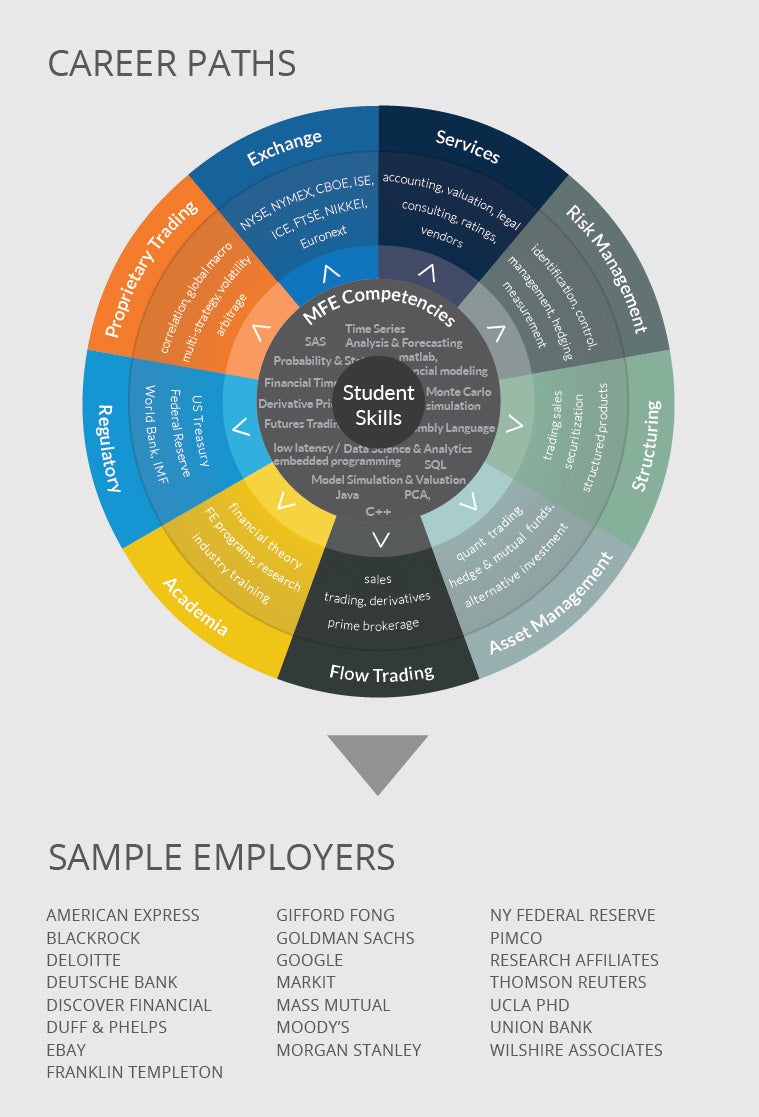
Following image is taken from UCLA MFE course website. As it shows, one can go into risk management, trading desks, financial services, quant pricing, regulatory roles etc. Often incoming students are also coming from similar roles and are looking for further specialization. In non-finance category, probably engineers make the biggest chunk of the incoming class.

When should you go for MFE?

If you have made your mind to get into finance industry and some relevant experience or background, MFE might offer you good opportunities with the advantage of lower competition than traditional MBA (Stanford MBA has acceptance rate of <6%). Plus, make sure you love Mathematics!

How to prepare your application for MFE?

Join us and we will guide you with our very strategic guidance! 🙂 Strong quantitative background, preparation for CFA, programming skills, mathematical modeling tools knowledge etc helps. Rest, we help you step by step in crafting a strong story and guide you through our selective sample SOPs.

One thing you need to nail for superb application results

I interviewed Bhavesh Sanghvi, CS grad from Iowa State University who is now working with Amazon in USA. He thinks that everyone works on their SOP, LORs and resume but if you can do this one thing, it might put you at a big advantage. He did it himself and found much success.

GRE and GMATs may become obsolete in the coming years but there is one thing that will not stop mattering for MS/PhD applications. This is also one of those things which if you get right can get you admitted right into your dream school.

And, now is the time to do it.

I bet you are thinking that we mean publishing more papers. But nope, that is not enough.

What we are talking about is emailing the Professors!

I also interviewed Ankit Srivastava, Asst Professor at IIT Chicago and PhD from University of California, San Diego. He said emailing Professors can be tricky but highly rewarding.

Here is why it can be so effective (as Ankit told me) – Professors fund students through grants and the goal of any school is to be able to admit and fund as many good students as possible. So, if a Professor recommends a student and can potentially fund her, the school committee would be more than happy to admit her directly with no fuss. 

It’s funny how simple and logical it is and yet, how many students ignore this step.

I had a client last year whose friend put her in touch with her advisor. As it happened, the advisor was looking for a suitable grad student immediately. Not only did the Professor recommend my client’s admission after a quick review of her resume (yes not even looking at SOP etc) but also gave her full funding. Things moved at lightning speed and it was one of the smoothest admission and visa process as you can imagine.

Also Read: Want to get more emails from Indian students, says award winning Prof in USA

The bottom line is while it is very hard to get positive responses from the Professors, but if you hit it right, it can be more effective than ANY other thing in your application. So you would be a fool to not try it out.

In MS Book, I have covered the topic in detail and provided sample emails and templates on how to contact the Professors because it is an important thing to do. Check it out here – https://scholarstrategy.com/smart-engineer-book/

So, do not leave out on this step when you are working hard to get into those TOP schools anyway. Good luck!

Exclusive MS advice from successful grads and professionals

In last two posts, we touched upon financial concerns and SOP tips. To recap,

1. MS in USA is affordable and within your reach if you understand the numbers and plan properly. We discussed break even analysis to look into that. Read it on http://wp.me/p39Fhf-oB

2. SOP is the magic wand you can use to help your application stand out. We looked at some Do’s and Don’ts. Check it on http://wp.me/p39Fhf-oW

We built specific tools for these two in the MS Book that you can use to save some time.

Applications are a multi-step complex process to ace which you need clarity of thought and action. Don’t let the details daunt you. The key is to know what kind of career you want to build and then choose the right program that will help you get there. But getting to a good university alone is NOT enough. It also matters how you spend your time in Graduate School. At least, in my case, I wish that I had taken some courses from non-CS departments too to augment my understanding. I felt that such advice can be valuable when you are about to join the Grad School. 

Continue reading