How to choose right university when you have multiple admits

choose right university from multiple admits

Congratulations on landing multiple admits. Now, choose the right graduate school for yourself by understanding what matters the most. It is critical that you do a good research on the university by reading about it, talking to current students (and alum) and discussing with study abroad experts.

Choose right research oriented university from multiple PhD admits

  1. Go by the reputation of Professors and depth of work in the field of your interest
    This determines the quality of your thesis, publications, ability to attend good conferences etc. It also helps you to get good references when you apply for research and academia. Advisor matters the most in PhD.
  2. Go by the availability of funding for PhD students
    Usually most of the good schools are able to offer some sort of funding to their PhD students. You may still want to double check though.

Choose right MS program when you want to join Industry

  1. Ranking matters because higher ranked schools attract more and better employers – Stanford, UIUC, Cornell, CMU, Columbia have great placements for example irrespective of global economic factors. You can afford to choose a university with higher ranking when you have multiple admits.
  2. Location matters to the extent that if you are not able to get into a high ranked program, prefer a school in a place that has enough good employers around. E.g. Silicon Valley, NYC, Boston, Chicago, Dallas etc. in general. If you are going for a specific field, pick locations that matter for you. Eg. Portland has huge Intel presence, San Diego has Qualcomm etc.
  3. Tuition and Availability of Scholarships – how costly is it to attend can matter a lot since grad school is pricey. I might love to attend Columbia for its great brand and location but do I have $100K to spare is the question. Why apply to schools you know you cannot attend?
  4. Curriculum matters – A student of ours left CMU MISM 12 month program in between because he felt he wasn’t learning anything new. Do a thorough study before heading to any program.

Choosing the right University is crucial to your success. Of course, you should have already done a major chunk of this research when you were shortlisting schools for your MS/PhD applications.

For those who are applying for MS – read our guide on Shortlisting Schools for MS

This is what Northeastern University has to say about choosing the right Graduate School.

Sample LORs (Letter of Recommendation) for MS

sample lors for MS

In this post, you will find real sample LORs from real MS candidates. Use these samples as a guide to get effective letter of recommendations for your MS in USA applications.

How to use sample LORs in your MS applications

The sample LORs provided in this post will aid you in encouraging your recommenders to submit strong LORs. These are not provided to be copied – reputed universities take plagiarism very seriously.

What is a good LOR

  • The best letters of recommendation come from professors or individuals who know you well.
  • A well-written letter of recommendation provides admissions committees with information that isn’t found elsewhere in the application.
  • A letter of recommendation discusses your personal qualities, accomplishments, and experiences that make you unique and perfect for the programs to which you are applying. 
  • Make sure that the Letter of Recommendation does not conflict with or duplicate the rest of the application (Personal Statement, Transcripts, Resume, etc.)
  • Recommender should describe his qualifications for comparing the applicant to other applicants. 

Format of a LOR

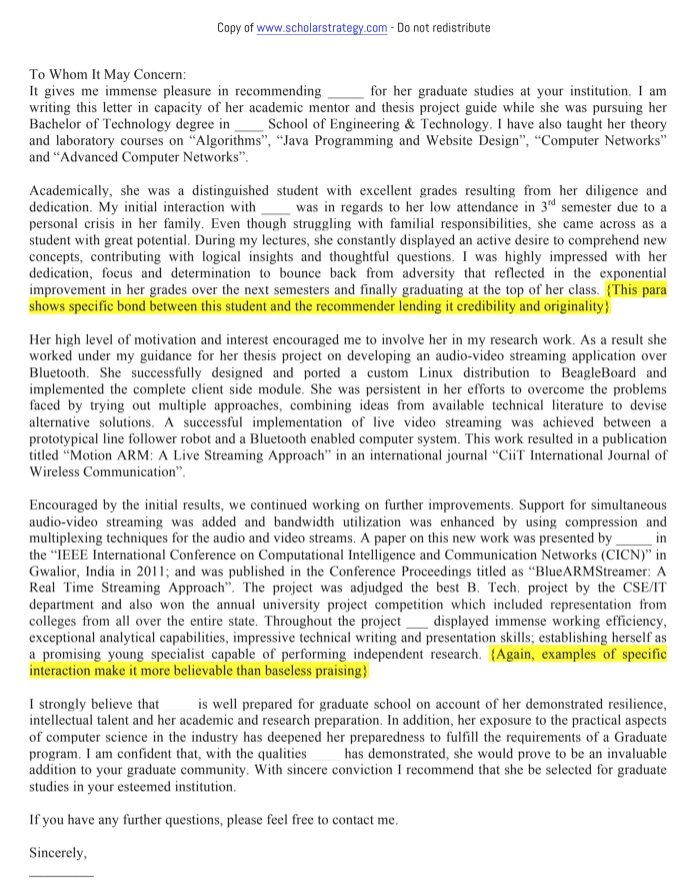
The university emails your recommender with a form and a chance to upload a LOR file. The form asks multiple questions to understand how well the recommender knows you and how strongly is he rating you. A sample LOR form from UIUC can be viewed here.

Of course, the freeform LOR that you recommender can submit is the actual detailed LOR that we are discussing in this post and these samples. Follow the format mentioned below:

  1. Start with a salutation and heading such as ‘To whom it may concern’
  2. First para should contain introduction and qualification of the recommender and why is he writing this letter. Why is he qualified to recommend you?
  3. Next 2 paragraphs will contain specific assessment of the candidate with appropriate examples. These will talk about multiple aspects about his candidacy and why recommender is recommending him. More specific the examples, better the LOR. Avoid generalizations and praises (think how a third person will write about you).
  4. Final para should summarize the assessment and recommend the candidate for the program in question.

Academic LOR Sample

sample academic lor for ms
Sample Academic LOR for MS

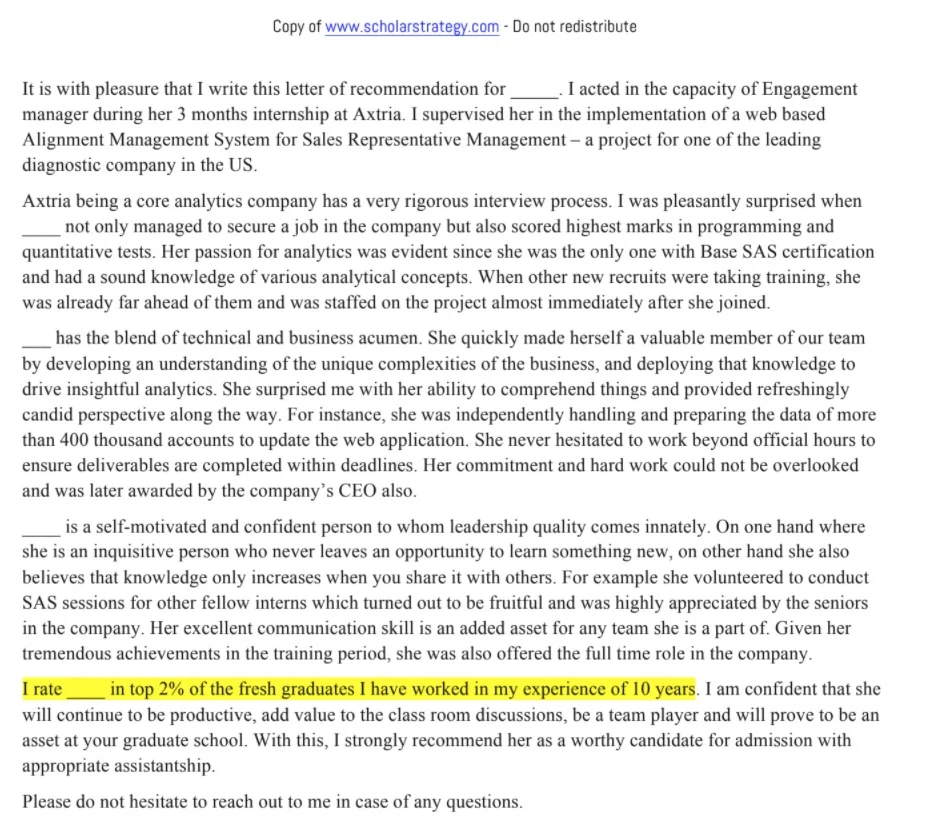
Professional LOR Sample

Sample Professional LOR for MS

For specific LOR tactics, check out our bestselling MS Book: Smart Engineer’s Complete Guide to MS in USA.

For our professional counseling, check out our MS/MBA Admissions Consulting Services

Most popular universities for Indians in last decade

Popular Grad Schools for Indians

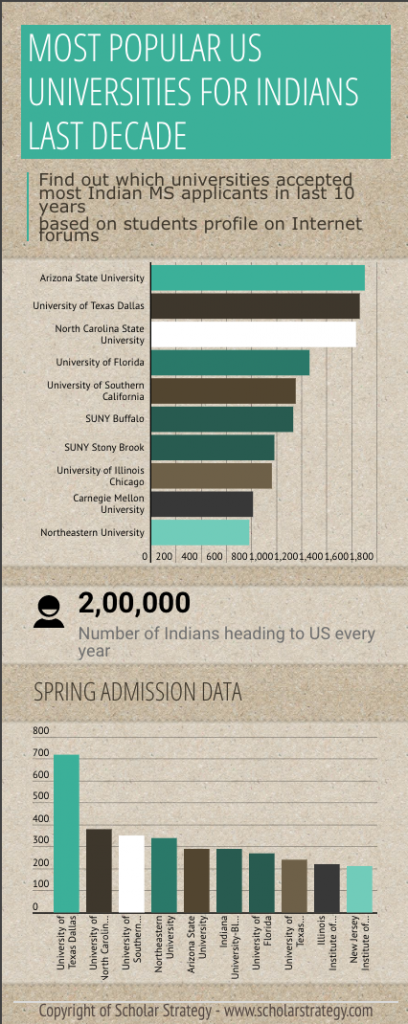
Ever wondered what are the most popular US universities amongst Indian MS applicants?

In 2019, 90,000+ Indian students headed to United States to enroll in graduate programs. Overall, 2 lac + students go to USA every year from India. Needless to say, USA is one of the most popular study abroad destination for Indians.

We dug up some numbers to find which schools are most Indian-friendly! So, here are the Top 10 schools by the intake of Indian students for last 10 years. Unsurprisingly, ASU and UT Dallas lead the pack. We were surprised by CMU’s high intake nonetheless. What do you think?

popular US universities for Indians

Top 10 popular destinations for Indian applicants

Where do most Indians head to in Spring?

So, here are the top 10 universities that gave admits to Indians over last decade.

Are you considering applying in Spring? Do read our post about pros and cons of applying in Spring semester.

Disclaimer: This is based on only the data that we gathered from students who reported their results on Internet. However, it should still give a pretty good insight into the bigger picture. 

Should you apply only to popular universities for Indians?

Of course, not. The above information is to help you select some safe schools. You should pick schools that you really wish to attend. See our guide to school selection for MS applications.

University Shortlisting for MS in USA

University Shortlisting for MS/MBA

University shortlisting is one of the trickiest components of applying to any Master’s program. US has more than 1500 universities – obviously you need good research and guidance to pick what’s right for you.

Applying to right graduate school can determine your job & scholarship prospects, so spend good time researching which schools suit your financial & career needs.

Let’s take a look at steps involved in shortlisting right universities

  1. Create a list of criteria that matters to you

    Criteria can include cost of attendance, ranks, job placements, weather etc

  2. Use a university search engine (or a proven study abroad counselor) to narrow your search to 10-20 universities meeting your criteria

  3. Visit the website of each of the school to further confirm your interest

  4. Check the deadlines and apply

University Shortlisting in USA

We are going to discuss the most important topic of your applications today i.e. which schools should you apply to. We recommend applying to at least 10 schools for MS and 5 schools for MBA programs.

University shortlisting is a very strategic decision that can determine:

  • Whether you get admitted or not
  • Even if you get admitted, whether you get scholarship or not
  • What will be your job prospects upon graduating

As you can see, all of these are critical factors for your future. Let us explore them further now.

Create a list of criteria that matters to you

Every applicant has different risk profile and financial constraints – hence, it is very important that you decide what matters most to you.

Mostly, people shortlist schools based on costs and availability of funding, job prospects, program ranking, class size, location, competition and living conditions such as weather, population of international students etc.

In our experience, job prospects and cost of attendance are the most important considerations. Let’s explore them further.

Job prospects at a school

Job hunt is a bigger topic but the bottomline is that there are two ways you are going to land a job interview when studying in US – on campus recruitment or applying on your own (off-campus). There are some companies that will come on campus and you can apply through your school’s career office. Obviously, this is easier than hunting companies and applying on their websites because an employer is going to devote more attention to students in person. So, higher the number of employers that come on campus in a school, better the job prospects will be for you.

Therefore, one of your criteria for university shortlisting should be to find schools that have more employers coming for placements on-campus. This is often correlated to the ranking of the program. Top 20 schools in your area of interest would be more attractive to the employers. If not, it would be help if the university is located in a job friendly city (such as NYC) rather than a suburban town (Dartmouth).

Cost of attendance

And you also don’t want to end up in huge debt while studying. So you want schools that are affordable or more likely to offer at least some kind of scholarship.

Of course, if you are looking to start your own company instead of joining a job, you should take that into account instead of maximizing job prospects. If you want to learn more about how we do it, check out our counseling packages and contact us.

Additionally, you might have some other personal factors while university shortlisting (for e.g. I have to study in Tristate area (NY, NJ, CT) because my aunt lives there). We advise not to restrict yourself and try to get into the best school you can because studying abroad is big investment both of money and time. So, you should try to get the maximum return and not restrain yourself. It’s fine if your brother lives in Iowa, studying from San Francisco is still going to be better for you.

Narrow your search to 10-20 universities meeting your criteria

Using a trusted counselor such as Scholar Strategy or by your own research, create an initial list of universities that meet your preferences. Look at our results page to get an idea of real applicant profiles and what programs did they get into.

Often local counselors make you apply to 2-3 safe schools where you are most likely to get admitted. It is fine as long as the schools are legit and will not compromise on your career prospects but sometimes, they have tie ups with not so legit schools. Most of the times, your visa will be rejected for such schools.

What is worse is when some unfortunate students end up going to these schools only to discover later that there are zero job prospects or that the degree itself is not recognized. This is terrible and the only option left at that point is to come back to India with a hefty education loan and a not so worthy degree. A student should be smart enough to not fall into these traps and make sure that you are taking counseling with someone who knows about this domain and is providing genuine guidance. A good counselor will tell you where NOT to go.

Secondly, most counselors have set universities that they make all students apply to irrespective of their profiles. This is because they have tie-ups with these universities. Unfortunately, if a counselor is earning from these schools, then its interest is aligned with them and not YOU. Have a say in school selection process and try to use your own due diligence to determine if it is worth applying to a school or not.

Sometimes, its better to take a job in India and wait another year before applying instead of going to a worthless school.

Visit the website of each of the school to further confirm your interest

The best place to get up-to-date information about a university is on its official website. Research university websites carefully to find out:

  • University’s selection criteria, application process and deadlines
  • Financial aid page for information on costs and university-funded scholarship, fellowships, or assistantships.
  • Curriculum, courses, capstone projects etc.
  • How is the campus life and activities? Does it fit your personality?

Key Takeaways

Remember that university shortlisting is the MOST critical part of your application and if done carelessly, can ruin all other efforts you put in GRE and application documents. Schools can largely determine your job and scholarship prospects, so it makes sense to spend enough time researching on which schools suit your financial and career needs. In our online counseling program, we use a proprietary triangulation technique for this which takes multiple criteria that have direct bearing upon your career prospect into account.

This post is the part of MS in USA application process series.

How to strengthen your profile for MS in USA

There are many ways to improve your profile before you apply to MS. Here are few things that can make the most impact-

Publish papers for thesis-based degrees

You can work with your college Professors to stay engaged in research. Publishing papers add a whole new depth to your candidacy by showing your research potential.

Freelance projects and build portfolio

Even if you don’t have clients, you can build interesting projects and publish on github. Shows you are a pro-active learner. (can do along with taking MOOCs in your areas of interest). Keep doing competitive coding, any accomplishments in there can improve your profile. Certificates directly don’t matter but participating in such things ensure that you stay hands-on and get to explore deeper concepts of programming.

Read papers on latest developments, connect the dots. You will start talking more intelligently about it. The biggest point where applicants stumble is that they have nothing intelligent to say in their SOP – everyone is saying ‘how they were attracted to computers since childhood’. The more you code, more you explore, better stuff you will be able to talk about. Your goals will be more specific.

Switch to a job closer to your area of interest if possible

One of my students switched his job from a business analyst role to a research based startup in ECE. First time, he did not get good admits but second time, he got into some decent schools for MS in ECE. He headed to UC Santa Cruz. The idea is to proactively push towards your passion. If your job is not helping in what you want to do, look for something more relevant.

Take MOOCs if you lack confidence in your subject

For people who have low grades or relatively less working knowledge of the subjects of their interests, doing online courses (reputed certified ones) can add some more credibility to your academic background. Read how much can MOOCs help you.

Get 320+ on GRE or 710+ on GMAT

Lastly, if your test scores are holding you back, get that sorted. There is no point in being held back if you think you can do much better on the tests. This becomes especially more important if your GPA is low.

How to get your research papers published?

Scholar Strategy MS in USA

Significance of research papers publications

For the first time, China has overtaken the United States in terms of the total number of science research papers publications, according to statistics compiled by the US National Science Foundation (NSF).

As an aspiring grad student or researcher, one of the best things you can do to enhance your application chances is publish a good quality research paper. But many applicants do not know how exactly to go about it.

Tips for becoming a published researcher

So, we invited Utkarsh Sinha who is a Petroleum Engineer, graduating from University of Houston and a published researcher to share some tips about the same. He is currently working with Hicor Technologies and is a JPSE & ATCE Published Author. Utkarsh has also been a summer research fellow at IIT Delhi!

He answers the following in this short video-

  1. How to approach Professors to work on a research project
  2. How to write a good research paper

Go through it and start cranking on your own research!

What MOOCs are popular among Engineers?

It is not surprising that online courses (MOOCs) are helping many engineers compensate for their poor quality of education. Growing number of engineers who apply to graduate schools abroad are facing a massive challenge. With engineering colleges sprouting in every corner, the quality of education and infrastructure has taken a huge beating. With barely qualified teachers, students lack any avenues to learn and get the kind of exposure that would make them competitive against their counterparts from China, Europe and USA. So how do these students learn when their colleges are offering so little?

Enter the number of MOOCs (Massive Open Online Courses), thanks to education startups like Udemy, Coursera and so on. With quality courses and online availability, an increasing number of students are resorting to taking such courses to augment their knowledge of popular subjects like Data Science, Basics of Computer Science and so on.

Engineers using MOOCs in their MS applications

Yasho Vardhan, an MIS applicant that I worked with, was feeling that his average GPA was putting him at a disadvantage in his applications. To further enhance his profile, he decided to take Introduction to Python for Data Science on edX and R Programming on Coursera. Since he was interested in Analytics which is growing more popular and competitive, he felt that he needed something more than his academics and work experience to differentiate himself. Further, such courses were highly recommended by his seniors at University of Maryland, the place where he is heading to this September.

Another popular online course is Machine Learning by Andew Ng on Coursera. When Sheelabhadra Dey, an Electronics Engineering student at NIT Trichy, started applying for MS in Computer Science (CS) programs with an interest in Machine Learning, he knew that CS is one of the most competitive programs. With a non-CS background, he needed to prove his mettle. So, he opted to complete online courses that would help him develop the CS skills that he could not in college. Now that he has admits from multiple reputed CS programs such as Texas A&M University, and University of Florida, he thinks his decision was a life saver.

The point is to gather the real skills and not worry about the certificate. Besides, developing good projects in these classes can be a great way to show you are a pro-active learner! These can also help to compensate for your low grades in a similar class you took in college or can fill in for lack of a formal education in the area you are applying to.

So, if you feel that you lack certain skill set that is hampering your career growth, it is time to go for a MOOC!

This article was originally written for and appeared in Tribune newspaper. 

How to plan the timeline of your Fall applications?

Many people are shocked to learn that applications to universities abroad can take anywhere between 6-9 months.

It’s not a sprint, it’s a marathon. And, to do well, you need to have a proper plan in place.

The good news is your future does not depend on the outcome of a single exam. One bad day doesn’t ruin you. You can do many things to put up a winning application in the end.

First things first – you need to follow the timeline so that you do not lose track of multiple things that need to be completed. Applying late or very close to deadlines can be detrimental to success. You do not want to do that.

What is the best time to apply to maximize your chances of admit? When should you take GRE? How long should you work on your SOP and essays? If you have all these questions, you are in the right place.

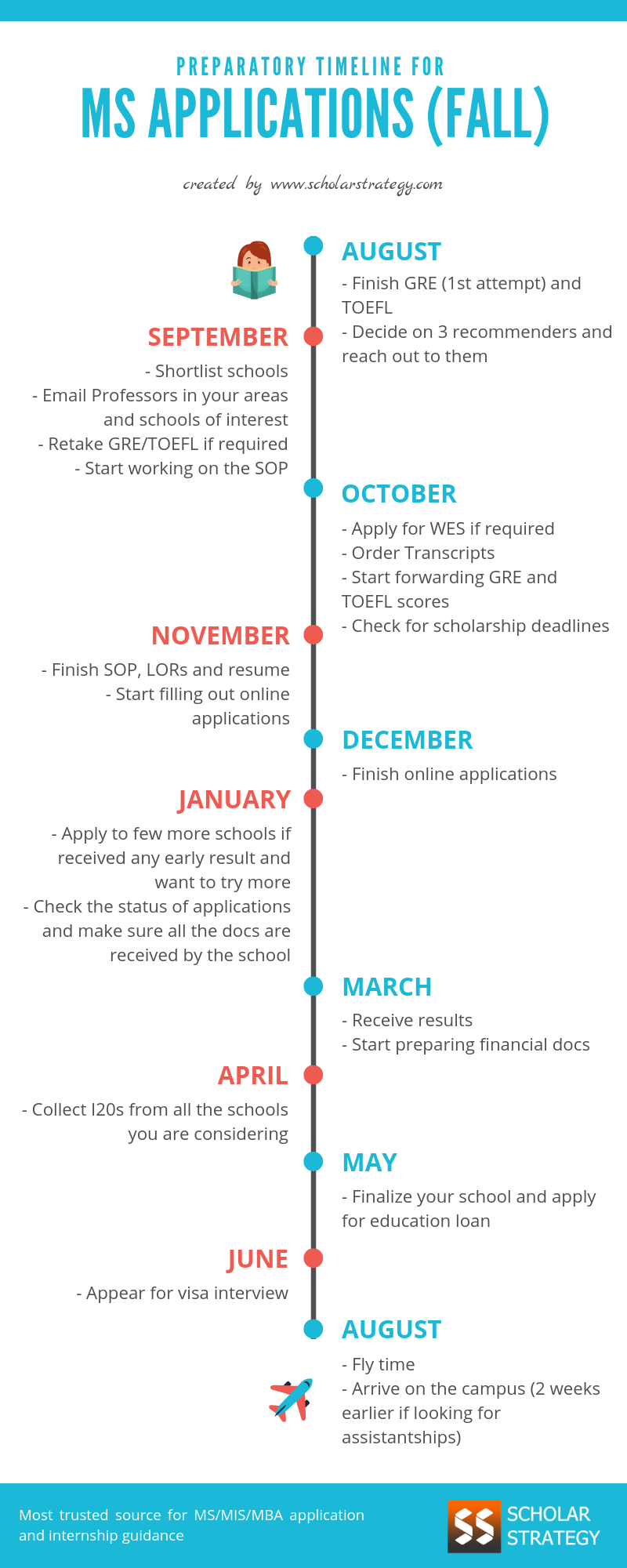
MS in USA application process can be overwhelming and cumbersome. So, here we have tried to put up an easy to understand timeline so that you can keep a tab on what needs to be completed when.

Discipline and time management is key to cracking your dream schools. And it starts from TODAY.

GRE/TOEFL

Take by end of Aug so that you have enough time to retake if necessary
Retake GRE if required by end of Sep (need 21 days between reattempts)

Shortlist Schools

by end of Sep – mid Oct. Here’s full post on how to shortlist schools.

Email Professors

Drop emails to relevant Professors you are interested to work with (especially for people interested in research) by mid of Oct.

Apply for WES

If any of your shortlisted schools require a WES evaluation, apply for it by the end of Oct since it can take a month or more to get their results.

Check for scholarships

There are some third party scholarships available for MS applicants. Search these by end of Oct (so that you can apply by their stated deadlines)

Order transcripts

from your undergraduate college by end of Oct

Finalize SOP, essays and LORs

by mid Nov

Fill the application online and send application packets where required

by end of Nov – mid Dec

Follow up on the status of your applications

and if the required material has been received by the schools in Jan. Resend if anything is amiss

Receive results

by end of Mar-Apr

Submit financial docs for I-20

by end of Apr

Finalize your school and apply for education loan

by May

Appear for visa interview

by end of June

Arrive on the campus

by Aug (2 weeks earlier if you need to look for funding on campus)


That’s it – it is not as cumbersome if you know what to expect. Save this infographic for a quick reminder.

Timeline for MS applications (fall)

For personalized assistance for your applications, check our counseling packages.