Positive Attitude + Thick Skin = Recipe for Success

positive attitude

When times are tough, it boils down to who can keep a positive attitude and live another day. No matter how good your job or boss, things do take an unfortunate turn every once in a while. There is always performance pressure and workplace politics to battle with.

90% of the startups do not fail because they don’t have money. They fail because they lose steam and give up. Same with people.

Have you ever seen success coming easy for anyone? That happens only in few movies. Otherwise, you have to grind it out, eat the shit sandwich as Mark Manson calls it and hope the timing works out.

Why is attitude so important?

A few days ago, I posted about psychology of Indians on LinkedIn and how they never encourage. It sort of went viral, sharing an excerpt here:

Indians don’t encourage or applaud. The best approval you get is silence.

They won’t reply to your requests or emails but when you have made it on your own, they’ll come & pat your back 🙂

Exceptions are there and I’ve been fortunate to know some of them 🙂

This post is not to criticize but to remind that each culture comes with its own quirks. And of course to encourage that you shouldn’t rely too much on getting validation in India. It’s nothing personal, it’s just how it is. Silence from the other end is not always a disapproval. Do what you believe in and may you find your own luck.

And it’s almost reminding me of dads in India. They don’t congratulate you on getting 99, they ask where did you lose that one mark! 🙂

The reason it touched a nerve is because that lack of encouragement deters so many people mid way. This is why we need a better attitude if we want to make it big in life. So, how about this mantra –

Positive Attitude + Thick Skin = Recipe for Success

Need more reasons to build a positive attitude?

1. It holds you up especially when things are not going your way

Take Abraham Lincoln. Most people are unaware that he battled crippling depression his entire life. His life was one of enduring and transcending great difficulty. It would be his own experience with suffering which drove his compassion to allay it in others. He was patient because he knew that difficult things took time. Above all, he found purpose and relief in a cause bigger than himself and his personal struggles, as the nation called for a leader of magnanimity during the Civil War. As crafty as he was, Lincoln’s strength was his will: the way he was able to resign himself to an onerous task without giving in to hopelessness, the way he was able to rise above the din and see politics philosophically. “This too shall pass” was Lincoln’s favorite saying, one he once said was applicable in any and every situation one could encounter.

Daily Stoic

2. It attracts right people in your life professionally and personally

Ah, yes. How many of us have gotten in horrible relationships again and again? What’s common between all of them? YOU. You are attracting these people and afraid of letting them go because of your insecurities.

Same at office. Are you ignoring bullying behaviour in your team or not telling your boss the truth because you are afraid? Having a positive attitude doesn’t mean being nice all the time – it means accepting things for what they are and being optimistic that things can improve. It allows you to find solutions instead of focusing on problems.

3. It makes you happy

I think this reason alone is enough. But again, this aspect is misunderstood.

Developing the positive thoughts is not about being always happy or cheerful. It is definitely not about ignoring things which are negative or unpleasant in your life. It’s about accepting that positive and negative are part of the life.

Once you acknowledge that one can not always be happy and can embrace even your bad moods, difficult emotions cannot ruffle you. And, isn’t that what happiness is anyway?

How to build positive attitude

But of course, the question is how to get this positive attitude? Well, here are few simple ways to get started on your journey of positivity.

  1. Limit social media browsing to 1 hour per day. It really doesn’t help to keep checking the lives and stories of people around us (most of which are fake). Stop comparing yourself to others. You don’t know what is really going on with them.
  2. Embrace a hobby and set time aside for it. Indulge in things outside your work. Take time to cook, bake, garden, paint, play music, run, yoga or whatever speaks to you. Have your happy time to balance the stress of the work. This is your ME time.
  3. Write 5 things you are grateful for each night/morning. This acts like a reaffirmation and reminds you of things you are taking for granted. For eg. you should be grateful for having a clean bed to sleep in, coffee every morning, a job, a family – not everyone has these.
  4. Give benefit of doubt to other people instead of being angry at them. Someone didn’t reply to your email and you assume they are ignoring you? Most likely, they were just too busy. Follow up and be professional. One day you will get busy and will realize how it feels. The point is, anger hurts no one but you.
  5. Ask for HELP. It’s that simple – asking for help is not a sign of weakness but of maturity and reliability. Too many freshers don’t ask for help and screw up the tasks they are given. Your boss wants you to know when it is time to ask for help. So, if things are getting overwhelming, ask for help – not just professionally but personally too. Delivering a task well done is more important than doing it all by yourself. A lot of your professional success will depend on how well you work with your team and colleagues. Asking for help also makes you a like-able person.

In the end, the attitude can make all the difference. Now that you are aware of the positive psychology and ways to build it up, it is never too soon (nor too late) to get started!

10 reasons why you should pursue MBA after engineering

why MBA after Engineering

Pursuing an MBA after engineering has become a popular career choice for engineers in the recent past. No wonder people scoring the most in CAT or Indians making it to Harvard and Stanford Business Schools are often engineers from IITs. As per few reports, the acceptance rate of IITs is only 1% as compared to MIT which stands at 8%.

I was once giving a talk at a college and someone asked me how did I get into career coaching and writing books after an engineering degree. To that, I replied, “Because every Indian is allowed to have a passion but she first needs to complete engineering.” Jokes apart, there are multiple good reasons why you should consider an MBA after engineering.

Why MBA after Engineering?

Every engineer, one in her lifetime, faces this dilemma – to MBA or not to MBA.

I myself pursued an MS in Computer Science first, worked on Wall Street and felt the need for an MBA eventually. This is when I knew what I wanted to get out of MBA – I wanted to get into startups. So, I headed to NYU Stern and hustled like crazy. In the end, I got what I was looking for – 2 fulltime job offers in my first summer itself. So, I decided to drop out from Stern – my purpose was solved.

So yes, I am a big proponent of an MBA in life but I put only one condition – do it ONLY when you know what you will use it for.

Now, here are some great reasons why you may consider MBA after engineering.

1. Career growth / promotions

At MNCs, it is difficult to get promoted beyond a point on your merit alone. A bling on your resume i.e. a reputed MBA degree can take you far in your professional ambitions. This is true especially for certain industries such as Management Consulting and Investment Banking that rely heavily on MBA grads.

2. Expanding your knowledge beyond technical domain

One you get out into real world after your college, you realize how little you know about interest rates, balance sheets, GDP, stock markets and so on. To follow the micro and macro economic developments and to be able to talk intelligently about it, you need to broaden your exposure. While MBA is not the only way to do it, it is a very good way of doing it.

3. Holistic understanding of business

After a bachelors and masters in engineering, I was comfortable solving equations and writing code. But I had no clue what drove stock market. The mention of balance sheet made me stare blankly. I would see the CEOs talk confidently about the business and I felt I was missing out on the fun.

The crux was that I felt my whole learning was one dimensional and while engineering gave me a great analytical foundation, I wanted to understand the practical aspects of finance and management. I did harbor ambitions of starting up someday and felt that studying business as a major could fill certain voids in my knowledge.

This is why I chose to go for MBA and got into NYU Stern.


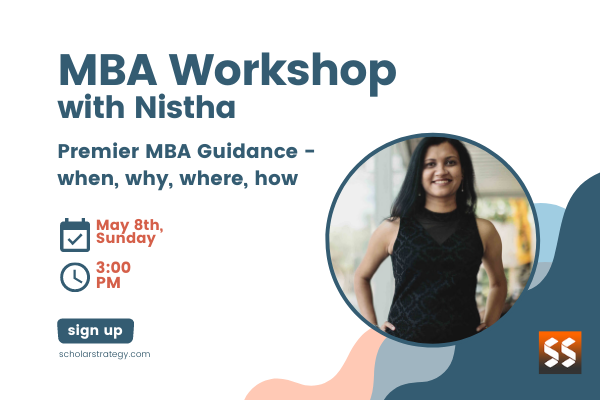
Don’t miss the MBA Workshop

Nistha is offering her paid advice for FREE in this one-time-only workshop.

Sunday, May 8 at 3pm IST

Click to register


4. Switching careers

MBA makes sense if it can help in career switch you are looking for. For example, if you are a software engineer looking to get into Finance, yes MBA will give you what you need and may be the only option you have.

5. Feeling stuck in your professional life

Many people feel stuck in their career growth in an industry that values MBA a lot. Therefore they need an MBA to move beyond a certain level. For e.g. some companies such as Big 4 Consulting or Wall Street may not consider you for executive roles unless you have an MBA.

Secondly, one may start feeling uninspired in their 30s and not fulfilled in their corporate jobs. Switching industries or roles at this stage is typically possible only through an MBA or specialized Master’s degree.

6. Getting higher salaries

Yes, want more dough and prestige? Getting that coveted MBA degree may be a perfect way of elevating yourself in the job market and competing for salaries that otherwise look out of reach. For example, average salary post MBA in USA was $116,000 in 2017.

7. Seeking leadership positions

Leadership is more than domain and subject matter expertise. Leaders need people skills, decision making prowess and ability to negotiate, strategize and maneuver their teams in tough times – these are the core skills that an MBA program teaches you. No wonder, >90% CEOs come from MBA backgrounds.

8. Personal development

Having done both MS and MBA from American Universities, I can clearly see the difference between Professors in Business Schools vs those in Engineering Schools.

B School Professors are charismatic. Their lectures are more like art performances. They reel you in, keep you engaged, intrigued and in awe. Engineering school faculty is no doubt, genius, but they lack the inter personal skills that makes the audience go ‘wow’.

If you want to improve your ‘presence’, MBA is a great transformer. I pushed myself outside every comfort zone back in my MBA days. I started speaking more, taking more chances, and became uber confident – all thanks to the MBA ecosystem.

9. Lack of other options

Some people became engineers but have no interest in pursuing a technical or administrative career. MBA is usually a good way out for such people.

10. Meeting interesting and ambitious peers

MBA eventually is about its brand and networking opportunities. How much is that worth to you is something you need to figure out. At NYU Stern, I had a working group of an Italian banker, an American lawyer, an American banker and a Chinese consultant. Such diversity and peer learning is a big selling point to top ranked MBA programs.

Let’s look at some FAQs

Should I do an MS/MTech or an MBA after engineering?

If you have interest in technical fields and want to be an engineer in a core technology company, MS or MTech is better. Also, you can do MBA after MS/MTech.

Does it make sense to consider MBA after engineering?

Absolutely, some of the most successful MBA grads are engineers by background.

When should I decide whether to do an MBA after engineering?

Many people go for MBA right after engineering college. This is okay only if you know what stream you want to choose in your MBA. Business Schools prefer candidates with some work experience. So if you are not sure, wait and get some work experience before going for MBA.

Do I need to have work experience before MBA?

Not necessarily but it helps.

How can I decide whether to do an MBA or not?

If you are not sure, talk to a career counselor such as Scholar Strategy. Make sure you take guidance from someone who has done MBA themselves.

How do I prepare for an MBA after engineering?

You need to clear the CAT test if you wish to pursue MBA in India and GRE/GMAT if you wish to pursue an MBA abroad. 

How can Scholar Strategy help in my MBA applications?
Check our MBA Application Service and contact us.

Want to get more emails from Indian students, says award winning Prof in USA

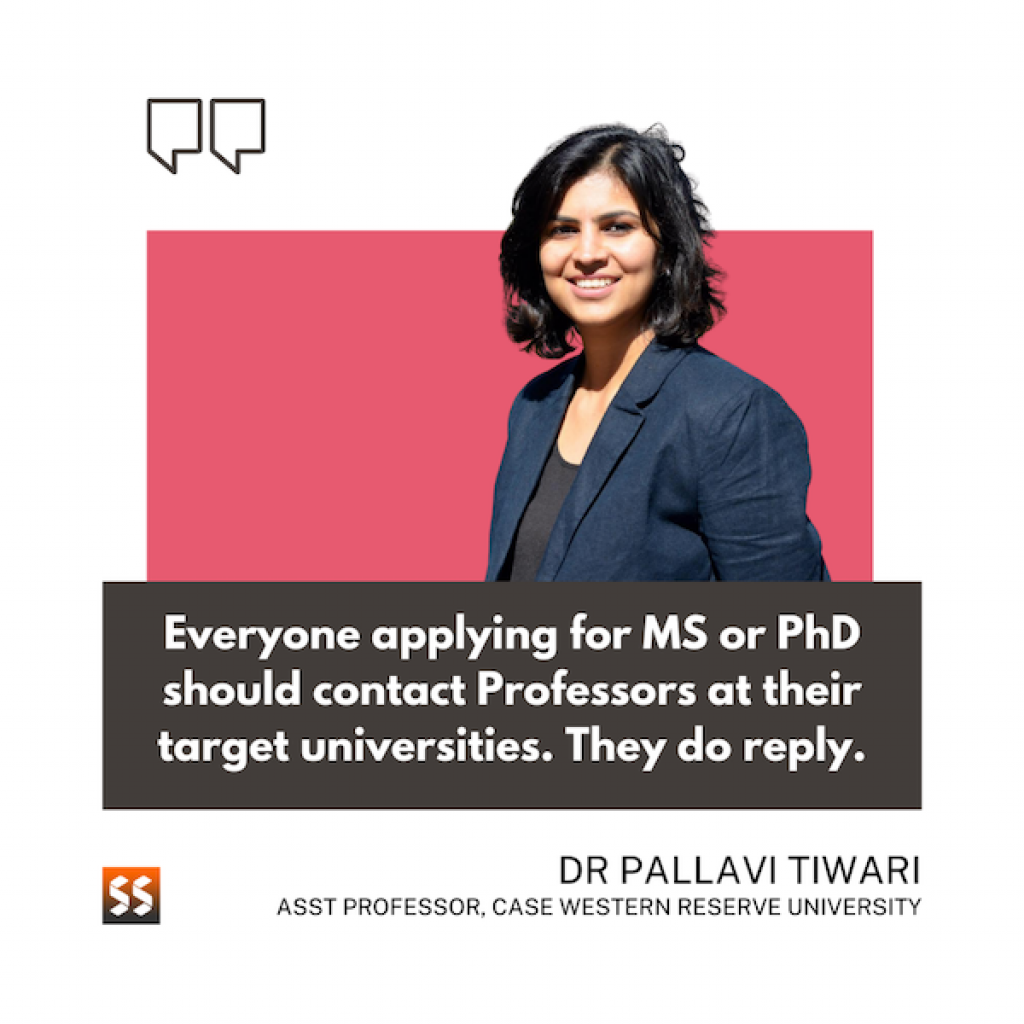
We invited Dr Pallavi Tiwari, Asst professor at Case Western Reserve University for a chat with the Scholar Strategy community. We discussed topics such as how to build a career in R&D and academia, how to contact professors etc.

She went on to Rutgers University where she finished her PhD in Biomedical Engineering and decided to continue her R&D career by taking the academia route. 

Pallavi, who herself hailed from a Tier 2 town in India and had a limited research exposure in college, has achieved great heights in her research career in USA.  

Dr Tiwari’s impact on brain cancer research was recognized in June when she was selected as one of six winners of the third annual Johnson & Johnson Women in STEM2D (WiSTEM2D) Scholars Award. Each recipient, representing each of the STEM2D disciplines—science, technology, engineering, math, manufacturing and design—will receive a $150,000 grant and three years of mentorship. She has previously been a recipient of many research-related awards including the Presidential 100 Women achievers award by the Govt of India for her contributions to Science and Research.  

At Case Western Reserve University, she is spearheading cutting-edge research in the field of computational imaging, artificial intelligence and machine learning to address some of the most critical clinical problems in brain tumors. She is the Director of Brain Image Computing Laboratory.

In her chat, Dr Tiwari advised engineering students to proactively reach out to Professors if they are applying to Grad School.

Keep the emails succinct because Professors are busy and do not copy paste the same email to multiple Professors. It is always good to read a few of their papers and mention them briefly in the email. Most importantly, be genuine.

I often get emails from students all over the world but I would like to see more emails from Indian students. I want them to know that research is a viable career option.

She would love to get more emails from Indian students and is always encouraging women to pursue careers in STEM. 

Also Read: Why Email Professors before applying to MS programs?

Dr Tiwari also added that worrying too much about jobs and salaries very early on can hamper grad students from exploring all the options.

Don’t pigeonhole yourself initially, else you will not know what other option could have worked very well for you. I myself didn’t have a very clear plan when I came to the USA but slowly realised that I want to continue to pursue research as a career option. If you are not sure of the commitment for PhD, you can come for MS and then decide later on.

She also discussed the importance of finding a good research mentor.

Working in a productive and collegial research lab in the long-run is a lot more important than going to a high-profile university. I have benefited greatly from the mentorship I received during my PhD and the friendships I built with my labmates over the years.

Full conversation with Dr Pallavi Tiwari is available on our Instagram TV.

USA needs International Students

US needs International Students

Last week, a tiny but significant news popped in on our feed.

91springboard ties up with University of Arizona to provide virtual courses to Indian students

Co-working operator 91springboard on 18 July 2020 said the company has tied up with the University of Arizona to provide virtual courses to Indian students at its shared workspace centres.

The University of Arizona, USA, and 91springboard have partnered to provide undergraduate and graduate courses to students and working professionals, the company said in a statement.

Src: PTI

Trump’s anti-immigration policies and rash acts against international students have irked the student community. But think of the universities as well, their business relies on foreign students who come and pay much higher out-of-state tuition fee. Indian and Chinese students make up for a large part of the student community in USA.

So, if Trump is making it tough for international students to come to USA, universities are now stepping up to explore other options. This partnership by Arizona shows that they are looking for ways to continue woo’ing foreign students.

By offering virtual courses but partnering with physical co-working space can give a better than online-only experience to students. So, they are tapping into that market segment which was not going to USA.

Of course, it remains to be seen if such hybrid courses will prove better than what is already being offered online.

Students can choose from over 40 undergraduate (4 years) and 20 graduate (2 years) courses in engineering, computer technology, humanities, business management, and applied sciences, among others.

src: PTI

They are offering the most popular courses among international students. This way, they are also trying to expand their bases in college students – many of who can consider in-person MS later on.

Why are international students important to USA?

  1. They pay higher tuition fee, thereby subsidizing education for domestic students
  2. Almost 25% of the unicorn startups in USA have been founded by an immigrant student
  3. These students spend money on many other things, thus contributing to the economy

What does this mean for you?

If you are an international students, this is an encouraging news because it opens more options to you. You don’t have to worry about being in USA, travel bans etc. You are taking courses at lower price points.

What you should think about though is – are such courses going to devalue the degrees?

Our Analysis

This move can make education more widely available and affordable for a certain segment of international students. However, will it also negatively impact the MS in USA segment? Will it eat on the customer base who was likely to come to USA for their studies? Do they think the higher volume of students who can take such courses virtually from India will compensate for the lower revenues they can generate on such courses?

It definitely shows that the universities are getting desperate and are looking for options to keep the students interested.

In the end, success of any program is determined by its ROI. If and only if a course can help its students get placed in the industry in good roles, will it succeed. That is why Ivy Leagues had been commanding such fee because their degrees were seen as a pathway to successful jobs.

But all that can change. It is an interesting time indeed. The education industry is reinventing itself and we hope its for good.

QnA with Duke MEM student

Duke MEM FAQs

Wondering if you should join or apply to Duke MEM program? We have our 2019 alum, Yusuf Bhinderwala, share a video review of his experience at Duke. It has all the latest updates.


And, for those who prefer to read – our older alumnus, Kanchana, shares what is it like to study MEM at Duke in a detailed QnA. She also talks about why she chose Duke over UIUC MSTM program. So, all those who are considering applying to Duke MEM and wondering what to expect, here we go.

duke mem

Coursework

What kind of technical courses are MEM students allowed to take?
Anything, simply anything

Are there any restrictions as such?
No. Provided you deliberate with the management on why you want to take up a course from the law school or Fuqua School of Business (if it’s not an allowed elective).

My main area of interest is Computer Engineering, so if I wanted, could I just pick up some courses in that area that are listed for the MS Computer Engineering course?

In the end, you are investing in an amazing experience where you can take away something new. Would you want to learn what you already know or expand your horizons? Think about that, sincerely!!!! Rope in people who are close to you and discuss your options. Don’t do an MS just for the sake of it…

I do not want to take up the course with the view of becoming a technical manager or anything of that sort. I would be more leaning towards being an entrepreneur. In that aspect, how do you think the course would help me?

Makes you managerially fit, lets you explore dimensions of studies that you never thought would affect your deliverables as an entrepreneur.

How is the course and what kinda projects do we have to do? Is it a lot of theory? OR is practical stuff involved?

It’s a constant learning process. They use what is known as case study method. Any subject you take, will require you to do substantial amount of work after the lecture. It’s a system of learning where the practical problem is thrown at you first and you figure out ways to solve it, then the concept related to the same is something that is taught in the last.

There is no theory or practical concept. Duke MEM involves a lot of case study analysis. It will stimulate your intellectual thinking and make you understand the concepts that you will learn in class.

In fact most of the non-technical jobs like Business Technology Analyst, Business Analyst etc have case interviews. They will put forth a problem to you and you have to find out all possible angles of approaching it. It’s purely creative and not technical…. So don’t worry when I say case interview.

Job Prospects and Job Hunt

How are the job prospects? Like what kinda companies hire us? and do we get paid well?The common notion is companies don’t hire freshers for a managerial post. Is that true?

It all depends on what you have to offer, if you are good enough, you can get whatever role you want. If you don’t have the aptitude and skills for it, you will never get the job, until you work towards it by taking related courses. No one will hire you as a manager if you don’t have the experience or substantiate with enough work/ study experience. If you are searching for a non-technical position, you may have to start from the beginning of the growth ladder for that non-tech position in any company.

Avg salary is somewhere in between $75,000 to $85,000 for starter positions. For people with prior experience and who have niche skills, it can cross even $100,000.

Do you get enough good companies to pick and choose among them?

Companies don’t come to you here. You have to network and get your job. It’s not impossible to get a job though. You have e-recruiting sites here, but you have to get in touch with new contacts through LinkedIn. Your choice of companies are not limited to the ones that come to the campus, you can apply to other companies through their respective sites and using a referral that you personally get in touch with through LinkedIn. And Duke trains you for this.

I have three years of work experience. Would I still have to complete an internship before joining? Further, how tough is it to get an internship immediately after nine months from arrival? 

The Internship Presentation is a chilled out thing, really. It’s a final 15 min presentation on your take-aways in your work/internship experience. It doesn’t even involve a lot of technical know-how to be presented. So if you are planning to take up an internship for the assessment, there is no point. You can leverage your work experience itself. You don’t need to separately do an internship if you have had the work experience.

The process of getting a job or an internship is different. There is the concept of NETWORKING that you will detest after some point. It is basically keeping in constant touch with your contacts that you make at career fairs, LinkedIn and other people you would have met otherwise. IT IS A FULL TIME COMMITMENT OR JOB TO DO INTERNSHIP/JOB HUNTING. It’s the same case in any grad school. What helps is that Duke will actively train you to Network! And you will have a series of Resume, Cover Letter Workshops and many such personal development activities that you have to promise yourself to make use of once at Duke. Because you honestly won’t find the time to do anything else besides managing your coursework and the endless team meetings.

Networking

Apart from the curriculum what kind of other opportunities are available to a MEM graduate (like some sort of consultancy club etc.) anything you can think of which is not mentioned in the curriculum but helps networking and developing?

Check out the MEMPDC at Duke http://www.dukemempdc.org/ . I am executive member of the CDAR club and I have conceptualized and organized a few activities for MEM student community. Apart from the four main clubs we have the Finance and Consulting clubs that have some exciting workshops and activities organized as well…. You can take part in any of them or even opt to be in the leadership team.

Your fees also covers the gym and all the athletic facilities at Duke. So you can make use of the same. There will also be MEM Olympics that covers an array of sports that you can take part in as well. Honestly, I would suggest you plan your academics in such a way that you get to participate in some activities atleast. The course itself is very heavy, even though it seems to be easy. Duke’s MEM is rated higher than Stanford’s MS&E and having had a stint with Stanford MS&E curriculum, I can personally tell you that it is true.

Duke MEM vs UIUC MSTM

I have admits from UIUC MSTM and Duke MEM and I am confused what to choose. You had the same choice, why did you decide on Duke?

I personally did not choose UIUC because I wanted more international exposure. 90% of the admits in UIUC last fall were Indians whereas it is around 50% in Duke. Having more diversity in a collaborative program like MEM enhances the experience multi-folds and it was an important factor I used to assess UIUC against Duke. Industry collaborations and opportunities are slightly better than UIUC is what I hear.

Duke having more feathers on its cap in terms of companies and industry relations, will only prove beneficial to you. Last but not the least, Duke has a very reputed Business School, Medical School, state of the art facilities as it is a private university, and is proudly called “The Stanford of the East”. It definitely has more visibility in terms of the MEM program.

Advice for incoming students

What other advice would you give to students who are going to Duke for MEM?

  1. Please come with an idea of whether you are going to finish it in 2 or 3 sems. Your peers here will confuse you. The program is completely doable in two semesters. But if you are adamant on going through the Career Fairs thrice then 3 sem option would be ideal. But people have told me that they waste a lot of time doing it in three semesters. I am completing it over two sems because I want to get back to work-life as soon as possible, I work effectively in lesser time as opposed to being complacent in three sems and this will also reduce my financial burden by a semester of living expense.
  2. Plan your courses beforehand as registrations for the famous courses closes within 2 secs of it opening…. I am not kidding. Also make sure that you plan to have all your classes over two to three days of the week instead of one subject a day, as you may lose time to go out and explore the University and what it has to offer besides academics. Look at which courses have a lot of team meetings as well. That will help you narrow down the courses.
  3. Most (95%) courses have team meetings. It will get really cumbersome. So be prepared to interact with people you may not like and also may have to shell out your weekend for the same. That is also one of the reasons why you need to have some free time over the week as well for yourself.
    It’s how you extract value from the MEM program at Duke that will matter in the end.

All about Statement of Purpose (SOP) for MS

sop for ms applications guide

How to write good SOP for MS applications? – It takes introspection, good writing and understanding. We know what AdCom is looking for in a SOP.

This is third article in this series. See the previous article on GRE here and School Selection here.

Once you have shortlisted which schools and programs you will be applying to, you need to go ahead and actually fill out the applications for each of them. Most of the schools now accept online applications, all you need is good internet access, valid email account and a credit card to pay the application fee in dollars.

Each application will ask you to fill out personal details. Tip: This can get repetitive, so it is advised that you create a text file and store your basic information from which you can copy and paste it into each application.
You will be required to upload some specific documents as well. This includes-

  1. Statement of Purpose (SOP)
  2. Letters of Recommendation (LOR)
  3. Resume (in some cases)
  4. Transcripts

In this post, we will focus on writing a powerful SOP for MS applications.

What is a Statement of Purpose (SOP) for MS

An SOP is a reflection of ‘who you are’ in front of the admission committee. This is one of the most important components of your application because this is the only document that is totally under your control. This is the place where you can tell your story and differentiate yourself from other candidates.

Here are the guidelines by Cornell University on what are they looking for in a SOP.

Components of a SOP

Background and Aspirations

In a typical SOP for MS applications, you will begin with a brief background/description of yourself and what you hope to achieve through studying MS at this university. Caveat: Don’t quote cliches here as everyone is doing it! Also, avoid getting too poetic. Remember you are applying for MS.

Academic and Professional relevance

Every school wants great students who will carry its name and reputation higher. For that, you need to show your academic and professional brilliance. So, talk about the academic (or professional if you have work experience) projects that can tell them about your subject expertise. Tip: Give more space to what you contributed and learned from that project instead of just describing it. How many and what kind of projects you want to highlight is up to you. But we recommend expanding on at least one and show your involvement. MS is about a lot of course projects and some research. You have to demonstrate that you can not only handle it but excel at it. Similarly, talk about any papers you might have published. Research papers and project become more important for PhD and MS programs that require a thesis to be completed.

Personal Story

Admission Committee consists of people who are reading your applications. Since they handle a large volume of applications every day, it is important to make your SOP stand out or be memorable. You can stand out by being academically brilliant too but if your experience is not that distinguished, try to put forth a strong story that connects your background and aspirations and aligns it with your passion to do MS at that school.

For e.g. even if you have not published big papers or done great research projects, you could have still started a startup with couple of friends and done some relevant work through it. The startup could be as simple as a website that offers building surveys for companies who want to do some marketing research. You could be highlighting some personal angle here such as how you came up with the concept and what were some of your lessons.

Here, you can also talk about extra-curriculars esp if you excel at something such as playing in a band, professional photography (something that is more than just a hobby), blogging (may be how you applied your php programming lessons to customize wordpress) etc.

Tip: Remember, anything that helps the admission committee personnel see a face behind your application is good as it will help him in remembering you. Caveat: But, dont spend too much space talking personal story that is not directly relevant to the course as that alone can’t get you admitted. Personal stories are good to supplement your acad/professional experience section.

Talk about how you have applied your learnings

Be it professional or personal section, remember to talk how you have applied your education or lessons into real world. This is a GREAT way to show that you’ll be able to translate your classroom lessons to your professional life. A naive example but you’ll get the point-

Having learned how xyz and abc help improving the signal strength of the wireless networks in my CCNA certification course, I was excited to help the system admin at my current company do so and so.

One more-

My brother’s company wanted to get customer feedback on one of their new products and I offered to get the surveys designed, filled and collected for them. Initially, I was doing it manually with my friends but then I realized that we can automate and package the service in a very easy-to-use way and put it online. To our surprise, we got contacted by lot of local companies in first month itself. Slowly, we iterated and developed pro packages that charged a premium for nicer result analysis. By integrating our services with right social media platforms and offline distribution channels, we had built a fully functional survey building service in six months. This gave me an inspiration to test new ideas online.

The above concludes the topics that should feature in all your SOPs (irrespective of the school). Next, you should be talking specific points about each school-

Why are you applying to this school?

This will typically discuss specific coursework, professors and research that you are interested in. This should tie up with your experience and background sections as well as your aspirations. You should have selected universities based on these anyways, so you should just be tying it all together at this point. If you are not finding good stuff to write here, you should rethink why you are applying to this school in the first place?

Caveats: Whenever you are mentioning specific professors, avoid talking about very famous ones as everyone will be talking about them. If the schools feels that your education will be hampered unless you are able to work for that professor only and if that professor is over subscribed, it might actually get you rejected even if your profile was great otherwise. So, exercise some caution when selecting professors with whom you want to work. A good strategy is to mention a couple of them and dont make your plans look too contingent on the availability of one professor.

Why should this school admit you?

As I said, it’s all about the ‘fit’. Talk about why you will excel at their program and afterwards professionally. The more you can convince them on this, better your chances are.

Alright, now that you are ready to crack your SOP, check out our Sample SOP for Engineers (yes you can use the inspiration to write for any program).

Don’t use Templates

Please refrain from using templates given by counselors or websites. The whole point is to make your application stand out and by using a template (especially the ones where you just change your specific information), you are looking similar to thousand other applicants. In fact, try to write the first SOP yourself without seeing any sample SOPs. After writing the first draft, check out some good SOPs and tweak accordingly.

You may also want to read some basic mistakes that you must avoid in writing your SOP.


For specific SOP tactics and samples, check out our bestselling MS Book: Smart Engineer’s Complete Guide to MS in USA.

For our paid professional counseling, check out our counseling packages.

MTech in India vs MS in USA – which is better?

Let’s cut the chase. Many applicants wonder if they should just go for an MTech in India instead of supposedly expensive MS degree in USA. Here are my thoughts on the same.

Whether you should go for GATE or not partly depends on where did you do your Bachelors from.

How helpful is an MTech degree?

Pros: MTech is cheaper than studying abroad and can make you eligible for placement in PSUs. If you did Bachelors from a low tier college and if you can do MTech from IIT/NIT/BITs (that means doing very very well in GATE), it will increase your employability and can give you access to top tier of employers in India.

Cons: Education quality in India is not good enough and the same is true for MTech. You have to, at the end of the day, deal with same kind of teachers and similar infrastructural constraints in colleges. That is why I said it depends on your college. If you did undergrad from a good college, MTech will give you only a little additional advantage in terms of job opportunities and I don’t think spending 2 years is worth it. Even if you get into a top tier institute in GATE, I feel that employers always have a higher demand for undergrads at these places and you might compete against not only your MTech batchmates but BTech guys as well. The fact is a Master’s from India is not considered that cutting-edge. So, if you think you are going to gain some major knowledge boost, that is wishful thinking.

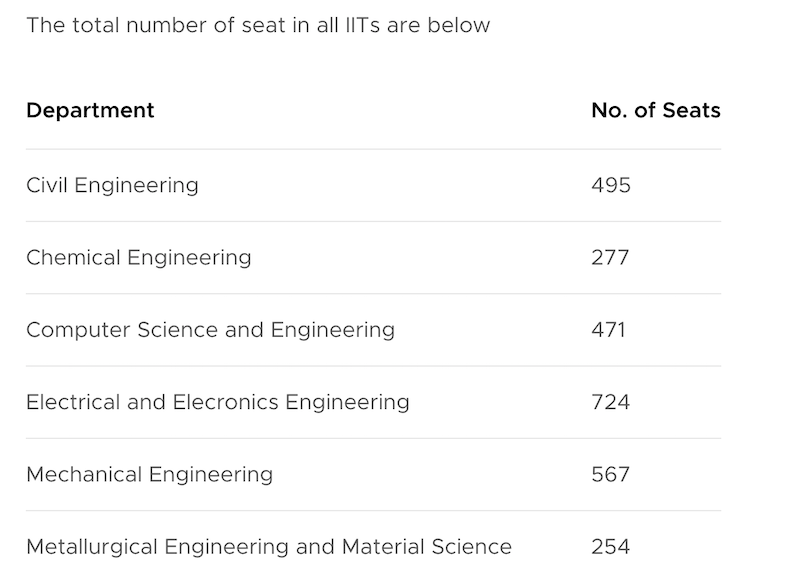
Just to give you a perspective on how competitive GATE is, IITs offered < 700 seats in Computer Science for MTech in 2020. Even if we double the number of IITs and calculating for more branches, that is <10,000 seats for MTech in IITs when 7.5 lac+ people appear for GATE every year. So, 98.5% of the candidates appearing for GATE will end up not meeting the cut off or even if they do, they will get non-IIT kind of colleges.

Pros of doing MS from USA

  1. Education is just way way better than in India. At UIUC and NYU, I had the privilege of learning under Nobel Laureates, reputed award winner scientists and people who were truly experts in their fields.
  2. Starting salaries are quite high (read USD 85k and above) that you can earn so much more than what you will back in India. Many students have this myth about financial affordability but if you do the math, you can repay the loan in 2-4 years if you go to a decent enough school and work hard to get a good internship/job since CS folks are really in demand there.
  3. Besides the exposure to a foreign land, opportunities and learning to be independent are something that will make you a better person and professional in the long run. It will prepare you for a global career better than an MTech.

So, what to do?

In the end, it depends on your financial constraints but if you can manage a semester worth of fee, I highly recommend looking at Master’s from USA instead of MTech in India.

Agree/Disagree? Comment below!

ICE asking online-only international students to leave USA

International students to leave US

JULY 24, 2020: Update

Just last week, we saw Trump revoking his ban and just when we thought the storm is over, Harvard announced that the ban does not apply to incoming Freshmen. In simpler words, any undergraduate student who was going to enter USA for the first time for his studies on a F-1 visa will not be allowed since college courses are running fully online and the ban revoke does not apply to them.

“International freshmen will not be able to come to campus this fall due to federal visa restrictions,” Harvard’s Indian-American Dean of the College Rakesh Khurana wrote to undergraduates Tuesday.

We are trying to find if this applies to incoming Master’s students as well. For the moment, it looks like USA has still not found its peace with students.

In lieu of the above, shall you continue your study abroad plans to USA? Contact us if you need help planning your future. Nistha has been helping students make their decisions this year more than ever and we are always happy to assist you.

JULY 15, 2020: Update

The Trump administration on Tuesday rescinded its ban on international students who planned to take classes entirely online in the fall as university campuses remain largely closed during the coronavirus pandemic.

Details of the administration’s rollback came during a court hearing over a challenge brought by Harvard University and the Massachusetts Institute of Technology in federal court. According to a court order, both sides had reached an agreement to rescind the policy, which was announced by Immigration and Customs Enforcement last week, sending thousands of students into a panic.

JULY 9, 2020: Original News

USA asked international students to leave the country if they are on an online-only coursework. Our analysis below.

US Immigration and Customs Enforcement (ICE) announced all of a sudden that international students will face deportation if their schools switch to remote learning fully due to the pandemic.

Due to COVID-19, there was a temporary exemption that permitted nonimmigrant students to take more online courses than normally permitted by federal regulation to maintain their nonimmigrant status. This ruling by ICE revokes this exemption and basically states that if you are studying fully online, you cannot stay in USA ?

The U.S. Department of State will not issue visas to students enrolled in schools and/or programs that are fully online for the fall semester nor will U.S. Customs and Border Protection permit these students to enter the United States. Active students currently in the USA enrolled in such programs must depart the country or take other measures, such as transferring to a school with in-person instruction to remain in lawful status. If not, they may face immigration consequences including, but not limited to, the initiation of removal proceedings.

It is devastating and cruel to say the least because online classes are not anybody’s fault. This comes after Trump banning issuance of new H1B visas last month ?

Who does it affect?

  • Current F1 students who are taking classes completely in online mode
  • Anybody planning to start Fall 2020 semester whose program is declared not hybrid cannot get F1 stamped or enter United States

Few options available to you:

  • Change your program of study such that they enroll in either hybrid or in person classes
  • Ask your advisor if there’s a way to enroll in courses which qualify for in-person credits – there might be certain project/independent study kind of courses that fulfill this criteria
  • Some people are talking about taking medical leave or transferring to another college but that is not feasible for everyone

Is there any hope on the horizon?

First, this turbulence is mainly caused by Presidential elections due later this year in USA. Things are expected to settle down after the elections.

MIT, Harvard, NEU have sued the govt for the same in order to protect the students.

India is also planning to raise the issue diplomatically to protect the students.

What are current students saying about it?

Nothing great to report.
Next year’s H1B is my last attempt, and with all the noise around, there is nothing promising to look forward to.
I love my job so that keeps me going and even though there are rumors of layoff, my team seems to be safe from being affected.
On a positive note, I feel lucky to have come here, did my MS and get a job before the pandemic hit.
Almost all the juniors who graduated last month from my college have active job offers, so that’s a great news.
The manner in which classes are being held (online) is a major drawback. Professors hate it, and attending a class in person is miles ahead of attending classes online. It’s not just the classes, but being have to be away from the University buzz is a major setback too.

The kind of support we are receiving from our faculty, and graduate associations (at CMU) is reassuring. But constantly being reminded by this administration that we are ‘aliens’ in this country, irrespective of our contributions, has consistently corroded our motivation to stay here for any longer than is needed. Before coming here last year I was of the opinion that every rule had a rationale that probably benefited the country’s economy or it’s politics. But now I am surprised to see how a country that was built by immigrants can be so xenophobic. Many of my friends are judiciously considering moving to other countries or going back home as soon as things settle. And it’s not only us Indians. An Australian colleague in my dept just sent his wife and 2 kids back home. I’ve heard from Chinese friends who want to go back home as soon as they graduate. I too am considering a future out of this country as soon as I graduate this December.

Colleges are trying to provide a hybrid model for current students so that they can stay. Apart from new i20 issuance (stating that we will be attending hybrid classes), nothing major is impacted for most of the universities (in hybrid mode). PS: College is supporting us in every way they can and Trump administration is doing the opposite. Keep calm and wait for November.

Rest, we are keeping an eye on the events very closely and will keep updating things here. You can also join our hyper active FB group to discuss the issues with fellow students.

Leave your comments and concerns below ?