How Deepika got an internship at Facebook?

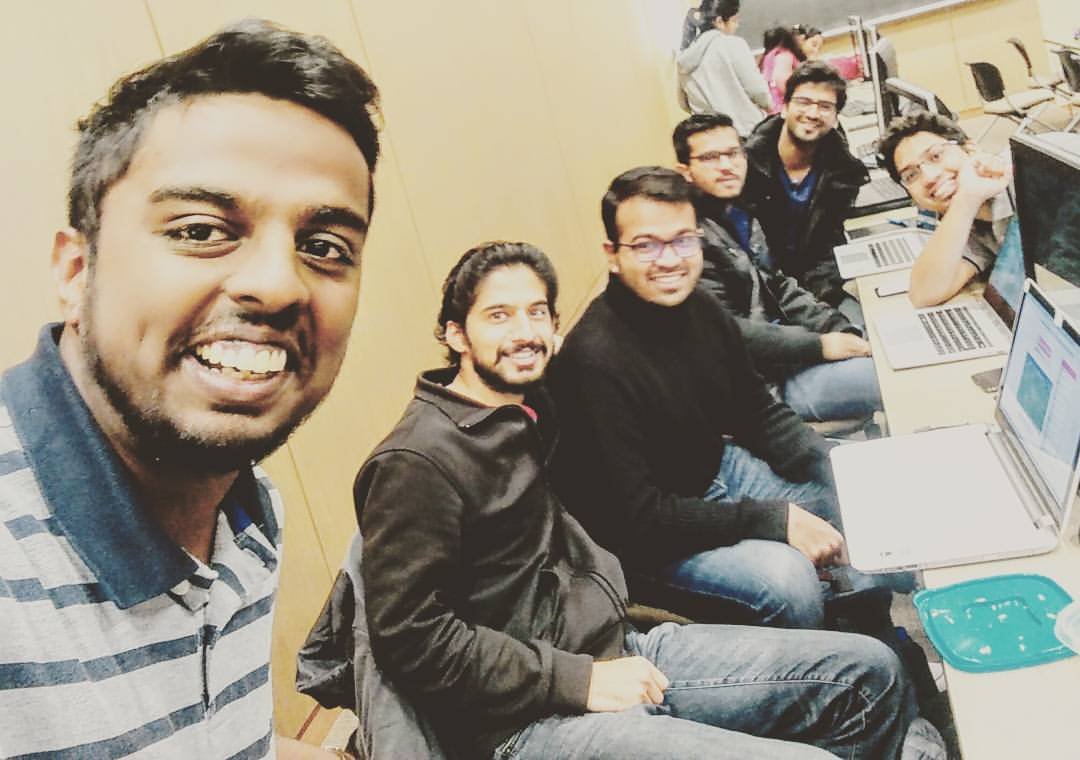
Deepika was one of our Fall 2016 batch student who went to USC to pursue her MS in CS. She cracked a summer internship at Facebook in 2017. So, we caught up with her and talked how she managed it!

What does it take to get a Facebook Internship from USC?

If you are dying to know what it takes to head to facebook, dig in:

Background

Deepika had 3 years of experience before heading to USC including at companies like Expedia. However, she did not get an offer from Expedia in USA. That was a reality check and she prepared hard to crack good offers.

Want more advice?

More questions for Deepika?

What would you like to see our next video on?

Comment below to tell me what you think! And don’t forget to subscribe to our YouTube channel.

Ciao

20 Secrets to Successful Dating in Grad School

The time in Grad School (equally relevant to college) is not just critical for your career but also for personal relationships. Many a time, school life does not derail because of the decisions of mind but that of the heart.

A healthy approach to relationships is a must have. Here are 20 tips to keep you emotionally sane-

1. Enjoy dating with an open mindset

Meeting multiple people gives you a better idea of your own preferences before you start seeing someone more seriously. And no, you are not supposed to be dating many people at the same time (glad you clarified).

2. A successful relationship is about compatibility and that goes beyond how cute someone is

I know, I know. Hormones. After a while, you will stop noticing the cuteness but if the person has a habit that annoys you (not making their bed, bad at losing in board games), it will become hard to ignore.

3. Break up is not the end of the world

For whatever reason, if you have to break up (or your partner initiates it), it is okay. No, seriously. You would think that it is the end of the world and you will never find anyone so good again. But usually, your mind is just reacting to the insecurity of ending up alone. Breaking up sucks but being stuck with a wrong person is a torture beyond comprehension.

4. Don’t date assholes, narcissists and control freaks

Self explanatory. Quit if the person is abusive, tries to make you feel bad for his/her problems, feels manipulative, does not pay attention to your needs or talks down to you. There is no reason big enough to justify staying with such people.

5. Kindness is the most important trait to look for

Yes, it is shocking but in the end, if your partner cannot be kind to you when you behave differently from what they expect, you will run crazy trying to please them. It is not a battle you can ever win. Romance will cool down, you have to pay bills and do unpleasant chores when you live together. There will be days when the world seems wrong. You need a kind partner to get through those days.

6. Don’t chase anyone, move on

If someone is breaking up again and again with you and coming back, stop. If they don’t value you, they are not worth keeping.

The longest relationship in your life is the one you have with yourself. You are the most important person in your life. Have some self-esteem.

7. Career and relationships are equally important

No amount of wealth can fill in for loneliness and no amount of company can fill in for emptiness. You can have a balanced family and professional life. Go for it. Don’t compromise on your dreams and always be there for your partner. Find that delicate balance — it is hard but it is so worth it.

8. Don’t try to change anyone

Everyone holds some beliefs and values in life. Some of those are non-negotiable. Unless you understand what you can and cannot live without, how can you find the ‘one’ for yourself? If your plan depends on changing your partner so adjust to your values, think again. Can you change for them?

Examples are known where deep incompatibility in religious beliefs, political beliefs, financial values corroded the relationship over time. If you are a spiritual person and that is core to your existence, you won’t be able to thrive easily with someone who is agnostic, materialistic and contrarian to your values. People usually don’t change when it comes to such core values. Exceptions may occur but you don’t want to hold your breath on it.

9. Backpack test

My favorite advice came from Richard Muller on Quora, “Take a week long backpack trip together. Before you get married, you want to experience stress together, ideally over an extended time.” How do you hold together in stressful moments will tell you if you are right for eachother or not.

10. Never cheat

Integrity is doing the right thing even when no one is looking. Don’t cheat — not because someone will find it out but because you are much better than that. One never sleeps peacefully when one is worrying about being caught.

11. Read relationship books before you fuck it up

You will fuck it up, trust me. But to avoid making it a catastrophe, educate yourself. Relationships can be understood by reading about human psychology and communication. I know 20 something people think it ludicrous to be reading about relationships. But you will be thankful later when you end up not losing a great person because of your ego. Or, when you get rid of a toxic person. Despite how smart you feel you are, you are naive and books can help.

Here are the three books I can recommend to start off with-

1. “How to Win Friends and Influence People” by Dale Carnegie — Because you need to learn how to be a likable person to be in a relationship
2. “Men are from Mars, Women are from Venus” by John Gray — Because it helps to understand different mindset of men and women (avoid generalizing too much though)
3. “Nonviolent Communication” by Marshall Rosenberg — Hands down the best material I have found on how to avoid miscommunication that kills so many relationships

12. Long distance is hard, not impossible

Any relationship needs investing time. If you can do that, distances may matter less. But don’t overtly romanticize the notion of making long distance work. As you move to a different country/place to study or start a job, you are going to change — whether you like it or not. You should take time to decide if that old relationship of yours is still the right one for you. In a good relationship, both people grow simultaneously.

And if you can grow from distances apart and keep the commitment and integrity alive, you can have a relationship that will truly stand the test of time. And if not, it is better to let go.

13. Don’t commit before you feel ready

This is an extension of point 3. If things are not great, quit. A right relationship is not supposed to be okayish, or just-good-enough; it is supposed to be great. It should make you feel not starry-eyed but calm from inside. ‘Yes, this is the person for me!’

So, if you are not feeling this way, don’t feel an obligation to commit just because you have dated each other long enough.

14. Discuss important things instead of sexting

Do you want to live abroad or in your home country? Do you want kids? Do you want to keep working after the marriage? Would you wish to take care of parents together after marriage? These are the questions that matter and yet most couples never discuss it until after the wedding.

15. Interracial relationships face extra challenges, are you prepared?

Asian cultures are ultra-conservative and a western person may find many of the customs strange. While Anglo-Indian, Jewish-Muslim marriages are not unheard of (and I personally know successful couples), they require that much stronger foundation to withstand the extra complications.

16. The only good reason to marry someone is love and compatibility

Definitely not peer or family pressure.

17. Best friend may not make best spouse

Intimate relationships need more than friendship to thrive. Read point 16.

18. Keep a good circle of friends and don’t let your life revolve solely around your partner

Grad School is a perfect place to meet super intelligent and interesting people. There are awesome things to do academically and socially. The worst thing to do is to miss out on this chance because you and your partner isolated yourselves socially.

What seems very intimate in the beginning can seem like an extra burden of expectations on each other. If your whole life revolves around your partner, there is more probability of getting disappointed when the other person cannot give what you want. It is not fair on either of you.

19. Nothing good will get away, don’t be desperate

Don’t worry about losing. If it is right, it happens. The main thing is not to hurry. Nothing good gets away — John Steinbeck

Read this wonderful letter containing relationship advice by John Steinbeck to his son.

20. Do not carry on if you know it isn’t going to work

Respect your partner’s time and break up gracefully and let them move on. Never hurt anyone with your careless attitude. Whatever you throw out to the universe will come back to you. Karma never forgets.


I have seen brilliant people dropping courses and grades and barely managing to study because they were involved in dramatic relationships. While there is no algorithm to find the right person (wouldn’t OKCupid pay billions for that?), the right relationship will feel right. And the right person will elevate you instead of letting you drown in the dungeons of insecurity and longing.

A long life lies ahead. Take time to study well, make the career that you dreamt. Attract a person that enjoys same things as you do and live happily ever after 🙂


How good is Portland State University for MS EE?

Welcome back! Today, I am sharing detailed feedback by Melvin Thomas, who is pursuing MS EE from Portland State University and interning at AMD. This is what he wrote about the program in an email-


Feedback from MS EE student at Portland State University

I know that this is one the last options of many MS VLSI aspirants, if not an unconsidered option because of its unranked status. However, I would like to share few feedback from my time here that might help someone in our group in future:

Tracks

  • Digital IC Design was considered the best thing here and I also joined here for the same. But the Professor who was handling both the Digital IC Design courses has retired and it is no longer the flagship track here. As such Digital IC Design 1 and 2 are taught by a good professor only once a year and sometimes the first course will be taught by him only in Spring term which is the third term provided you join in Fall, and its pretty late to learn the core course then. Still, ASIC Design course is great and the Department are coming up with a separate Physical Design Course as well. ASIC Design will be taught in Winter and in Fall, before DIC1(by the best professor) in Spring and hence you may not be in a position to take advantage of his classes and take the succeeding courses with a systematic learning. But learning DIC1 is pretty manageable on your own irrespective of the Professor and that is what I did in my first term so that I can get the fundamentals early.
  • Computer Architecture track is excellent here and have 4 courses for it and is taught by excellent professors and research scientists working in Intel. The questions asked for all the interviews are directly from the slides they teach even though they are application level question which you cannot answer without understanding the fundamentals. But the fundamentals are structured very well and even the advanced computer architecture courses are handled excellently.
  • The in-demand red-hot winning track here is the Design Verification and Validation track and a high percentage of openings in the industry are verification positions and a large % of my batch mates, including myself, are working in Design Verification and Validation positions. It is excellently organized and taught and it is what fetches jobs here at this point of time.
  • There are many professors who are not that great and few important subjects are taught by great professors only once a year. So making compromises with choice of subjects and professors are very common here to fit your schedule. This is one drawback but there is no other way around this.

Coursework, and Research

  • The course offers great flexibility and you will end up completing multiple tracks by the time you graduate because one track’s core courses are another track’s breadth and depth courses. Few compromises have to be done to fit your schedule and planned coursework because learning systematically is very important. For me, staying ambitious with my courses has been vital and I have taken the risk of two tough subjects in one term just to leverage the options of being taught by good professors but that required full dedication in that term. Even while doing my internship I have opted for the course that adds value looking at the market, and not for the sake of taking a course to have a relaxed term. This is where many go wrong, but provided you work hard with total dedication, things are manageable and certainly rewarding with time.
  • There is no research happening here. There is no funding for it. And there are only 2 or 3 “real professors” – others are adjuncts who either have strong industry experience with PhD or are instructors without a PhD – and it shows in the way they teach. But it doesn’t mean they teach bad, rather they teach differently as compared to a real professor. It then comes down to how much you want to learn and how much you try to learn from them and as long as you do it, you are still getting benefits – ultimately the learning happens but in a different way.
  • Quarter system is really tough. There is no real time to grasp things as they are taught and also we don’t get time to do huge projects as compared to those in semester systems. Any slight slack off costs you so much as such and we have to be ambitious with projects and do additional projects during breaks to match our competitors.
  • CS Department here is one of the worst. I strongly discourage anyone from joining PSU for CS. But ECE Department is glorious with respect to VLSI and especially Computer Architecture and Verification and it is going to stay so for the upcoming years. Also, the Embedded track here is not good. It is totally different from the coursework of other universities with courses that aren’t organized well and I strongly discourage anyone to join PSU for an embedded program.

Job/Internship Prospects

  • This is not an Intel place at least for the past few years. Intel is on freeze and very few have got any calls except the ones who have someone at a senior position to refer them. That being said, Intel is not the only company around and verification jobs are plenty in other companies.
  • There are no career fairs here. Everything depends on your portal luck and mostly referrals help you. I got 3 calls through portals because I have a high CGPA (>3.9), and I am one of the few people to get this portal luck. Yet what is effective is someone to refer you and otherwise your portal luck never aids you mostly.

Scholarships, and Finance

  • Getting a TA is totally dependent on your academic performance and rapport with the professors. There are many who had less GPA and who got an internship because they had someone to refer them in. But they could not get a TA because Professors do know your capacity from your grades and projects. I got 2 TA offers – one in my third term which is rare to be honest – and one currently and another Grader position. Being a TA covers nearly covers all the expenses of a term and paid me around $7000 for 3 months. Being a TA here is sometimes an easy task – you don’t have to take class, most of the time – rather conduct office hours and help them either then or via email and I never tried for an on-campus job – but no job could be better than a TA, especially when I am studying along and when it provides me flexibility with my timings.

Location

  • Portland is a fantastic place to live and study and its cheap. It is blessed with nature and for me with the right academics too and I truly enjoy being here. It was tough for me to make this decision because I was going to an unranked University but I decided to join PSU instead of UTD because of my financial situation. But my decision to join PSU quitting my job at HPE was one of the best decisions I made and I never regret coming here and irrespective of what people told me a year ago, I am doing my internship in a well reputed big shot company and alongside people from USC, UMinn, UPenn etc. – my journey is different, my route is different, but with support of all those who believed in me, including you, and with hard work and grace of God, I am on the right track well among the right mix.

Peer learning

  • The academic standard of Indians studying here is poor. There are only a handful who are really ambitious and know things and do really work hard. So there is lack of competition here and all the terms I spend considerable time in figuring out how to say no to all the people approaching me for being their project partners. There are only few whom you can learn with. With that being said, I am working with people who graduated from UMinn, UPenn, USC etc. here in AMD and an unranked PSU guy is up with those people who are from the big brackets! – as you said, the reward of hard work irrespective of where you are.

Thanks for this honest feedback, Melvin 🙂 We wish you all the best always.

If I had to summarize, I would say that it is less about the school you attend than what you do there. If you know how to hustle, you can make it big from anywhere. Of course, starting from a school that helps you in moving towards your goal does put you at an advantage. But if you do not have a choice, do what Melvin did – made the best of what he had in hand and emerged victorious. I trust in you.

Want to work with us? Check our mentoring packages 🙂

5 deadly mistakes by MS/MBA applicants

Every year I see some good profiles getting rejected on various forums. It is not that shocking really. Let us see the worst mistakes applicants make in their applications. application mistakes

1. Applying to wrong/very-few schools

Wrong schools are the ones that are likely to reject you or do not offer you the right career prospects in your field. The result is that you end up with no admits or worse yet, have a bad admit which can jeopardize your career. Secondly, if you do not apply to enough (at least 10 for MS and 6 for MBA), then you are not distributing your risk properly. The incremental cost of another school’s application is relatively low, so do not be miserly when it comes to applying to enough number of schools. application mistakes

Wrong school is not always the low ranked, it could be a higher ranked one but one that doesn’t offer you right resources for your areas of interest.

Why does this happen?

It happens when applicants do not do proper school research, go by the advice of counselors who just want to get you an admit anyhow and suggest uber-safe but horrible schools, rely too much on the ranking alone, want to save money by applying to low tuition schools etc.

It also happens when applicants are not clear on what they are looking for. Knowing what you want to do after Master’s is crucial to choosing right schools.

Examples

A very good PhD applicant applied to Columbia EE program and got into it. This was the only admit but they did not offer any form of aid. It was not possible for this candidate to attend Columbia with a $100K loan. This situation could have been saved if he had found out earlier that Columbia offers scholarships rarely.

A student reported negative feedback on CMU 12 months MIS program. This could have been avoided by doing better fact-finding and connecting to the alumni of this specific program before deciding to attend it.application mistakes

There are some CS schools which rarely take students from non-CS background. If you are ECE student applying to CS in such a school, then it is simply a foolish choice.

2. Applying late

Many very good profile candidates decide very late that they should apply. If you apply after 15th Jan, I feel that your admit as well as aid chances start going down significantly. Simply because seats are getting filled already and competition for remaining seats goes up. That is why we suggest a Fall timeline wherein you finish applications by end of Dec max.

Why does this happen?

Lack of awareness and targeting too many things (applying for MS, MBA, taking CAT, GATE at the same time). Spending too much time by yourself hoping you can do it all on your own while being in a demanding job.

3. Not spending enough time on SOP/essays and story

SOP is not a formality. It is a critical piece of your application. Applications are a sales pitch telling the AdCom what they are looking for about you. ‘Why should they admit you’ should be clearly conveyed. [pullquote]I had parts of my application ready but I was still not able to glue them together in order to impress the admission committee. So I started seeking an authentic reputed counselor who would give decisive opinions and statements about different aspects of my application. Nistha is always available for any doubts or clarifications and the phone calls I had with her were super helpful! I want to thank you Nistha for all the support and motivation that you have given me. My University of Illinois Urbana Champaign – Data Science dream wouldn’t have been possible without you – Akhil (UIUC) See all testimonials [/pullquote]

Why does this happen?

Same as above – it happens when people are running late and are too busy or just take the whole process very lightly. The fact is admissions in US/Europe/Canada work very differently from that in India. As a result, Indians underestimate how much time it will take to prepare a good application. I have seen that a good MS application can take 1-2 months for SOP/LOR prep and a solid MBA application needs around 3 months to get done all the essays. 

Another cause is overconfidence. I have seen many people with good GPA and GRE scores thinking that they can easily get anywhere. They do not pay attention to what they are writing in SOP and essays and there are cases when 330+/780+ scores are not able to make it to Top 20 schools. Admission Committee is looking for technical expertise other than scores. And they are looking for someone with clear goals. They are looking for a winner who will take the name of their school to new heights. And a high GRE/GMAT and GPA score alone does not convince them.

Story matters even more when you are switching your streams (e.g. ECE student applying to MS in CS, IT to Banking in MBA). You need to very carefully demonstrate your fit in these cases.

4. Relying on [wrong] counselors

By wrong, we mean the counselors whose commercial interests are not aligned with your career interests. Those whose metric of success stem from how many admits they got you instead of thinking of your wellbeing. Those who are number driven and willing to take anyone and everyone. Counselors who get paid by the universities will recommend you to apply to schools which are not worth attending (these will land you with zero career prospects and in some cases, visa rejections).

While one doesn’t need a counselor, a right counselor at right time can really be the difference between a Top 30 and Top 10 school. See how we work with out clients.

Why does this happen?

If you feel you are not able to find enough time, it is better to take counseling help and save time. The problem happens when people go for big names and those who offer cheaper counseling (compensating by taking a lot of students and not giving enough time to anyone). The problem is that these counselors might suggest you safe but unworthy schools because they want to show they have gotten so many admits. They have tieups with shady schools which do not even require GRE. Whenever you hear this, run in another direction. Many of these counselors claim to write SOP for you. Yes, when you hear this, again run. And don’t look back. [pullquote]Nistha was very helpful in giving advice about sop. She also organized webinars regarding internships which were quite helpful – Shravya (Georgia Tech, UCLA) See all testimonials [/pullquote]

What you need to ask any counselor is – who is exactly advising you and does he have background in your field? Has he gone through MS/MBA application process himself? Will he be reviewing your essays personally and on what points? How much time will he be devoting to you? Have they helped get students with your profile in the past? What exactly were the results?

I have heard from 2 students in this season already who went for other counselors in Delhi and Mumbai and had very bad experience. Every year, I get enrollments from people who have already wasted time with unreliable counselors.

First of all, if you start 6-8 months in advance of the deadlines, you can find all the information on the Internet and do NOT really need a counselor. A good counselor will not spoonfeed or write for you, he will guide you in the right direction and keep you on track. He will tell you honestly your chances in good schools and make you work hard to get there.

5. Not addressing the weak points in their profile

If I am the AdCom and I am seeing a GPA which seems low for your background, then I will question your ability to handle the coursework in Graduate School. It is your responsibility to tell me why that low GPA does not represent your true capability. If you ignore that or choose not to say anything about it, I would assume that there is no good reason for it and you may face problem in handling the coursework. This is one example of why you must think about what are the shortcomings in your profile and how to address those.

Why does this happen?

Lack of awareness and shortage of time 🙂

One-year or two-year MS program?

Let us discuss the pros and cons of each and decide whether you should apply for one-year or two-year MS programs. Most of the thesis based courses are two years. Only if you wish to return to industry, some universities offer one-year fast track MS programs. One year programs are more usual in professional programs such as MIS/MEM and MBA.

Popular one year Master’s degrees

S No.UniversityProgram Name
1CornellMEng in CS, EE and others
2University of ChicagoMPCS
3CMUMISM
4UT AustinMS Business Analytics
5ColumbiaMFE
6University of WashingtonMSIS
7Indiana University, BloomingtonMIS
8MIT Sloan One year trackMBA
9Cornell Johnson One year trackMBA
10Kellogg One year trackMBA

By program-

MIS/MEMCMU 12 month MISM, Washington MSIS, U Buffalo MIS, Duke MEM, Indiana University, Bloomington

MS – Cornell MEng, MPCS (Masters Program in Computer Science) at U of Chicago

Business AnalyticsUT Austin, Georgia Tech, UIC

MFE – Berkeley, Columbia, UCLA

MBA – INSEAD, London Business School, Kellogg one year track, Cornell Johnson one year track, MIT Sloan one year track, ISB

One-year or two-year MS

One year programs are more intensive whereas two-year programs space out the curriculum at a more breathable pace. Time flies by in graduate school and one-year duration means that before you know it, the job hunt is on and you are about to graduate. Two-year programs are obviously more immersive and give you a chance to experience the culture, location and build better relations. One year programs do not have time for summer internships.

One year programs typically admit people with higher work experience and proven quantitative aptitude so that they can handle the coursework intensity. A portion of the folks in one-year programs come from companies which as sponsoring their studies (e.g. Washington MSIS).

When should you choose one year program?

Just looking for a degree? One-year programs are your savior!

If you are clear on your goals (and are not looking for a drastic career change), one year program can save you one year of opportunity cost, which can be huge! Most of the students pursue MS to get into campus placements and one-year programs still offer you that without the extra fee and extra year of lost employment. Secondly, if your company is sponsoring you, then they might prefer that you finish the degree sooner.

When should you choose a two-year MS over one-year program?

If you have less than three years of work experience and want to explore different options before choosing your fulltime employer, then go for a longer program. This will allow you to take more courses, do more networking and do a summer internship.

If you are a higher work-ex candidate but wish to do a career change, go for a two-year program so that you can get a summer internship – which is a great way of trying out a role without committing to it.

Word of advice

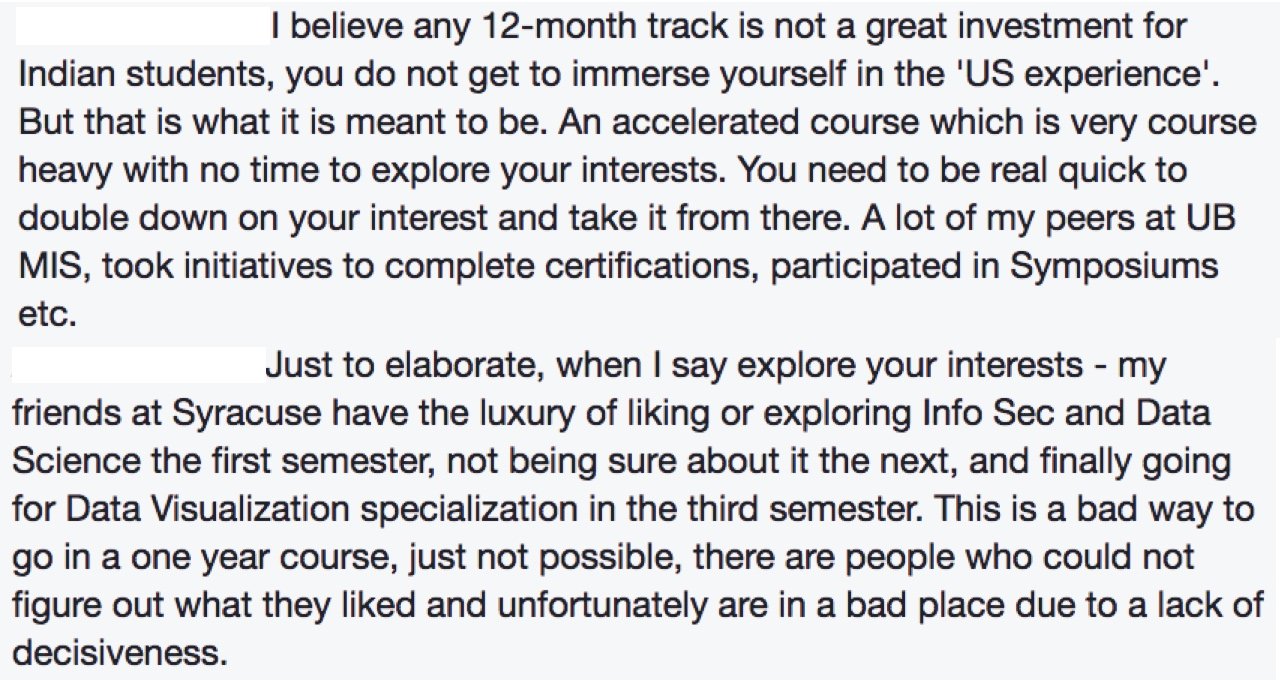
In an interesting discussion in our closed Facebook group of only our clients, we were arguing what works better. I am posting some interesting comments from it-

Conclusion

At the end, it can be a tricky call. I have worked with freshers who chose a ten-month program and >10 years experienced professional who chose a two-year program. Eventually, it is about understanding what you need at this juncture of your career. In our counseling, we address such doubts and help you pick what is right for you.

Why every Grad Student should have a website?

One thing that baffles me is that only a few people going to pursue Master’s put serious efforts into building their own website. You are overlooking a lot of advantages if you do not yet have your website!

Why should you blog?

A lot of companies and recruiters search for your name online before the interview. While a good LinkedIn profile is a must, additionally having a website can put you at edge especially when you are looking for a job at startups. I got my startup job in NYC mostly because of my blog. Yes, you read that right. Writing online showcases-

  1. You are knowledgeable – writing about a topic requires researching and fact finding. If you are writing informational posts, it shows you are an active reader and know about your field.
  2. You are confident – showing your work to the public requires having confidence in yourself. Whether righting informational posts or opinions, you project yourself as someone who is ready to take charge.
  3. You are intelligent – yep, if you write well, most people correlate it to a higher intelligence and IQ.

Employers value your knowledge, creativity, and intelligence. A good weblog is a great way to show that. 

And more importantly, once you start writing, you will be forced to learn more so that you can write better. It is a very rewarding exercise.

Blog or website?

Now, the question is some people find writing to be a very daunting exercise. It is okay. As I said, you can gradually build upon it. But even if you are not actively blogging, you can still create a static website with your updated resume (even a creative version to grab your employer’s eye!), list of projects with details, references and any interesting things you are up to. It can be your online diary and the good thing is half of it can come from your LinkedIn profile anyway. Secondly, your university is giving you free server space anyway, so why not create a quick page there?

But I do encourage you to start blogging about your field little by little. There are many ways to start it and I will post a new article on it soon. It always helps to have other websites link to you and this is where we can help you. If you write a good article related to grad school life or your field, we will be happy to guest post it on Scholar Strategy website. Already have something? email us at scholarstrategy@gmail.com 🙂

Show me an example!

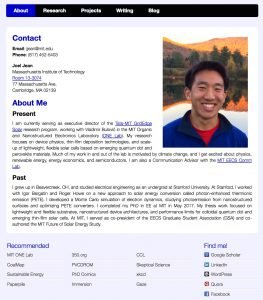
I like this simplistic website of Mr. Joel Jean who I hope won’t mind me using him as an example. He is focusing on the text and work rather than making it flashy. And if someone is really interested in peeking inside his mind, he has a separate link to the blog. Looks professional, to the point and seriously impressive!


Feedback on MS EE at UNCC

Scholar Strategy alumnus Sajin joined UNCC for MS EE in Fall 2016. He shares his feedback on the program-

Before coming here, I didn’t feel that UNCC was a good option to do my Master’s in. But, I’ve been proven wrong in every way. The coursework for Embedded systems, computer architecture and operating systems specialization is really good.

Coursework

The advanced course in operating systems offered here is a direct clone of an MIT grad course, and it is extensive enough to prepare anyone to go directly into industry. I highly recommend anyone who wants to do something in operating systems (kernel development, device drivers, etc), to have a look into UNCC.

The research work in computer architecture is really good, and the professor who handles that (Dr. Hamed Tabhki), gives you good relevant research work on that field if you show interest. The focus is on general purpose GPUs and FPGAs. Also, there is an excellent professor in the CS department who offers very good courses on high-performance computing. For Embedded systems, there are decent courses, but things could be better.

Vlsi coursework is not up to the mark, but they’ve hired some new professors recently. I’ll update you on the progress in due time. As of now, UNCC is not a good place to be, if anyone is planning to specialize in VLSI.

In general, I’ll highly recommend UNCC if anyone is interested in computer engineering (There is no MS in computer engineering as such right now, but MS in electrical engineering covers all this).

Finance

In terms of funding, the situation is not that good. None of the MS students get tuition fee waiver, at least in computer engineering. Funding is mostly in the form of TAs and RAs, and most of these will go to people who opt for thesis (the situation is different in computer science).

Employment prospects

In terms of jobs, a lot of people taking up operating systems are getting into good companies. Around 8 of the 22 who took the advanced OS course cracked Intel. People have gotten into Cisco, Amazon, and Texas Instruments. Last year, around 4-5 got into Qualcomm. The job scene is good for people who opted for the right, challenging courses. Also, it is worth mentioning that people who took embedded systems courses are getting lots of calls for embedded firmware jobs.

About my progress, I’ve gotten into Wind River Systems, which is an Intel subsidiary. I am working in the CoreOS team of their flagship real time OS VxWorks. I’m getting to work on cutting edge stuff, and am really enjoying the experience here.

Thanks for your honest thoughts, Sajin. Hope it helps the prospective applicants.

WEBINAR on EE programs and recruiting in USA

Electrical and Electronics students perhaps face the toughest competition when it comes to getting into Top US programs for Master’s. EE projects are tougher and with lack of great infrastructure in Indian colleges, it becomes harder to stand apart from international competition.

To help you prepare better for MS in EE applications and jobs thereafter, we have invited Sajin Sabu who is pursuing MS EE at UNCC.

“Before coming here, I didn’t feel that UNCC was a good option to do my Masters in. But, I’ve been proven wrong in every way. The coursework for Embedded systems, computer architecture and operating systems specialization is really good” – Sajin

So, we have Sajin with us who I have mentored personally and I know that this is going to be blast of a session! He himself was a bit disappointed when he was heading to UNCC but he says it did wonders for him. Find out more details when he shares his story.
I will be moderating this myself and asking questions about studying EE and finding jobs in USA. With so much competition for EE programs, you do not want to miss it.

QnA will cover:

  • What are good and less competitive EE programs in US?
  • How to get into these programs?
  • How to recruit for EE role in USA?
  • and more

We will be announcing the final webinar links on our Facebook Group on MS Internships and Jobs (click here to join), so please join us there for follow-up announcements. We have limited seats, so hurry up.

Building career in Analytics through MS programs

Anyone looking to build a career in Analytics should check out MIS (Analytics), MS Data Science and MS Business Analytics programs.

Career in Analytics – Why you should not miss riding this trend?

In four years of Scholar Strategy, one trend that is so glaringly clear is the rise of interest in Analytics and Data Science programs. This stems from the growth of number of jobs in this field in big enterprises and small businesses alike. Be it a software giant, pharma company, a SAAS business, a food tech or ed-tech company, analytics underpins every industry and sector. Thanks to the massive data science teams at FANG (Facebook, Amazon, Netflix, and Google) and their success, suddenly everyone wants to play the data game!

As large number of professionals pursue a career in analytics and many looking to switch over, competition is on the rise as well. Which means that it can be very tricky to navigate the quantitative job landscape as an entry-level graduate. Burtch Works Study reported that 86% of analytics professionals have at least a Master’s degree, and 18% have a Ph.D. No wonder, we at Scholar Strategy have seen an increasing number of applicants in MIS (Analytics), MS Data Science and MS Business Analytics programs. We already discussed the subtle differences between these in our previous post.

What is Predictive Analytics?

A new term that is becoming more ubiquitous is Predictive Analytics and a lot of jobs use it in their descriptions! It can be looked upon as a subset of Data Science which specifically deals with forecasting future business outcomes. It helps us predict what can happen based on the past events. As per adobe data blog, “for instance, your credit score is calculated using predictive analytics. Based on a predetermined predictive analytics model that includes data about how you have behaved in the past, your credit score predicts how creditworthy you are likely to be in the future.” Since a major application of data science in business is to predict and prepare for the future trends and customer behavior, predictive analytics is growing in demand.

Analytics has changed many industries, one of the major ones being Marketing. The way businesses attract customers and draw leads has changed significantly. In fact, the very way that businesses think of customer acquisition and focus on incoming vs outgoing interest, has grown because analytics makes it possible to measure the efficacies of different channels. This growth in data and ability to use it effectively for business decisions is one of the major transformations we have seen in past 5-6 years.

What does it mean for you and your career?

If you are looking to become a data analytics professional, you need to wade through the competitive waters to get a good analytics position. An advanced graduate degree can give you the differentiation and a good entry point in the market. But still, it takes effort and sagacity to get to a coveted analytics role in the market. To better understand this, we are holding a webinar on Studying and Recruiting in Analytics! Looking at the overwhelming response to our last Data Science webinar, we are focusing on providing more insider information by successful grads who are now working in the industry. And if you want to know what does it take to become an Analytics professional, do not miss it 🙂