Your definitive guide to Study Abroad in USA

Scholar Strategy is India’s leading Study in USA guidance community. For last 9 years, our candidates have gone on to study at MIT, Stanford, UIUC, Cornell, Berkeley, CMU, and other top universities. Not only that, we take pride in helping our candidates be prepared for landing internships at companies like Tesla, Apple, Facebook, Amazon and more.

Are you harboring dreams of world class education and studies abroad for career opportunities? USA has been the leading destination for ambitious students worldwide. Here, we cover all the information you need to realize your dreams.

Why Consider Study in USA

History of Innovation

The United States of America is called the nation of explorers. It is the birthplace of many inventions that changed the world.

From inventors like Henry Ford and Thomas Edison to industrialists like John D. Rockefeller were born in the US. 

Cultural Diversity and Opportunity to Grow

The nation is renowned globally for its multicultural environment, its opportunities, and what has become a common phrase – “American Dream.” 

Don’t know what the American Dream is?

Investopedia defines the American dream as “the belief that anyone, regardless of where they were born or what class they were born into, can attain their version of success in society. It is achieved through sacrifice, risk-taking, and hard work, rather than by chance.”

The US is revered for its infrastructure that promotes innovation, entrepreneurship, and technology. No wonder, it is the number one study abroad destination.

World’s Best Universities

It has some of the world’s oldest universities: Harvard, Stanford, MIT are all based in the US.

As per QS world rankings 2021, five universities in the Top 10 are all based out of the US.

American universities provide a great learning experience, opportunity to grow like no other country.

QS Global RankSchool
1Massachusetts Institute of Technology (MIT)
2Stanford University
3Harvard University
4California Institute of Technology (Caltech)
9University of Chicago

Recruiters of top-notch organizations pay high salaries to students of American universities. 

The schools receive huge donations and are well funded to invest in research and development areas.

Courses to Target

Study in USA allows you to choose from a plethora of courses. The country will probably have a course/degree on every subject you can imagine.

  • MIT, the California Institute of Technology, John Hopkins University, and Carnegie Mellon University are famous for STEM education.
  • Apart from STEM, courses on Psychology, Journalism, Medicine, Business & Management, Social Sciences are also top-rated. 

Indian students mostly enroll in American university programs to study Engineering and Management. The courses like MS and MBA attract Indians applicants due to the high standard of education and the possibility of getting a high-paying job in the world’s largest economy–United States of America.

Undergrad

Colleges in the US offer a four-year Bachelor’s degree. Students aspiring to study at the undergraduate level in American colleges have to give the SAT exam.

The higher the score, the better are your chances to get an admission letter from schools like Harvard, MIT, and Stanford.

MS (Science & Engineering)

Studying MS (Master of Science) in the US is a dream for students passionate about Science and Technology. 

It has the world’s best universities that offer STEM (Science, Technology, Engineering, and Mathematics) education.

The country is a leader in Research & Innovation sectors and is the home to many tech behemoths like Facebook, Amazon, and Intel. 

Where did you find this article?

The chances are you found it on Google Search (or Gmail), Facebook, or LinkedIn–all of these companies were founded in the US.

The Top-5 universities for MS in the US are:

  1. Harvard University
  2. Stanford University
  3. Massachusetts Institute of Technology (MIT)
  4. The University of California, Berkeley (UCB)
  5. Columbia University

See our page on all about MS in USA.

MBA

MBA courses in the US are among the best in the world. 

Studying at top universities in the US allows you to network with people from diverse cultural backgrounds and nationalities. A network built during your time at a B-School can be leveraged later when you are looking to form business partnerships.

As per QS global MBA rankings, four out of the Top-4 MBA programs are taught in American universities. 

QS Global MBA RankSchoolDurationAvg. Salary(USD)
1Stanford Graduate School of Business21 months152,503
2The Wharton School21 months150,000
3MIT Sloan School of Management24 months140,000
4Harvard Business School21 months148750
8Columbia Business School20 months150,000
Top MBA programs in US

Application Process for Study in USA

Most top American universities and colleges have the authority to decide their standard and admission criteria.

The most common aspect of applying to study in the US is standard competitive exams like GRE, GMAT, and SAT. GRE is usually accepted for admission in MS programs, GMAT for MBA, and SAT is the standard test students give for undergraduate courses. 

The below sequence of steps may help you speed up your application process:

  1. Decide five to ten universities you’re planning to get into for the subjects of your interest. 
  2. Search for ways to finance your education. This may include eligibility for a loan, scholarships, and grants. We’ve written a comprehensive article that will give you more clarity on ways to finance your education abroad. 
  3. Prepare for and give the English proficiency exams like TOEFL, IELTS, and degree-specific exams like GRE and GMAT.
  4. Prepare for the colleges based on your exam scores.
  5. Prepare and polish the documents common for admission in most colleges: SOP, Essay, Letter of Recommendations.
  6. Appear for the personal interview with the admission officers.
  7. If you receive an acceptance letter, confirm your intent to take admission to that university. 

The universities require you to pay a non-refundable fee to confirm admission.

If you’re struggling during any phase of admission, we at Scholar Strategy can help you. Click here to contact us.

Main Challenges

Student Visa

The US government allows non-American citizens to enter the country only with a valid visa.

Without a relevant Visa, you won’t be allowed to study in the US if you’re an international student aspiring to study in the country.  All your hopes of studying in the US will go in vain if your visa application isn’t approved.

The US government offers three student visa types, including F, J, and M.

  1. F Student Visa: For study at the university level or to study English at an institute that teaches English.
  2. J Exchange Visa: It is applicable for an exchange program at the university and high school level.
  3. M Student Visa: It is applicable for vocational study or training in the US.

Before you can apply for an F, J, or M student visa, you must have an acceptance letter from an American university or higher education institute.

Read our detailed post on all about the student and work visas in the US

Competitive Admissions

If you aspire to study in top American universities–ranked among the best in the world–the admission process would most probably include an exam. 

These exams are conducted to test your English proficiency or examine particular skill sets needed for a course you’re applying to study. 

ExamPurpose
TOEFLTo test the applicant’s English proficiency. 
IELTSTo test the applicant’s English proficiency. 
GMATFor admission in MBA/Management courses
GREFor MS/MBA courses

Please note that a good score in such exams doesn’t guarantee an admit and is just a tool to filter out applicants. 

If you’re planning to study at these top universities, your work experience and extracurriculars help you stand out among the applicants.

Getting admission into a top school is a dream for many, but not everyone can pay the price to afford it–not talking only about money. The admission process is highly competitive.
For example, The acceptance rate of admission to Stanford MBA is around 7 percent, and for MIT, it is 6.7 percent. 

Cost of Study in USA

The cost of education is one of the critical factors that influence a study-abroad aspirant’s ability to choose a country, courses, and universities for foreign education.

The US is the world’s most popular destination for international students and the most expensive. The tuition fee and living expenses vary based on the student’s university choice and the university’s location. 

The tuition fee for public universities and community colleges is lower as compared to those of private universities. The low cost doesn’t imply that public universities’ quality of education is lower than private universities. 

For example, The University of California–Berkeley is one of the best schools globally despite being funded by the government.

Average fees at US universities 2018-19

 Public two-year collegesPublic four-year colleges (in-state fees)Public four-year colleges (out-of-state fees)Private non-profit four-year colleges
Tuition & Other fees $3,660$10,230$26,290$35,830
Room & Board$8,660$11,140$11,140$12,680
Total (per year)$12,320$21,370$37,430$48,510
src: TopUniversities

The values given in the table above are an estimate, and the actual cost may differ based on the university and city you plan to study in. 

Click here to know more about the cost of college education in the US.
Also, Read the Cost of MS in the USA in INR – how you can afford it.

All about GRE Exam 2022 (Graduate Record Examination)

Scholar Strategy MS in USA

Let’s take a look at the GRE exam which is required for MS/MBA applications and how you can do better at it.

Applications for undergraduate and graduate programs like MBA and MS in USA is much different than what we are used to in India. Let’s take a look at what the process is like.

Following are the components of the application process-

  1. Taking a exam like GRE, GMAT or TOEFL
  2. Shortlisting schools for your aspirations
  3. Preparing required documents for the application
  4. Apply by the deadline

Note: Ideally, shortlisting schools should be done before giving GRE but students prefer to get the tests out of the way and be comfortable with the score before focusing all energies into shortlisting schools and actually applying to them. A candidate is able to typically apply to around 10 universities for MS and MIS programs.


1. Taking GRE, TOEFL exams

In this post, we elaborate on GRE tests

What is GRE?

GRE stands for Graduate Record Examination. GRE General Test is a standardized computer based test conducted by Educational Testing Service (ETS). You can find details here but we will summarize the important points for you-

Taking a GRE General Test costs $205 and sending your scores can cost $25 for each school as of 21 Feb 2020. You need to create or have a My GRE Account to register online for the computer based GRE General Test, check more details here.

What is the format of GRE exam?

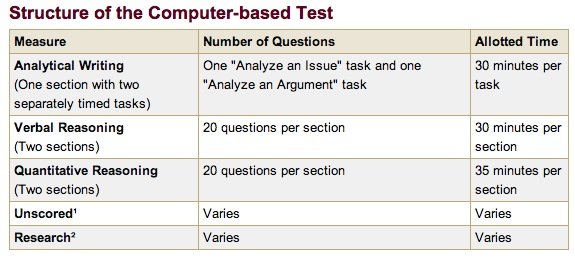
GRE General Test consists of six sections. The first section is always the analytical writing section involving separately timed issue and argument tasks. The next five sections consist of two verbal reasoning sections, two quantitative reasoning sections, and either an experimental or research section. These five sections may occur in any order. The experimental section does not count towards the final score but is not distinguished from the scored sections. You can skip back and forth within sections. The entire test lasts about 3 hours 45 minutes.

GRE

When should you write GRE?

GRE scores remain valid for five years, so it makes sense to give it early and have enough time to focus on applications. Tip: Do not leave GRE to be taken in last 2 months of the application deadline. One, it increases stress and might affect your ability to score higher. Two, in case you are not happy with your score, you will have to take GRE again but you can only take GRE once a month. Therefore, we recommend that you take GRE at least THREE months before your application submission timelines. For e.g. for Fall applications, try to give GRE by July of preceding year.

What is a good GRE test score?

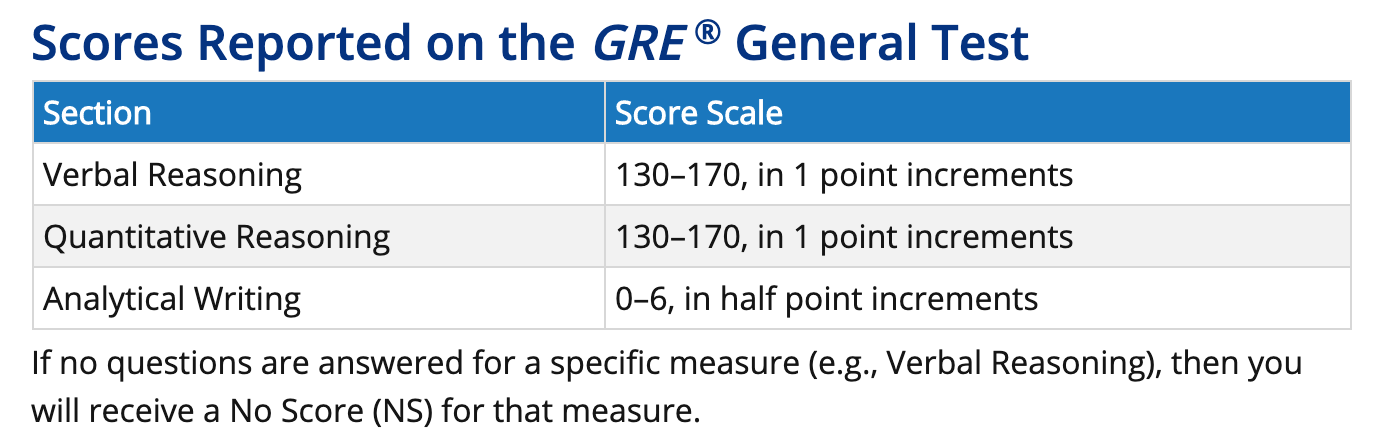
Latest GRE tests are being scored out of 340. Anything above 320 is considered a good score. Remember that just taking the GRE does not mean that your scores are available everywhere. When you actually apply to specific schools later, you will explicitly need to send your score report to that school. Bad news is that it costs $25 (INR 1400) to send your score to each school. Great news is that you can send upto 4 reports free on the day you take the GRE test. Tip: So, it makes sense to know at least 4 schools you are most likely to apply and send your scores to those when you take the test. (That is a saving of $100 right away!)

TOEFL – The TOEFL iBT test measures your ability to use and understand English at the university level and is required for Indian students to apply to US or European schools. The test costs $180 in India. You can register online. The scores are out of 120 and anything above 105 is considered good. If you sincerely prepare for GRE verbal section and have been going to a English primary school, you should not need to worry too much about TOEFL. Again, its more of a formality and its score, unless too low, will never impact your application results.

How much does GRE score matter?

We have seen students fretting for months on GRE. It is one thing to prepare well and it is another thing to stress about a test. Particularly, we Indians, tend to take tests too seriously. But remember that GRE is not your regular entrance exam!

“You do not pass or fail GRE or GMAT, you just show that your aptitude is above a certain level”

These tests are only a small part of the overall application process – so acing one doesn’t mean you’ll get into Harvard and bombing it doesn’t mean that you won’t get into a good school either. You simply want to score more than a baseline that is used as a filter by schools to weed out low aptitude students. Want to know a secret? – even if your score is low but overall profile is awesome, you can explain why you did poorly on the exam and if reason is sound enough (for eg. You had some personal family problem, illness etc), a school will most likely not reject you on basis of low score alone.

FAQS:

  1. What is GRE subject test? –  The GRE Subject Test is a special requirement mostly for Ph.D or for students who want to change their Undergraduate stream. It is usually optional if you are applying for MS in your field. Some say that taking it still helps improve your profile but I recommend spending the time you would on a subject test on the application contents instead.
  2. Can I give GRE again if my score is low? – Yes, so give the exam without being stressed. Taking it multiple times does not put you at a disadvantage.
  3. What is the best time to give GRE? – Please give it at least five months before you plan on submitting your applications.
  4. Where can I give GRE in India? – Ahmedabad, Allahabad, Bangalore, Calcutta, Chennai, Gurgaon, Hyderabad, Mumbai, New Delhi and Trivandrum.

Preparation Material:

The best available software to practice for GRE is POWERPREP® II software and the best part is that it is FREE. It consists of two full-length, simulated practice tests for the computer-based GRE revised General Test. The strategy we recommend is to take the first test when you are beginning to prepare for GRE to understand where you stand. Use your scores to understand where you need to put more efforts, for e.g. do you need more work on verbal (if so, which section) or quantitative. Next step is to prepare thoroughly, take other available tests from Barron’s, Kaplan, Princeton etc. When you have taken all other tests and have taken a test date, you take the PowerPrep second test again. Note that this is the closest simulation to actual tests, so the scores that you get on PowerPrep are the best estimation of how much you are likely to score in real test. Also, even after taking the two tests, keep giving it multiple times as you get some new questions each time. More information available here.

How to get a 330+ score in GRE exam?

Please read our detailed post on getting a score of 330 and above in GRE.


Key Takeaways:

Ok, if you had to just remember 5 things from this post, remember this-

  1. You need to take GRE General Test to apply for MS in USA and other countries.
  2. You should take it THREE months before you intend to submit the applications. For Fall applications, give GRE by July.
  3. User PowerPrep software wisely to prepare for GRE. We recommend taking it once at beginning of your preparation and once just before appearing for the real test.
  4. Do sufficient research to shortlist 4 schools that you intend to apply before appearing for GRE so that you can send 4 FREE score reports.
  5. Don’t obsess over GRE scores, as long as its not too low, it doesn’t matter. The only factor to consider here is the cost factor. It is expensive to take these tests, so give after ample preparation.
  6. You can score 330+ in GRE.

GRE is only one part of the applications. For other parts, check out our next posts on School Selection and Preparing Key Documents.

Which MBA programs are worth considering in Europe

Europe has some of the world’s oldest universities – Cambridge, Oxford, the University of Paris, to name a few. Many such universities have the best and globally renowned business schools. While the US is the most popular destination for international MBA aspirants, many European schools compete aggressively with American schools for top ranking spots.

In this article, we will uncover why you should consider doing an MBA in Europe.

Why should you do an MBA in Europe?

Europe is one of the most popular MBA destinations for international students. The reasons given below make it the ideal location to pursue your dream of getting an MBA from a top college.

Best MBA schools

Europe is home to some of the oldest and globally renowned universities. As per QS Global MBA Rankings 2021, Europe’s top 10 MBA schools rank within the top 25 globally. 

Short course duration

Most of the top European universities offer MBA courses that students can complete in 12 months. Adding specific specializations may extend your course duration by a few months.

The time you will need to do an MBA in Europe with specializations is still less than in the US, where an MBA is usually 24 months.

International exposure

Top business schools provide you a global perspective on business and teach you critical skills that would enable you to work in some of the world’s best organizations with high salaries.

Studying at top universities in Europe allows you to network with people from diverse cultural backgrounds and nationalities. A network built during your time at a B-School can be leveraged later when you are looking to form business partnerships. Most of these universities have a strong alumni network, which can guide and mentor you, whenever you need assistance in the time of professional adversity.

Also Read: MBA in Canada for Indian applicants

Eligibility Criteria

Eligibility criteria for MBA in Europe vary based on the university and your native country.

Most European nations have their regional language, and universities teach the majority of the courses in their local language. International students aspiring to study in European countries have to prove their proficiency in the local language (usually by giving an exam) or have the option to enroll in courses taught in English. 

MBA is one of the few courses with the language of instruction as English, keeping in mind the course’s global recognition and nature.

The standard eligibility criteria for admission to top MBA programs in Europe are:

  • A Bachelor’s degree.
  • A work experience of at least 3 years (exceptions apply).
  • A good score in GMAT, GRE, or an equivalent exam.
  • Proof of English proficiency. Universities require students to submit the score of English proficiency exams like TOEFL and IELTS.

Also Read: Why MBA? Here’s how to decide

Top 10 MBA schools in Europe in 2021

As per the QS Global MBA Rankings 2021, these are the top 10 business schools in Europe (in the ascending order of ranking). 

  1. HEC Paris
  2. INSEAD
  3. London Business School
  4. IE Business School
  5. IESE Business School
  6. Esade Business School
  7. Oxford (Said)
  8. Cambridge (Judge)
  9. Imperial College Business School
  10. SDA Bocconi

The table below gives you the key information about an MBA at Europe’s top 10 business schools (data collated from the website TOPMBA).

QS Global MBA RankUniversityCountryDurationAvg. GMATFee (USD)Avg. Work ExperienceAvg. Salary(Post 3 months; in USD)
5HEC ParisFrance15 months69070k-80k6128,206
6INSEADFrance10 months71090k-100k6105,900
7London Business SchoolUnited Kingdom21 months701100k-110k5106,837
9IE Business SchoolSpain11 months68570k-80k793264
11IESE Business SchoolSpain19 months68190k-100k6123,662
13Esade Business SchoolSpain18 months65770k-80k6104,161
16Oxford (Said)United Kingdom12 months69080k-90k596,233
17Cambridge (Judge)United Kingdom12 months69370k-80k699,753
22Imperial College Business SchoolUnited Kingdom12 months65060k-70k682,853
23SDA BocconiItaly12 months665(source: The Economist)60k-70k6120,760

Cost of an MBA in Europe

The course fee at most of the European business schools is less in contrast to American business schools. While a full-time MBA at a top B-School in the US will cost you around USD 150k, the average fee for the top 10 business schools in Europe is around USD 80,000. The comparatively short duration of an MBA in Europe also saves students time, reducing the opportunity cost.

There are many means by which students can finance their MBA abroad in regions like Europe.

Scholarships, grants, and tuition waivers by the universities are some of the common ways to reduce your education cost.  

Click here to know more about financing your MS or MBA education abroad.

Job Opportunities

An MBA degree from a top business school comes with an excellent job assurance: regarding the quality of work and compensation. 

European B-Schools is a top recruitment destination for global corporate behemoths looking to employ the best talent. Consulting companies like BCG, Bain & Company, and McKinsey & Company give more preference to MBAs from Oxford SAID, INSEAD, and IE Business School than many famous American business schools. 

As given in the table above, the average salary for schools like HEC Paris and SDA Bocconi is higher than USD 120k. This amount is more than the average wage of an MBA grad at many American universities recognized for their MBA degree. 

Immigration options

Besides the prospect of a good job, many European nations provide desirable work visa options compared to the US. 

EU Blue Card work permit is one such option. As per the EU Blue Card Network, “The EU Blue Card is a work- and residence permit for non-EU/EEA nationals. The European Blue Card provides comprehensive socio-economic rights and a path towards permanent residence and EU citizenship.” In layman’s terms, it’s the European version of the American Green Card.

Some countries like the UK allows graduates to stay in the country for 6 months after course completion. Students can utilize this time to find a job of their liking.

Conclusion

Europe is an ideal destination for an MBA if you aspire to study Business abroad at a school ranked among the best in the world.

While the US is more popular than Europe for an MBA, the fee and the opportunity cost in European schools are far less; yet, the quality of education is almost identical. The salary offered in the top European schools is similar in contrast to many famous MBA schools in the US and, in some instances, even more.

Book a call with Scholar Strategy NOW if you have finalized your decision to do an MBA abroad and need assistance with your application. 

Our clients are studying at Harvard, MIT, Columbia, and many other top business schools. 

TOEFL vs IELTS – which one should you take?

Introduction

TOEFL vs IELTS is one of the most common query for any study abroad applicant. These are two of the most renowned exams used to judge the test takers’ English fluency. Most of the applicants are non-native English speakers aspiring to study abroad in English-speaking nations or universities where the language of instruction is English. 

Even though these exams test the applicant’s English proficiency, their structure and method of scoring differ. 

This article will address the common “TOEFL Vs. IELTS” dilemma that troubles people who dream of studying in a foreign university. 

What is TOEFL

Test of English as a Foreign Language (TOEFL) is an exam used to judge the candidate’s English fluency. It measures proficiency using 4 sections- Reading, Listening, Speaking, and Writing. 

Over 11,000 universities accept the TOEFL scores in over 150 countries. Most American universities accept TOEFL scores as proof of English proficiency. 

Decided on TOEFL? Click here to read ALL about TOEFL.

What is IELTS

The International English Language Testing System (IELTS) is used to measure the test-takers’ English proficiency level. Most of the IELTS exam applicants are students planning to study abroad and people planning to migrate to a foreign country for work. 

Types of IELTS 

IELTS exam is categorized into 2 types–IELTS Academic and IELTS General Training.

IELTS Academic 

IELTS Academic measures an applicant’s ability to converse in English- the way they need it in a university and academic environment. A good score on the test reflects your skill to study in English-speaking nations or enroll in a course taught in English in foreign countries.  

IELTS General Training

IELTS General Training is recommended for those who wish to study below degree level or people who want to migrate to Canada, Australia, New Zealand, and the UK. The exam measures the general English proficiency that is needed for living abroad. 

Most of the candidates who wish to study abroad give the IELTS Academic exam. For the rest of the text, the term “IELTS” would imply the IELTS Academic test.

IELTS Format

IELTS is conducted as either Paper-based or Computer-delivered. 

The test measures your ability to communicate well in English and has 4 sections- Reading, Listening, Speaking, and Writing. Apart from the Speaking section, all the other sections are completed on the same day. The Speaking section can be conducted up to a week before or after the other sectional tests. 

Unlike TOEFL, the IELTS candidate communicates with a human rather than speaking to an automated computer system.

IELTS Score

The score is categorized using a nine-band scale.

Band scoreSkill level
Band 9Expert user
Band 8Very good user
Band 7Good user
Band 6Competent user
Band 5Modest user
Band 4Limited user
Band 3Extremely limited user
Band 2Intermittent user
Band 1Non-user

TOEFL Vs IELTS

Here are some common factors that will give you a glimpse of both the exams and may help you decide on the TOEFL Vs IELTS dilemma.

EXAMTOEFLIELTS
DurationAbout 3 hours long.Around 2 hours and 45 minutes long.
SectionsReading, Listening, Speaking, and Writing.Reading, Listening, Speaking, and Writing.
PriceCost is usually between 160 and 200 USD (USD 185 in India)The cost differs across countries (INR 14000 in India).
Question typeMost of the questions in TOEFL are of the MCQ category.Besides MCQ, many questions require you to frame/type your answers.
Category of text used for the Reading sectionPrimarily academic text is used, which is slightly difficult to read because of challenging vocabulary and concepts.Has academic texts and articles from newspapers and magazines.
Scoring scaleScore on a scale from 0 to 120Score on a scale from 0 to 9
Number of score reports that can be shared for free45
The average score needed by American universities 74.4 (source: USNEWS.com)6.5
Exam frequency60 times in a year48 times in a year
English accents used North American, British, New Zealand, AustralianAustralian, Canadian, New Zealand, British, American  
Validity2 years2 years
TOEFL vs IELTS comparison

Which exam should you write?

You can use this 5-step process to solve the dilemma TOEFL Vs. IELTS-

  1. Decide the countries and schools you aspire to get admission to. 
  2. Research which exam is accepted by most of the universities and countries you aspire to go to. 
    Generally, most universities in the US accept the TOEFL score. In contrast, most  schools in countries like the UK, Canada, Australia, New Zealand, and the UK prefer the IELTS score as proof of English proficiency (some universities in these countries accept both TOEFL & IELTS). 
  3. Prepare for the exam that is widely accepted in the area you aspire to study at.
  4. If both TOEFL & IELTS are accepted at your desired university, we suggest you give a sample exam of both the tests if you aren’t very confident about your English proficiency. This will help you understand your strengths and weaknesses. 
  5. Suppose you get your target score, good for you. If you don’t, focus on the test that is more aligned with your strengths. For example: 
    • In TOEFL, the Speaking section is conducted on a computer, while on IELTS, the Speaking section requires you to have a conversation with a human. If you are frightened of interviews, focus more on IELTS while improving your confidence on the side. 
    • If your reading skills and vocabulary aren’t that good, going for IELTS will be a better choice since TOEFL’s Reading section primarily has academic text, which is slightly hard to read.

Conclusion

TOEFL & IELTS are among the most popular English proficiency exams students give as part of their journey of getting admission into a top university abroad. 

While the sections in both the exams are the same, their structure and method differ. 

We have tried to cover critical points that may help you decide which exam you should give.

While making any crucial decision in life, being self-aware of our strengths and weaknesses is of utmost importance.

The same goes for deciding the exam you plan to give. After deciding on your target universities, focus more on your strengths while simultaneously working to decrease the intensity of your weaknesses. 

Ask yourself these questions while making the final decision-

  1. What are my target colleges?
  2. Which exam is accepted in most of my target colleges?
  3. Which are my strengths and weaknesses in English? 

If you would like to know more about these exams, there is no better resource than the exam’s official website- TOEFL and IELTS.

Are you already done with TOEFL or IELTS? Now is the time to focus on your application.

Book a call with Scholar Strategy if you aspire to study in universities like Harvard, MIT, and Columbia.