There are a decent number of Data Science programs in the US and their count is increasing every year. We are going to review how good Columbia Data Science program is in this post. We base it on the effectiveness of the curriculum, job opportunities and cost of attending. And then, in the end, we make our recommendation whether someone should attend this program or not.
Here, we go-
Columbia Data Science review by ScholarStrategy
Curriculum
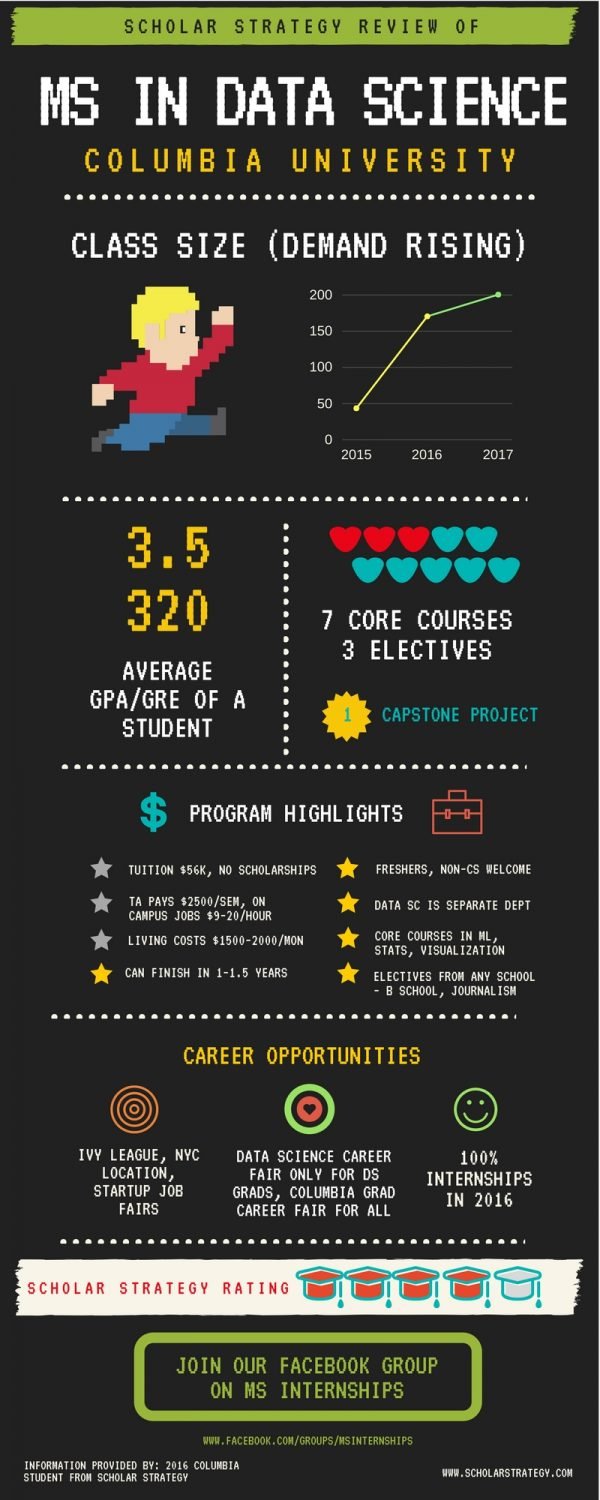
It is a 30 credit course (10×3) with 7 core and 3 elective courses and 1 capstone project. Core courses include Machine Learning, Visualization, Statistics and Inference Modeling. Elective courses can be taken from any department (Journalism, CS, business school, ECE). For example, cloud computing and analytics, Big data, building story from data etc. It is a 1.5 years course (or can be completed in 1 year but not recommended). The curriculum is good and challenging. TA’s conduct special training sessions on Python and R whenever required for a course. One is expected to have a good understanding of Statistics and Linear Algebra. We feel that curriculum designed for an overall exposure and can give a good platform to begin your Data Science journey.
Career opportunities
Being an Ivy league brand, expect good career services office and resources to help you find a good career opportunity. Data Science is a separate department and it holds a separate career fair only for DS students, which is a big plus. Additionally, Columbia career fair is open to all. Apart from this, the program benefits a lot from its location as there are multiple startup job fairs in NYC which are all a subway ride away. Arushi, despite being a fresher, managed offers from Amazon, Milliman Max, and Synergic Partners (Madrid). Everyone got an internship in 2016.
Cost of attending
This is where Columbia hurts. With around $60,000 in tuition alone and $2000 per mon of living costs, program is one of the costliest in the US. There are practically no scholarships and on-campus jobs pay very little ($10-12 per hour) and so does TAships ($2600 per sem).
Others
Location and Brand are a big plus and give you unlimited opportunities at networking and exposure. With average GPA of 3.7 and GRE score of 326+, the admission is very competitive. The program encourages freshers as well as non-CS grads to apply, therefore class is overall diverse in background.
Competing programs
Biggest competitors are CMU BIDA, CMU MCDS, Harvard DS, UT Austin MSBA, U Washington, Georgia Tech etc. While CMU is still the touted leader, Columbia Data Science is catching up fast.
Watch everything in a short video:
Result
So, given all the factors, we feel that Columbia Data Science program is defintely worth attending if one can manage the finances. We give it a rating of 4/5 hats!
MS in Germany is becoming increasingly popular among engineers. In this post, we look at MS in Computer Science (CS) courses and its options in Germany.
Germany has been a pioneer in technological innovations. The country is the origin of inventions ranging from the diesel engine to the printing press. It is home to many engineers and innovators who changed the world for the better.
The German government always has been at the forefront of digitizing the country and is investing in the education of the workforce needed for this mission. It is among the top study destinations for international students aspiring to build a career in Computer Science and the IT industry.
Why consider MS in CS in Germany?
It has the world’s best universities
Many of the world’s highest-rated universities (among the top 50 by Times Higher Education) for computer science like the LMU Munich, Technical University of Munich, and Technical University of Berlin are in Germany.
To sustain its culture of innovation, the country focuses on delivering a world-class education in engineering and research.
Offers highly affordable education
Studying abroad at a top-notch college is a dream for many students, but not everyone has the financial backing to support this dream. The general rule is: the better the university ranking is, the higher is the tuition fee. Well, Germany is an exception.
The education in most of the German public universities is free, or either highly subsidized for local and international students as compared to other destinations popular among international students.
The students have to pay an amount of around 250-300 euros at the beginning of each semester called the “Semester Contribution.” This is charged for the administrative expenses, student union, public transport, and certain academic study material.
The cost of living in most German cities is way less in contrast to North American and other European countries favored by international students.
As per DAAD (the largest German support organization for the international exchange of students and researchers), the average monthly house rent for a student in Germany is around 350 euros. The rent varies across cities and may reach up to 725 euros for places like Munich.
The approximate per month living expense for an international student may vary from 750 to 1100 euros depending on the city. This estimate includes expenditures like food, rent for accommodation, and commuting, but excludes the tuition fee.
Job opportunities
Germany is the home of many Tech and IT behemoths like SAP and is the hub for innovation and research.
To speed up the German’s visions of digitization, the government is investing in training people from across the world to prepare them for IT and Tech jobs in Germany.
A Software Engineer in Germany has an average salary of around 55,000-60,000 euros per year.
Best universities for MS Computer Science in Germany
Germany has 40 plus universities that offer courses in Computer Science.
According to Times Higher Education ranking of educational institutes, the best universities in Germany for studying Computer Science are:
Technical University of Munich: The count of CS faculty at TUM is among the highest in Germany. The university is renowned for promoting innovation and entrepreneurship.
LMU Munich: One among Europe’s premier universities in research and is committed to international standards for teaching and research.
Technical University of Berlin: One of the largest universities in Germany. It aims to develop science and technology for the interest of society.
University of Freiburg: Founded in 1457 and introduced the Faculty of Engineering in 1995.
RWTH Aachen University: The university has around 45,000 students and is renowned for its outstanding reputation in the field of research.
Technical University of Darmstadt: Among the leading technical universities in Germany. It is recognized in the international education community for its focus on research and innovation.
Karlsruhe Institute of Technology: Other than Engineering, the university offers courses in a broad range of disciplines, i.e. in natural sciences, economics, and the humanities and social sciences.
University of Bonn: It has the highest number of Nobel Prize winners and Fields Medalists in the past decades than from any other German university.
University of Tübingen: The university was founded in 1477 and provides innovative courses on Machine Learning, Neuroscience and Behavioral Science, Computational Linguistics, and Management, etc.
University of Erlangen-Nuremberg: “Knowledge in motion”is the university’s motto. The Faculty of Engineering is renowned for its excellence.
Eligibility
The eligibility criteria for admissions in a postgraduate course in Computer Science in Germany vary due to university-specific guidelines. The criteria given below are common to most German universities.
An undergraduate degree in any field of Computer Science, Maths, Technology, or any other closely related disciplines. The aggregate percentage for admission in the best colleges should be at least 60.
B1 or B2 Certificate.
An average GREscore of 310-325.
Proof of language proficiency based on the language of instruction in a particular course/university
IELTS: 6.5
TOEFL(iBT): 80-90
TestDAF with TDN-16
German Language Diploma: Second Level(DSD-II)
Goethe Certificate-C2 Level.
Proficiency in German is required if the mode of instruction is German or Dual (German and English).
The eligibility criteria, as per Collegedunia for some German universities, is given in the table below:
University
Eligibility
ELP Test scores
Technical University Munich
GRE/GATE Score
TOEFL: 88
UG in relevant Subject
IELTS: 6.5
RWTH Aachen University
UG in a relevant subject
TOEFL: 90
GRE score
IELTS: 5.5
Technical University Darmstadt
BSc in a relevant subject
TOEFL: 88
IELTS: 6.5
University of Freiburg
UG in CS/Maths or closely related field
TOEFL: 94
IELTS: 7.0
Technical University of Berlin
Previous degree with CS, IT & methodological science
TOEFL: 87
IELTS: 6.5
Admission Process
The admission process is exhaustive and should be well-planned. The aspiring students should consult an expert if they are stuck during any phase.
Ways to apply for admission
The process of admission may vary across universities. The three most common methods to apply for MS in Germany are:
Via the university portal
Uni-assist applications
Through DAAD
Documents Needed
Besides university-specific documents, most universities you are applying to may ask:
Academic Records and Application: These documents are evaluated by Uni-assist.
Standard admission test scores: Scores for admission tests like GRE and GATE (for Indian students).
Language proficiency test scores: German or English proficiency exam scores should be submitted based on the courses and universities selected.
Work Experience: Documentation of relevant work experience.
Some universities may require additional Documents: Letter of Recommendation, Statement of Purpose, and. CV.
The cost of doing an MS in CS in Germany is significantly less than compared to other popular study destinations in Europe and North America. Despite this, many organizations provide full or partial scholarships to deserving candidates to manage their living expenses in Germany.
Some of the most popular scholarships for studying in Germany are:
DAAD Scholarships
The Deutschlandstipendium
The Friedrich Ebert Stiftung
Heinrich Böll Foundation
Bayer Foundations
Conclusion
Enrolling for an MS in CS course in Germany is a great option if you aspire to study at a university ranked among the best globally and in a country that is respected for its historical innovation.
The tuition fee at most of the German universities, that offer courses in Computer Science and other disciplines, is significantly less than popular international education destinations like the US and Canada.
The job prospects after education in Computer Science at a German university are better in contrast to many European nations. You can dream of working at the best software firms in the world without the burden of an education loan.
We have now covered MS in Germany, MS in Canada and MS in USA. Which other country are you considering and would like to know more about?
Studying in Canada is getting more and more lucrative by the day. So, what is it like to be a student in Canada?
Recent M.Eng. (Computer Engineering) graduate from University of Toronto, Shreya Rajput holds a specialization in Analytics. She is also working part time with a startup that focuses on ML solutions. She took Scholar Strategy services before heading to Canada. She shares her candid feedback on Canada below.
Why did you choose studying in Canada?
During my application process, I remember having applied to 10-11 schools. Out of which 8 were American Universities. Back then the only country that I had in my mind was the U.S.A. Initially, my parents weren’t completely on board with the idea of their daughter moving to a foreign land for studies. After continuous persuasion, they did agree. As my mom’s cousin stays in Toronto, Canada gave them a sense of security and they wanted me to consider it as an option. And honestly, that was the point when I started looking into Canada, as a prospective destination for my masters.
I did some research on Canadian schools and found that Canada has some of the world’s top schools. However, the number of good universities in Canada is much smaller when compared to the USA and most of these schools are competitive. I did not want to compromise on the quality of education. Having said that, Canada would have been an option for me only if I made it into the top Canadian universities. I received my admit from T.A.M.U in April, and I was going to apply for my U.S student permit, that’s when I received my admit from the University of Toronto, which led me to reevaluate my options.
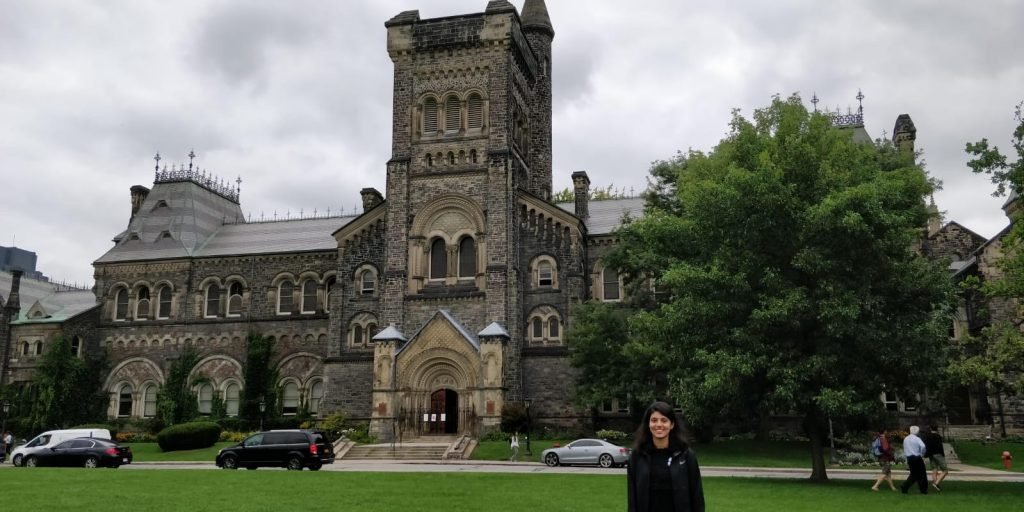
Shreya’s first day at University of Toronto
While I was deciding between T.A.M.U and the University of Toronto, I spoke to my aunt. The only thing she told me was “In your age money and American lifestyle seems exciting but do consider a few years down the lane”. I think that statement greatly influenced my decision. Moreover, Canada is right next to the States. Then, Canadian schools not only offer one of the best educations but are more affordable compared to their counterparts in the U.S.A. The University of Toronto is one of the best computer science schools in Canada as well across the globe. I am happy with the decision I took. Also, Canada being an immigrant-friendly country makes a lot of things easier for international students.
Canadians are very nice people. With one-fifth of its population foreign-born, Canada is very diverse (at least Toronto where I live). I have found people accepting of different races. My favourite thing is the food here, you can literally find everything, from Mexican to Asian to Goan cuisine.
Another thing that I like here is that students can work part-time. It not only reduces the financial burden on the students, but also helps them gain some decent industrial experience before graduation.
What have you not liked about Canada?
Canadian universities are either research-intensive or Industry experience-oriented. The University of Toronto is a research-intensive school and in fact, most top Canadian schools are research-focused. I found the courses at the university are much harder and less industry-oriented (mostly thesis oriented) when compared to American Schools. I feel this is something that differs from school to school. Again, I am talking in the context of graduate courses.
Bachelor’s here is on par with the US. The job market is good. Toronto has many companies and it’s a growing market but, when I discuss the salaries and number of opportunities with my friend in Boston, the numbers are definitely lower. Then, rents are high in Toronto and Vancouver. As a student, it sometimes becomes difficult to afford it. The rent for a two-bedroom apartment in downtown (where most companies are located), is around 3500-3800$, while median salaries in software jobs are around 4500$ per month (after taxes).
Lastly, I am not a winter person, so I do find Canadian winters extremely long and harsh.
What advice would you give to a friend thinking of studying in Canada?
I would advise my friends to look into school ranking, courses, and the job market for the program/field they intend to pursue. Canada like any other country has all kinds of schools- good and bad, and all universities offer different levels and quality of courses/curriculum. As mentioned earlier universities could either be research-oriented or industrial experience-oriented, make sure that the courses and universities you choose align well with your goals and interests. One suggestion would be, getting in touch with the seniors, and understanding their experiences to make an informed decision.
Additionally, researching the job market before choosing a country is important if you wish to work after your studies. Hence, I would strongly suggest that you research job opportunities in Canada in your field of interest. For instance, my field of education is software and there are tremendous opportunities in the Software Industry, which perfectly align with my career goals. But I have seen my friends struggle looking for jobs in the Hardware, Aerospace and Chemical sector.
How easy or tough is it to get the work visa/PR in Canada?
Obtaining a work visa after post-graduation is easy. The graduate students receive an open work permit which allows them to work in Canada for 2-3 years without any employer sponsorship. The duration of the work permit depends on the course/program length. A course of less than a year entitles you only a year (or less) of work permit.
PR here is based on a point system and going to school in Canada can help you strengthen your profile. From what I hear, the ranking of your university also plays a role and, gaining at least one year of Canadian work experience could be beneficial. A lot of my seniors received their PR within two years of their graduation. While things are easy, being a part of illegal activities like working beyond 20 hours/week can jeopardize your stay in Canada.
Are you considering settling there – why or why not?
At this point, I am not sure about the settlement. I would like to stay another 4-5 years here. I want to live close to my family if that were not the case, then why not! Not being a winter person, the only reason I can think of to reconsider my settlement in Canada would be the winters, else I think it’s a great country to settle in, people here are very friendly and accepting.
To summarize, studying in Canada has its pros and cons. But for someone looking to settle in a peaceful, nature filled, warm hearted country that offers great quality of living, Canada is an option that cannot be ignored.
Wondering if you should join or apply to Duke MEM program? We have our 2019 alum, Yusuf Bhinderwala, share a video review of his experience at Duke. It has all the latest updates.
And, for those who prefer to read – our older alumnus, Kanchana, shares what is it like to study MEM at Duke in a detailed QnA. She also talks about why she chose Duke over UIUC MSTM program. So, all those who are considering applying to Duke MEM and wondering what to expect, here we go.
Coursework
What kind of technical courses are MEM students allowed to take? Anything, simply anything
Are there any restrictions as such? No. Provided you deliberate with the management on why you want to take up a course from the law school or Fuqua School of Business (if it’s not an allowed elective).
My main area of interest is Computer Engineering, so if I wanted, could I just pick up some courses in that area that are listed for the MS Computer Engineering course?
In the end, you are investing in an amazing experience where you can take away something new. Would you want to learn what you already know or expand your horizons? Think about that, sincerely!!!! Rope in people who are close to you and discuss your options. Don’t do an MS just for the sake of it…
I do not want to take up the course with the view of becoming a technical manager or anything of that sort. I would be more leaning towards being an entrepreneur. In that aspect, how do you think the course would help me?
Makes you managerially fit, lets you explore dimensions of studies that you never thought would affect your deliverables as an entrepreneur.
How is the course and what kinda projects do we have to do? Is it a lot of theory? OR is practical stuff involved?
It’s a constant learning process. They use what is known as case study method. Any subject you take, will require you to do substantial amount of work after the lecture. It’s a system of learning where the practical problem is thrown at you first and you figure out ways to solve it, then the concept related to the same is something that is taught in the last.
There is no theory or practical concept. Duke MEM involves a lot of case study analysis. It will stimulate your intellectual thinking and make you understand the concepts that you will learn in class.
In fact most of the non-technical jobs like Business Technology Analyst, Business Analyst etc have case interviews. They will put forth a problem to you and you have to find out all possible angles of approaching it. It’s purely creative and not technical…. So don’t worry when I say case interview.
Job Prospects and Job Hunt
How are the job prospects? Like what kinda companies hire us? and do we get paid well?The common notion is companies don’t hire freshers for a managerial post. Is that true?
It all depends on what you have to offer, if you are good enough, you can get whatever role you want. If you don’t have the aptitude and skills for it, you will never get the job, until you work towards it by taking related courses. No one will hire you as a manager if you don’t have the experience or substantiate with enough work/ study experience. If you are searching for a non-technical position, you may have to start from the beginning of the growth ladder for that non-tech position in any company.
Avg salary is somewhere in between $75,000 to $85,000 for starter positions. For people with prior experience and who have niche skills, it can cross even $100,000.
Do you get enough good companies to pick and choose among them?
Companies don’t come to you here. You have to network and get your job. It’s not impossible to get a job though. You have e-recruiting sites here, but you have to get in touch with new contacts through LinkedIn. Your choice of companies are not limited to the ones that come to the campus, you can apply to other companies through their respective sites and using a referral that you personally get in touch with through LinkedIn. And Duke trains you for this.
I have three years of work experience. Would I still have to complete an internship before joining? Further, how tough is it to get an internship immediately after nine months from arrival?
The Internship Presentation is a chilled out thing, really. It’s a final 15 min presentation on your take-aways in your work/internship experience. It doesn’t even involve a lot of technical know-how to be presented. So if you are planning to take up an internship for the assessment, there is no point. You can leverage your work experience itself. You don’t need to separately do an internship if you have had the work experience.
The process of getting a job or an internship is different. There is the concept of NETWORKING that you will detest after some point. It is basically keeping in constant touch with your contacts that you make at career fairs, LinkedIn and other people you would have met otherwise. IT IS A FULL TIME COMMITMENT OR JOB TO DO INTERNSHIP/JOB HUNTING. It’s the same case in any grad school. What helps is that Duke will actively train you to Network! And you will have a series of Resume, Cover Letter Workshops and many such personal development activities that you have to promise yourself to make use of once at Duke. Because you honestly won’t find the time to do anything else besides managing your coursework and the endless team meetings.
Networking
Apart from the curriculum what kind of other opportunities are available to a MEM graduate (like some sort of consultancy club etc.) anything you can think of which is not mentioned in the curriculum but helps networking and developing?
Check out the MEMPDC at Duke http://www.dukemempdc.org/ . I am executive member of the CDAR club and I have conceptualized and organized a few activities for MEM student community. Apart from the four main clubs we have the Finance and Consulting clubs that have some exciting workshops and activities organized as well…. You can take part in any of them or even opt to be in the leadership team.
Your fees also covers the gym and all the athletic facilities at Duke. So you can make use of the same. There will also be MEM Olympics that covers an array of sports that you can take part in as well. Honestly, I would suggest you plan your academics in such a way that you get to participate in some activities atleast. The course itself is very heavy, even though it seems to be easy. Duke’s MEM is rated higher than Stanford’s MS&E and having had a stint with Stanford MS&E curriculum, I can personally tell you that it is true.
Duke MEM vs UIUC MSTM
I have admits from UIUC MSTM and Duke MEM and I am confused what to choose. You had the same choice, why did you decide on Duke?
I personally did not choose UIUC because I wanted more international exposure. 90% of the admits in UIUC last fall were Indians whereas it is around 50% in Duke. Having more diversity in a collaborative program like MEM enhances the experience multi-folds and it was an important factor I used to assess UIUC against Duke. Industry collaborations and opportunities are slightly better than UIUC is what I hear.
Duke having more feathers on its cap in terms of companies and industry relations, will only prove beneficial to you. Last but not the least, Duke has a very reputed Business School, Medical School, state of the art facilities as it is a private university, and is proudly called “The Stanford of the East”. It definitely has more visibility in terms of the MEM program.
Advice for incoming students
What other advice would you give to students who are going to Duke for MEM?
Please come with an idea of whether you are going to finish it in 2 or 3 sems. Your peers here will confuse you. The program is completely doable in two semesters. But if you are adamant on going through the Career Fairs thrice then 3 sem option would be ideal. But people have told me that they waste a lot of time doing it in three semesters. I am completing it over two sems because I want to get back to work-life as soon as possible, I work effectively in lesser time as opposed to being complacent in three sems and this will also reduce my financial burden by a semester of living expense.
Plan your courses beforehand as registrations for the famous courses closes within 2 secs of it opening…. I am not kidding. Also make sure that you plan to have all your classes over two to three days of the week instead of one subject a day, as you may lose time to go out and explore the University and what it has to offer besides academics. Look at which courses have a lot of team meetings as well. That will help you narrow down the courses.
Most (95%) courses have team meetings. It will get really cumbersome. So be prepared to interact with people you may not like and also may have to shell out your weekend for the same. That is also one of the reasons why you need to have some free time over the week as well for yourself. It’s how you extract value from the MEM program at Duke that will matter in the end.
Ever wondered what are the most popular US universities amongst Indian MS applicants?
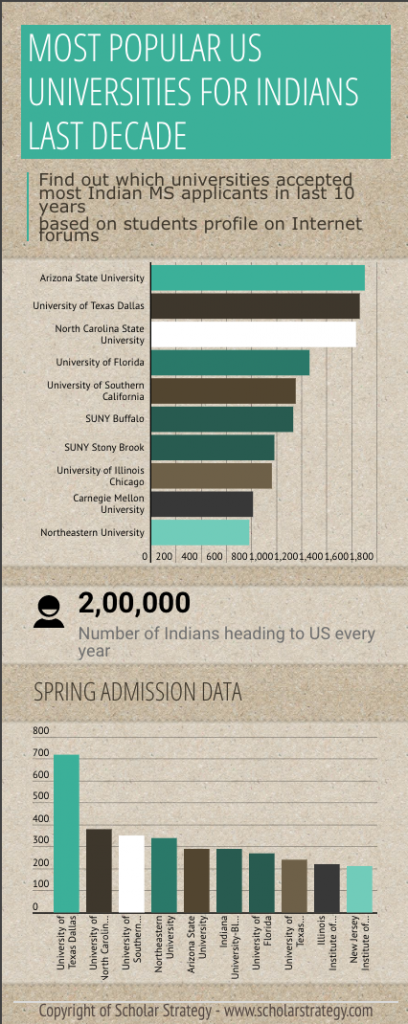
In 2019, 90,000+ Indian students headed to United States to enroll in graduate programs. Overall, 2 lac + students go to USA every year from India. Needless to say, USA is one of the most popular study abroad destination for Indians.
We dug up some numbers to find which schools are most Indian-friendly! So, here are the Top 10 schools by the intake of Indian students for last 10 years. Unsurprisingly, ASU and UT Dallas lead the pack. We were surprised by CMU’s high intake nonetheless. What do you think?
Are you considering applying in Spring? Do read our post about pros and cons of applying in Spring semester.
Disclaimer: This is based on only the data that we gathered from students who reported their results on Internet. However, it should still give a pretty good insight into the bigger picture.
Should you apply only to popular universities for Indians?
Of course, not. The above information is to help you select some safe schools. You should pick schools that you really wish to attend. See our guide to school selection for MS applications.
MS in Canada is becoming an increasingly lucrative to international students looking to study abroad. Let’s see its pros and cons over MS in USA.
Why apply to MS in Canada?
1. H1B and green card uncertainty in USA due to Trump policies
Trump has hinted that he does not like immigrants (which is the intention of 90%+ internationals who go for MS in USA), H1B caps and OPT rules are constantly under scrutiny and green card processing takes forever.
In comparison, you easily get work permit upon graduation in Canada for 2-4 years in any field to work anywhere you want. The study permit itself allows for taking jobs off campus right from the beginning. Within this time frame, you can easily get your permanent residency. Therefore, studying from Canada means not only getting higher education but a hassle-free option of settling in Canada.
2. The high quality of living and curriculum
Canada’s political stability, tolerant government, super healthcare, natural beauty lends itself to the wonderful quality of living in a peaceful environment. Yes, winters might be an issue for some people. I saw the ultimate reward of being in Canada in our alumnus’ Rafi’s response –
“I used to weigh 120+ kg in India and had multiple health issues. After coming to Canada and seeing the fitness of people around me, it made me work hard to become healthy myself. Today I weigh 70 kg and have learned swimming and skiing. I love it here.”
While Canada may have a fewer number of schools than the USA, most of them are comparable in quality of coursework and research to the top tier schools of USA.
3. Not so bad job opportunities
Plus, for all the health and wellness benefits it offers, the job scenario is also not bad (we are talking about engineering fields for this post). There are increasing opportunities in growing fields such as Data Science. Plus, most of the bigger tech companies are opening offices in Canada if not already.
In terms of the cost of attendance and living, it may be akin to the USA in total. However, financial aid opportunities seem to be abundant in good Canadian universities.
As is the case we discussed in MS in Germany blog post, downsides of studying in Canada are:
1. Lower job packages
While it is not unheard of to get $100K USD+ packages in the USA in software and technology along with handsome relocation bonuses, Canadian offers are lower with little bonuses.
2. Lower possibilities of working in the USA
It is hard to get placement in US offices from Canada. So, if you graduate from Canada, you are best positioned to work in Canada only. I still believe that the USA offers the best job market and growth opportunities in most of the engineering fields.
To summarize, those looking for long-term settlement, relocation to a foreign country and peaceful living, Canada offers you a wonderful opportunity. But if you are studying abroad to earn as much as possible and might want to come back to India, USA is still a better bet.
The comparison is more clear from this interview with Rafi Alam. He shares insights about studying and working in Canada.
Did you know that Hyperloop competition by Elon Musk was won by TU Munich students for a second time! That is not all, pursuing MS in Germany can nearly be free in technical streams. German schools further help all students in getting co-ops kind of internships for practical training. However, there is still a catch when you compare it to USA. Read on to find out…
In an interview with Sangram Gupta, we chat about his experience of pursuing an MS in CS from TU Munich, Germany. He is also interning with a Business Intelligence startup called Incuda.gmbh where he is earning 15 euros per hour. Best thing – he did not spend a single penny in his MS.
Interview covers
How helpful is the curriculum like?
How long does it take to do an MS?
How much does one spend on graduate school in Germany? (Its almost free!)
Who should apply to German schools (which kind of programs are best)?
What is the process to apply to programs in Germany?
What is the internship process and ease of doing internships in Germany?
What is the employment scenario in Europe?
Why you should or should not consider MS in Germany? (Conclusive comparison with USA)
Video
Let us find out more directly from him in this video-
Welcome back! Today, I am sharing detailed feedback by Melvin Thomas, who is pursuing MS EE from Portland State University and interning at AMD. This is what he wrote about the program in an email-
Feedback from MS EE student at Portland State University
I know that this is one the last options of many MS VLSI aspirants, if not an unconsidered option because of its unranked status. However, I would like to share few feedback from my time here that might help someone in our group in future:
Tracks
Digital IC Design was considered the best thing here and I also joined here for the same. But the Professor who was handling both the Digital IC Design courses has retired and it is no longer the flagship track here. As such Digital IC Design 1 and 2 are taught by a good professor only once a year and sometimes the first course will be taught by him only in Spring term which is the third term provided you join in Fall, and its pretty late to learn the core course then. Still, ASIC Design course is great and the Department are coming up with a separate Physical Design Course as well. ASIC Design will be taught in Winter and in Fall, before DIC1(by the best professor) in Spring and hence you may not be in a position to take advantage of his classes and take the succeeding courses with a systematic learning. But learning DIC1 is pretty manageable on your own irrespective of the Professor and that is what I did in my first term so that I can get the fundamentals early.
Computer Architecture track is excellent here and have 4 courses for it and is taught by excellent professors and research scientists working in Intel. The questions asked for all the interviews are directly from the slides they teach even though they are application level question which you cannot answer without understanding the fundamentals. But the fundamentals are structured very well and even the advanced computer architecture courses are handled excellently.
The in-demand red-hot winning track here is the Design Verification and Validation track and a high percentage of openings in the industry are verification positions and a large % of my batch mates, including myself, are working in Design Verification and Validation positions. It is excellently organized and taught and it is what fetches jobs here at this point of time.
There are many professors who are not that great and few important subjects are taught by great professors only once a year. So making compromises with choice of subjects and professors are very common here to fit your schedule. This is one drawback but there is no other way around this.
Coursework, and Research
The course offers great flexibility and you will end up completing multiple tracks by the time you graduate because one track’s core courses are another track’s breadth and depth courses. Few compromises have to be done to fit your schedule and planned coursework because learning systematically is very important. For me, staying ambitious with my courses has been vital and I have taken the risk of two tough subjects in one term just to leverage the options of being taught by good professors but that required full dedication in that term. Even while doing my internship I have opted for the course that adds value looking at the market, and not for the sake of taking a course to have a relaxed term. This is where many go wrong, but provided you work hard with total dedication, things are manageable and certainly rewarding with time.
There is no research happening here. There is no funding for it. And there are only 2 or 3 “real professors” – others are adjuncts who either have strong industry experience with PhD or are instructors without a PhD – and it shows in the way they teach. But it doesn’t mean they teach bad, rather they teach differently as compared to a real professor. It then comes down to how much you want to learn and how much you try to learn from them and as long as you do it, you are still getting benefits – ultimately the learning happens but in a different way.
Quarter system is really tough. There is no real time to grasp things as they are taught and also we don’t get time to do huge projects as compared to those in semester systems. Any slight slack off costs you so much as such and we have to be ambitious with projects and do additional projects during breaks to match our competitors.
CS Department here is one of the worst. I strongly discourage anyone from joining PSU for CS. But ECE Department is glorious with respect to VLSI and especially Computer Architecture and Verification and it is going to stay so for the upcoming years. Also, the Embedded track here is not good. It is totally different from the coursework of other universities with courses that aren’t organized well and I strongly discourage anyone to join PSU for an embedded program.
Job/Internship Prospects
This is not an Intel place at least for the past few years. Intel is on freeze and very few have got any calls except the ones who have someone at a senior position to refer them. That being said, Intel is not the only company around and verification jobs are plenty in other companies.
There are no career fairs here. Everything depends on your portal luck and mostly referrals help you. I got 3 calls through portals because I have a high CGPA (>3.9), and I am one of the few people to get this portal luck. Yet what is effective is someone to refer you and otherwise your portal luck never aids you mostly.
Scholarships, and Finance
Getting a TA is totally dependent on your academic performance and rapport with the professors. There are many who had less GPA and who got an internship because they had someone to refer them in. But they could not get a TA because Professors do know your capacity from your grades and projects. I got 2 TA offers – one in my third term which is rare to be honest – and one currently and another Grader position. Being a TA covers nearly covers all the expenses of a term and paid me around $7000 for 3 months. Being a TA here is sometimes an easy task – you don’t have to take class, most of the time – rather conduct office hours and help them either then or via email and I never tried for an on-campus job – but no job could be better than a TA, especially when I am studying along and when it provides me flexibility with my timings.
Location
Portland is a fantastic place to live and study and its cheap. It is blessed with nature and for me with the right academics too and I truly enjoy being here. It was tough for me to make this decision because I was going to an unranked University but I decided to join PSU instead of UTD because of my financial situation. But my decision to join PSU quitting my job at HPE was one of the best decisions I made and I never regret coming here and irrespective of what people told me a year ago, I am doing my internship in a well reputed big shot company and alongside people from USC, UMinn, UPenn etc. – my journey is different, my route is different, but with support of all those who believed in me, including you, and with hard work and grace of God, I am on the right track well among the right mix.
Peer learning
The academic standard of Indians studying here is poor. There are only a handful who are really ambitious and know things and do really work hard. So there is lack of competition here and all the terms I spend considerable time in figuring out how to say no to all the people approaching me for being their project partners. There are only few whom you can learn with. With that being said, I am working with people who graduated from UMinn, UPenn, USC etc. here in AMD and an unranked PSU guy is up with those people who are from the big brackets! – as you said, the reward of hard work irrespective of where you are.
Thanks for this honest feedback, Melvin 🙂 We wish you all the best always.
If I had to summarize, I would say that it is less about the school you attend than what you do there. If you know how to hustle, you can make it big from anywhere. Of course, starting from a school that helps you in moving towards your goal does put you at an advantage. But if you do not have a choice, do what Melvin did – made the best of what he had in hand and emerged victorious. I trust in you.
Scholar Strategy alumnus Sajin joined UNCC for MS EE in Fall 2016. He shares his feedback on the program-
Before coming here, I didn’t feel that UNCC was a good option to do my Master’s in. But, I’ve been proven wrong in every way. The coursework for Embedded systems, computer architecture and operating systems specialization is really good.
Coursework
The advanced course in operating systems offered here is a direct clone of an MIT grad course, and it is extensive enough to prepare anyone to go directly into industry. I highly recommend anyone who wants to do something in operating systems (kernel development, device drivers, etc), to have a look into UNCC.
The research work in computer architecture is really good, and the professor who handles that (Dr. Hamed Tabhki), gives you good relevant research work on that field if you show interest. The focus is on general purpose GPUs and FPGAs. Also, there is an excellent professor in the CS department who offers very good courses on high-performance computing. For Embedded systems, there are decent courses, but things could be better.
Vlsi coursework is not up to the mark, but they’ve hired some new professors recently. I’ll update you on the progress in due time. As of now, UNCC is not a good place to be, if anyone is planning to specialize in VLSI.
In general, I’ll highly recommend UNCC if anyone is interested in computer engineering (There is no MS in computer engineering as such right now, but MS in electrical engineering covers all this).
Finance
In terms of funding, the situation is not that good. None of the MS students get tuition fee waiver, at least in computer engineering. Funding is mostly in the form of TAs and RAs, and most of these will go to people who opt for thesis (the situation is different in computer science).
Employment prospects
In terms of jobs, a lot of people taking up operating systems are getting into good companies. Around 8 of the 22 who took the advanced OS course cracked Intel. People have gotten into Cisco, Amazon, and Texas Instruments. Last year, around 4-5 got into Qualcomm. The job scene is good for people who opted for the right, challenging courses. Also, it is worth mentioning that people who took embedded systems courses are getting lots of calls for embedded firmware jobs.
About my progress, I’ve gotten into Wind River Systems, which is an Intel subsidiary. I am working in the CoreOS team of their flagship real time OS VxWorks. I’m getting to work on cutting edge stuff, and am really enjoying the experience here.
Thanks for your honest thoughts, Sajin. Hope it helps the prospective applicants.