Is it worth doing an MS in the US and get H1B visa?

After Trump and H1B news, is it worth doing MS in USA? Read our detailed analysis to help you decide whether it makes sense to pursue MS abroad or not

Why is Trump after H1Bs?

Trump has so much political pressure because of his promises during the elections that he is going over board. This has been worsened by Disney’s lawsuit where an American employee who was laid off sued that tech companies are not hiring foreigners because they cannot find that talent in US but they are hiring them because of low wages. Making it too tough will definitely antagonize Tech industry which itself is a non-trivial lobby. Therefore, I see it as a short term issue rather than long term.

Obviously, its a multi layered issue. Lets take a look-

What are the proposed changes to H1B visa norms?

As per HindustanTimes, following changes has been suggested in recent bills (some readers have pointed out that some of these are incorrect which shows how misguiding Indian media can be)-

  • Doubling minimum salaries of H-1B visa holders to $130,000 – BAD
  • Earmark 20% of H-1B visas for small and start-up employers
  • Remove ‘per country’ cap for employment visas to ensure equal distribution
  • Firms hiring H-1B visa holders need to make a “good faith” effort to recruit Americans first
  • Give preference to students educated in the US for H-1B visas rather than computerized lottery system – GOOD
  • Crack down on outsourcing companies that import workers for temporary training and then send them back home to do the same job – GOOD
  • Prohibit spouses of H-1B visa holders from working in the US
  • Prohibit companies with more than 50 employees, of which at least half are H-1B or L-1 holders, from hiring additional H-1B employees – BAD
  • Strict audit and vetting by Department of Labor to clamp down on fraud or misuse

Should international students be worried?

Many of these will negatively impact people getting H1B via TCS/Infosys kind of companies. An international F1 based grad student will only be impacted when-

  1. Min H1B wage is raised
  2. OPT extension is removed
  3. MS quota is removed

First point here is quite negative and if its raised to 130K as per the latest proposal on 31 Jan, it will be brutal. No doubt. In fact, if they clamp down more on TCS/Infosys scenarios, it might turn out beneficial to other H-1B applicants (including grad students) because of reduced competition!

There has been hue and cry over H1Bs in the past as well but anti H1B laws never passed. In fact, OPT 24 months extension was a big boost for international students. But it does not mean that the new law cannot pass. I think we need to wait for what happens with this bill. (as of 1 Feb, 2017)

Assuming it passes and minimum wage is raised to 100K+ will impact recruitment and many employers may cut down on campus recruitment of internationals. As one post here points out about Mech recruitment slowdown even from a school like UIUC – that is possible in other non-IT fields as well. Although to be fair, Mech recruiting has always been more sluggish than CS, EE, MIS/MEM recruitment because many jobs are in defense or state agencies which require American citizenship. It means that a student will have to hustle more for limited jobs. That is harsh reality.

So, there is no doubt that circumstances of finding jobs/internships will get TOUGHER if these laws are passed (only if min wage is increased too much, OPT ext revoked).

Now, is it worth doing MS in that case?

I would still be optimistic about MS but I will be cautious on financial matters. USA, still, remains a better job market than most other countries. For tech fields, it is worth a hustle. For non-tech fields, yes, be more wary. A better strategy can be to:

  • Apply to schools with chances of funding/lower financial burden.
  • Apply to schools in urban areas, metros such as NYC, Silicon Valley, Boston, Chicago – if companies get wary of recruitment, they stop traveling to interior locations.
    At the end of the day, there will always be jobs for people with strong skills (in in-demand fields such as IT, Analytics etc) but those who are relying on getting an easier pass just by graduating from US may have to bite a bullet.

In summary, I am not saying that things are all hunky dory and there is nothing to worry but unless this law gets passed, it doesn’t matter. Just like his ban on 7 nations is still in a state of confusion (with federal court ruling against his ban but executive order still prevailing) – things are murky. Let’s wait and watch. So, please be patient.

What I have heard about campus placements so far?

  1. UMCP MIS has seen decline in companies sponsoring H1Bs.
  2. A student seeing a decline in campus placements and H1B sponsorships at NCSU.
  3. Another student was more neutral about her MSBA program at ASU. She will inform once the fulltime recruitment begins this semester.
  4. A student who recently graduated and is on OPT has not reported any negative news in his company yet.
  5. A Harvard CS student is less fearful – ‘I’ve had emails this week from 3 different companies asking me if I’m interested in full-time positions starting after spring. It will definitely have some negative impact, but if you’re good and try hard enough, I’m pretty sure you’ll be able to find a job.’
  6. One ECE student from TAMU – ‘During career fair last week most of the companies were particularly asking about sponsorship requirement which I haven’t heard that much during the career fairs conducted last semester.’

I am not taking sides yet but bracing up for a tough ride if Trump goes rogue 🙂

I mentor students and have been directly helping MS aspirants at Scholar Strategy but I have tried to keep my views as unbiased as possible. The fact is when I went to attend UIUC and graduated, there was no STEM OPT extension. Lottery happened and I lucked out. I could get lucky only because I had decided to take a chance. So, take a calculated risk, an informed decision. Go for MS – not just for jobs but to build your skills and learn. Once you focus on learning valuable skills, job will find you (if not US, a better place) 🙂

This post was originally posted on Quora.

How to prepare for UT Austin MSBA interview

Getting an UT Austin MSBA interview invite is a big deal since it is one of the best Business Analytics programs in USA. Here are the questions you need to prepare for it.

As per one of our students who appeared for the interview and later attended this fantastic program-

The interview was mainly behavioral and the questions were mostly repeated. Since my interview was quite late, I had connected with many people and prepared a comprehensive set of questions. No question was asked beyond these.

UT Austin msba interview

UT Austin MSBA Interview questions

  1. Why Analytics?
  2. Why UTA?
  3. Long and short term career goals.
  4. Where do you see analytics in 3-5 years and how do you think you would contribute to it?
  5. Tell me about a project or an experience or something of that sort which you built from scratch, or something you really contributed to.
  6. Where did you hear about this program?
  7. An incidence from your life that changed you as an individual/ something that you are really proud of.
  8. Is there anything more that you feel that the admissions committee should know about you?
  9. Where do you want to work after graduation and why? US or India?
  10. Your knowledge on programming languages and statistics?
  11. Which company /domain in analytics do you wish to work for?
  12. Any questions for me?
  13. What are the other programs that you have applied to? Why will you choose UTA over others?
  14. Describe your work experience.

The interviewer had my CV open in front of her. So she asked a few questions around my work experience, projects and other activities that I had mentioned.


Among the MSBA programs, UT Austin interview is comparatively less technical than University of San Francisco etc.

For such discussions, join our FB group – MS Internships and Jobs (only for grads)

And, if you are looking to crack a top program in Business Analytics, MIS or Data Science, come work with us.

Should you be worried about Trump’s attack on H-1B?

Why is Trump after H-1Bs?

Trump has political pressure to get back jobs for Americans – can act upon that. This has been worsened by Disney’s lawsuit where an American employee who was laid off sued that tech companies are not hiring foreigners on H-1B because they cannot find that talent in US but they are hiring them because of low wages.

H-1Bs are the most coveted work visas: In 2016, the US Citizenship and Immigration Services announced that they received 2,36,000 H-1B petitions within five days of opening the process, more than thrice the number of mandated cap of 65,000 in the general category.

What are the proposed changes to H-1B visa norms?

As per HindustanTimes, following changes has been suggested in recent bills-

  1. Doubling minimum salaries of H-1B visa holders to $130,000
  2. Earmark 20% of H-1B visas for small and start-up employers
  3. Remove ‘per country’ cap for employment visas to ensure equal distribution
  4. Firms hiring H-1B visa holders need to make a “good faith” effort to recruit Americans first
  5. Give preference to students educated in the US for H-1B visas rather than computerized lottery system
  6. Crack down on outsourcing companies that import workers for temporary training and then send them back home to do the same job
  7. Prohibit spouses of H-1B visa holders from working in the US
  8. Prohibit companies with more than 50 employees, of which at least half are H-1B or L-1 holders, from hiring additional H-1B employees
  9. Strict audit and vetting by Department of Labor to clamp down on fraud or misuse

Should international students be worried?

There has been hue and cry over H-1Bs in the past as well but anti H-1B laws never passed. In fact, OPT 24 months extension was a big boost for international students. But it does not mean that the new law cannot pass. H-1B for international students on F1 is a different case from people getting H-1B via TCS/Infy etc (as is evident from some of the proposed reforms above). That said, what can hurt international students-

1. raising of minimum H-1B wages significantly. This directly impacts recruiting.

2. removing OPT extension.

Making it too tough will definitely antagonize Tech industry which itself is a non-trivial lobby. However, it may take some time before we see the opposition able to make a significant impact or pressurize Trump in the opposite direction. I am more worried short term than long term.

In summary, I am not saying that things are all hunky dory and there is nothing to worry but unless this law gets passed, it doesn’t matter. Just like his ban on 7 nations is still in a state of confusion (with federal court ruling against his ban but executive order still prevailing) – things are murky. Let’s wait and watch. So, please be patient.

What I have heard about campus placements so far?

1. UMCP MIS has seen decline in companies sponsoring H-1Bs

2. A student seeing a decline in campus placements and H-1B sponsorships at NCSU.

3. Another student was more neutral about her MSBA program at ASU. She will inform once the fulltime recruitment begins this semester.

4. A student who recently graduated and is on OPT has not reported any negative news in his company yet.

5. A Harvard CS student is less fearful – ‘I’ve had emails this week from 3 different companies asking me if I’m interested in full-time positions starting after spring. It will definitely have some negative impact, but if you’re good and try hard enough, I’m pretty sure you’ll be able to find a job.’

6. One ECE student from TAMU – ‘During career fair last week most of the companies were particularly asking about sponsorship requirement which I haven’t heard that much during the career fairs conducted last semester.’

I will keep you updated on what I get to know – I am not taking sides yet but bracing up for a tough ride if Trump goes rogue 🙂

This post was originally posted on our Fb group for MS internships and jobs.

Better late than never!

Sharing a blog post from Divya who will remain a very special student. I remember her as a soft-spoken but determined girl who I think can do anything she sets her heart upon. Good luck Divya, thanks for sharing this! It should help the candidates who are running late for their MS applications.

I am Divya and I am currently pursuing my Master’s in business analytics from W.P.Carey School of Business at Arizona State University Tempe. It is an intensive 9 month program and I started in Fall 2016 and looking forward to graduate in Summer 2017. Prior to doing my Master’s, I did my under graduation in Computer science and engineering from SRM university, Kathankulathur Chennai and worked as a Junior Research Analyst at McKinsey and Company in Chennai.

I gave my GRE and TOEFL exam during my final year during my under graduation and applied to a few universities for MS in Computer science. However, during that time I did not have any proper guidance and randomly applied to a few universities for ms in computer science based on my what friends did without proper profile evaluation and course evaluation. Though I got admitted into a few programs, upon talking to a lot of seniors figured out that they were not worth my profile and suggested me to properly evaluate my profile and shortlist universities and apply again next fall. At the same time, I got an offer to join McKinsey and company decided to take it up as I felt it would add a great value to my profile. After interning for the first 5 months I got an offer to join them full-time. After a lot of thinking and getting opinions from a lot of people, I decided to work with McKinsey and company for at least 2 years and gain experience and then apply for fall 2016 as it was a great opportunity to start my career in such a big firm. Though I was working with a different team, I was introduced to the field of analytics at McKinsey. I interacted with a lot of folks from the analytics and team and understood the nuisances of the field. That is when I decided to apply for analytics instead of computer science. Though I did not have any relevant experience related to analytics, I applied to business analytics as it involves computers (data mining, sql, python), statistics and exposure to how business work and highlighted my under grad in computer science and my business exposure at McKinsey as my relevant expertise for the course. Though I made this decision much before the fall admission season begun I was not able to spend time from August to December to apply since it was the peak work season and it was very hectic.

It was during January that I reached out to Nistha and took her help to shortlist universities , recreate my sop and lor and resume. Since gre score was valid for 5 years I didn’t retake it and applied with the old score. However I had to retake my toefl exam. Since it is a time-consuming process, by the time I completed all these process and submitted by application it was almost march. I was on the round 3 of application deadlines. Most of the applications were submitted on the last hour of the deadline. However, I am glad that I applied rather than postponing it again to next fall. Thanks to Nistha for motivating me and helping me out in the last minute. Without her, I don’t think I would have applied for this fall. Finally I got a few admits and out of them I shortlisted ASU as their course ranking was very good and it was just a 9 month program.

After having completed almost 50% of my program, I consider this decision as one of the best decision I have ever taken in my whole life. The educational experience is phenomenal and it has been a wonderful learning opportunity for me so far. Had I not taken this decision, I would have continued working and would not have moved out of my comfort zone. The amount of learning I inculcated in the last 5 months is much more than the amount of learning I had from my 4 years of under graduation. Hence I consider myself lucky to have not given up till the last minute. I urge all students who haven’t applied till now to stop worrying about being late and to start working on their applications as soon as possible. After all, it is always “better late than never”.

MS in Financial Engineering courses

“Everyone from derivatives traders to hedge fund managers want to predict financial market outcomes. Who wouldn’t bet on a sure thing? The reality is that no one can really guarantee where the stock market is headed. But don’t think people aren’t trying. Financial engineers are the folks that just might figure it out.” – reads the description on Baruch Master’s in Financial Engineering program website. Although that sounds a tall claim to me, the fact is that these programs are on a rise.

For long, finance as a field attracts engineers because of the stupendous compensation packages as well as the glamor. While the traditional route has been to study MBA later in your career to move into Banking or Trading, why compete in those super-duper competitive Business Schools? Why not go directly for a Finance course? Enter Master of Financial Engineering (MFE) degree programs such as CMU, Columbia, Berkeley, UCLA, NYU, Cornell, Washington etc. Baruch is probably the cheapest of the lot but ranked quite high.

The finance industry needs people who possess deep mathematical modeling skills and computational expertise. While no specific undergraduate major is required, most students will have a degree in quantitative subject matters such as mathematics, engineering, computer science, physics, etc. Engineer’s quantitative and programming skills lend themselves well to solving the complex and creative challenges of today’s financial markets. Although it is not related to traditional branches of engineering, the field picks a lot of people with engineering backgrounds (as is true with MBA). Financial engineering draws on tools from applied mathematics, computer science, statistics and economic theory to address current financial issues as well as to devise new and innovative financial products.

What specializations are possible within MFE?

One can venture into Computational Finance, Risk Management, Corporate Finance, Algorithmic and Technical Finance etc.

What career options open up after MFE?

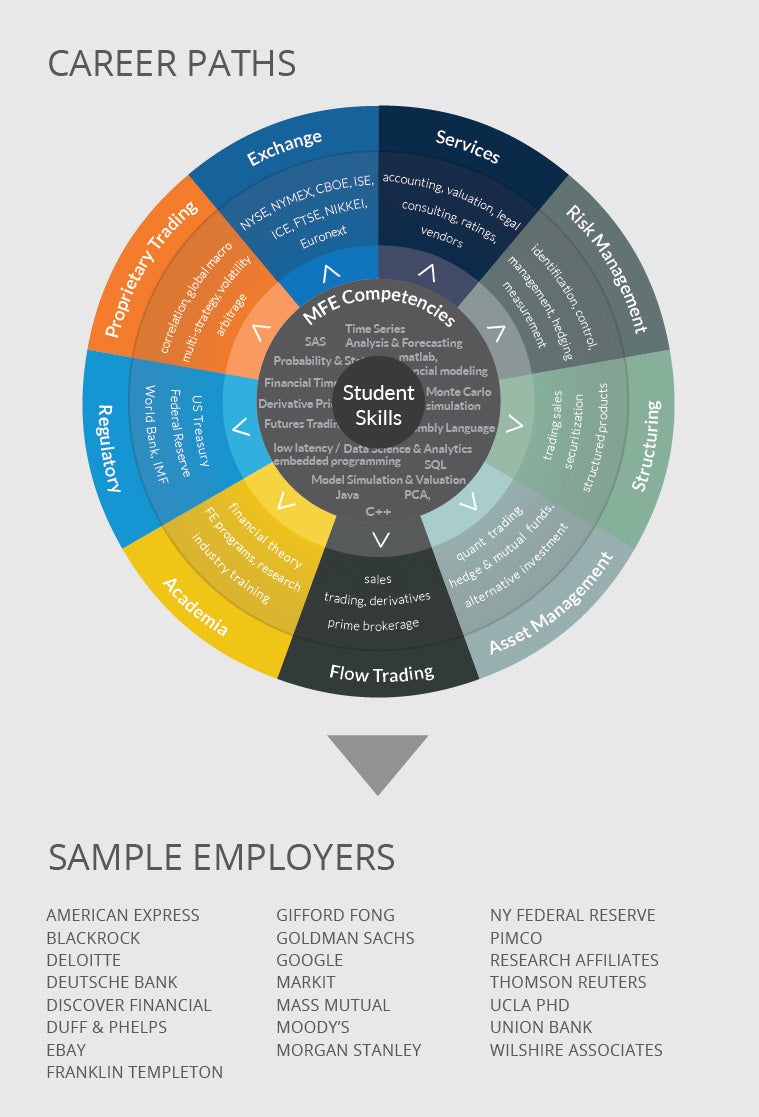
Following image is taken from UCLA MFE course website. As it shows, one can go into risk management, trading desks, financial services, quant pricing, regulatory roles etc. Often incoming students are also coming from similar roles and are looking for further specialization. In non-finance category, probably engineers make the biggest chunk of the incoming class.

When should you go for MFE?

If you have made your mind to get into finance industry and some relevant experience or background, MFE might offer you good opportunities with the advantage of lower competition than traditional MBA (Stanford MBA has acceptance rate of <6%). Plus, make sure you love Mathematics!

How to prepare your application for MFE?

Join us and we will guide you with our very strategic guidance! 🙂 Strong quantitative background, preparation for CFA, programming skills, mathematical modeling tools knowledge etc helps. Rest, we help you step by step in crafting a strong story and guide you through our selective sample SOPs.

STEM OPT – what do you need to understand?

sop for ms applications guide

Students are always confused about OPT and STEM extensions etc. because these directly impact how easily you are able to work in USA because admit it, one of the foremost reasons for pursuing MS in USA is to get a job there afterwards. Let’s look at some simple things you need to know about these without getting into the complications.

STEM stands for Science, Technology, Engineering and Math (STEM) programs and many graduate degrees qualify to be considered as STEM degrees such as:

  1. Business Analytics
  2. MIS
  3. Quantitative Finance
  4. Computer and Information Sciences
  5. All branches of Engineering including Industrial Engineering

However, it is better to ensure that the program you are applying for is STEM validated before you apply if that is your major concern. Frankly, I do not care that much. When I was applying for jobs, there were no OPT extensions. These things sometimes boil down to chance. What matters more to me is that there are good opportunities to be availed in USA and that is something I cannot say about Europe.

Earlier the students were provided with 17 months of additional OPT, which has now been extended to 24 months. This means that now you can hunt for jobs for up to 3 years (1 original + 2 years additional) after graduation. Why is it needed? Because to work in USA, you need to get H-1B visas. And number of H-1B visas allotted each year are less than the number of people applying for those (selected based on random lottery system). So, sometimes students graduated from MS programs are not able to get the H-1B. To give more time to these students, the government decided to extend the OPT so that they can try their luck at lottery again.

To qualify for the 24-month extension, you must:

  • Have been granted OPT and currently be in a valid period of OPT;
  • Work for an employer who meets all the requirements listed below in the STEM OPT Employer Responsibilities section
  • Have earned a bachelor’s, master’s, or doctoral degree from a STEM accredited program

We have discussed CPT and OPT in detail in the MS Book if you shall be interested in exploring further.

Grad Student shares his feedback after first year at NCSU

Our alumnus Nishad went to NCSU in Fall 2015. He sent a detailed feedback and some great tips for future applicants. Sharing it as it is-

I am currently in my second semester as I started here in Fall 2015. The first semester went well and I got the 4.0 I wanted. This semester I managed to convince one of the professors to pay me (it’s not an RA/TA and it pays very less but its better than nothing and I do not want to spend long hours doing a dining/ library job) for some research work which may hopefully lead to a paper and conference presentation as the field is new and exciting.

I have also secured an internship with GoPro after many other unsuccessful interviews (Apple, Nvidia, Tesla). So right now, it seems good, I will be in the Bay Area for an internship with a smallish company (GoPro has about ~1500 employees) and I have family in the area so I will not be paying rent. Exactly the internship I was hoping for. They have already talked about extending a full-time offer if the internship goes well and I have every intention of making sure I hit the ground running once I get there. If they do, I can probably handle 4 courses next semester and get done with Masters sooner than I expected.

I also wanted to touch upon a few points with respect to the things that went right/wrong with me with respect to choosing my university.

I had admits from NC State, UC Boulder and UNCC. Of the three, it was always going to be between the first two, but I think I should have chosen UC Boulder (I am currently at NCSU)

I would outline the mistakes I made in the following order:

  1. Prejudices/ Preconceived notions: Happens with everyone but I guess I had some preconceived notions about both the universities based on friends telling me things, and even based on the interaction I had with the admissions staff in the university. I clearly remember thinking the UC Boulder admissions in-charge sending long-winding emails (I realize that is kind of my email right now) and I was somewhat put off by it.
  2. Coursework details: On paper, NCSU coursework looked fine but I should have delved more deeply into which courses are available at what frequency and how easy it is to take courses which are not part of your major. In my case, I had a few very important courses only offered by the Computer Science department and they were only available to me if Computer Science students gave up some seats. That never happened and despite repeated discussions with the department I never could end up taking those courses.
  3. Sabbaticals: In India this very rarely happens, so this did not cross my mind and I can be forgiven for this mistake I think. Professors are on sabbatical in the US. Very frequently it turns out. The professor who takes two of the most important subjects has been on sabbatical since I joined the universities and has not yet returned. One of the subjects I took under the replacement professor and frankly he has not been up to the mark. Very disappointing experience.
  4. Get in touch with a person doing the same major at the University: This is again something that seems obvious in retrospect. But all the above points could have been addressed if I took the time to get in touch with someone who could have answered all these questions for me. In my case, getting an RA/TA as a non-thesis Masters student was impossible. Simply put, the university does not allow it. Now this was not very important for me but I can very well imagine someone else who comes along, confident that they will be able to secure an RA/TA due to their academic capabilities.