
How good is Columbia Data Science MS program?

Columbia MS in Data science Review

There are a decent number of Data Science programs in the US and their count is increasing every year. We are going to review how good Columbia Data Science program is in this post. We base it on the effectiveness of the curriculum, job opportunities and cost of attending. And then, in the end, we make our recommendation whether someone should attend this program or not.

Here, we go-
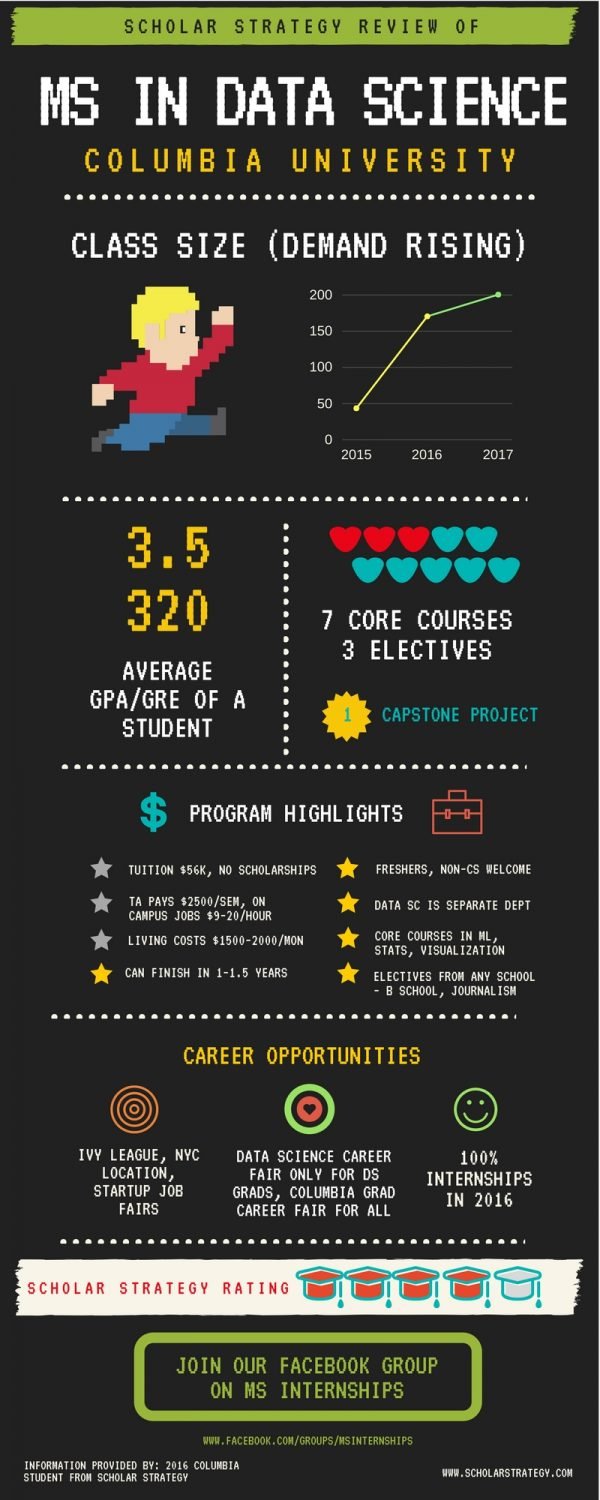
Columbia Data Science review by ScholarStrategy

Curriculum

It is a 30 credit course (10×3) with 7 core and 3 elective courses and 1 capstone project. Core courses include Machine Learning, Visualization, Statistics and Inference Modeling. Elective courses can be taken from any department (Journalism, CS, business school, ECE). For example, cloud computing and analytics, Big data, building story from data etc. It is a 1.5 years course (or can be completed in 1 year but not recommended). The curriculum is good and challenging. TA’s conduct special training sessions on Python and R whenever required for a course. One is expected to have a good understanding of Statistics and Linear Algebra. We feel that curriculum designed for an overall exposure and can give a good platform to begin your Data Science journey. 

Career opportunities

Being an Ivy league brand, expect good career services office and resources to help you find a good career opportunity. Data Science is a separate department and it holds a separate career fair only for DS students, which is a big plus. Additionally, Columbia career fair is open to all. Apart from this, the program benefits a lot from its location as there are multiple startup job fairs in NYC which are all a subway ride away. Arushi, despite being a fresher, managed offers from Amazon, Milliman Max, and Synergic Partners (Madrid). Everyone got an internship in 2016.

Cost of attending

This is where Columbia hurts. With around $60,000 in tuition alone and $2000 per mon of living costs, program is one of the costliest in the US. There are practically no scholarships and on-campus jobs pay very little ($10-12 per hour) and so does TAships ($2600 per sem).

Others

Location and Brand are a big plus and give you unlimited opportunities at networking and exposure. With average GPA of 3.7 and GRE score of 326+, the admission is very competitive. The program encourages freshers as well as non-CS grads to apply, therefore class is overall diverse in background.

Competing programs

Biggest competitors are CMU BIDA, CMU MCDS, Harvard DS, UT Austin MSBA, U Washington, Georgia Tech etc. While CMU is still the touted leader, Columbia Data Science is catching up fast.


Watch everything in a short video:


Result

So, given all the factors, we feel that Columbia Data Science program is defintely worth attending if one can manage the finances. We give it a rating of 4/5 hats!

Which program do you want to know about next? Subscribe to our YouTube channel and comment there.

Building career in Analytics through MS programs

Anyone looking to build a career in Analytics should check out MIS (Analytics), MS Data Science and MS Business Analytics programs.

Career in Analytics – Why you should not miss riding this trend?

In four years of Scholar Strategy, one trend that is so glaringly clear is the rise of interest in Analytics and Data Science programs. This stems from the growth of number of jobs in this field in big enterprises and small businesses alike. Be it a software giant, pharma company, a SAAS business, a food tech or ed-tech company, analytics underpins every industry and sector. Thanks to the massive data science teams at FANG (Facebook, Amazon, Netflix, and Google) and their success, suddenly everyone wants to play the data game!

As large number of professionals pursue a career in analytics and many looking to switch over, competition is on the rise as well. Which means that it can be very tricky to navigate the quantitative job landscape as an entry-level graduate. Burtch Works Study reported that 86% of analytics professionals have at least a Master’s degree, and 18% have a Ph.D. No wonder, we at Scholar Strategy have seen an increasing number of applicants in MIS (Analytics), MS Data Science and MS Business Analytics programs. We already discussed the subtle differences between these in our previous post.

What is Predictive Analytics?

A new term that is becoming more ubiquitous is Predictive Analytics and a lot of jobs use it in their descriptions! It can be looked upon as a subset of Data Science which specifically deals with forecasting future business outcomes. It helps us predict what can happen based on the past events. As per adobe data blog, “for instance, your credit score is calculated using predictive analytics. Based on a predetermined predictive analytics model that includes data about how you have behaved in the past, your credit score predicts how creditworthy you are likely to be in the future.” Since a major application of data science in business is to predict and prepare for the future trends and customer behavior, predictive analytics is growing in demand.

Analytics has changed many industries, one of the major ones being Marketing. The way businesses attract customers and draw leads has changed significantly. In fact, the very way that businesses think of customer acquisition and focus on incoming vs outgoing interest, has grown because analytics makes it possible to measure the efficacies of different channels. This growth in data and ability to use it effectively for business decisions is one of the major transformations we have seen in past 5-6 years.

What does it mean for you and your career?

If you are looking to become a data analytics professional, you need to wade through the competitive waters to get a good analytics position. An advanced graduate degree can give you the differentiation and a good entry point in the market. But still, it takes effort and sagacity to get to a coveted analytics role in the market. To better understand this, we are holding a webinar on Studying and Recruiting in Analytics! Looking at the overwhelming response to our last Data Science webinar, we are focusing on providing more insider information by successful grads who are now working in the industry. And if you want to know what does it take to become an Analytics professional, do not miss it 🙂